Soccer Notebook Culture in Asia vs. Europe — The Critical Difference Between 'Writing to Reflect' and 'Watching to Reflect'
Young soccer players in Japan keep soccer notebooks. Young players in Europe attend video analysis sessions. Both are forms of 'reflection,' yet differences in cultural background have produced entirely distinct methodologies. This article analyzes this regional divide through the lens of sports science and proposes a 'third approach' that integrates the strengths of both cultures.
Two Reflection Cultures — An Overview
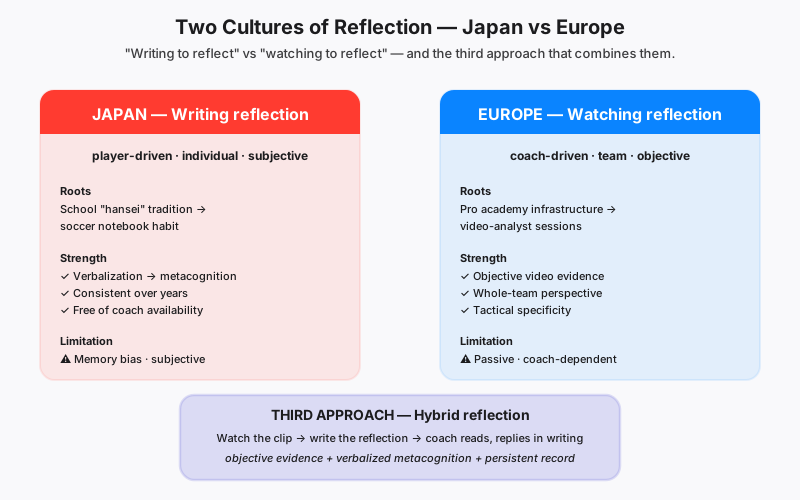
There is a clear divide between the reflection cultures of Japan and Europe. Japan has a culture of 'players writing individually,' while Europe has a culture of 'coaches showing the team.'

Photo by Howard Bouchevereau on Unsplash
When the Footnote Editorial team surveyed soccer education practices worldwide, a clear regional divide in approaches to reflection emerged. This is not merely a difference in habits — it is a systematic difference rooted in educational culture and social structure.
The Japanese Model: Player-Driven 'Writing Reflection'
- Individual players record in soccer notebooks (starting from elementary school age)
- Introspective, subjective entries are the norm (verbalizing emotions and decisions)
- Multiple commercial soccer notebook products exist (e.g., the Shunsuke Nakamura model, Keisuke Honda's 'Dream Notebook')
- The practice has a direct continuity with diary-writing and self-reflection traditions in the school system
The European Model: Coach-Driven 'Watching Reflection'
- Sessions where coaches show players edited video clips
- Objective, tactical analysis is the focus (positioning and data)
- One-on-one meetings and team briefings serve as the settings for reflection
- Individual notebook habits among players are not common practice
The Roots of Japan's Notebook Culture — The Educational Tradition of 'Hansei'
Japan's soccer notebook culture is directly linked to the tradition of 'hansei' (structured self-reflection) in Japanese education. The culture of writing diaries in school and conducting end-of-day reflection sessions naturally extended into sports.
In the Japanese school system, 'hansei' (self-reflection) is built into education from early childhood. End-of-day classroom reflection sessions, summer break diaries, and end-of-term self-evaluations — these practices instill the habit of 'verbalizing and reflecting on one's actions' from a young age. The soccer notebook is a natural extension of this educational tradition into sports.
The reason Shunsuke Nakamura — one of Japan's most celebrated midfielders — naturally embraced soccer notebooks in his second year of high school is that the act of 'writing to reflect' was already second nature through years of schooling. For players in the West, 'writing in a notebook after a match' may feel unusual, but for Japanese players it is simply an extension of what they have always done in the classroom.
This cultural background carries important implications when applying findings from Toering et al. (2009), a Dutch study on self-regulation in youth soccer. Their finding that reflection skills correlate with performance suggests that Japan — with its deep educational tradition of reflection — may be uniquely positioned to leverage this advantage even more effectively than in Europe.
Strengths and Limitations of European Video Analysis
European video analysis excels in objectivity and specificity, but it has inherent limitations as a mechanism for fostering introspective reflection in players.
Strengths of Video Analysis
- Objectivity — Video eliminates memory bias. A player may believe they released the pass on time, but the footage reveals the delay
- Visual comprehension — For understanding tactics, video can be more efficient than verbal explanation
- Whole-team perspective — Video reveals team-wide movement and off-the-ball runs that individual players cannot see during a match
Limitations of Video Analysis
- Passive — Players are 'shown' the video; the process of actively constructing their own reflection is weak
- Invisible inner reasoning — Video shows 'what happened' but not 'why the player chose that action'
- Weak mental-health coverage — Psychological elements such as anxiety, pressure, and motivation cannot be addressed through video analysis alone
Research by MacIntyre et al. (2014) noted that metacognition in sport has been 'surprisingly under-researched.' While video analysis excels at analyzing 'behavior,' developing 'thinking about thinking (metacognition)' requires active reflection accompanied by verbalization — in other words, the act of writing in a notebook.
Scientific Comparison — Which Is More Effective: Writing or Watching?
The verdict: neither alone, but both combined produce the greatest effect. That said, when it comes to fostering autonomous player development, 'writing reflection' holds a clear advantage.
A study by Kawasaki et al. (2019) published in Brain Sciences demonstrated that a group tasked with verbally describing their own movements showed significantly greater motor skill acquisition than the control group. Verbalization triggers brain activity that overlaps with motor execution and motor imagery — a mechanism that accelerates skill learning.
Meanwhile, the effectiveness of video analysis has been demonstrated primarily in 'error detection' and 'tactical understanding.' However, research by Cropley et al. (2007) showed that reflective practice interventions improved self-awareness, evaluative skills, and self-efficacy — effects that cannot be achieved through video viewing alone.
Footnote's Original Framework: The Integrated Model
Synthesizing the existing body of research, we believe maximum reflection effectiveness emerges through the following sequence:
- Immediate verbalization (write) — Verbalize decisions, emotions, and physical sensations right after the match. Record your subjective experience while memory is fresh
- Objective verification via video (watch) — Compare your written recollections against the footage to discover gaps between perception and reality
- Gap analysis and goal updating (write) — Analyze the causes of those gaps and record your next action steps
- Feedback from AI or a coach (receive) — Get an external perspective on trends spanning multiple matches
This four-step model integrates the Japanese 'writing culture' with the European 'watching culture' and adds the modern element of AI-powered feedback. Footnote is designed to facilitate steps 1, 3, and 4 within the app.
Approaches from Around the World
Beyond Japan and Europe, regions such as South America, Africa, and North America each have their own distinct soccer cultures. Styles of reflection likewise mirror the culture of each region.
South America — Improvisation and Oral Culture
Soccer culture in South America — in countries like Brazil and Argentina — is built on the improvisational foundation of street football. Reflection happens less through structured notebooks or video sessions and more through oral discussion with teammates and coaches. Real-time feedback like 'you could've done more with that play' is a constant part of everyday training.
North America — A Data-Driven Approach
With the rise of MLS, a data-analytics-driven approach has taken hold in the United States. Reflection built on objective data — GPS tracking, distance covered, sprint counts — aligns naturally with America's broader business analytics culture. However, the subjective introspection element tends to be as weak as in the European model.
South Korea — Similarities with Japan and Its Own Identity
South Korea also has an educational tradition of self-reflection, and player recording habits share similarities with Japan. However, influenced by the more regimented discipline culture in Korean soccer, notebooks can sometimes take on the character of 'reports to the coaching staff' — a dynamic that differs from intrinsically motivated self-reflection.
The Third Approach — Integrating 'Writing' x 'Watching' x 'AI'
The next generation of soccer reflection integrates the strengths of the Japanese model (verbalization, metacognition, consistency) with those of the European model (objectivity, tactical analysis, data), while using AI to automate the feedback loop.
Each regional approach analyzed in this article has its own strengths and limitations. The Footnote Editorial team's proposal is an integrated model that draws on the best of each:
- From the Japanese model — The habit of players verbalizing their own experience. Recording mental and emotional states. Continuity driven by intrinsic motivation
- From the European model — Improving reflection accuracy through objective data. Tactical-level analytical frameworks
- What technology adds — Trend detection across multiple matches (AI analysis). Quantification and visualization of skills. Automated feedback
The importance of this integrated approach is further supported by the latest research from Esposito et al. (2025), published in Scientific Reports. Their finding that a facilitation program based on metacognitive self-questioning significantly improved self-regulation skills in sports coaches reinforces the scientific validity of 'writing reflection.'
As of 2026, Japan possesses an educational advantage unmatched anywhere in the world: a 'writing reflection culture.' By combining this with technology, there is potential to build a player development model more effective than any other region in the world.
Frequently Asked Questions
Do European players really not keep soccer notebooks?▾
While individual differences exist, no organized, culture-wide notebook habit comparable to Japan's has been documented. In Europe, the pillars of reflection are video analysis and coach-player dialogue; individual written records by players are not common practice. That said, notebooks do exist at the coaching level — Pep Guardiola, for example, is known for his meticulous notes.
Is Japan's soccer notebook culture truly unique in a global context?▾
Yes. As far as our research indicates, Japan is the only country in the world where the practice of players individually keeping reflection notebooks is this widespread. This is directly linked to the tradition of 'hansei' (self-reflection) in Japanese education, and it represents a significant advantage from a sports science perspective.
Should I use both video analysis and a notebook?▾
Ideally, yes. Use the notebook to record subjective reflections — your decisions, emotions, and mental imagery — and use video to verify the objective facts. Comparing the two reveals the gap between perception and reality, which is the most valuable insight of all.
Can AI feedback replace video analysis?▾
At present, AI is a complement to video analysis, not a replacement. AI detects patterns from numerical data and text, but analyzing positioning and off-the-ball movement from footage requires dedicated video analysis technology. Footnote's AI analysis is designed as a complementary tool to enhance the quality of 'writing reflection.'
References
- [1] Toering, T., Elferink-Gemser, M. T., Jordet, G., & Visscher, C. (2009). “Self-regulation and performance level of elite and non-elite youth soccer players” Journal of Sports Sciences, 27(14), 1509-1517.
- [2] MacIntyre, T. E., Igou, E. R., Campbell, M. J., Moran, A. P., & Matthews, J. (2014). “Metacognition and action: a new pathway to understanding social and cognitive aspects of expertise in sport” Frontiers in Psychology, 5, 1155.
- [3] Kawasaki, T., Kono, S., & Tozawa, R. (2019). “Efficacy of Verbally Describing One's Own Body Movement in Motor Skill Acquisition” Brain Sciences, 9(12), 356.
- [4] Cropley, B., Miles, A., Hanton, S., & Niven, A. (2007). “Exploring the value of reflective practice interventions within applied sport psychology” Sport Psychologist, 21(2), 158-178.
- [5] Esposito, A. G., et al. (2025). “Metacognitive strategies improve self-regulation skills in expert sports coaches” Scientific Reports, 15, 3222.
Related Articles
How Pro Soccer Players Use Journals — Reflection Techniques from World-Class Examples
8 min read
Shunsuke Nakamura's Soccer Journal — Dissecting the Methodology of an 18-Year Writing Habit Through Science
7 min read
The Science Behind How Verbalization Improves Soccer — How 'Writing' and 'Thinking' Connect in the Brain
6 min read
Metacognition Training — The Science Behind 'Thinking Soccer' and How to Develop It Through Journaling
12 min read
Mental Training and the Soccer Notebook Habit — The Science of Writing Your Way to a Stronger Mind
9 min read
Track Your Growth with Footnote
Just record your matches — AI analyzes every 5 games. Visualize growth with PVS Score. All features free during beta.
30-second signup · No credit card required
Last updated: 2026-05-05 ・ Footnote Editorial