Mental Training and the Soccer Notebook Habit — The Science of Writing Your Way to a Stronger Mind
The single biggest variable determining soccer performance is neither technique nor physicality — it is mentality. Pennebaker's (2018) research program, spanning more than 30 years, has demonstrated across over 100 studies that writing about emotional experiences improves psychological health and builds the foundation for peak performance. Makoto Hasebe's 56 habits detailed in his bestselling book, Mankad et al.'s (2009) expressive writing intervention during ACL rehabilitation, and Hatzigeorgiadis et al.'s (2011) meta-analysis on self-talk — when these findings converge, they reveal that the soccer notebook is the most accessible, scientifically validated mental training tool available.
The Science of Expressive Writing — Mental Care Through the Written Word
Research by Pennebaker (2018) on expressive writing and Gabana et al.'s (2020) athlete-adapted study demonstrates that writing about emotions reduces avoidance behaviors, promotes problem-solving coping, and enhances performance readiness.

Photo by Vitaly Gariev on Unsplash
Professor James Pennebaker launched his expressive writing research program in 1986, and it now spans more than 30 years of investigation. His 2018 review in Perspectives on Psychological Science, drawing on over 100 studies, reported that writing about emotional experiences for 15–20 minutes produces measurable health benefits (effect size d = .16).
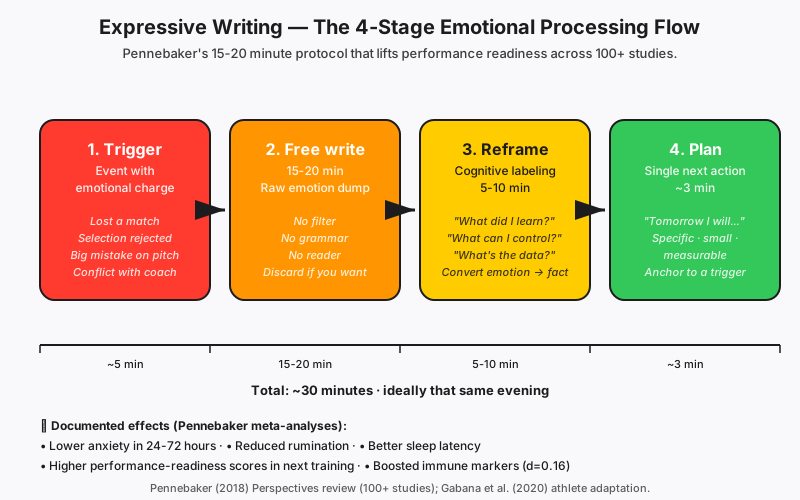
Gabana et al. (2020) adapted Pennebaker's writing paradigm specifically for athletes and published the results in Frontiers in Psychology. In a study of college athletes, a three-day expressive writing intervention produced the following effects:
- Reduced avoidance behavior toward stressors — a shift from 'I don't want to think about it' to 'I can face it'
- Increased problem-solving-oriented coping — processing emotions cleared the way for calm analysis and action planning
- Improved reflective strategies for competition and training — the act of writing itself elevated the quality of reflection
- Enhanced mood awareness — athletes became able to recognize their emotional state in real time
Writing 'I'm frustrated,' 'I'm anxious,' or 'I'm disappointed in myself' after a match is not a sign of mental weakness. It is a scientifically validated mental care technique backed by over 100 studies.
Mankad, Gordon, & Wallman (2009), published in the Journal of Clinical Sport Psychology, demonstrated this effect in an even more specific context. Athletes rehabilitating from ACL (anterior cruciate ligament) injuries who engaged in expressive writing showed significant improvements in psychological recovery markers. If writing proves effective under the extreme stress of a serious injury, its benefits for everyday stressors — a poor match, a missed selection — are all the more promising.
Makoto Hasebe's 56 Habits — Managing Your Mind Through Systems, Not Willpower
Makoto Hasebe's 'Organizing the Mind: 56 Habits for Winning' (2011) introduced the philosophy of managing mental states through daily systems rather than sheer willpower. The soccer notebook is the core tool within this system.

Photo by Omar Ramadan on Unsplash
Makoto Hasebe served as captain of the Japan national team for many years and played in the Bundesliga for over a decade. His book 'Organizing the Mind' (Gentosha, 2011), which sold over 1.5 million copies, is fundamentally about managing mental states through the accumulation of small daily habits rather than powering through adversity with grit or determination.
Hasebe's Teachings That Connect Directly to Notebook Habits
- 'Tidying up your surroundings is tidying up your mind' — organizing your thoughts on paper is the act of clearing the clutter from your inner emotional landscape
- 'Manage your evening hours' — a post-match journaling routine at night prevents emotional spiraling and ensures you start the next day with a clear mind
- 'Focus on what you can control' — what belongs in your notebook is not the referee's decisions or the opponent's rough play, but the aspects of your own game that you can improve
- 'Always prepare for the worst case' — writing out every possible scenario before a match builds the psychological readiness to stay composed when the unexpected happens
Hasebe's habits are, in sports psychology terms, a textbook pre-performance routine. By having a systematic process for organizing the mind, athletes can deliver stable performance regardless of fluctuations in condition. The soccer notebook is the most practical tool for executing this routine through the concrete act of writing.
The mind is not something you toughen — it is something you organize. Good preparation draws good results toward you.
— Makoto Hasebe, 'Organizing the Mind' (2011)
Pre-Match Visualization and the Role of the Notebook
Hatzigeorgiadis et al.'s (2011) meta-analysis showed that pre-planned self-talk significantly improves performance. Written visualization in a notebook before a match enables more structured mental preparation than verbal self-talk alone.
Visualization (mental imagery) is a mental skill practiced by many top athletes, but simply 'closing your eyes and imagining' lacks specificity and reproducibility. Written visualization in a notebook structures your thinking and functions as a blueprint for self-talk on match day.
Five Items to Write in Your Pre-Match Notebook
- Today's focus points — write down just one or two plays to concentrate on (be specific: 'keep my first touch forward,' for example)
- Anticipated scenarios — based on the opponent's characteristics, write out likely situations and how you will respond
- Self-talk preparation — write the phrases you will repeat to yourself during the match ('open your body angle,' 'take a deep breath,' etc.)
- If the worst happens — plan for scenarios such as consecutive mistakes or conceding a goal immediately, and prepare a reset phrase for each
- What I want to gain from this match — not the result, but what you as an individual want to prove or experiment with, stated in writing
Hatzigeorgiadis et al.'s (2011) meta-analysis found that instructional self-talk — technical cues such as 'watch the ball' or 'bend your knees' — is particularly effective in situations requiring fine motor precision. For soccer scenarios like free kicks and penalty kicks, designing instructional self-talk in your notebook beforehand can directly improve performance.
Shunsuke Nakamura was known for his habit of re-reading his notebook before matches. By revisiting verbalized records of past successes, he deliberately elevated his self-efficacy and optimized his psychological state heading into competition.
Post-Match Emotional Processing — Writing to Recover from Mental Damage
Post-match emotions — especially after a defeat or a costly mistake — must be properly processed, or they carry over as negative influence into the next match. Expressive writing, based on Pennebaker's (2018) research, is one of the most effective methods for this processing.
After a loss, a missed penalty, a failed selection trial — soccer players frequently face intense negative emotions. Attempting to suppress these feelings by telling yourself to 'forget about it' or 'just move on' is, according to Pennebaker's (2018) research, counterproductive. Emotional suppression increases rumination — the state of replaying the same thoughts on an endless loop — and delays recovery.
How to Write a Post-Match Emotional Processing Entry
- Write your emotions raw (5 minutes) — 'I'm furious,' 'I'm ashamed of myself,' 'Why did I mess up in that moment?' — pour out your feelings without self-censorship
- Separate facts from feelings (5 minutes) — 'I missed the penalty' is a fact; 'I'm worthless' is an emotion. Write each category separately
- Analyze causes across three layers (5 minutes) — break it down into technical causes, psychological causes, and situational causes
- Write one next action (2 minutes) — based on your analysis, decide on one specific thing to do in the next match or training session
This four-step process takes approximately 17 minutes. Pennebaker's (2018) research protocol recommends 15–20 minutes of writing, making this timeframe consistent with the evidence-based optimal duration.
Writing is not about erasing emotions — it is about placing them where they belong. Frustration does not need to disappear. But you must prevent that frustration from dominating you and causing you to shrink in your next performance.
How Continuous Journaling Builds Mental Resilience
Mental strength is not an innate personality trait — it is a skill built through accumulated reflection. Here we explain the mechanisms by which consistent notebook habits create an 'unbreakable mind.'
Mental resilience is a distinct concept from 'mental toughness.' Resilience is the ability to recover from adversity and adapt — and it can be developed through training. Maintaining a soccer notebook activates three mechanisms that build this resilience.
Mechanism 1: Accumulating a Record of Past Recoveries
If your notebook contains a record showing that 'after that devastating loss, I played one of my best matches the next game,' then the next time you face a setback, you have evidence-based confidence: 'I've overcome this before. I can overcome it again.' Without records, memories fade, and groundless anxiety takes over.
Mechanism 2: Recognizing Emotional Patterns
Review six months of notebook entries and patterns emerge: 'I feel anxious before every match, but once the whistle blows it disappears,' or 'After a major mistake, I always feel down for three days but recover on the fourth.' A person who knows their patterns is not controlled by them. When you can predict that 'the next three days will be tough, but I'll recover on day four,' you maintain composure even in the depths of a slump.
Mechanism 3: Making Growth Visible
Mankad et al.'s (2009) ACL rehabilitation study identified one factor in writing-assisted psychological recovery as 'the ability to view one's own recovery process objectively.' The soccer notebook works the same way — being able to compare yourself three months ago with who you are today, and seeing tangible growth, becomes the energy to push through difficult periods.
Mentally strong players are not players who never feel down. They are players who have a system for recovering when they do. The soccer notebook is at the core of that system.
Frequently Asked Questions
I know my mental game is weak. Can writing in a notebook really make a difference?▾
Feeling that your 'mental game is weak' usually means you simply have not trained your mental skills. Pennebaker's (2018) body of over 100 studies demonstrates that writing about emotions improves psychological health. Gabana et al.'s (2020) athlete-specific study confirmed that just three days of expressive writing reduced avoidance behavior and increased problem-solving orientation. A notebook is not a cure-all, but it is the most accessible, scientifically supported entry point into mental training.
Won't writing about my anxieties before a match make me even more anxious?▾
Pennebaker's (2018) research shows that while emotions may fluctuate briefly during the writing process, psychological stability improves afterward. Externalizing anxiety by putting it on paper reduces it more effectively than letting it spin in your head. Additionally, Hatzigeorgiadis et al.'s (2011) meta-analysis demonstrated that preparing coping strategies in the form of self-talk in advance improves performance in anxiety-inducing situations.
Aren't Hasebe's habits meant for adult professionals? Can middle and high school players apply them?▾
The essence of Hasebe's 56 habits is the philosophy of 'managing your mind through systems,' which is applicable regardless of age. In fact, building these habits during the middle and high school years is far more efficient than constructing them from scratch as an adult. You do not need to adopt all 56 habits — starting with three — evening reflection, focusing on what you can control, and keeping things organized — is more than enough.
Should I keep writing in my notebook even when I'm injured and can't play?▾
The injury period is precisely when you should be writing. Mankad et al.'s (2009) ACL rehabilitation study showed that expressive writing significantly improved psychological recovery. Recording your rehab progress, emotional changes, and return-to-play goals prevents mental stagnation and prepares you for your comeback. What you write during injury becomes 'proof that you overcame it' — a wellspring of resilience for your future self.
My teammates make fun of me for writing in a notebook. What should I do?▾
The fact that Shunsuke Nakamura maintained his notebook habit for over 18 years and Makoto Hasebe journaled throughout his career is the strongest counterargument. Those who mock it simply do not know the scientific value of writing. That said, there is no need to convince them. Your growth record is yours alone. Letting your results speak for you is the most persuasive response. As Toering et al.'s research shows, players who maintain reflective habits reach the top level at a significantly higher rate than those who do not.
References
- [1] Pennebaker, J. W. (2018). “Expressive Writing in Psychological Science” Perspectives on Psychological Science, 13(2), 226-229. Link
- [2] Gabana, N. T., Van Raalte, J. L., Hutchinson, J. C., Brewer, B. W., & Petitpas, A. J. (2020). “Written Emotional Disclosure Can Promote Athletes' Mental Health and Performance Readiness” Frontiers in Psychology, 11, 599925.
- [3] Mankad, A., Gordon, S., & Wallman, K. (2009). “Psycholinguistic Analysis of Emotional Disclosure: A Case Study in Sport Injury” Journal of Clinical Sport Psychology, 3(2), 182-196.
- [4] Hatzigeorgiadis, A., Zourbanos, N., Galanis, E., & Theodorakis, Y. (2011). “Self-Talk and Sports Performance: A Meta-Analysis” Perspectives on Psychological Science, 6(4), 348-356. Link
- [5] 長谷部誠 (2011). “心を整える。勝利をたぐり寄せるための56の習慣” 幻冬舎.
Related Articles
The Science Behind How Verbalization Improves Soccer — How 'Writing' and 'Thinking' Connect in the Brain
6 min read
Shunsuke Nakamura's Soccer Journal — Dissecting the Methodology of an 18-Year Writing Habit Through Science
7 min read
Growth Mindset and the Soccer Journal — How to Raise Players Who Believe in Effort Over Talent
9 min read
How Pro Soccer Players Use Journals — Reflection Techniques from World-Class Examples
8 min read
Metacognition Training — The Science Behind 'Thinking Soccer' and How to Develop It Through Journaling
12 min read
Track Your Growth with Footnote
Just record your matches — AI analyzes every 5 games. Visualize growth with PVS Score. All features free during beta.
30-second signup · No credit card required
Last updated: 2026-05-05 ・ Footnote Editorial