Verbalization Accelerates Transfer -- Why Writing Makes Skills from Other Sports Carry Over to Soccer
F1 drivers practice juggling a soccer ball, basketball players take ballet lessons, and soccer players sharpen their footwork through tennis -- the phenomenon of skills transferring between different sports has been scientifically documented for over 120 years, since Thorndike & Woodworth's research in 1901. However, simply playing other sports does not guarantee transfer. The key lies in verbalization. By expressing movements in words, abstracting them, and consciously extracting shared principles, the rate of skill transfer improves dramatically.
The Science of Skill Transfer -- Principles from 120 Years of Research
Thorndike & Woodworth's (1901) 'identical elements theory' demonstrated that transfer is more likely when two tasks share more common elements. Modern sports science has revealed that these 'common elements' extend beyond motor patterns to include cognitive processes.

Photo by Walls.io on Unsplash
Transfer of learning refers to the phenomenon in which abilities acquired in one task influence performance on another. Thorndike & Woodworth (1901) proposed that transfer occurs when two tasks share 'identical elements' -- and this became the starting point for all skill transfer research.
Three Dimensions of Transfer
- Motor pattern similarity -- The degree of overlap in joint angles, muscle activation patterns, and timing. For example, a tennis forehand and a soccer side volley share the common pattern of rotational movement
- Perceptual-cognitive process commonality -- Similarity in spatial awareness, anticipation, and decision-making. The passing decisions in basketball and the through-ball decisions in soccer share the cognitive process of 'reading space'
- Environmental-constraint similarity -- The degree of time pressure, interpersonal confrontation, and uncertainty. The one-on-one encounter in martial arts and the dribbling challenge in soccer share the constraint of 'disrupting the opponent's center of gravity'
In their systematic review, Rosalie & Muller (2012) analyzed perceptual-motor skill transfer between sports and confirmed the existence of both general transfer and specific transfer. Their critical finding was that transfer does not happen automatically -- it depends on the learner's 'conscious extraction process.'
The core insight: Skill transfer does not happen simply because movements look alike. Efficient transfer occurs only when the learner consciously recognizes the shared principles and can articulate them in words.
Why Verbalization Acts as a Bridge for Transfer
Kawasaki et al. (2019) showed that verbalizing a movement co-activates brain regions associated with both motor execution and motor imagery. This 'verbalization to mental rehearsal' mechanism is what accelerates skill transfer between different sports.
Why does writing accelerate transfer? The mechanism can be understood in three stages.
Stage 1: Abstraction
When you verbalize a movement from another sport, underlying principles are extracted from the specific motor pattern. The moment you describe a tennis serve as 'transmitting rotational energy from the trunk to the extremities through the kinetic chain,' it stops being a tennis-specific technique and becomes a universal principle that applies equally to a soccer kick.
Stage 2: Neural Reactivation
As the research by Kawasaki et al. (2019) published in Brain Sciences demonstrates, verbalizing a movement co-activates the motor execution and motor imagery regions of the brain. In other words, the act of writing simulates the act of moving inside the brain. When you verbalize a movement learned in another sport, a re-simulation occurs within the context of soccer.
Stage 3: Intentional Application
Research by Buszard et al. (2020) in Frontiers in Psychology showed that analogy-based instruction can be more effective than explicit instruction in certain cases. An analogical verbalization like 'receive the ball with the same feeling as moving quickly to the hit point in tennis footwork' is a powerful way to connect two motor skills in the brain.
Transfer without verbalization relies on coincidence. Transfer with verbalization becomes intentional design. The key to maximizing the benefits of cross-training lies in the process of making abstract principles conscious by writing them in a notebook.
Cross-Training in Practice: Examples from Professional Athletes
The world's top athletes strategically incorporate training from outside their primary sport. What they have in common is that they clearly articulate what they aim to learn from each additional sport.
The effectiveness of cross-training is supported by the practices of elite athletes. What stands out is that they do not simply 'play other sports' -- they are highly conscious of which specific elements they want to transfer.
F1 Drivers and Soccer
F1 drivers are well known for incorporating juggling and futsal into their training. The goal is to train 'reaction speed to unpredictable movements' and 'fine control with the feet.' The plantar sensitivity required for precise pedal adjustments shares overlapping neural pathways with the ball-touch sensitivity developed through juggling. The crucial point is their recognition that the abstract principle of 'refining plantar sensation' is common to both activities.
Basketball Players and Ballet
NBA players who take ballet classes are not just seeking improved flexibility. The ability to 'change direction while maintaining a stable axis' and 'awareness of body position in space (proprioception)' that ballet develops can make a decisive difference in soccer as well -- in one-on-one dribbling and aerial duels.
Soccer Players and Racket Sports
European soccer academies are increasingly incorporating tennis and table tennis into their training programs. The 'anticipation-decision-execution cycle speed' that racket sports develop directly enhances the quality of transitions in soccer. Furthermore, the ability to 'predict shot direction from the opponent's body orientation' required in racket sports is cognitively identical to the anticipation ability needed in soccer defense.
What transfers between sports is not just strength or endurance. Spatial awareness, the ability to synchronize timing, and decision-making under uncertainty -- cognitive skills are the greatest benefit of cross-training.
— Summary of findings from inter-sport skill transfer research
The Dual Benefits of Cross-Training -- Physical and Cognitive
Hammami et al. (2018) found that groups that included cross-training showed significantly greater improvements in sprint, agility, and the Yo-Yo test compared to groups that only did soccer-specific training. More recent research has also demonstrated cognitive transfer effects.
The benefits of cross-training manifest through two major pathways.
Physical Transfer Effects
Hammami et al. (2018) examined the effects of a 12-week cross-training program (integrating swimming, athletics, and gymnastics) on soccer players. Compared to the soccer-only training group, the cross-training group showed significantly greater improvements in the 10-meter sprint, change-of-direction agility, and the Yo-Yo intermittent recovery test.
- Multi-dimensional cardiopulmonary development -- Swimming strengthens the upper-body respiratory muscles while running builds lower-body endurance, complementing each other
- Injury prevention -- Avoiding repetitive identical movement patterns reduces the risk of overuse injuries
- Motor learning generalization -- Adapting to diverse movement patterns increases the speed of acquiring new motor tasks
Cognitive Transfer Effects
Research by Vestberg et al. (2012, 2017) demonstrated that executive functions in soccer players -- attentional control, inhibitory function, and working memory -- correlate significantly with on-field performance. Exposing yourself to diverse decision-making environments through cross-training has the effect of broadly strengthening these executive functions.
Specifically: chess develops spatial awareness and the ability to think ahead, martial arts develop split-second judgment and prediction of an opponent's movements, and other team sports develop coordination and communication in different contexts. These cognitive skills transfer directly to match-day decision-making in soccer.
If you evaluate cross-training on physical benefits alone, you are seeing only half the picture. Cognitive transfer -- spatial awareness, anticipation, decision-making -- is what makes the decisive difference in long-term soccer development.
The Abstraction-Verbalization-Reapplication Framework for Maximizing Transfer
A three-step framework for intentionally maximizing cross-training benefits rather than leaving them to chance. By writing down 'what carries over' instead of just 'what you did,' the rate of transfer fundamentally changes.
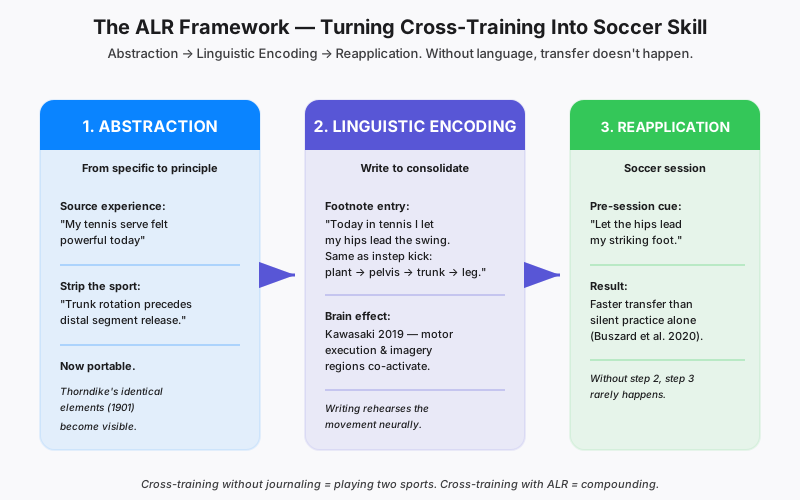
The framework that translates the research-backed conditions for skill transfer -- 'conscious recognition of common elements' and 'neural reactivation through verbalization' -- into practice is ALR: Abstraction, Linguistic Encoding, and Reapplication.
Step 1. Abstraction -- Extract the Underlying Principle
Detach the movements and decisions you experienced in another sport from their sport-specific context and grasp them at the level of principle. Instead of 'I hit a forehand in tennis,' abstract it to 'I efficiently transmitted rotational energy from the trunk to the extremities.'
- What is the underlying principle of the movement? (rotation, weight shift, kinetic chain, anticipation, timing...)
- Which body parts or cognitive functions are being used?
- Which situations in soccer share a similar structure?
Step 2. Linguistic Encoding -- Write It in Your Notebook
Write the abstracted principle in your own words. As Kawasaki et al. (2019) demonstrated, verbalization reactivates motor programs in the brain. Writing converts an 'experience' into 'knowledge,' making context-independent transfer possible.
- Write down one principle you noticed during today's cross-training session
- Describe specifically which soccer situation it could apply to
- Write one thing you want to try in your next soccer practice
Step 3. Reapplication -- Test It in Soccer
Approach your soccer practice or match with conscious awareness of the verbalized principle. Afterward, record in your notebook 'how the principle actually applied,' 'what worked,' and 'what didn't.' By repeating this cycle, transfer becomes intentional and iterative rather than accidental.
'Did it -- wrote about it -- tried it -- wrote about it again' -- this cycle is the core process that transforms ordinary cross-training into scientifically driven transfer training.
Recording Cross-Training in Footnote
Footnote's practice log is designed to maximize the transfer effects of cross-training. It lets you structurally record not just 'what you did' but 'what carries over.'
Footnote allows you to effectively verbalize the outcomes of cross-training within your practice logs. The following recording workflow is designed so that you naturally practice the ALR framework.
Key Points for Recording
- Log the cross-training element in your practice record -- e.g., '30 minutes of tennis wall practice. Adjusting the racket face angle has the same structure as fine-tuning accuracy on an inside kick'
- Explicitly note the transfer point -- 'The "getting to the hit point early" lesson from today's tennis is the same principle as preparing for the first touch in soccer'
- Set an application goal for the next soccer practice -- 'Tomorrow I will focus on "moving my feet to the ball before it arrives"'
- Add a follow-up note on results -- 'Tried the "early preparation" awareness from tennis on my trapping -- first touch quality felt noticeably better'
Footnote's AI analysis, which runs every five matches, also detects trends from your cross-training records. Patterns such as 'self-ratings for first-touch quality tend to improve in weeks when tennis is included' help you identify which forms of cross-training are most effective for you.
The best cross-training is not just 'playing another sport.' It is 'putting into words what you can bring back from another sport to soccer.'
Cross-Training Caveats -- When Verbalization Backfires
Verbalization is not a silver bullet. When beginners become overly conscious of their movements, they risk falling into 'paralysis by analysis.' Balancing developmental stage with the depth of verbalization is essential.
The research on skill transfer and verbalization comes with important caveats.
Paralysis by Analysis
Research by Masters (1992) and Beilock et al. (2002) documented the 'choking under pressure' phenomenon, where directing excessive conscious attention to an already automated skill degrades performance. In other words, forcing yourself to verbalize movements you can already perform unconsciously can be counterproductive.
Depth of Verbalization by Developmental Stage
- Beginners (lower elementary school) -- Reflections at the level of 'That was fun' or 'I liked doing X' are perfectly sufficient. Do not push for abstraction
- Intermediate (upper elementary to middle school) -- Encourage analogies such as 'X in tennis felt similar to Y in soccer'
- Advanced (high school and above) -- Practice all steps of the ALR framework. Abstraction at the principle level and intentional application
The Risk of Negative Transfer
Not all transfer is positive. Motor patterns that are similar yet subtly different -- such as a baseball swing interfering with a soccer kicking motion -- can cause 'negative transfer.' Verbalization is equally important here. By clearly articulating 'these movements are similar, but here is the critical difference,' you can prevent negative transfer.
Verbalization is complete only when you write down 'what is different' alongside 'what is shared.' Articulating the differences is the most effective way to prevent negative transfer.
Frequently Asked Questions
How often should I do sports other than soccer?▾
One to two cross-training sessions per week is recommended. In Hammami et al. (2018), the group that devoted 20 to 30 percent of weekly training volume to cross-training saw the best results. That said, avoid drastically reducing your soccer practice time. The ideal balance is to keep soccer training as the foundation and supplement it with other sports.
Which sport is most beneficial for soccer?▾
It depends on your goal. Racket sports (tennis, table tennis) are effective for improving anticipation and decision-making, ballet and gymnastics for core strength and balance, swimming and running for multi-dimensional cardiopulmonary development, and martial arts for one-on-one tactical skills. Using the ALR framework introduced in this article, you can maximize transfer to soccer from any sport.
Do elementary school children need to keep cross-training records?▾
Adjust the depth of recording to the child's age. For lower elementary school students, 'That was fun' or 'I liked X' is plenty. From upper elementary school onward, prompting analogies like 'X in tennis felt like something in soccer' naturally cultivates transfer awareness. The full ALR framework is appropriate from middle school age and above.
Can verbalization ever be counterproductive?▾
Yes. Directing excessive conscious attention to an already automated skill can trigger 'paralysis by analysis' (Masters, 1992). The key is to focus verbalization on new skills you are still learning and avoid verbalizing movements you can already perform unconsciously.
How can I manage cross-training records in Footnote?▾
Record the content of your other sport in Footnote's practice log and verbalize what carries over to soccer as a 'transfer point.' Once five matches' worth of data accumulates, the AI detects correlation patterns between cross-training and performance, giving you clues to the optimal cross-training menu for you.
References
- [1] Thorndike, E. L. & Woodworth, R. S. (1901). “The influence of improvement in one mental function upon the efficiency of other functions” Psychological Review, 8(3), 247-261.
- [2] Rosalie, S. M. & Muller, S. (2012). “A model for the transfer of perceptual-motor skill learning in human behaviors” Research Quarterly for Exercise and Sport, 83(3), 413-421.
- [3] Kawasaki, T., Kono, S., & Tozawa, R. (2019). “Verbal description of motor imagery enhances motor learning: Implications for mental practice” Brain Sciences, 9(8), 187. Link
- [4] Buszard, T., Farrow, D., & Masters, R. S. W. (2020). “Optimizing performance of young tennis players using analogy instructions” Frontiers in Psychology, 11, 1-8. Link
- [5] Hammami, A., Gabbett, T. J., Slimani, M., & Bouhlel, E. (2018). “Does cross-training improve physical fitness in youth soccer players? A systematic review” Biology of Sport, 35(4), 361-369.
- [6] Vestberg, T., Gustafson, R., Maurex, L., Ingvar, M., & Petrovic, P. (2012). “Executive functions predict the success of top-soccer players” PLoS ONE, 7(4), e34731. Link
- [7] Masters, R. S. W. (1992). “Knowledge, knerves and know-how: The role of explicit versus implicit knowledge in the breakdown of a complex motor skill under pressure” British Journal of Psychology, 83(3), 343-358.
- [8] Hatzigeorgiadis, A., Zourbanos, N., Galanis, E., & Theodorakis, Y. (2011). “Self-talk and sports performance: A meta-analysis” Perspectives on Psychological Science, 6(4), 348-356.
Related Articles
The Science Behind How Verbalization Improves Soccer — How 'Writing' and 'Thinking' Connect in the Brain
6 min read
Metacognition Training — The Science Behind 'Thinking Soccer' and How to Develop It Through Journaling
12 min read
How to Review a Match --- What Pro Scouts Look For and Proven Recording Techniques
7 min read
Growth Mindset and the Soccer Journal — How to Raise Players Who Believe in Effort Over Talent
9 min read
How Rugby Builds Physicality, Contact Tolerance, and Tactical Intelligence for Soccer
11 min read
Track Your Growth with Footnote
Just record your matches — AI analyzes every 5 games. Visualize growth with PVS Score. All features free during beta.
30-second signup · No credit card required
Last updated: 2026-05-05 ・ Footnote Editorial