Tennis × Soccer — The Science Behind How Anticipation, Footwork, and Rotational Movement Transfer to the Pitch
Tennis and soccer may look like entirely different sports, but from a sports-science perspective they share a remarkable number of common elements. Reading an opponent's body orientation to predict shot direction ('anticipation'), continuously adjusting position relative to the ball ('footwork'), and transferring rotational energy from the trunk to the extremities ('kinetic chain') — these are decisive skills in both tennis and soccer. This article draws on the anticipation research of Abernethy et al. and Williams & Ford, as well as Elliott's biomechanics work, to explain how tennis training can scientifically enhance soccer performance.
Why Tennis Helps Soccer — Three Transfer Pathways
Tennis and soccer share three core skills: anticipation, footwork, and rotational movement. According to Thorndike's (1901) identical-elements theory, the greater the number of common elements between two activities, the more likely skill transfer will occur.

Photo by Braden Egli on Unsplash
Skill transfer between sports occurs most efficiently when two activities share common movement patterns, cognitive processes, and environmental demands. Analyzing the relationship between tennis and soccer reveals at least three major transfer pathways.
- Anticipation — In tennis, players predict shot direction from the opponent's racket angle, body orientation, and backswing. In soccer, players predict passes and shots from the opponent's body orientation, plant-foot position, and gaze direction. Both rely on the shared cognitive process of prediction from body-based cues.
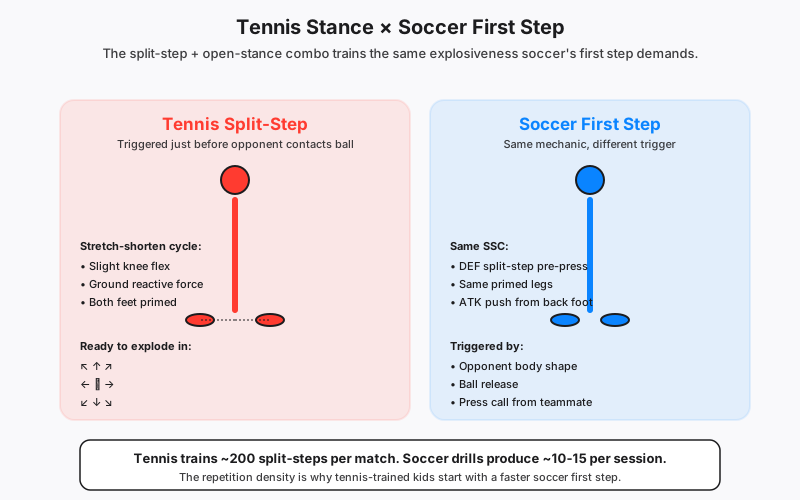
- Footwork — The split step, recovery step, and side step in tennis are structurally identical to the positional adjustments used in soccer defense — approaching the ball and maintaining balance. The shared principle is keeping the feet moving constantly to stay prepared for the next action.
- Rotational Kinetic Chain — In a tennis serve or forehand, rotational energy from the trunk is transmitted through the shoulder, elbow, wrist, and into the racket. In a soccer kick, trunk rotation transfers through the hip, knee, ankle, and into the foot. The underlying principle of energy transfer is the same.
Crucially, these shared elements are not vague similarities — they are quantitatively supported by research in neuroscience and biomechanics. The sections below examine each transfer pathway alongside the supporting data.
The overlap between tennis and soccer goes far deeper than 'both use a ball.' The cognitive processes of anticipation, the movement patterns of footwork, and the mechanical principles of rotation align across all three layers.
Anticipation Transfer — The Ability to 'Read' an Opponent Travels from Court to Pitch
Abernethy et al. (2005) demonstrated that racket-sport experts predict shot direction significantly earlier and more accurately than novices. This anticipation skill is not sport-specific — it has the potential to transfer as a visual-search pattern to other adversarial sports.

Photo by Jim Weatherford on Unsplash
Anticipation in tennis refers to the ability to read the direction and quality of a shot before the opponent strikes the ball. Research by Abernethy et al. (2005), published in the Journal of Experimental Psychology: Human Perception and Performance, showed that skilled tennis players can accurately predict shot direction 200–300 ms before racket-ball contact by reading the trunk rotation angle, shoulder orientation, and backswing angle of the opponent.
Visual-Search Patterns of Tennis Players
Shim et al. (2005), writing in Human Movement Science, used eye-tracking to analyze the visual-search patterns of expert tennis players. They found that experts, compared to novices, focused their gaze on the opponent's trunk, shoulders, and hip rotation rather than fixating on the extremities (wrist or racket face). This 'trunk-centered visual-search pattern' is strikingly consistent with the anticipation patterns observed in soccer.
Direct Transfer to Soccer
A review by Williams & Ford (2008) in the International Journal of Sport Psychology confirmed that soccer players' anticipation skills also depend on body-based cues such as the opponent's trunk orientation, hip angle, and plant-foot position. In other words, the ability cultivated in tennis — predicting the next move from an opponent's body orientation — directly translates to 1v1 defending, goalkeeper save decisions, and pass interceptions in soccer.
- Tennis anticipation — Reading shot direction from the opponent's backswing, trunk rotation, and weight transfer
- Soccer GK — Reading shot trajectory from the shooter's plant-foot orientation, trunk rotation, and approach angle
- Soccer 1v1 defending — Reading the attacking direction from the opponent's weight shift, shoulder orientation, and ball positioning
- Shared principle — Probabilistic prediction from body-based cues
Just as elite tennis players watch the opponent's body rather than the ball, elite soccer players read the opponent's body orientation rather than the ball. This 'gaze-allocation pattern' is the single most valuable cognitive skill that transfers from tennis to soccer.
— Summarized from findings in Williams & Ford (2008)
Footwork Transfer — How the Split Step and Recovery Transform Defending
The split step — the core of tennis footwork, where a player performs a small hop just before the opponent strikes to accelerate the first step in any direction — is directly applicable to defensive positioning in soccer.
Tennis footwork is far more than quick feet. It is a four-phase cyclical process — predict, prepare, move, recover — which is structurally identical to defensive positioning in soccer.
The Split Step Principle and Its Soccer Application
The tennis split step involves a small hop on both feet timed to the moment the opponent strikes the ball, using the rebound from landing to accelerate the first step in any direction. By lifting the feet off the ground at this precise moment, the stretch-shortening cycle (SSC) on landing is engaged, reducing reaction time by 20–30 ms compared to initiating movement from a static stance.
In soccer, the 'small hop before the save' that goalkeepers perform during penalties operates on exactly the same principle. Coaches constantly stress the importance of 'never letting your feet stop' in 1v1 defense, and players with tennis experience already understand at a physical level the sensation of staying in constant motion to prepare for the next change of direction.
Recovery Steps and Change of Direction
In tennis, recovering to the center of the court after each shot is what separates winners from losers. This pattern of 'offensive action followed by an immediate return to a neutral position' is identical to transitions in soccer. Players who recover instinctively on the tennis court tend to show faster recovery to their defensive positions after joining an attack in soccer.
- Split step → 1v1 defending — Staying light on your feet so you can react instantly to a change of direction
- Side step → Sliding defense — Maintaining a low center of gravity while shuffling laterally to cut off passing lanes
- Recovery step → Transitions — The habit of returning to position immediately after an offensive action
- Crossover step → Covering space behind — Efficient foot movement when backpedaling to track runs in behind
Practicing tennis footwork even once a week noticeably reduces the tendency to 'plant your feet' during soccer defense. This is not a strength gain — it is a neural pattern transfer: the habit of staying in constant motion.
Rotational Kinetic Chain Transfer — The Shared Energy-Transfer Principle of Serves and Kicks
As the biomechanics research of Elliott et al. (2003) demonstrates, the tennis serve transmits energy through a kinetic chain from the lower body to the trunk, shoulder, elbow, and wrist. This principle is mechanically identical to the hip-knee-ankle chain in a soccer kick.
The most important element of a tennis serve or forehand is not arm strength — it is amplifying and transmitting trunk-generated rotational energy to the extremities through the kinetic chain. This principle is fundamentally the same in a soccer kick, and it provides the scientific basis for how tennis practice can improve both kicking power and accuracy.
The Shared Structure of the Kinetic Chain
Elliott et al. (2003), writing in the British Journal of Sports Medicine, quantitatively analyzed the kinetic chain in the tennis serve. Energy is transmitted sequentially — ground reaction force → knee extension → hip rotation → trunk rotation → shoulder internal rotation → elbow extension → wrist snap — with each segment receiving and accelerating the velocity of the preceding one, producing a 'whip-like' effect.
The instep kick in soccer follows the same pattern: plant-foot placement → hip flexion → forward thigh swing → knee extension → ankle stabilization, concentrating energy at the distal end (the foot). A review by Lees et al. (2010) in the Journal of Sports Sciences confirmed that the proximal-to-distal kinetic chain in the kicking motion is mechanically equivalent to that of the serve.
Specific Transfers from Tennis to Soccer
- Forehand → Instep kick — Energy transfer initiated by trunk rotation. Eliminates 'arm-only hitting' and 'foot-only kicking' by developing the sensation of generating power with the whole body
- Serve toss → Volley preparation — The feel for storing energy by arching the body like a bow and releasing it all at once
- Backhand slice → Outside-of-the-foot kick — Reversing the direction of rotation while keeping the contact surface stable
- Leading with trunk rotation → All kicking motions — The awareness of initiating movement from the trunk, not from the extremity (foot or racket)
In tennis, 'arm-only hitting' — striking without engaging the trunk — is the most critical flaw to correct. In soccer, 'foot-only kicking' similarly produces neither distance nor accuracy. A player who has internalized the feel of 'hitting with the body' in tennis can immediately grasp the same concept when coached on soccer kicking: 'Oh, it's the same sensation as in tennis.' This moment of recognition is the essence of transfer through verbalization.
Tennis coaches say 'don't hit with your arm — hit with your body.' Soccer coaches say 'don't kick with your foot — kick with your body.' Two different sports, the exact same principle.
Tennis × Soccer in Practice — How Pros and Academies Are Using Cross-Training
Several European soccer academies have adopted tennis as a cross-training discipline, with particularly promising results in goalkeeper development and 1v1 defensive training.
The tennis-soccer cross-training connection extends beyond theory — it is actively practiced in professional environments.
The Overlap Between GK Training and Tennis
Goalkeeper movements share an especially large number of commonalities with tennis: anticipation, the split step, and explosive lateral movement. Goalkeeper academies in Spain and Germany have widely adopted reaction-training drills using tennis balls. The irregular bounce of a tennis ball creates unpredictable scenarios that effectively develop a goalkeeper's reaction speed and decision-making.
The Rise of Multi-Sport Development
The German Football Association (DFB) recommends that players under 12 actively participate in sports other than soccer. Tennis is one of the recommended activities, cited for its benefits in 'adversarial anticipation and decision-making,' 'precision footwork,' and 'rotational movement development.' Multiple studies have shown that early specialization increases the risk of burnout and overuse injuries, and multi-sport experience — including tennis — contributes to long-term athlete development.
Traits of Soccer Players with Tennis Experience
Players with tennis backgrounds tend to exhibit the following characteristics: their feet never stop moving in 1v1 defense, they approach the ball faster, they use their entire body when kicking, and they react more quickly to opponents' movements. Each of these traits corresponds directly to a skill developed in tennis.
Young players should be exposed to as many sports as possible. Tennis is one of the best cross-training activities for developing anticipation and footwork. Players who only do soccer miss out on opportunities to develop skills that soccer itself demands.
— The multi-sport development philosophy in European youth coaching
Recording Tennis-to-Soccer Transfer with Footnote
When logging tennis practice in Footnote, the key to maximizing transfer is not just recording what you did but verbalizing what carries over to soccer.
Here is a practical framework for documenting tennis cross-training sessions in Footnote. It applies the ALR (Abstract → Language → Reapply) framework introduced in the cross-training verbalization article, tailored specifically to the tennis-soccer connection.
Recording Template
- What you did in tennis — A concise record of the session. Example: '30 min of forehand cross-court rallies, 20 min of serve practice'
- What you noticed — Sensory-level observations. Example: 'Ball speed increased when I rotated my trunk before swinging'
- What transfers to soccer — Where the abstracted principle applies. Example: 'If I focus on trunk rotation during instep kicks, I should get more distance'
- What to try in the next soccer session — A specific action item. Example: 'Focus on trunk-first rotation during long-kick practice'
- Results (add after soccer practice) — Document how the transfer felt. Example: 'The trajectory changed when I focused on trunk rotation, but the timing of contact still needs work'
Organize Insights into Three Transfer Categories
When recording observations from tennis practice, tagging each insight under one of the following three categories improves the quality of transfer.
- Anticipation — Insights about reading opponents, gaze allocation, and prediction accuracy
- Footwork — Insights about foot movement, positioning, change of direction, and recovery
- Kinetic chain — Insights about trunk rotation, energy transfer, and contact quality
Footnote's AI analysis, which runs every five matches, also detects correlation patterns with cross-training records like these. Seeing trends such as 'defensive self-ratings improve in weeks when tennis is included' or 'transition scores rise during periods with more footwork-category insights' helps you pinpoint which elements of tennis produce the greatest transfer effect for you personally.
The moment you think 'I can use this in soccer' on the tennis court, open Footnote and jot it down. That single act of verbalization is what transforms a court-side experience into a pitch-side weapon.
Frequently Asked Questions
How many times per week should I play tennis to see soccer benefits?▾
One to two sessions per week, each lasting 30–60 minutes, is recommended. There is no need to drastically reduce soccer training — the goal is to complement it. Adding tennis on off-days or recovery days is particularly effective, as it provides cross-training benefits without lowering your soccer training intensity.
Will tennis help even if I have zero experience with it?▾
Absolutely. In fact, the beginner stage is when motor learning is most active, making it the ideal time to acquire foundational patterns in footwork and anticipation. You do not need to become good at tennis — the objective is to identify principles shared with soccer within tennis movements. From your very first session, focus on 'anticipation' and 'foot movement' and start recording your observations.
Which tennis drills transfer the most to soccer?▾
It depends on your goal. For anticipation, rallying (practicing reading the opponent's body) is most effective. For footwork, volley drills and footwork-specific exercises offer the highest transfer. For kicking power, the rotational mechanics of serves and forehands are most directly transferable. Goalkeepers in particular benefit from the split step and lateral dive practiced during volley drills.
Can tennis technique negatively affect my soccer kicking?▾
Generally, no — but there are caveats. Because tennis is upper-body dominant, the risk of it interfering with soccer kicking mechanics is low. However, assuming that tennis body mechanics map directly onto soccer without any differences can cause you to overlook subtle distinctions. By verbalizing not only the similarities but also the differences between tennis and soccer, you can prevent negative transfer.
How should I log tennis sessions in Footnote?▾
Record the tennis content in Footnote's practice log and add a one-liner for 'soccer transfer point' — what you think will carry over. Tagging each insight under one of the three categories (Anticipation, Footwork, Kinetic Chain) makes it easier for the AI analysis to detect meaningful patterns over time.
References
- [1] Abernethy, B., Gill, D. P., Parks, S. L., & Packer, S. T. (2001). “Expertise and the perception of kinematic and situational probability information” Perception, 30(2), 233–252.
- [2] Shim, J., Carlton, L. G., Chow, J. W., & Chae, W. S. (2005). “The use of anticipatory visual cues by highly skilled tennis players” Journal of Motor Behavior, 37(2), 164–175.
- [3] Williams, A. M. & Ford, P. R. (2008). “Expertise and expert performance in sport” International Review of Sport and Exercise Psychology, 1(1), 4–18.
- [4] Elliott, B., Fleisig, G., Nicholls, R., & Escamilla, R. (2003). “Technique effects on upper limb loading in the tennis serve” Journal of Science and Medicine in Sport, 6(1), 76–87.
- [5] Lees, A., Asai, T., Andersen, T. B., Nunome, H., & Sterzing, T. (2010). “The biomechanics of kicking in soccer: A review” Journal of Sports Sciences, 28(8), 805–817.
- [6] Thorndike, E. L. & Woodworth, R. S. (1901). “The influence of improvement in one mental function upon the efficiency of other functions” Psychological Review, 8(3), 247–261.
- [7] Vestberg, T., Gustafson, R., Maurex, L., Ingvar, M., & Petrovic, P. (2012). “Executive functions predict the success of top-soccer players” PLoS ONE, 7(4), e34731. Link
- [8] Rosalie, S. M. & Müller, S. (2012). “A model for the transfer of perceptual-motor skill learning in human behaviors” Research Quarterly for Exercise and Sport, 83(3), 413–421.
Related Articles
Verbalization Accelerates Transfer -- Why Writing Makes Skills from Other Sports Carry Over to Soccer
11 min read
The Science Behind How Verbalization Improves Soccer — How 'Writing' and 'Thinking' Connect in the Brain
6 min read
How to Review a Match --- What Pro Scouts Look For and Proven Recording Techniques
7 min read
Mental Training and the Soccer Notebook Habit — The Science of Writing Your Way to a Stronger Mind
9 min read
Baseball Meets Soccer — How Rotational Mechanics and Throwing Biomechanics Transfer to Kicking and Throw-Ins
12 min read
Track Your Growth with Footnote
Just record your matches — AI analyzes every 5 games. Visualize growth with PVS Score. All features free during beta.
30-second signup · No credit card required
Last updated: 2026-05-06 ・ Footnote Editorial