Table Tennis x Soccer — The Science of Transferring Reaction Speed, Anticipation, and Decision-Making to the Pitch
Reacting to a smash traveling over 150 km/h in under 0.2 seconds, reading the spin, and predicting the trajectory to return the ball — table tennis is one of the most reaction-intensive and decision-demanding sports on Earth. And this very ability to make accurate judgments at extreme speed is precisely the skill that creates decisive advantages in a soccer match. Ak & Koçak (2010) demonstrated that table tennis players exhibit significantly shorter reaction times than non-athletes, while Vestberg et al. (2012) showed that executive functions in soccer players predict match performance. This article explores how table tennis training can enhance the cognitive performance required in soccer, backed by scientific evidence.
Why Table Tennis Is the Ultimate Reaction Trainer
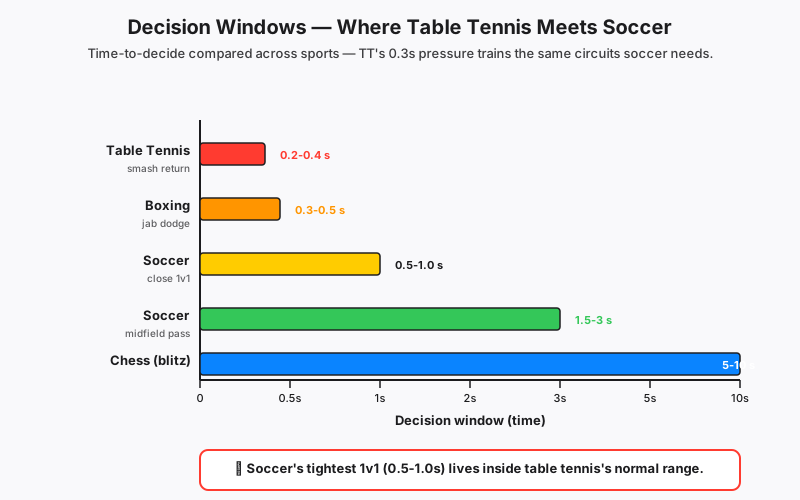
In a table tennis rally, the ball is in the air for only about 0.3 to 0.5 seconds. Repeatedly predicting, deciding, and executing within this extreme time constraint fundamentally sharpens the central nervous system's reaction speed and decision-making velocity.

Photo by Marcus Clark on Unsplash
Table tennis is not a sport dominated by raw physical ability like sprinting 100 meters in under 10 seconds — it is governed by the cognitive ability to make the right decision in 0.3 seconds. The table measures just 2.74 meters long. Top players' smashes exceed 150 km/h. The ball reaches your side of the table in a mere 0.2 to 0.4 seconds after leaving the opponent's racket. Within that window, a player must identify the type of spin, predict the landing point, select the optimal stroke, position their body, and execute a precise contact.
Reaction Time Compared with Other Sports
Even returning a tennis serve demands quick reactions, but the longer court gives players 0.5 to 0.8 seconds of decision time. A soccer goalkeeper facing a penalty kick has roughly 0.4 seconds. In table tennis, decisions in the 0.2-to-0.4-second range are made dozens — sometimes hundreds — of times in a row during every session. In other words, table tennis functions as a compressed-format training drill for the reaction and judgment demands of soccer.
- Table tennis rally — Decision time per shot: 0.2–0.4 s. Dozens of consecutive decisions per set
- Tennis rally — Decision time per shot: 0.5–0.8 s. The court's length provides more time
- Soccer passing decisions — Decision time: 0.5–1.5 s (under pressure). Decision frequency reaches hundreds per match
- Soccer GK (penalty kick) — Decision time: ~0.4 s. Nearly identical time constraint to table tennis
Table tennis is a sport in which thousands of high-speed decisions are made every hour. This concentrated cognitive load is exactly why it serves as the ultimate cross-training tool for sharpening decision speed in soccer.
Transfer of Reaction Time and Decision Speed — A Brain Trained by Table Tennis Is Faster in Soccer Too
Ak & Koçak (2010) demonstrated that table tennis players have significantly shorter visual and auditory reaction times than non-athletes. This difference is not sport-specific — it reflects an improvement in the central nervous system's information-processing speed that transfers to other sports, including soccer.
In their study published in the International Journal of Table Tennis Sciences, Ak & Koçak (2010) compared reaction times between table tennis players and non-athletes. Table tennis players showed significantly shorter visual-stimulus reaction times (approximately 15–20% faster), with an even larger gap in choice reaction time — the speed of selecting the correct response from multiple options.
Simple vs. Choice Reaction — Soccer Demands the Latter
Reaction time is divided into simple reaction time (one stimulus, one response) and choice reaction time (selecting the correct response from multiple stimuli). Soccer overwhelmingly demands the latter. Is the opponent going to dribble or pass? Cut left or right? Players must instantly determine the most likely option from multiple possibilities.
Table tennis trains this choice reaction to its absolute limit. From the opponent's racket angle, swing direction, and body orientation, a player must instantly distinguish forehand from backhand, drive from cut from smash, cross-court from down-the-line, and respond accordingly. This cognitive process of probabilistically selecting the optimal response from multiple cues is structurally identical to 1v1 defending in soccer, a goalkeeper's saving decisions, and a midfielder's pass-route selection.
Executive Functions and Their Relationship to Soccer
In their PLoS ONE study, Vestberg et al. (2012) showed that executive functions in soccer players — particularly attentional shifting, working memory, and inhibitory control — significantly predicted goals and assists over the course of a season. Table tennis demands all of these executive functions at high intensity, and Rodrigues et al. (2002) also reported that table tennis training contributes to broad improvements in cognitive function.
The most important 'muscle' in soccer is the brain. Table tennis is one of the most efficient sports for training it.
— Summary based on the findings of Vestberg et al. (2012)
From Hand–Eye to Foot–Eye Coordination — Building a Bridge Between Sports
The hand–eye coordination developed through table tennis may seem unrelated to footwork in soccer. However, its essence lies in the speed and accuracy of converting visual information into motor output — a central processing capacity that also transfers to foot–eye coordination.
Table tennis is played with a racket in the hand; soccer is played with the foot on the ball. Hand and foot — completely different motor effectors. So why would table tennis benefit soccer? The answer lies in visuomotor transformation at the central processing level.
What Is Visuomotor Transformation?
Visuomotor transformation is the process of taking visual information (the ball's trajectory, spin, and speed), processing it in the brain, and converting it into appropriate motor commands (where, when, and with how much force to move the body). In table tennis, this transformation must be completed in under 0.2 seconds, pushing the central nervous system's processing pipeline to its absolute limit.
Crucially, this optimization is not confined to hand movements. The brain's pipeline from visual processing to motor planning to motor execution shares common upstream stages — visual analysis, prediction, and judgment — regardless of whether the output target is the hands or the feet. The high-speed visuomotor transformation ability built through table tennis naturally transfers to soccer skills such as first-touch decisions (predicting the bounce), heading (predicting aerial trajectories), and volleys (timing the contact).
Specific Examples of Transfer
- Table tennis receive → Soccer first touch — Instantly assessing the incoming ball's speed and spin, then choosing the right surface (part of the foot) and weight of touch
- Table tennis smash → Direct shot in soccer — Predicting the optimal contact point and timing body movement to meet it
- Table tennis block → Goalkeeper save — Processing the opponent's attack accurately with minimal movement
- Changing course mid-rally → Redirecting a pass — A split-second decision switch that defies the opponent's expectations
What table tennis really trains is not 'hand skill.' It trains the brain's ability to convert visual input into motor commands as quickly and accurately as possible. And that ability transfers to the feet, the eyes — the entire body.
Reading Spin → Predicting Trajectories — The Soccer Ball Curves Too
Reading spin — one of table tennis's core skills — has the potential to transfer directly to trajectory prediction of curving and knuckling balls in soccer. The key is having an embodied understanding of how spin affects the ball's aerodynamic behavior.
Spin determines the outcome of table tennis rallies. Topspin, backspin, sidespin, and complex combinations of all three — players must instantly read the direction and amount of spin on the incoming ball and adjust their racket angle and force accordingly. This ability to read spin shares deep connections with ball-trajectory prediction in soccer.
Spin and the Magnus Effect
A spinning ball curves because of the Magnus effect. This physical phenomenon follows the same laws in table tennis as it does in soccer. Through thousands of hours of rallying, table tennis players internalize the impact of spin on a ball's trajectory at a subconscious level. This experiential physics model proves valuable in soccer in the following situations.
- Free-kick trajectory prediction — Goalkeepers and defenders must predict the curve based on kicking technique (instep, outside, inside). Players who have physically experienced spin physics in table tennis make more accurate predictions
- Predicting the landing point of a cross — Long passes and crosses with spin follow non-linear trajectories. Experience in reading spin improves the accuracy of landing-point predictions
- Post-bounce deviation — A ball with spin can bounce in unexpected directions. Players who routinely handle post-bounce changes in table tennis react to these situations faster
- Application to one's own kicking — Understanding spin physics accelerates the acquisition of techniques for intentionally applying curve or topspin to kicks
Reading Visual Cues
Table tennis players read spin from the opponent's racket angle, swing direction, and the sound of impact. This is a cognitive skill of predicting outcomes from limited cues — structurally identical to predicting ball flight from a kicker's leg swing and contact surface in soccer. Williams & Ward (2007) confirmed in their Nature Reviews Neuroscience review that perceptual-cognitive expertise in sport is built on the efficient use of specific visual cues.
Table tennis players don't just know intellectually that 'balls curve' — they understand it in their bodies. This embodied physics model naturally influences how they position themselves in a defensive wall against a free kick or time their dive as a goalkeeper.
European Academy Practices — Why Table Tennis Tables Sit in Soccer Facilities
Bayern Munich, Chelsea FC, Ajax, and other elite academies worldwide have table tennis tables in their training facilities. This is not recreation — it is a cross-training strategy grounded in scientific evidence.
Visit a European soccer club and you will notice table tennis tables inside the training facility. FC Bayern Munich's academy complex, Chelsea FC's Cobham Training Centre, Ajax's De Toekomst — world-class academies have all installed table tennis tables as standard equipment.
Three Purposes Behind Adopting Table Tennis
- Cognitive warm-up — Ten to fifteen minutes of table tennis rallying before the physical warm-up switches on visual processing, reaction speed, and decision-making before players step onto the pitch. It serves as a warm-up for the brain
- Cognitive training on recovery days — Even on rest days, table tennis keeps cognitive functions sharp with minimal physical load. It is the ideal tool for training the brain without impeding physical recovery
- Team building and a competitive environment — Table tennis is a 1v1 competitive format that sustains healthy rivalry among players. Pre-match table tennis battles in the locker room help activate a competitive mental state
Table Tennis's Special Role in Goalkeeper Development
Table tennis occupies a particularly important place in goalkeeper development. The skill set required of a goalkeeper — reaction speed, anticipation, positioning, and split-second decision-making — overlaps almost entirely with the skill set demanded by table tennis. Some goalkeeper coaches leverage the fact that the forehand ready position in table tennis (knees slightly bent, center of gravity shifted slightly forward, poised to move in any direction) is virtually identical to the goalkeeper's basic stance.
Table tennis doubles also share elements with combination play in soccer. In doubles, alternating shots requires players to monitor their partner's position while selecting their own shot placement — a form of spatial-sharing cognition. This mirrors the process in soccer combination play of adjusting one's own decisions while tracking a teammate's movement.
The table tennis tables at Bayern's facility are not a perk — they are scientifically positioned as 'the lowest-cost tool for training cognitive ability.' One table and two rackets deliver cognitive training on par with equipment costing tens of thousands of dollars.
Recording Table Tennis × Soccer Transfer in Footnote
When recording table tennis training outcomes in Footnote, focusing on cognitive insights — 'what did I read?' and 'how did my decisions change?' — rather than physical metrics will maximize the transfer effect.
Because table tennis places low physical demand, the primary content worth recording is cognitive change. Apply the ALR (Abstract → Language → Re-apply) framework introduced in the cross-training verbalization article, tailored specifically to cognitive skill transfer between table tennis and soccer.
What to Record After a Table Tennis Session
- Reaction and decision insights — e.g., 'I started watching the opponent's racket angle during rallies. My accuracy in reading serve spin improved'
- Anticipation insights — e.g., 'I learned to distinguish a smash from a drive based on the size of the opponent's backswing'
- Transfer hypothesis to soccer — e.g., 'Table tennis gave me the habit of watching the opponent's takeaway. In soccer 1v1s, I might be able to read body orientation earlier'
- Experiment for the next soccer practice — e.g., 'In 1v1 defending, focus on the opponent's torso instead of the ball'
- Follow-up after soccer practice — e.g., 'When I focused on the opponent's torso, I felt like I fell for fewer feints'
Organize by Four Cognitive Skill Categories
When recording cognitive transfer from table tennis to soccer, classifying entries into the following four categories makes patterns easier to spot.
- Reaction speed — Quickness of the initial response to a stimulus. Improvements in snap decisions
- Anticipation — Reading the opponent's moves ahead of time. Accuracy of cue detection
- Decision switching — Adapting to changing situations. Selecting the optimal response from multiple options
- Trajectory prediction — Predicting ball flight and bounce. Embodied understanding of spin effects
Footnote's AI analysis can detect correlations between these cognitive skill categories and match performance. If a trend such as 'during weeks with two table tennis sessions, self-reported decision errors in matches decreased' becomes visible, the cognitive training benefit of table tennis can be felt in concrete terms.
The most important thing to record about table tennis is not 'how many balls I hit' but 'what I became able to read.' The habit of verbalizing cognitive insights is what ultimately changes decision speed on the soccer pitch.
Frequently Asked Questions
Which soccer position benefits most from table tennis?▾
All positions benefit, but the effects are most pronounced for goalkeepers and midfielders. Goalkeepers see direct transfer in reaction speed and anticipation, while midfielders gain faster decision-making in pass-route selection. Defenders also improve their ability to read opponents in 1v1 situations, and forwards sharpen their shot-decision speed.
Do I need to be good at table tennis for it to help?▾
No. Being 'good' at table tennis is not a prerequisite for transfer to soccer. What matters is repeatedly cycling through the react–decide–execute loop at high speed during rallies. Even a slow rally between beginners involves faster decision cycles than tennis or soccer, making it fully effective as cognitive training. Start by simply enjoying the game while focusing on watching the opponent's racket to predict the next shot.
Is table tennis or tennis more effective as cross-training for soccer?▾
It depends on the skill you want to develop. If the goal is faster reactions and decision-making, table tennis has the edge — its decision cycles are overwhelmingly quicker. If you want to train footwork and rotational movements involved in kicking, tennis is more suitable. Ideally, incorporate both: table tennis to train 'brain speed' and tennis to train 'body movement.'
How often should I play table tennis to see results?▾
One to two sessions per week of 15–30 minutes each is sufficient to expect meaningful effects. Because table tennis is low in physical load, incorporating a 10–15 minute rally as a pre-practice warm-up for soccer training is also effective. European academies have been reported to use table tennis as a 'cognitive warm-up' before practice sessions.
How should I record table tennis sessions in Footnote?▾
Log the table tennis content in Footnote's practice records, focusing on cognitive insights — 'what I was able to read' and 'which decisions got faster.' Being mindful of which of the four categories each insight falls into (reaction speed, anticipation, decision switching, trajectory prediction) makes it easier for the AI analysis to detect correlation patterns with soccer performance.
References
- [1] Ak, E. & Koçak, S. (2010). “Coincidence-anticipation timing and reaction time in youth tennis and table tennis players” Perceptual and Motor Skills, 110(3), 879–887.
- [2] Rodrigues, S. T., Vickers, J. N., & Williams, A. M. (2002). “Head, eye and arm coordination in table tennis” Journal of Sports Sciences, 20(3), 187–200.
- [3] Vestberg, T., Gustafson, R., Maurex, L., Ingvar, M., & Petrovic, P. (2012). “Executive functions predict the success of top-soccer players” PLoS ONE, 7(4), e34731. Link
- [4] Williams, A. M. & Ward, P. (2007). “Anticipation skill in sport: Exploring new horizons” In G. Tenenbaum & R. C. Eklund (Eds.), Handbook of Sport Psychology (3rd ed., pp. 203–223). Wiley.
- [5] Vestberg, T., Reinebo, G., Maurex, L., Ingvar, M., & Petrovic, P. (2017). “Core executive functions are associated with success in young elite soccer players” PLoS ONE, 12(2), e0170845. Link
- [6] Rosalie, S. M. & Müller, S. (2012). “A model for the transfer of perceptual-motor skill learning in human behaviors” Research Quarterly for Exercise and Sport, 83(3), 413–421.
- [7] Thorndike, E. L. & Woodworth, R. S. (1901). “The influence of improvement in one mental function upon the efficiency of other functions” Psychological Review, 8(3), 247–261.
Related Articles
Verbalization Accelerates Transfer -- Why Writing Makes Skills from Other Sports Carry Over to Soccer
11 min read
The Science Behind How Verbalization Improves Soccer — How 'Writing' and 'Thinking' Connect in the Brain
6 min read
Metacognition Training — The Science Behind 'Thinking Soccer' and How to Develop It Through Journaling
12 min read
Growth Mindset and the Soccer Journal — How to Raise Players Who Believe in Effort Over Talent
9 min read
Tennis × Soccer — The Science Behind How Anticipation, Footwork, and Rotational Movement Transfer to the Pitch
11 min read
Track Your Growth with Footnote
Just record your matches — AI analyzes every 5 games. Visualize growth with PVS Score. All features free during beta.
30-second signup · No credit card required
Last updated: 2026-05-06 ・ Footnote Editorial