Metacognition Training — The Science Behind 'Thinking Soccer' and How to Develop It Through Journaling
What exactly is "thinking soccer"? Science has a clear answer. It is **metacognition** — the ability to objectively monitor and regulate your own thinking, decisions, and actions. In a study by Toering et al. (2009), youth players who scored high on reflection (a core metacognitive process) were **4.9 times** more likely to be members of a top-tier club. Yet as MacIntyre et al. (2014) pointed out in Frontiers in Psychology, metacognition remains "curiously under-explored" in sports science. This article draws on the latest peer-reviewed research to explain what metacognition means for soccer and how to develop it through soccer journaling.
What Is Metacognition? — 'Thinking About Thinking' in Soccer
Metacognition is the ability to be aware of your own cognitive processes. In soccer, it refers to the capacity to monitor and adjust your own decision-making, attention allocation, and tactical understanding during a match. It is the scientific basis of what people call 'thinking soccer.'

Photo by Christian Agbede on Unsplash
Metacognition is a concept introduced in 1976 by developmental psychologist John Flavell, defined as "thinking about thinking." It consists of two components:
- Metacognitive knowledge — Knowledge about your own strengths, weaknesses, and thinking patterns. For example: "I tend to lose peripheral vision under pressure" or "My positioning on crosses from the left side needs work."
- Metacognitive regulation — The ability to adjust your actions based on that knowledge. For example: "I noticed my vision narrowing, so I'll drop the ball back and reset."
In soccer terms, a player with strong metacognition is someone who can recognize how they are thinking in real time and adjust their play accordingly. When a player with low metacognition makes a bad pass, they chalk it up to bad luck. A player with high metacognition runs through a different process: "I was rushing → my vision narrowed → I missed the open teammate on the far side → next time I'll look up before deciding." This loop runs almost automatically.
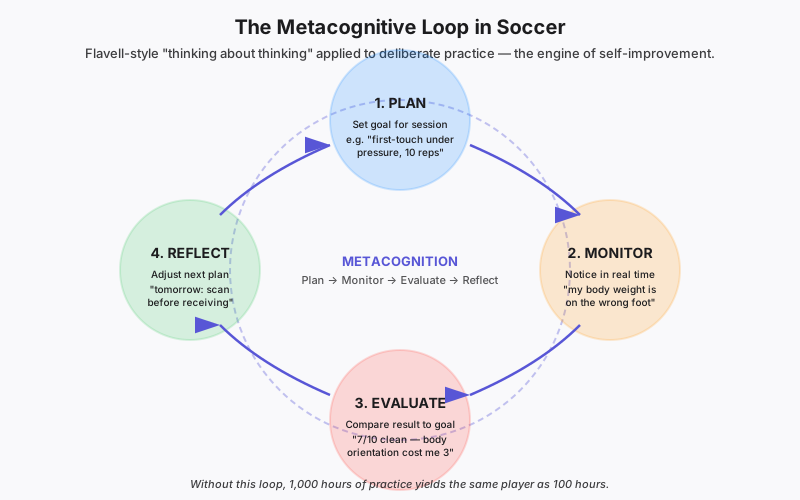
"Thinking soccer" is not a vague motivational concept — it is a trainable skill explained by the cognitive science of metacognition. And because it is a skill, it can be systematically improved through practice.
The Scientific Evidence Linking Metacognition to Sports Performance — Four Key Studies
MacIntyre et al. (2014) called metacognition 'curiously under-explored' in sports science. Toner & Moran (2014) demonstrated the value of conscious awareness in expert athletes. Brick et al. (2015) mapped the metacognitive self-regulation processes of elite endurance athletes. And in 2025, Esposito et al. reported the effectiveness of metacognitive strategy interventions in coaching.

Photo by Laurenz Kleinheider on Unsplash
MacIntyre et al. (2014) — Metacognition Is "Curiously Under-Explored" in Sport
MacIntyre, Igou, Campbell, Moran, & Matthews (2014) published "Metacognition and action: a new pathway to understanding social and cognitive aspects of expertise in sport" in Frontiers in Psychology. The central argument of the paper is that despite decades of metacognition research in educational psychology, the concept remains "curiously under-explored" in the context of sport.
MacIntyre and colleagues argued that metacognition is a critical factor in explaining individual differences in sports performance. In particular, they proposed that differences in metacognitive skill may largely account for why athletes with the same level of physical ability perform differently. This offers a scientific answer to the perennial question in soccer: "They all do the same training — so why do some players improve faster than others?"
Toner & Moran (2014) — Expert Athletes Benefit from Conscious Awareness
Toner & Moran (2014) published "In praise of conscious awareness: a new framework for the investigation of 'continuous improvement' in expert athletes" in Frontiers in Psychology. Traditional sports psychology held that expert-level movements are performed unconsciously, but Toner & Moran challenged this view.
Their argument is straightforward: expert athletes actually benefit from conscious awareness of their own movements. Even skills that have been automated can be continuously improved through metacognitive monitoring. This directly contradicts the misconception that once a player is 'finished,' reflection becomes unnecessary. Science shows the opposite — ongoing metacognitive awareness is what enables continuous improvement at the highest level.
Brick, MacIntyre & Campbell (2015) — Metacognitive Self-Regulation in Elite Athletes
Brick, MacIntyre, & Campbell (2015) published "Metacognitive processes in the self-regulation of performance in elite endurance runners" in Psychology of Sport and Exercise. This qualitative study examined international-level Irish endurance runners to map in detail the metacognitive processes they employ during competition.
The findings revealed that elite athletes use a combination of the following metacognitive strategies:
- Planning — Preparing multiple strategic scenarios before competition based on anticipated conditions
- Monitoring — Continuously checking their physical state, pace, and mental condition during competition
- Evaluation — Making real-time judgments such as "Is my current strategy working?"
- Regulation — Consciously adjusting focus of attention or pace based on ongoing evaluation
This process maps directly onto soccer. Tactical planning before a match (Planning) → Checking your own positioning and passing accuracy during the match (Monitoring) → Asking "Is my defensive approach working?" (Evaluation) → Adjusting your position or style of play (Regulation). The ability to run this four-stage cycle at high speed is the essence of what people call "soccer IQ."
Esposito et al. (2025) — Metacognitive Strategies Are Effective in Coaching Too
Esposito, Ceruso, Cavalera, Cozzolino, & D'Elia (2025) published "Metacognitive strategies improve self-regulation skills in expert sports coaches" in Scientific Reports. The study tested the effects of a metacognitive strategy training program with 71 expert sports coaches.
The results showed that coaches who received metacognitive strategy training demonstrated significantly improved self-regulation skills compared to the control group. This study carries two major implications. First, it provides direct evidence that metacognition can be improved through training. Second, it suggests that when coaches develop stronger metacognitive abilities, the quality of their instruction to players may also improve.
Why Soccer Journals Train Metacognition — Three Mechanisms
The act of writing in a soccer journal engages all three metacognitive processes: monitoring, evaluation, and regulation. Here we explain the structural reasons why writing automatically becomes metacognition training.
Mechanism 1: Forced Activation of Self-Monitoring
The moment you sit down to write "what happened in today's match," your brain automatically begins reviewing your own actions during the game. This is the metacognitive process of monitoring in action. The self-monitoring ability that Brick et al. (2015) identified in elite athletes can be developed through the habit of regular journaling.
The crucial point is that writing raises the resolution of your monitoring. Instead of a vague feeling of "today was bad," you arrive at specific observations like "In the 15th minute of the first half, I panicked under the press during build-up play and chose a long ball that was intercepted." This increase in resolution directly improves your decision-making accuracy in the next match.
Mechanism 2: Structuring Causal Attribution
Writing about "why that play happened" engages the metacognitive process of evaluation. Research by Cleary & Zimmerman (2001) showed that expert athletes, compared to non-experts, tend to attribute outcomes to specific technical factors rather than vague causes.
Attributing a mistake to "lack of talent" blocks growth. Attributing it to "my body was facing straight ahead on my first touch instead of being open" leads to a concrete action for improvement. Writing in a journal transforms the attribution process from intuitive and vague into structured and specific.
Mechanism 3: Pre-Programming Future Actions
Writing "next match, I will do this" is advance preparation for the metacognitive process of regulation. The elite runners in Brick et al. (2015) prepared multiple scenarios before their races. Writing in a soccer journal something like "If the opponent presses high next match, I'll play it back to the keeper instead of forcing the build-up" is exactly this kind of strategic preparation.
Simply by writing in a soccer journal, all three elements of metacognition — monitoring, evaluation, and regulation — are naturally exercised. This is the scientific mechanism behind the common observation that players who keep journals tend to improve faster.
A Lineage of 'Thinking Players' — The Metacognition Shared by Pirlo, Xavi, and Iniesta
The legendary 'cerebral' players in soccer history all display hallmarks of exceptional metacognitive ability. Seeing themselves and their surroundings from above during a match and adjusting their play to the situation — this is metacognitive regulation in its purest form.
Andrea Pirlo — "Controlling the Tempo of a Match Inside His Mind"
In his autobiography 'Penso quindi gioco' (I Think Therefore I Play), Pirlo described his in-match thought processes in remarkable detail. The title itself is a play on Descartes' 'I think, therefore I am,' revealing that Pirlo understood his own playing style as fundamentally an act of thinking. Pirlo's greatest strength was his ability to consciously control the tempo of a match — an outstanding form of metacognitive regulation. He constantly monitored whether the pace should be faster or slower, then manipulated the rhythm of the entire game through the speed and timing of his passes.
Xavi Hernández — "Reading the Match Four Seconds Ahead"
Xavi repeatedly stated in interviews that he would scan his surroundings three times before receiving the ball. This is a textbook example of deliberate information gathering — metacognitive monitoring. Furthermore, Xavi explained: "I'm not deciding what the best play is. I'm gathering the information I need to decide what the best play is." This layered structure — consciously controlling the process of gathering information for decision-making — is metacognition in its essence. Xavi's celebrated ability to 'read the game' was a sophisticated integration of metacognitive knowledge (pattern recognition of situations) and metacognitive regulation (automated information-gathering routines).
Andrés Iniesta — "Structured Thinking Behind Seemingly Intuitive Play"
Iniesta's play appears 'intuitive' at first glance, but as Toner & Moran (2014) argued, expert 'intuition' is not unconscious automation — it is the product of highly metacognitive processes. Iniesta himself described in his autobiography how he simultaneously processed the opponent's center of gravity, his teammates' movement patterns, and shifts in available space while instantaneously evaluating which play would be most effective. This is the monitoring → evaluation → regulation cycle identified by Brick et al. (2015), accelerated to its absolute limit.
What all these players share is the fact that they reached the very top not through physical ability, but through metacognitive ability. None of them — Pirlo, Xavi, or Iniesta — were exceptional in terms of speed or physicality. What set them apart was their ability to consciously control their own thinking processes — an extraordinary level of metacognition.
Five Journal Exercises to Build Metacognition
Metacognition is a trainable skill (Esposito et al., 2025). Here are five practical metacognition training exercises you can do with a soccer journal.
Exercise 1: The "Decision Fork" Log
After a match, write down three 'decision forks' — moments where you chose option A over option B. For each one, record: (1) why you made that decision, (2) what alternative options existed, and (3) what the outcome was. This exercise trains metacognitive monitoring and evaluation simultaneously.
Exercise 2: The "Emotion Log"
Record the emotional shifts you experienced during the match in chronological order. For example: '10 min — fully focused,' '30 min — frustrated after conceding,' '60 min — tired and losing concentration.' This is a practice in monitoring your own internal state. As MacIntyre et al. (2014) noted, awareness of your emotional state is a crucial dimension of metacognition. By making the link between emotions and decisions visible, you can discover patterns such as 'I tend to attempt risky passes when I'm frustrated.'
Exercise 3: The "Outside Observer" Perspective
Describe your own play in the third person. For example: 'He panicked under the press in the 65th minute and chose the safe back-pass. If he had taken two seconds to scan the field, he would have spotted the overlapping run on the right side.' By depicting yourself as an external observer, you practice what Toner & Moran (2014) call conscious awareness — an effective technique for developing a metacognitive perspective.
Exercise 4: The "Pre-Match Scenario" Prep
Before a match, write three 'if-then' scenarios. This is the soccer adaptation of the strategic pre-planning that Brick et al. (2015) found in elite runners. For example: 'If the opponent plays a high line → look for long balls in behind,' 'If their press is fast → use the goalkeeper in build-up,' 'If I make a mistake and get down on myself → take 30 seconds of deep breathing, then refocus on the next play.' After the match, review whether these scenarios actually played out and how well they worked. This feedback loop progressively sharpens your metacognitive regulation.
Exercise 5: The "Weekly Pattern Analysis"
At the end of each week, review all your journal entries and extract recurring patterns. Observations like 'I've lost concentration in the second half three matches in a row' or 'I always pass in the same direction when pressed' are invisible from a single entry. Toering et al. (2009) showed that the quality of reflection matters — and quality means not just isolated reviews, but recognizing long-term patterns. Building metacognitive knowledge requires this kind of meta-level reflection.
Frequently Asked Questions
At what age can children start training metacognition?▾
Developmental psychology research suggests that the foundations of metacognition begin to develop around ages 8 to 10. However, with structured tools like a soccer journal, children can start metacognition training in stages from around age 10. At first, writing just one thing — 'the play I remember most from today' — is enough. As they get older, they can progress to more advanced exercises such as decision fork logs and emotion tracking.
What is the difference between a player with high metacognition and one who 'overthinks and plays slowly'?▾
The decisive difference is when the thinking happens. Players with high metacognition think deeply before and after matches, preparing their in-game decisions in advance (Brick et al., 2015). Players who 'overthink' try to reason from scratch during the match itself. Pre-match scenario planning in a soccer journal is a form of 'pre-computing' that speeds up in-game decision-making. Metacognition does not slow down thinking during a match — it accelerates it through preparation.
Are metacognition and soccer IQ the same concept?▾
They are not exactly synonymous, but they overlap significantly. Soccer IQ is a broad term generally encompassing situational awareness, tactical understanding, and positioning. Metacognition is a more precise scientific concept focused specifically on the ability to be aware of and control your own decision-making processes. As MacIntyre et al. (2014) pointed out, metacognition can be understood as one of the key cognitive foundations that make up 'soccer IQ.'
Can metacognition really improve just from writing in a soccer journal?▾
Simply writing is not enough on its own, but practicing the structured exercises described in this article — decision fork logs, emotion tracking, scenario preparation, and so on — has been shown to improve metacognition. Esposito et al. (2025) demonstrated that metacognitive strategy training significantly improves self-regulation skills. The journal is a tool for metacognition training, and its effectiveness depends on how you use it. Rather than writing vague entries like 'today was good,' the key is to write in response to specific, targeted questions.
What kind of feedback from coaches or parents effectively promotes metacognition?▾
The most effective approach is to offer questions rather than answers. Prompts like 'Why did you choose that pass?', 'What other options did you have?', and 'What would you do next time in the same situation?' stimulate metacognitive thinking in players. Esposito et al. (2025) also showed that when coaches consciously employ metacognitive strategies, the effectiveness of their instruction improves. One important caveat: asking 'why?' immediately after a mistake can backfire. It is more effective to wait until emotions have settled and then create time for written reflection in a journal.
References
- [1] MacIntyre, T. E., Igou, E. R., Campbell, M. J., Moran, A. P., & Matthews, J. (2014). “Metacognition and action: a new pathway to understanding social and cognitive aspects of expertise in sport” Frontiers in Psychology, 5, 1155. Link
- [2] Brick, N., MacIntyre, T., & Campbell, M. (2015). “Metacognitive processes in the self-regulation of performance in elite endurance runners” Psychology of Sport and Exercise, 19, 1-9. Link
- [3] Toner, J., & Moran, A. (2014). “In praise of conscious awareness: a new framework for the investigation of 'continuous improvement' in expert athletes” Frontiers in Psychology, 5, 769. Link
- [4] Esposito, G., Ceruso, R., Cavalera, C. M., Cozzolino, M., & D'Elia, F. (2025). “Metacognitive strategies improve self-regulation skills in expert sports coaches” Scientific Reports, 15, 3222. Link
- [5] Toering, T., Elferink-Gemser, M. T., Jordet, G., & Visscher, C. (2009). “Self-regulation and performance level of elite and non-elite youth soccer players” Journal of Sports Sciences, 27(14), 1509-1517.
- [6] Cleary, T. J., & Zimmerman, B. J. (2001). “Self-regulation differences during athletic practice by experts, non-experts, and novices” Journal of Applied Sport Psychology, 13(2), 185-206.
Related Articles
The Science Behind How Verbalization Improves Soccer — How 'Writing' and 'Thinking' Connect in the Brain
6 min read
The Complete Guide to Soccer Journals — How Pros Build the Habit of Reflection
7 min read
How Pro Soccer Players Use Journals — Reflection Techniques from World-Class Examples
8 min read
Growth Mindset and the Soccer Journal — How to Raise Players Who Believe in Effort Over Talent
9 min read
Mental Training and the Soccer Notebook Habit — The Science of Writing Your Way to a Stronger Mind
9 min read
Track Your Growth with Footnote
Just record your matches — AI analyzes every 5 games. Visualize growth with PVS Score. All features free during beta.
30-second signup · No credit card required
Last updated: 2026-05-05 ・ Footnote Editorial