The Science Behind How Verbalization Improves Soccer — How 'Writing' and 'Thinking' Connect in the Brain
Why does putting your play into words accelerate soccer development? This is not folk wisdom — it is a mechanism demonstrated in peer-reviewed journals including Brain Sciences (2019) and Perspectives on Psychological Science (2011, 2018). Verbalization activates brain regions that overlap with motor execution areas, accelerating skill acquisition. This article unpacks the scientific evidence from four studies showing how the act of writing in a soccer journal directly improves performance.
How Verbalization Improves Motor Skills
In a study published in Brain Sciences, Kawasaki et al. (2019) found that participants who verbally described their own body movements showed significantly greater improvement in motor skill acquisition than a control group. Verbalization overlaps with brain activity associated with motor execution and motor imagery.

Photo by Vitaly Gariev on Unsplash
Kawasaki, Kono, & Tozawa (2019) divided 36 participants into a 'description group' (who verbalized their own ball-spinning movements) and a 'control group' (who read magazines aloud), then compared motor skill acquisition. The description group showed significant improvement in movement smoothness (successful rotations) and a reduction in motor errors (ball drops).
Key finding: Verbalization of movement activates brain regions that overlap with motor execution and motor imagery. In other words, 'writing' about a movement is connected to 'performing' it at the neural level.
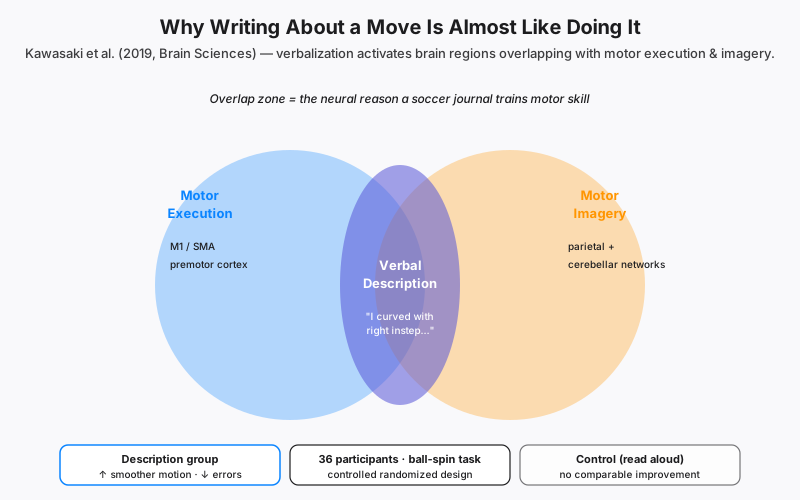
When you write in your soccer journal, 'I struck slightly right of center with my right instep and applied curve,' you are not merely recording what happened. You are reactivating the motor program for that kick in your brain, sharpening execution accuracy for next time. This is the neuroscientific mechanism behind the idea that 'just writing makes you better.'
The Science of Self-Talk — What a Meta-Analysis of Over 11,000 Athletes Reveals
Hatzigeorgiadis et al.'s (2011) meta-analysis demonstrated that self-talk interventions have a significant positive effect on sports performance. 'Instructional self-talk' proved especially effective in precision-based sports.

Photo by Thought Catalog on Unsplash
Hatzigeorgiadis, Zourbanos, Galanis, & Theodorakis (2011) published a meta-analysis on the relationship between self-talk and sports performance in Perspectives on Psychological Science. By integrating findings from multiple studies, they confirmed that self-talk interventions produce a significant positive effect on athletic performance.
Self-talk works through four mechanisms:
- Attentional focus — Instructions like 'watch the ball' or 'check your body angle' direct attention to the right target
- Confidence building — Motivational self-talk such as 'I can do this' or 'just like in training'
- Effort regulation — Phrases like 'push through here' or 'stay focused for 10 more minutes' that sustain effort
- Emotional control — Self-talk such as 'stay calm' or 'focus on the next play' that manages emotions
Writing in your soccer journal is the process of structuring this self-talk in advance. If you write 'today I will keep a half-turned stance in 1v1 situations' before a match, that instructional self-talk is more likely to surface automatically during play. Writing is, in effect, designing your future self-talk.
Expressive Writing — The Psychological Benefits of 'Writing' Backed by Over 100 Studies
Pennebaker's (2018) research program, spanning more than 30 years, has demonstrated across over 100 studies that writing about emotional experiences improves psychological health and reduces ruminative thinking.
Professor James Pennebaker has studied the effects of 'expressive writing' since 1986. In his 2018 review published in Perspectives on Psychological Science, he reported that structured emotional writing produces an overall health effect size of d = .16 (Cohen's d), based on over 100 studies.
Gabana et al. (2020) applied these findings to the sports context. Published in Frontiers in Psychology, their study adapted Pennebaker's writing protocol for athletes and found the following effects:
- Reduced avoidance behavior toward stressors (greater willingness to confront problems)
- Increased problem-solving behavior
- Improved reflection strategies for competition and training
- A mediating effect between mood awareness and athletic performance
Writing honestly about post-match frustration, anxiety, and failure in your soccer journal is not a sign of mental weakness. It is a scientifically validated mental health practice backed by over 100 studies. When Shunsuke Nakamura candidly recorded his weaknesses and anxieties in his notebook, he was — perhaps unknowingly — tapping into the very mechanism of expressive writing.
The Role of Reflection in Self-Regulated Learning
Reflection is the final phase of the three-phase self-regulated learning (SRL) cycle — and also the starting point of the next cycle. The speed and quality of this 'reflect → plan → perform → reflect' loop determines the rate of development.
Zimmerman's (2006) model of self-regulated learning describes the learning process in three phases:
- Forethought — Goal setting, strategy planning, and self-efficacy assessment
- Performance — Actual play, self-monitoring, and attention control
- Self-Reflection — Evaluating outcomes, attributing causes, and processing emotional reactions
A soccer journal is primarily used in Phase 3 (self-reflection), but it also serves Phase 1 (forethought). Writing 'next match I will shoot from a half-turned stance' is a forethought-phase plan; writing 'did I actually manage to shoot half-turned?' after the match is a self-reflection-phase evaluation.
The reason Toering et al. (2009) found that players with higher reflection scores were 4.9 times more likely to belong to elite clubs lies in the 'rotation speed' of this self-regulated learning cycle. Even if two players repeat the same drill 100 times, the one who verbalizes what they learned after each repetition will reach an entirely different level from the one who simply repeats without reflection.
It is not a difference in talent, but a difference in the quality and frequency of reflection — this is the most important message from Toering et al.'s research. A soccer journal is the tool that structurally guarantees both the quality and frequency of that reflection.
Three Science-Backed Principles for Effective Reflection
Synthesizing the research covered so far, three scientific principles emerge for maximizing the effectiveness of reflection in your soccer journal.
Principle 1: Verbalize specific movements
Based on Kawasaki et al.'s research, describe concrete physical actions rather than vague assessments like 'it went well' or 'it went badly.' A level of specificity such as 'I struck the underside of the ball with my right instep in a scooping motion' is what reactivates the brain's motor regions.
Principle 2: Write your emotions honestly
Based on Pennebaker and Gabana's research, do not hide frustration, anxiety, or anger — write it down. Verbalizing emotions reduces avoidance behavior and promotes problem-solving. 'I made a mistake but I don't care' is far less effective than 'I'm frustrated by that mistake. The cause was a poor first touch because I rushed' — science confirms this.
Principle 3: Write one action for next time
Based on Zimmerman's self-regulated learning cycle, connect your reflection to the next forethought phase. Writing one specific thing to focus on in the next match keeps the reflection cycle turning without interruption. Writing multiple goals dilutes attention, so narrowing it to one is most effective.
Frequently Asked Questions
Can a soccer journal help even if I struggle to put things into words?▾
Yes. Kawasaki et al.'s research showed that the effect comes from the act of verbalizing movement itself, not from eloquence. You don't need to write polished sentences — even bullet points or individual words still activate the brain's motor regions as long as they describe the movement.
What is the connection between self-talk and a soccer journal?▾
A soccer journal is essentially a blueprint for future self-talk. If you write 'today I will keep a half-turned stance in 1v1 situations' before a match, that instruction is more likely to come to mind during play. Hatzigeorgiadis et al.'s meta-analysis confirmed that pre-planned self-talk is effective for improving performance.
Is it okay to write about negative emotions?▾
It is not just okay — it is recommended. Pennebaker's (2018) analysis, based on over 100 studies, showed that writing about negative emotional experiences improves psychological health and reduces rumination. Writing 'I failed' or 'I'm frustrated' is not weakness; it is a scientifically supported form of mental health care.
Does AI feedback have the same effect as a human coach's comments?▾
Not exactly the same, but it offers complementary value. AI excels at detecting patterns across multiple matches, an area where it can surpass human analysis. On the other hand, human coaches are superior in empathy and motivation. Ideally, both should be used together.
References
- [1] Kawasaki, T., Kono, S., & Tozawa, R. (2019). “Efficacy of Verbally Describing One's Own Body Movement in Motor Skill Acquisition” Brain Sciences, 9(12), 356. Link
- [2] Hatzigeorgiadis, A., Zourbanos, N., Galanis, E., & Theodorakis, Y. (2011). “Self-Talk and Sports Performance: A Meta-Analysis” Perspectives on Psychological Science, 6(4), 348-356. Link
- [3] Pennebaker, J. W. (2018). “Expressive Writing in Psychological Science” Perspectives on Psychological Science, 13(2), 226-229. Link
- [4] Gabana, N. T., Van Raalte, J. L., Hutchinson, J. C., Brewer, B. W., & Petitpas, A. J. (2020). “Written Emotional Disclosure Can Promote Athletes' Mental Health and Performance Readiness” Frontiers in Psychology, 11, 599925.
- [5] Zimmerman, B. J. (2006). “Development and Adaptation of Expertise: The Role of Self-Regulatory Processes and Beliefs” The Cambridge Handbook of Expertise and Expert Performance.
- [6] Toering, T., Elferink-Gemser, M. T., Jordet, G., & Visscher, C. (2009). “Self-regulation and performance level of elite and non-elite youth soccer players” Journal of Sports Sciences, 27(14), 1509-1517.
Related Articles
Metacognition Training — The Science Behind 'Thinking Soccer' and How to Develop It Through Journaling
12 min read
The Complete Guide to Soccer Journals — How Pros Build the Habit of Reflection
7 min read
How Pro Soccer Players Use Journals — Reflection Techniques from World-Class Examples
8 min read
Growth Mindset and the Soccer Journal — How to Raise Players Who Believe in Effort Over Talent
9 min read
Mental Training and the Soccer Notebook Habit — The Science of Writing Your Way to a Stronger Mind
9 min read
Track Your Growth with Footnote
Just record your matches — AI analyzes every 5 games. Visualize growth with PVS Score. All features free during beta.
30-second signup · No credit card required
Last updated: 2026-05-05 ・ Footnote Editorial