Growth Mindset and the Soccer Journal — How to Raise Players Who Believe in Effort Over Talent
The well-meaning compliment "that kid has real talent" may actually be stunting growth. In a study by Stanford professor Carol Dweck (2009), children who were praised for effort subsequently improved their performance by **30%**, while those praised for intelligence saw a **20% decline**. This theory of Growth Mindset is most powerful when applied to youth soccer. This article integrates Dweck's motivation theory, Vella et al.'s (2016) sport-specific research, and Toering et al.'s (2009) elite player study to explain the mechanisms by which soccer journaling structurally reinforces a growth mindset.
What Is Growth Mindset? — Applying Dweck's Theory to Soccer
Growth mindset, proposed by Professor Carol Dweck, is the belief that abilities can be developed through effort and learning. Its opposite, fixed mindset, holds that talent is innate and unchangeable. This difference in belief fundamentally determines the rate at which a soccer player improves.

Photo by Sushobhan Badhai on Unsplash
Dweck & Leggett (1988) proposed a social-cognitive model in Psychological Review that explains human motivation and behavioral patterns through "implicit theories of intelligence." Under this framework, people's views of ability fall into two categories.
- Entity Theory (Fixed Mindset) — The belief that intelligence and ability are fixed and unchangeable. Failure is interpreted as "proof that I lack talent."
- Incremental Theory (Growth Mindset) — The belief that intelligence and ability grow through effort and learning. Failure is interpreted as "I just haven't found the right approach yet."
This theory matters enormously in soccer because youth players experience "successes" and "failures" at an overwhelming frequency. The moment a player makes a mistake in a match, do they think "I have no talent" or "I'll do it differently next time"? This fork in the road dramatically changes their growth trajectory over the following months.
The core of Dweck's theory: Mindset is not innate — it can be shaped by environment and intervention. This means that coaches, parents, and even the way a soccer journal is used can shift a player's beliefs toward a growth orientation.
Fixed vs. Growth — How Mindset Differences Show Up on the Pitch
Players with a fixed mindset avoid failure and repeat only the plays they are already good at. Players with a growth mindset seek challenges and learn from failure, leading to significantly greater long-term development.

Photo by Peter Zhan on Unsplash
Dweck & Leggett's (1988) social-cognitive model shows that differences in ability beliefs influence behavioral patterns through goal orientation. People with a fixed mindset tend to adopt "performance goals," while those with a growth mindset tend to adopt "learning goals." Mapping these differences onto soccer scenarios reveals a stark contrast.
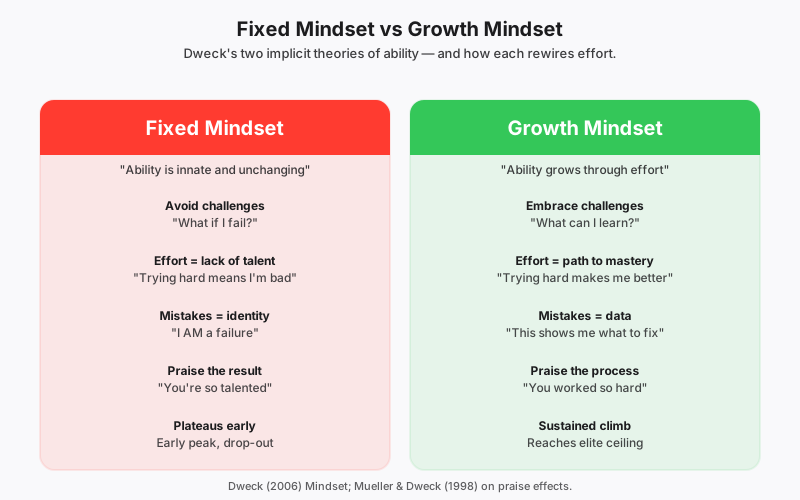
Typical Patterns of a Fixed-Mindset Player
- Plays exclusively with their dominant foot, avoiding situations that require the weaker foot
- After a mistake, pretends to "move on" but actually avoids the same challenge going forward
- Dislikes matchups against stronger opponents (fears being exposed as less skilled)
- Interprets coaching feedback as criticism, leading to a drop in motivation
- Writes in their soccer journal: "I was in bad form today" — and stops there, avoiding any root-cause analysis
Typical Patterns of a Growth-Mindset Player
- Actively attempts weaker skills ("I'm not good at it yet, but I'll get better with practice")
- Reviews mistakes and asks: "How can I improve next time?"
- Welcomes matchups against stronger opponents (sees them as a chance to identify areas for growth)
- Records coaching feedback as specific improvement points
- Writes in their soccer journal: "The mistake was caused by the angle of my first touch. I'll focus on this in tomorrow's practice"
Vella et al. (2016), in a review published under APA Division 47, reported that athletes with a high-growth/low-fixed mindset profile competed at higher levels. Crucially, the question is not whether growth mindset causes improvement or improvement causes growth mindset, but rather that the two form a virtuous cycle.
Effort Praise: +30%. Talent Praise: -20%. — The Science of How We Praise
In a study reported by Dweck (2009) in Olympic Coach Magazine, children praised for effort improved performance by 30%, while those praised for intelligence (talent) declined by 20%. A single difference in how praise was delivered created a 50-point gap.
Dweck's (2009) report in Olympic Coach Magazine (Vol. 21) offers one of the most actionable insights for sports coaches. In the experiment, children took a test and were then divided into two groups receiving different feedback.
- Effort-praise group: "You worked really hard. You got this result because you put in the effort."
- Intelligence-praise group: "That's impressive. You must be really smart."
They were then offered the chance to take a harder test. The results were dramatic.
The effort-praised group embraced the harder test and improved by 30%. The intelligence-praised group avoided the harder test and declined by 20%.
Why does this happen? Children praised for intelligence try to protect the label "I'm smart." If they attempt a difficult task and fail, the label is threatened. So they avoid the challenge entirely. Meanwhile, children praised for effort learn that "the act of trying has value in itself." A difficult task becomes "an opportunity to try even harder."
Translated to the soccer pitch: When a player dribbles past two defenders, do you say "You have natural talent!" or "The work you put in at practice is paying off! Great job being aware of your body positioning"? That one sentence changes what the player does in the next match.
Practical rule: Praise the process, not the result. Instead of "You're talented," say "You executed the move we practiced." Instead of "You have a gift," say "I love that you kept challenging yourself after failing three times."
Four Mechanisms by Which Soccer Journaling Reinforces Growth Mindset
The soccer journal is the most effective tool for cultivating growth mindset — often without the player even realizing it. The act of writing itself structures the process of converting failure into learning. This also explains why players with high reflection scores in Toering et al. (2009) were 4.9 times more likely to belong to top-tier clubs.
Mechanism 1: Converting Failure into Data
For a fixed-mindset player, failure is "evidence of my limitations." But the moment they write in their journal, "I attempted 1v1 dribbles 3 times today and succeeded once. Both failures happened when I attacked the opponent's left side," failure transforms from an emotional blow into analyzable data. This naturally guides the player toward the "learning goal orientation" described by Dweck & Leggett (1988).
Mechanism 2: Making the Growth Trajectory Visible
The biggest trap of a fixed mindset is the illusion that "I haven't changed." Flipping back to a journal entry from three months ago and realizing "I couldn't trap the ball at all back then, but now I can" is nothing less than self-generated proof that ability changes with effort. This is far more powerful than any lecture — it is a belief rewrite rooted in lived experience.
Mechanism 3: Habituating Attention to Process
When the journal format includes a recurring prompt like "What went well today and what needs improvement," the player naturally shifts focus from results to process. The emphasis moves from "We lost the match" to "What did I do on the pitch?" In effect, the player is performing Dweck's (2009) recommended "process praise" on themselves.
Mechanism 4: Putting the Power of "Not Yet" into Words
Dweck emphasizes the concept of "yet" — not "I can't" but "I can't yet." The soccer journal naturally encourages this shift. Writing "My crosses with my weaker foot still lack accuracy. Next week I'll practice 20 per session" is an act of articulating the "not yet" mindset and connecting it to an improvement plan. At the root of Toering et al.'s (2009) finding that reflection quality created a 4.9x difference in elite attainment lies precisely this ability to convert "not yet" into "next action."
A Practical Guide for Coaches and Parents — Five Habits to Cultivate Growth Mindset
Growth mindset is not something you teach in a lecture — it is something you cultivate through daily interactions. Here are five concrete practices that combine Dweck's research with soccer journal usage.
Habit 1: Commit to "Process Praise"
In post-match and post-training feedback, eliminate phrases like "You're talented" and "You have natural ability." Replace them with process-focused praise: "That play showed the body positioning you worked on in last week's practice" or "I love that you kept trying a fourth time after failing three times." As Dweck's (2009) 30% vs. -20% data shows, this shift in praise alone can dramatically change a player's willingness to take on challenges.
Habit 2: Add a "What I Learned" Section to the Journal
Add a "What I learned today" prompt to the journal format. This single field shifts the player's focus from outcome ("We won/lost") to learning ("What did I gain?"). Because it can always be filled in — even after a bad day — it reinforces the growth mindset belief that failure equals learning opportunity, every single day.
Habit 3: Learning from Keisuke Honda's Dream Journal — Write "I Will," Not "I Want To"
Keisuke Honda famously wrote in his elementary school graduation essay, "I will become the best soccer player in the world" — not "I want to become," but "I will become." This was not mere bravado; it embodied the essence of growth mindset. "I want to" is a passive wish, while "I will" is an active declaration that naturally triggers planning for what needs to be done. Encouraging players to write goals in their soccer journal using "I will" instead of "I want to" serves as linguistic training for a growth-oriented mindset.
Habit 4: Conduct Regular "Before and After" Reviews
Set aside time once a month to reread journal entries from one month earlier. The concrete evidence that something the player "couldn't do" before is now something they can do is the most powerful proof that ability changes with effort. This is more effective than external praise because the player discovers the evidence themselves.
Habit 5: Explore Causal Attributions Together
The most practical element of Dweck & Leggett's (1988) theory is "attribution." Guide the player away from attributing failure to "I don't have talent" (fixed, internal attribution) and toward "I need to change my practice method" (growth, external attribution). When a player writes "Why it didn't work" in their journal, a coach or parent can follow up with "So what do you think you should practice differently?" — gently steering the attribution toward a growth orientation.
Frequently Asked Questions
At what age can you start developing a growth mindset?▾
Dweck's research has confirmed that even preschool-age children change their challenge-seeking behavior based on how they are praised. The moment a child starts playing soccer is the ideal time to begin. That said, there is no need to teach young children the concept of "growth mindset" explicitly. Simply practicing a daily approach of "It's okay to fail — let's think about what to do next" is enough.
Is praising talent completely off-limits?▾
What Dweck's (2009) research warns against is praising talent alone. You can mention talent as long as you pair it with specific process feedback — for example, "Great instincts, and on top of that, you really applied what you worked on in practice today." The key is to always keep the proportion of effort, strategy, and process praise high.
Can simply writing in a soccer journal change a player's mindset?▾
The act of journaling itself structures the reflective process, so it does have an effect. However, for maximum impact, it is best combined with guidance on how to write (focusing on process, always including a "What I learned" entry) and process praise from coaches and parents. Toering et al.'s (2009) research also showed that it is the quality of reflection, not just its presence, that influences elite attainment.
Can a player who already has a fixed mindset be changed?▾
Yes. A core tenet of Dweck's theory is that mindset itself is malleable. However, it does not change from a single talk. It requires months of consistent effort: shifting how praise is given, building a journaling habit focused on reflection, and making growth visible over time. Vella et al.'s (2016) review also demonstrated the effectiveness of mindset interventions in sport settings.
At what age is goal-setting like Keisuke Honda's dream journal effective?▾
Writing clear long-term goals in sentence form generally becomes effective around the upper elementary school years (roughly age 10). For younger children, short-term and concrete goals — such as "What will I focus on in the next match?" — are more appropriate. Regardless of age, the key is encouraging players to write goals as active declarations ("I will") rather than wishes ("I want to").
References
- [1] Dweck, C. S. (2009). “Developing Talent Through a Growth Mindset” Olympic Coach Magazine, 21(1), 4-7.
- [2] Dweck, C. S., & Leggett, E. L. (1988). “A Social-Cognitive Approach to Motivation and Personality” Psychological Review, 95(2), 256-273. Link
- [3] Vella, S. A., Braithewaite, R. E., Gardner, L. A., & Spray, C. M. (2016). “A Systematic Review and Meta-Analysis of Implicit Theory Research in Sport, Physical Activity, and Physical Education” International Review of Sport and Exercise Psychology, 9(1), 191-214. Link
- [4] Toering, T., Elferink-Gemser, M. T., Jordet, G., & Visscher, C. (2009). “Self-regulation and performance level of elite and non-elite youth soccer players” Journal of Sports Sciences, 27(14), 1509-1517. Link
Related Articles
Metacognition Training — The Science Behind 'Thinking Soccer' and How to Develop It Through Journaling
12 min read
The Science Behind How Verbalization Improves Soccer — How 'Writing' and 'Thinking' Connect in the Brain
6 min read
The Complete Soccer Journal Guide for Elementary-Age Players — Age-Appropriate Templates and Tips for Building the Habit
6 min read
Mental Training and the Soccer Notebook Habit — The Science of Writing Your Way to a Stronger Mind
9 min read
How to Develop Decision-Making in Soccer — What Cognitive Science Reveals About 'Smart Players'
14 min read
Track Your Growth with Footnote
Just record your matches — AI analyzes every 5 games. Visualize growth with PVS Score. All features free during beta.
30-second signup · No credit card required
Last updated: 2026-05-05 ・ Footnote Editorial