A Parent's Guide to the Soccer Journal — How to Support Your Child's Growth the Right Way
The single most important rule when parents get involved in the soccer journal is this: **do not write it for them.** Dweck's (2009) growth mindset research demonstrated that praising talent lowers a child's willingness to take on challenges, while praising effort increases persistence and motivation to learn. In this article, we draw on findings from sports science and developmental psychology to explain exactly how parents can use the soccer journal to support their child's autonomous growth.
Why You Should Never Write the Journal for Your Child
The real value of a soccer journal lies in the reflective thinking process. When a parent writes it, the most important benefit — metacognitive training — is lost entirely.

Photo by Vitaly Gariev on Unsplash
What Toering et al. (2009) found is that the value of a soccer journal resides not in the finished text but in the metacognition (thinking about one's own play) that occurs during the writing process. When a parent dictates content — "Why don't you write this?" — or fills in the journal themselves, this metacognitive process is bypassed entirely.
Bandura's (1977) social learning theory shows that self-efficacy is built from the experience of accomplishing something on your own. A journal shaped by a parent's hand, no matter how polished, does nothing to build the child's self-efficacy. Worse, it risks instilling a sense of helplessness — "I can't do this by myself."
Three lines your child wrote alone are worth more for their growth than thirty lines you helped them write. The soccer journal is not a homework assignment to be graded — it is training for the mind.
Common Mistakes Parents Make
- Writing it for them — Dictating what to write. If the words are not the child's own, there is no genuine reflection
- Correcting spelling and grammar — The soccer journal is not a language arts assignment. Even factual inaccuracies have value because they capture the child's authentic perception
- Forcing feelings — "Write more about what you did wrong" is a guaranteed way to make a child resent the journal
- Comparing with other children — "Your teammate writes so much more" is the most damaging feedback a parent can give
The Right Role for Parents — Be a Listener and a Cheerleader
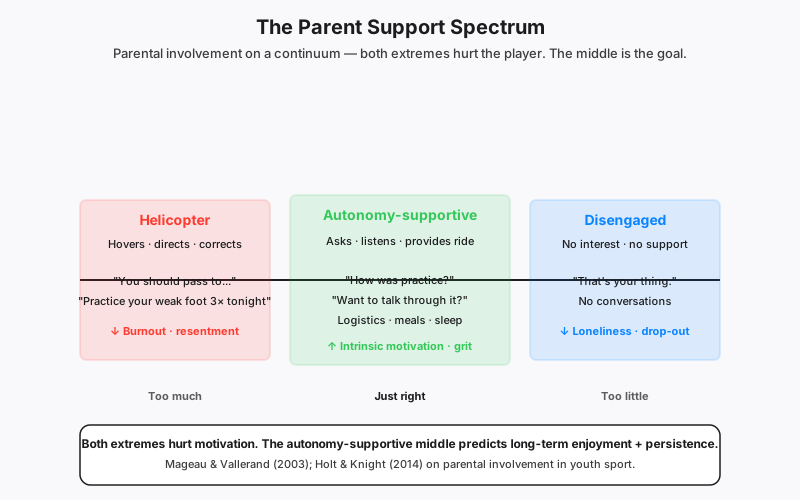
A parent's greatest contribution is not making the child write but simply listening. Become the kind of listener who draws out reflection naturally through conversation.

Photo by Vitaly Gariev on Unsplash
From a developmental psychology perspective, elementary-school-age children (roughly ages 6-12) are at a stage where reflection works better through dialogue than through silent internal thought. In other words, thinking out loud with someone produces higher-quality reflection than sitting alone in front of a notebook. This is precisely where a parent's role comes in.
Three Steps to Effective Listening
- Start with open-ended questions — Ask broadly: "How was today's match?" Avoid yes/no questions like "Did you win or lose?"
- Dig into specific moments — "What play stood out the most?" "What were you thinking in that situation?" Draw out the child's own words
- Mirror their words back — "I see, so the cross from the right side worked out well." Accept what they say without evaluating or correcting
After this conversation, all you need to add is: "Why not jot that down in your journal?" Thoughts that have already been organized through dialogue translate directly into high-quality journal entries.
Children are not looking for the right answer — they are looking for the feeling that someone listened. That feeling becomes the confidence that their own thoughts have value.
— Applied from Bandura's (1977) self-efficacy theory
The Science of Feedback — Praise Effort, Not Talent (Dweck's Growth Mindset)
"You're a natural" stalls growth. "You really worked hard" accelerates it. Here we apply the science of praise from Dweck (2009) to everyday soccer-journal situations.
Carol Dweck's (2009) body of research demonstrated that the way we praise children fundamentally alters their approach to learning. Children praised for intelligence or talent tend to avoid difficult challenges (fixed mindset), while children praised for effort and process actively seek out difficult challenges (growth mindset).
How to Praise Around the Soccer Journal: Don'ts vs. Do's
- Don't: "You have real soccer talent" — The moment the child feels their talent has been judged, they risk giving up when challenges arise
- Do: "It's impressive that you reflect in your journal after every match" — This values the sustained effort itself
- Don't: "That goal was genius" — Praising only results makes the child crumble on days when results don't come
- Do: "Choosing to use your left foot in that situation — great decision" — This acknowledges the process and thinking behind the play
- Don't: "Your writing has gotten really good" — Superficial praise signals that you are not engaging with the substance
- Do: "I can see you played with last week's goal in mind — there's a real connection between your journal and your play" — This values the link between reflection and action
The core of Dweck's research: praise the attitude, not the aptitude. Praise the process, not the product.
This principle is especially powerful in the context of soccer journaling. Writing in the journal is itself a product of effort and process, so simply acknowledging the act of writing directly reinforces a growth mindset. Focus your feedback not on goals scored or matches won, but on the thinking process recorded in the journal.
Five Mistakes Parents Commonly Make
Well-intentioned actions backfire more often than you might think. The following five are especially common and all undermine a child's autonomous growth.
- Editing the journal — Correcting grammar or rewriting content. The purpose of a soccer journal is metacognition, not writing skill. Even entries full of errors are valuable as long as the words are the child's own
- Forcing them to write about mistakes from the match — "Write about that missed pass" turns the journal into a punishment essay. Forcing negative reflection breeds resentment toward the journal and destroys the habit of reflection itself
- Requiring daily entries — Especially for elementary-school-age players (ages 6-12), making it a daily obligation leads to going through the motions. Writing only on match days is perfectly fine — consistency matters more than volume
- Using the journal to criticize teammates — Leading questions like "Don't you think the loss was because of so-and-so?" turn reflection into a breeding ground for blame. Keep the focus on the child's own play
- Sharing journal content with the coach or other parents without permission — Violating a child's privacy ensures they will never write honestly again. Always get the child's explicit consent before sharing
What all these mistakes have in common is that the parent is projecting their own expectations onto the child. The soccer journal is not a tool for the parent — it is a tool for the child. Toering et al. (2009) also noted that excessive external control can hinder the development of self-regulated learning skills.
Knowing When to Step Back — The Courage to Watch from a Distance
The hardest and most important thing for a child's growth is for the parent to step back. Knowing the right moment to reduce involvement is how you maximize your child's autonomy.
In Bandura's (1977) self-efficacy theory, autonomy is built through an accumulation of successful experiences completed independently. When parents provide constant support, this autonomy cannot develop.
A Roadmap for Gradually Stepping Back
- Introduction phase (first 1-2 months) — Build the journaling habit through conversation. For younger children (ages 6-8), it is fine for the parent to write down what the child says
- Transition phase (months 3-6) — Ask, "Want to try writing on your own today?" and let the child decide. After they write, you can say, "Can I take a look?" — but if they say no, respect that
- Autonomy phase (6 months onward) — Stop engaging with the content. "I see you wrote today" — acknowledging the continuation is enough. Only discuss the content when the child brings it up first
A good sign it's time to step back: your child opens the journal and starts writing on their own. At that point, your role is complete. Instead of asking "What did you write?" simply say "I see you wrote today." That's all they need.
Handling Situations Where Stepping Back Feels Difficult
- After a tough loss — Don't say "Maybe write about it in your journal." Instead, acknowledge the emotion: "That was really tough." Reflection can wait until the feelings settle
- When the entries seem half-hearted — Don't say "Put more effort into it." Just keep watching. Thin entries are a phase — what matters is that the habit continues
- When they haven't written in weeks — Don't scold. Start with a conversation: "How's soccer going lately?" The response you need differs depending on whether they have lost interest in the journal or in soccer itself
Frequently Asked Questions
My child only writes "it was fun" in their soccer journal. Should I push them to write more?▾
Writing "it was fun" is itself a valid reflection. From there, try drawing out more detail through conversation: "What was the most fun part?" Rather than forcing more words on the page, raise the resolution of their reflection naturally through dialogue.
I never played soccer myself. Is there any point in being involved if I can't give technical advice?▾
Absolutely. What's asked of a parent is not technical coaching — it's the role of listener and cheerleader. Simply asking "What were you thinking in that moment?" activates the child's metacognition. Technical feedback is the coach's job.
My two children are on the same team, and the younger one feels inferior because the older sibling's journal entries are more detailed.▾
Avoid comparing siblings. Journal quality naturally varies with age, developmental stage, and personality. The most effective approach is to compare each child with their own past entries: "You're writing more specifically than last time." Dweck's growth mindset research also shows that focusing on personal progress rather than comparison with others enhances motivation.
The coach has asked players to submit their soccer journals. I'm worried my child won't write honestly anymore.▾
One effective approach is to maintain two journals: a submission copy for the coach that focuses on facts and goals, and a private journal (or app) for honest feelings and concerns. This dual-journal approach is common even among professional players.
My child wants to switch from a paper journal to an app. Is paper better?▾
If your child is the one saying "I want to use an app," respect that autonomous decision. Mueller & Oppenheimer (2014) found that the quality of reflection matters more than the medium. In many cases, app features like reminders, XP rewards, and analytical reports actually support the habit more effectively than paper.
References
- [1] Dweck, C. S. (2009). “Mindsets: Developing talent through a growth mindset” Olympic Coach, 21(1), 4-7.
- [2] Toering, T., Elferink-Gemser, M. T., Jordet, G., & Visscher, C. (2009). “Self-regulation and performance level of elite and non-elite youth soccer players” Journal of Sports Sciences, 27(14), 1509-1517.
- [3] Bandura, A. (1977). “Social Learning Theory” Prentice Hall.
- [4] Mueller, P. A., & Oppenheimer, D. M. (2014). “The Pen Is Mightier Than the Keyboard: Advantages of Longhand Over Laptop Note Taking” Psychological Science, 25(6), 1159-1168.
Related Articles
The Complete Soccer Journal Guide for Elementary-Age Players — Age-Appropriate Templates and Tips for Building the Habit
6 min read
Why Coaches Should Have Players Keep Soccer Journals — and How to Implement Them
8 min read
The Complete Guide to Soccer Journals — How Pros Build the Habit of Reflection
7 min read
Growth Mindset and the Soccer Journal — How to Raise Players Who Believe in Effort Over Talent
9 min read
The Complete Parent Communication Guide for Youth Soccer — Words That Build Up and Words That Break Down, According to Psychology Research
18 min read
Track Your Growth with Footnote
Just record your matches — AI analyzes every 5 games. Visualize growth with PVS Score. All features free during beta.
30-second signup · No credit card required
Last updated: 2026-05-05 ・ Footnote Editorial