Why Coaches Should Have Players Keep Soccer Journals — and How to Implement Them
A soccer journal is not just a personal tool for players — it is one of the most cost-effective development methods available to coaches. Research by Toering et al. (2009) showed that players with high-quality reflection skills were 4.9 times more likely to be affiliated with elite clubs. Furthermore, Cropley et al. (2007) reported that teams where the coach cultivates a culture of reflection see greater promotion of self-regulated learning among players. This article explains the process for introducing journals to a team, the rotation feedback method, and specific question-based coaching techniques for drawing out players' metacognition.
The Scientific Case for Coaches Introducing Journals
The benefits of soccer journals are not just anecdotal. Multiple sports science studies have demonstrated that structured reflection improves player performance and autonomy.

Photo by Tim Mossholder on Unsplash
Toering et al. (2009) measured six components of Self-Regulated Learning among Dutch youth soccer players. The results showed that players who scored high on reflection were 4.9 times more likely to belong to elite clubs. Crucially, there was no significant difference in training volume — the differentiating factor was not 'how much they practiced' but 'how well they reflected.'
Cropley, Miles, & Peel (2007) investigated reflective practice among coaches in England. Their findings revealed that teams where the coach engaged in systematic reflection were more likely to see reflective habits spread to the players. In other words, when coaches build a culture of reflection, it directly leads to players adopting journaling habits.
A more recent study by Esposito et al. (2025) reported that when youth soccer coaches employed metacognitive instructional strategies, players showed improved decision-making quality and game understanding. The soccer journal is the most practical tool for integrating metacognitive coaching into daily practice.
A coach's job extends beyond designing good training sessions. Nurturing players' ability to reflect on their own, learn independently, and grow on their own terms is the core of long-term development.
A Step-by-Step Process for Introducing Soccer Journals to Your Team
The most common mistake is abruptly telling players to 'start writing a journal tomorrow.' Following a phased approach significantly increases the adoption rate.

Photo by Yuval Zukerman on Unsplash
Four Steps to Introduction
- Share the purpose (Week 1) — The top priority is helping players understand 'why they are writing.' Explain from two angles: concrete examples like 'Professional player X keeps a journal' and 'there is scientific evidence that writing improves performance'
- Provide a template (Week 2) — Players won't know what to write on a blank page. Start by distributing a simple three-item template to everyone: one thing that went well, one area for improvement, and one goal for next time
- Read every player's journal during the first two weeks — In the early stages, the feeling that 'the coach is actually reading this' is the decisive factor in adoption. Even a single-line comment for each player is enough
- Transition to rotation feedback from Week 3 — Commenting on every player's journal every week is unsustainable. Switch to a rotation system at this point (detailed in the next section)
Important Considerations at Launch
- Don't make submission mandatory — Take the stance that 'the journal is for yourself; only share it if you want to.' This respects player autonomy
- Don't reprimand players who don't write — Scolding turns the journal into a punishment. Instead, specifically praise players who do write, which indirectly motivates those who don't
- Keep a journal yourself as a coach — As Cropley's research demonstrates, if the coach isn't practicing reflection, the message lacks credibility. Even brief entries in your own coaching diary make a difference
In teams where the coach does not practice reflection, asking players to reflect will not take root. Culture is built from the top down.
— Based on findings from Cropley, Miles, & Peel (2007)
The Rotation Feedback System — Covering Every Player with 2-3 Reviews per Week
It is impossible to comment on every journal for a 20-player squad each week. By rotating through 2-3 players per week, you minimize the coach's workload while maintaining the feeling that 'someone is reading my journal' for everyone.
McNeill, Sproule, & Horton (2019) proposed a Post-Event Reflection (PER) tool that provides coaches with a framework for structured post-match reflection. The rotation feedback system adapts this approach to player journal feedback.
How It Works
- Divide the team into 5-6 groups — Each group of 3-4 players. Mixing positions and ability levels is recommended
- Provide detailed comments on one group's journals each week — Two to three lines of question-based comments per player is sufficient. Total time required is approximately 15-20 minutes
- Center your comments around questions — For example: 'Were there other options in that situation?' or 'What will you focus on in tomorrow's training to achieve this goal?' The aim is to stimulate metacognition, not to provide answers
- After 5-6 weeks, start the second cycle — Check how players have responded to previous comments and provide specific feedback on their growth
What to Do on Non-Rotation Weeks
- Give a brief acknowledgment to players who submitted — Even a simple 'Read it' goes a long way
- Share anonymous excerpts in team meetings — With the player's permission, share outstanding reflections with the entire team. Good examples are contagious
- Communicate with parents — Letting parents know 'this week the team is writing about X topic' can spark meaningful conversations at home
The most important aspect of coach feedback is not frequency but presence. The feeling that 'someone is reading my journal' is what decisively improves both the quality and continuation rate of player reflections.
Guide with Questions, Not Instructions — Coaching for Metacognition
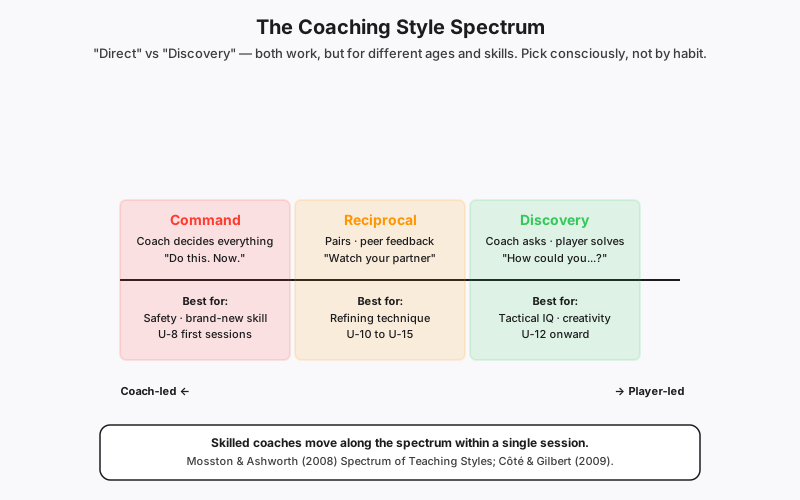
Telling a player to 'use the right side more' may be effective short-term, but it does not develop autonomous decision-making. Asking 'Why do you think play was concentrated on the left side?' is what produces long-term growth.
Research by Esposito et al. (2025) reported that coaching interventions using metacognitive questions — such as 'Why did you make that decision?' and 'What other options were available?' — significantly improved players' in-game decision-making quality. Journal comments serve as a means to continue this metacognitive coaching beyond training sessions and matches.
Examples of Effective Questions
- Questions that deepen reflection — 'What do you think caused that shot to miss?' 'Compared to the moments when you succeeded, what was different?'
- Questions that broaden perspective — 'Where were your teammates in that situation?' 'Were you aware of the opposing defender's movement?'
- Questions that connect to next actions — 'What will you focus on in the next training session to overcome this challenge?' 'If the same situation arises a week from now, how would you want to play?'
- Questions that stimulate metacognition — 'While writing today's journal, did you notice anything new?' 'Compared to your last reflection, how has your play changed?'
The essence of question-based coaching: Rather than providing answers, design a process through which players discover the answers themselves. The experience of self-discovery builds self-efficacy, which translates into autonomous decision-making in the next match.
The things to avoid in journal comments are directives and giving away the 'right answer.' Writing 'You should have crossed the ball in that situation' is less effective than 'Think about what other options you had in that situation' — the latter deepens the player's thinking.
Digital Tools for Team Management — Balancing Efficiency and Analysis
Paper journals have clear limitations when managing feedback and tracking trends across 20 players. Digital tools allow coaches to reduce their workload while enabling data-driven individualized coaching.
The challenges of paper journals are well-known: the hassle of collecting and returning them, storage space, poor searchability of past entries, and the inability to aggregate data. Managing half a year's worth of paper journals for a 20-player squad places a significant drain on coaching resources.
Benefits of Digital Tools for Coaches
- Centralized management — View all players' journals in a single dashboard. Instantly see who wrote, when they wrote, and what they wrote about
- Trend analysis — When a specific player repeatedly writes about the same challenge, coaches can identify that pattern through data
- Streamlined feedback — Commenting through an app eliminates the physical overhead of collecting and returning journals
- Parent communication — Within the scope that the player permits, the status of reflections can be made visible to parents
- AI-powered analysis — AI-equipped apps like Footnote automatically generate trend analysis reports from five matches' worth of data, assisting the coach's analytical work
Practical Challenges and Solutions for Implementation
- Some players don't have personal devices — A practical solution is to prepare a few team tablets and have players take turns entering their reflections after practice
- Gaining parental buy-in — For parents concerned about screen time, hold an information session explaining the educational value of journaling and the app's built-in restrictions
- Players using the app for non-journal activities — A purpose-built soccer journal app excludes social-media-like features, minimizing this concern
The transition from paper to digital doesn't need to happen all at once. The natural approach is to first establish a journaling culture with paper, then introduce digital tools as an option once players are comfortable with the habit. Remember that the ultimate goal is not the medium itself but the quality and consistency of reflection.
Frequently Asked Questions
Should I require the entire team to keep journals? Should I force players who don't want to write?▾
Forcing compliance is counterproductive. During the introduction phase, provide everyone with the opportunity, but ultimately respect each player's autonomy with a 'write if you want to' approach. That said, once the growth of journal-keeping players becomes visible, it is very common for non-writers to start voluntarily.
One of my players keeps writing the same things over and over. What should I do?▾
Repetitive content is a sign that the player's reflective perspective has become fixed. Prompting with a focused theme — such as 'Today, try writing only about your defending' or 'Reflect solely on your off-the-ball movement today' — can open up new angles of self-analysis.
A parent complained that 'the journal is too much homework.' How should I respond?▾
First, clearly communicate that the soccer journal is not homework — it is a personal growth tool for the player. If you remove any submission requirement and set the minimum at just three lines, the perceived burden drops significantly. Holding a parent meeting to share the purpose and scientific evidence behind journaling is also highly effective.
Can journals be introduced to younger age groups (ages 6-8)?▾
Yes, but the method needs to be adapted. Instead of written entries, use a format of drawings plus a short note ('a play I enjoyed' and 'something I want to try next'). Conduct verbal reflections as a team after practice, then encourage players to 'try drawing it' — this is the approach best suited for younger children.
Should coaches keep their own reflective journals as well?▾
Absolutely. Research by Cropley et al. (2007) shows that a coach's own reflective practice influences the entire team's culture of reflection. Simply recording 'what was effective in today's session' and 'what I'd change next time' in five minutes after training or a match improves coaching quality and sets a credible example for players.
References
- [1] Toering, T., Elferink-Gemser, M. T., Jordet, G., & Visscher, C. (2009). “Self-regulation and performance level of elite and non-elite youth soccer players” Journal of Sports Sciences, 27(14), 1509-1517.
- [2] Cropley, B., Miles, A., & Peel, J. (2007). “Reflective Practice: Value of, Issues with, and Developments in Sports Coaching” Sports Coach UK Research Project.
- [3] Esposito, G., Ceruso, R., & D'Elia, F. (2025). “Metacognitive strategies in youth soccer coaching: Effects on decision-making and game understanding” Journal of Physical Education and Sport, 25(1).
- [4] McNeill, M. C., Sproule, J., & Horton, P. (2019). “The changing face of sport and physical education in the 21st century” Sport, Education and Society, 8(1), 1-18.
Related Articles
A Parent's Guide to the Soccer Journal — How to Support Your Child's Growth the Right Way
7 min read
Soccer Journal Templates --- Match, Training, and Monthly Review Formats
5 min read
The Complete Guide to Soccer Journals — How Pros Build the Habit of Reflection
7 min read
Metacognition Training — The Science Behind 'Thinking Soccer' and How to Develop It Through Journaling
12 min read
Growth Mindset and the Soccer Journal — How to Raise Players Who Believe in Effort Over Talent
9 min read
Track Your Growth with Footnote
Just record your matches — AI analyzes every 5 games. Visualize growth with PVS Score. All features free during beta.
30-second signup · No credit card required
Last updated: 2026-05-05 ・ Footnote Editorial