The Complete Parent Communication Guide for Youth Soccer — Words That Build Up and Words That Break Down, According to Psychology Research
A single remark from a parent can shape a child's entire soccer journey. Deci & Ryan's (1985) Self-Determination Theory demonstrates that children's intrinsic motivation peaks when three psychological needs — autonomy, competence, and relatedness — are satisfied. Meanwhile, Knight et al. (2017) found that excessive sideline instructions and results-focused comments during matches are the leading cause of youth dropout from sport. This article integrates three psychological frameworks — Cognitive Evaluation Theory, Growth Mindset, and Autonomy Support — to provide concrete phrases parents can use in every situation: during a game, after practice, following a defeat, and when a child says they want to quit.
Why a Parent's Words Carry So Much Power — Cognitive Evaluation Theory and Autonomy Support
According to Deci & Ryan's (1985) Cognitive Evaluation Theory (CET), external feedback can either strengthen or destroy a child's intrinsic motivation. Whether a parent's words function as 'informational' or 'controlling' feedback determines the outcome.

Photo by Vitaly Gariev on Unsplash
Many parents underestimate the impact of their words on the youth soccer sideline. Yet psychological research consistently shows that parental communication is a decisive factor in a child's motivation, enjoyment, and willingness to continue playing.
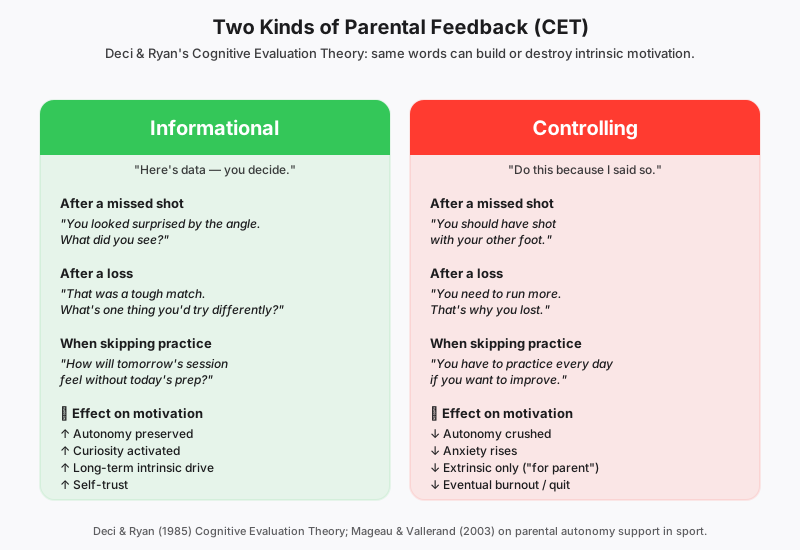
Cognitive Evaluation Theory (CET) — How the 'Quality' of Your Words Shapes Motivation
Cognitive Evaluation Theory, proposed by Deci & Ryan (1985), is a sub-theory of Self-Determination Theory (SDT). Its central insight is that external feedback — including what parents say — carries two distinct aspects: an informational aspect and a controlling aspect.
- Informational feedback — 'That second pass you made — great use of space.' → Builds the child's sense of competence and strengthens intrinsic motivation
- Controlling feedback — 'Run harder!' 'Why didn't you shoot?!' → Strips the child of autonomy and destroys intrinsic motivation
A critical point from CET is that the same message can be informational or controlling depending on how it is delivered. 'You should have taken the shot' is a factual observation, but shouting it angrily from the sideline during a match makes it controlling feedback, while bringing it up calmly at home afterward makes it informational.
Three Basic Psychological Needs — A Checklist for Your Words
Self-Determination Theory defines three Basic Psychological Needs that underpin intrinsic motivation. Whether your words satisfy these three needs is the litmus test.
- Autonomy — The feeling of choosing and acting under one's own will. Commands like 'Do this now!' undermine it
- Competence — The feeling of 'I can do this.' Feedback on process rather than outcome nurtures it
- Relatedness — The feeling of connection with others. 'Win or lose, I love watching you play' satisfies it
Three questions to ask yourself before speaking: (1) Does this protect my child's sense of 'I chose this'? (2) Does it build the feeling of 'I can do this'? (3) Does it convey 'You are accepted by me no matter what'? If the answer is yes to all three, the science says your words are on the right track.
Fredricks & Eccles (2004) — Quality of Involvement Matters More Than Quantity
In their longitudinal study published in Developmental Psychology, Fredricks & Eccles (2004) analyzed the effects of parental involvement on children in sport. The conclusion is clear: the quantity of parental involvement has no significant relationship with a child's performance — only the quality matters. In other words, showing up to every game is neither inherently good nor bad; what you say and how you behave once you are there determines everything.
The study classifies parental involvement into three types:
- Supportive involvement — Driving to practice, cheering, listening — involvement that respects the child's autonomy → Improves motivation and enjoyment
- Directive involvement — Technical coaching, tactical instructions, critiquing plays → May appear effective short-term but reduces motivation over time
- Pressuring involvement — Expectations about results, comparison with other children, scolding → Increases anxiety, kills enjoyment, and accelerates dropout
Whether a child plays soccer for ten years or quits after two is not determined by talent — it is determined by the quality of their parents' words.
What to Say During a Match — Phrases to Absolutely Avoid and How to Be a Supportive Spectator
In Knight et al.'s (2017) research, 73% of children who received technical instructions or critical comments from parents during games reported that they 'stopped enjoying the match.' During a game, the parent's role is not 'coach' — it is 'supporter,' full stop.

Photo by Vitaly Gariev on Unsplash
During a match, a child's emotions are at their peak — and at their most vulnerable. Knight, Berrow, & Harwood (2017), in a study published in Psychology of Sport and Exercise, examined British youth athletes and their parents to investigate in detail how parental behavior during games affects children psychologically.
The study identified the top three parental behaviors that cause children the most stress: (1) technical instructions shouted from the sideline, (2) negative reactions to mistakes — including sighs and head-shaking, and (3) arguing with referees or opposing teams. Every one of these behaviors originates from good intentions — wanting to help — but children themselves report feeling 'embarrassed,' 'pressured,' and that 'soccer stopped being fun.'
Five Phrases You Must Never Say During a Match
- 'Shoot!' 'Run!' 'What are you doing?!' — Instructions and commands. They usurp the coach's role and leave the child confused about whose directions to follow
- 'Why did you misplace that pass?' — Analyzing a mistake mid-game completely destroys the child's concentration. Holt et al. (2008) call this 'performance-contingent feedback' and report that it significantly elevates anxiety levels
- 'Look — your teammate is doing it right.' — Comparison with other children directly undermines the sense of competence central to Self-Determination Theory. The child hears not 'I'm bad' but 'My parent doesn't accept me'
- 'You need to win this one.' — Pressure about results. In Dweck's (2006) framework, results-oriented messaging reinforces a Fixed Mindset and promotes failure-avoidance behavior — meaning the child stops taking risks on the field
- (Silent sighs, head-shaking, arms crossed) — You don't have to say a word — children are watching. In Knight et al.'s (2017) survey, 'negative body language after a mistake' ranked among the most hurtful parental behaviors
Supportive Phrases You Can Use During a Match
During a game, the safest approach is content-free encouragement — cheers that carry no specific instruction. Save comments about particular plays for after the final whistle.
- 'Nice!' 'Great job!' 'Keep it up!' — Positive affirmation without specific instructions. Works after both good plays and mistakes
- 'Have fun out there!' — Shifts focus from results to the experience. A message that respects autonomy
- 'You're okay! Shake it off!' — Right after a mistake. Satisfies the need for relatedness: 'I'm accepted even when I fail'
- 'Let's go!' 'Come on!' — Simple energy. Safe precisely because it carries no content
- 'Good decision!' — Recognizes the decision-making process, not the outcome. Even if the shot misses, it affirms that choosing to shoot was the right call
- Clapping only — When words risk becoming controlling, applause alone is the best option
The golden rule: 'Swallow everything the coach would say.' Technical instruction is the coach's job. The only thing a parent needs to provide is the psychological safety that lets a child take risks without fear.
Holt et al. (2008) — The Model Spectator
In a study published in the Journal of Applied Sport Psychology, Holt et al. (2008) used observation and interviews to analyze patterns of parental involvement in youth sport. The research revealed clearly distinct behavioral patterns between 'autonomy-supportive parents' and 'controlling parents.'
Three behaviors were common among autonomy-supportive parents: (1) refraining from giving instructions during games, (2) acknowledging the child's effort regardless of the result, and (3) letting the child speak first on the ride home — rather than the parent talking. Point three is especially important: when a parent starts sharing their own observations right after the game, the child loses the chance to reflect in their own words.
Ninety percent of what you want to say during a match is better left unsaid. The remaining ten percent is covered by 'Great job!' and 'Nice!'
After Practice and on the Ride Home — Drawing Out Reflection Without Creating Pressure
The car ride home after practice or a game is both the most important and the most error-prone moment in parent-child sport communication. Using open-ended questions and letting the child 'talk in their own words' is the scientifically sound approach.
The single biggest mistake parents make on the way home is stating their own opinion first. When you lead with 'Your defending wasn't great today' or 'You could have shot more,' the child shifts into a mode of searching for 'the right answer Mom or Dad wants.' This is the exact opposite of autonomy.
In Holt et al.'s (2008) research, the pattern identified among autonomy-supportive parents was that the ride-home conversation always began with the child speaking. The parent asks a question, the child talks, the parent listens — that sequence matters.
Open-Ended Questions for the Ride Home
The following phrases are open-ended questions that cannot be answered with a simple 'yes' or 'no.' They create opportunities for the child to think and articulate on their own.
- 'What was the most fun part today?' — Focuses on enjoyment, not results. A question that taps into the source of intrinsic motivation
- 'Was there a play where you thought, I nailed that?' — Respects the child's own evaluation criteria instead of imposing the parent's standards
- 'Did you try anything new today?' — Asks whether they challenged themselves. Reinforces a growth mindset
- 'Did any of your teammates make a cool play?' — Shifts attention beyond themselves to the team. Builds both observation skills and relatedness
- 'Did the coach mention anything to you?' — Gets the child to reconstruct the coach's feedback in their own words. A metacognition exercise
- 'If you could do it again, would you change anything?' — Draws out forward-looking awareness rather than regret. Future-oriented framing
Ride-Home Patterns to Avoid at All Costs
- Leading with your own evaluation — Whether it's 'You were off today' or 'Great game!' — when the parent evaluates first, the child's autonomous reflection disappears
- Turning the car into a debriefing room — 'Why didn't you pass in that situation?' is an interrogation, not a question. The child goes into defensive mode
- Comparing with other children — 'Your teammate scored three goals and you didn't' is the most toxic form of feedback. It directly destroys the sense of competence in Deci & Ryan's framework
- Asking only about results — When 'What was the score?' or 'Did you win?' is the first question, it silently broadcasts the message that only the result matters
- Trying to fill the silence — When a child is quiet, they are processing. Do not force them to talk. The right move is: 'Whenever you feel like talking, I'm here to listen'
The most powerful ride-home phrase: 'I really enjoyed watching you play today.' It says nothing about the result and affirms the child's worth unconditionally. That alone satisfies the need for relatedness.
'Saying Nothing' Is Also Communication
In Knight et al.'s (2017) survey, one of the things children wanted most from their parents was 'not talking about soccer right after the game.' This is especially true after a loss or a game where the child made a costly mistake — they need time to process their emotions.
Play their favorite music in the car, skip the soccer talk entirely, go home, have dinner, take a bath, and then — just before bed — ask 'How was today?' This kind of deliberate timing actually produces the highest-quality reflection. Metacognition in a calm emotional state is deeper and more accurate than reflection in the heat of the moment.
The ideal ride-home conversation is 80% the child talking and 20% the parent listening. The parent's role is not 'the one who teaches' — it is 'the one who listens.'
After a Loss or a Mistake — Using Growth Mindset to Reframe Failure
In Dweck's (2006) Growth Mindset theory, whether failure is seen as 'proof of limited ability' or 'an opportunity to grow' fundamentally changes how effectively a child learns afterward. A single phrase from a parent can shift the entire frame through which a child views failure.
The moments when children hurt the most in youth soccer are after a loss, after missing a penalty, or after their mistake led to a goal. What a parent says in these moments has a decisive impact on the child's growth trajectory going forward.
The Growth Mindset concept, systematized by Carol Dweck (2006) in her book Mindset, contrasts a Fixed Mindset — the belief that talent is innate and unchangeable — with a Growth Mindset — the belief that ability develops through effort. The difference between these two mindsets becomes most visible in the face of failure.
Common Post-Failure Mistakes and How to Reframe Them
Below are typical phrases parents default to after a failure, paired with growth-mindset reframings.
- Avoid: 'Don't worry about it' → Better: 'I can see you're frustrated. That frustration means you were giving it everything you had' — Acknowledges the emotion instead of dismissing it. Gives the feeling of frustration a positive meaning
- Avoid: 'It wasn't your fault' → Better: 'Soccer is an eleven-a-side game. What you learned today will help you next time' — Rather than deflecting responsibility, communicates the nature of team sport and the value of process
- Avoid: 'The ref got it wrong' → Better: 'Ref decisions are part of the game. Let's focus on what you can control' — Encourages internal attribution instead of external blame. Shifts the locus of control back to the child
- Avoid: 'Why didn't you pass there?' → Better: 'What did you think about that moment?' — An inquiry, not an interrogation. Letting the child analyze the cause themselves develops metacognition
- Avoid: 'You're talented enough to do better' → Better: 'Can you think of one thing you learned from today's game?' — References to talent reinforce a Fixed Mindset. Focusing on learning nurtures a Growth Mindset
Applying Dweck's 'Process Praise' in Practice
Dweck's (2006) research repeatedly emphasizes the importance of praising 'process' — effort, strategy, choices — rather than outcomes. Applied to soccer, this looks like the following:
- Outcome praise (avoid): 'You scored twice — amazing!' → Implies that a game without goals is 'not amazing'
- Talent praise (most dangerous): 'You've got natural ability' → When failure inevitably comes, the child concludes 'Maybe I don't have it after all'
- Process praise (recommended): 'You checked the far side of the field before making that play — great awareness' → Recognizes a specific action and the decision-making behind it
- Effort praise (recommended): 'You kept running hard right to the final whistle — that takes real commitment' → Affirms effort that can be given regardless of the result
- Challenge praise (recommended): 'You tried that shot with your weaker foot — what a brave attempt' → Values the act of taking on a challenge, even if the result was a miss
The most important thing for a parent is to watch what their child can learn when they lose, when they fail — whether they won or lost is secondary.
— Dweck (2006) Mindset: The New Psychology of Success
What to Say After a Heavy Defeat or When Your Child Is in Tears
After a crushing 0-8 loss, or when a child is crying because their mistake cost the team the game — in these extreme moments, neither analysis nor reflective questions are needed. The first priority is receiving the emotion.
- 'It's okay to cry. When something hurts this much, crying is the right thing to do' — Grants permission to express emotion. Telling a child to 'toughen up' teaches emotional suppression and damages long-term mental health
- 'That was really tough' — Four simple words that convey empathy. No lecture, no analysis needed
- 'Let's go home and have your favorite meal' — Completely disconnects from soccer. Recovery requires psychological distance
- (Simply being there without saying a word) — In Knight et al.'s (2017) survey, the thing children wanted most was 'just having someone there.' Presence over words
The first ten minutes after a loss are not 'teaching time' — they are 'emotional recovery time.' Analysis and reflective questions can wait until the next day. What matters right now is being near a safe person.
'I Want to Quit Soccer' — Balancing Autonomy Support with Knowing When to Encourage Persistence
Following Deci & Ryan's (1985) principle of autonomy support, a child's 'I want to quit' should first be met with listening and empathy. However, parents also need the perspective to distinguish between a momentary emotional reaction and a considered decision.
'I want to quit soccer' — this sentence hits parents hard. But it is far from uncommon in youth soccer. Fredricks & Eccles (2004) found that participation rates in youth sport decline with age, with the primary drivers being 'loss of enjoyment,' 'increased pressure,' and 'interest in other activities.'
The important thing to recognize is that 'I want to quit' comes in several varieties. A momentary emotional outburst and a carefully considered decision require different responses.
Four Patterns Behind 'I Want to Quit' — and How to Respond
- Pattern 1: An emotional reaction right after a loss or mistake — 'I messed up today' / 'I just can't anymore' → Do not take this at face value. Wait for the emotion to settle. Empathize with 'That sounds really tough' and revisit the subject a day or two later
- Pattern 2: A relationship problem — 'The coach scares me' / 'Teammates are bullying me' → This is not a soccer problem; it is an environment problem. Listen carefully, then consider switching teams or speaking directly with the coaching staff. Do not force the child to endure it
- Pattern 3: Interest in other activities — 'I want to try basketball' / 'I'd rather learn to code' → This is a sign of growth. Fredricks & Eccles (2004) note that exploring diverse activities is essential for adolescent development. Clinging to soccer is the parent's ego, not the child's need
- Pattern 4: A prolonged loss of enjoyment — Weeks or months of 'I don't want to go' → This points to a fundamental motivational issue. One or more of the three basic psychological needs from Self-Determination Theory is chronically unmet
A Four-Step Conversation That Respects Autonomy
Applying Deci & Ryan's (1985) autonomy support principles to dialogue produces the following four steps:
- Receive the emotion — 'So you're feeling like you want to stop.' Accept the feeling without dismissing it. 'Don't be ridiculous!' or 'You're not quitting!' is the worst possible opening
- Listen for the reason — 'What's been the hardest part?' Ask openly. 'Why would you quit?!' is an interrogation, not a question
- Explore options together — 'Switching teams is one option, taking a break is another. What do you think?' Present multiple paths. Do not corner the child into a binary 'quit or stay' choice
- Let the child make the final call — 'In the end, this is your decision. Whatever you choose, I'm behind you.' The core of autonomy is the feeling of 'I chose this myself'
When You Want to Say 'Give It a Little More Time'
Autonomy support does not mean doing whatever the child says. It is perfectly natural to feel 'I'd like them to keep going a bit longer.' Here is how to express that constructively:
- Use 'I' as the subject — Not 'You should keep going' but 'I love watching you play, and I'd like to keep watching a little longer.' Deliver it as an I-message
- Set a time frame — 'How about giving it one more month, and if you still feel the same way, I'll respect that.' A visible endpoint reduces the psychological burden
- Propose changing the conditions — 'If this team isn't working, would you be open to visiting another one?' or 'What if we cut training from three days a week to two?' Changing the environment often solves the problem
- Lead with 'You can quit any time' — Paradoxically, being told 'You're free to stop whenever you want' often leads to 'Well, maybe I'll keep going a bit.' In Deci & Ryan's theory, having an exit restores autonomy, and with it, motivation regenerates
The single worst response: 'We've invested so much time and money in this.' Bringing up the cost of parental investment loads the child with guilt and obligation, transforming soccer from something they enjoy into a debt they owe.
The fact that a child can say 'I want to quit' out loud is proof that the parent-child relationship is healthy. A child who stays silent and keeps playing joylessly is a far more serious problem.
Everyday Communication at Home — How Time Away From Soccer Builds a Child's Confidence
Fredricks & Eccles' (2004) longitudinal research shows that a child's self-efficacy in sport is influenced by the home environment as a whole. Opportunities to build a child's confidence exist not only during practice or matches but in everyday moments — at the dinner table, in passing conversations, and in daily routines.
Parental communication does not begin and end at the soccer field. In fact, it is the accumulation of everyday interaction at home that lays the mental foundation for match day. A child who feels 'consistently recognized' at home recovers faster after a mistake on the pitch — because their need for relatedness is being met on a daily basis.
Casual Soccer Conversations at the Dinner Table
- 'Is there anything you're looking forward to in this week's training?' — Draws out anticipation for the future. Builds a mental habit of viewing soccer positively
- 'Are you getting along well with anyone on the team lately?' — Shows interest in relationships, not soccer skill. Satisfies the need for relatedness
- 'That drill your coach ran looked interesting' — Communicates that the parent is paying attention to practice content — without evaluating performance
- 'Would it be okay if I come watch the game this weekend?' — Asking permission rather than announcing 'I'll be there' is a small gesture that respects the child's autonomy
Building Confidence Outside of Soccer
In Deci & Ryan's (1985) framework, the sense of competence is not confined to a single activity. 'I did it' experiences across schoolwork, household chores, friendships, and hobbies all elevate a child's general self-efficacy — and that spills over into soccer performance.
- Make 'thank you' specific — Not just 'Thanks for doing the dishes' but 'You stacked those plates really neatly — that helped a lot.' Specificity in recognizing actions builds competence
- Tolerate failure in everyday life — A parent who doesn't get angry about a bad test score builds the trust that they won't get angry after a bad game. Consistency matters
- Include the child's voice in family decisions — Children from families that ask 'Where do you want to go this weekend?' develop a stronger sense of autonomy
For children, the ultimate reward is not the result on the scoreboard — it is the certainty that their parent accepts them unconditionally.
— Holt et al. (2008) Journal of Applied Sport Psychology
The ultimate principle: Tell your child, 'Whether you're great at soccer or not, I love you just the same.' This single statement is the foundation beneath every communication technique. Feedback only works when unconditional love is already established.
References
- [1] Deci, E. L., & Ryan, R. M. (1985). “Intrinsic Motivation and Self-Determination in Human Behavior” New York: Plenum Press. Link
- [2] Dweck, C. S. (2006). “Mindset: The New Psychology of Success” New York: Random House.
- [3] Holt, N. L., Tamminen, K. A., Black, D. E., Sehn, Z. L., & Wall, M. P. (2008). “Parental involvement in competitive youth sport settings” Psychology of Sport and Exercise, 9(5), 663-685. Link
- [4] Knight, C. J., Berrow, S. R., & Harwood, C. G. (2017). “Parenting in sport: A position paper on parenting expertise” Psychology of Sport and Exercise, 34, 153-165. Link
- [5] Fredricks, J. A., & Eccles, J. S. (2004). “Parental influences on youth involvement in sports” Developmental Psychology, 40(4), 535-546. Link
Related Articles
A Parent's Guide to the Soccer Journal — How to Support Your Child's Growth the Right Way
7 min read
Growth Mindset and the Soccer Journal — How to Raise Players Who Believe in Effort Over Talent
9 min read
Mental Training and the Soccer Notebook Habit — The Science of Writing Your Way to a Stronger Mind
9 min read
The Complete Guide to Choosing a Youth Soccer Club — 7 Evaluation Criteria and How to Make the Right Decision
14 min read
The Complete Match Day Preparation Guide for Soccer — From the Night Before to Post-Match Recovery
11 min read
Track Your Growth with Footnote
Just record your matches — AI analyzes every 5 games. Visualize growth with PVS Score. All features free during beta.
30-second signup · No credit card required
Last updated: 2026-05-06 ・ Footnote Editorial