The Complete Guide to Choosing a Youth Soccer Club — 7 Evaluation Criteria and How to Make the Right Decision
Choosing a soccer environment for your child is a critical decision that affects not only their athletic development but also their personal growth. Côté et al. (2007) showed in their sport development model that 'fun' and 'diverse experiences' during early childhood form the foundation for long-term athletic development. However, club teams, community teams, and soccer academies each have distinct characteristics, and placing a child in an environment that does not match their age, personality, or goals can even risk making them dislike soccer altogether. In this article, we present 7 objective evaluation criteria and a concrete trial-visit checklist, so you can choose a team based on evidence rather than gut feeling.
Types of Youth Soccer Teams — Club Teams, Community Teams, and Soccer Academies
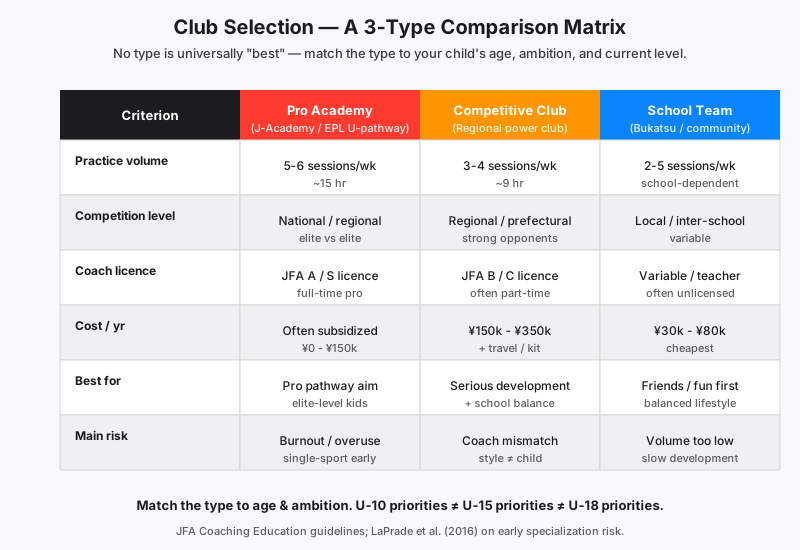
The first step in choosing a team is understanding the differences between the three main types of youth soccer organizations. Each has its own advantages and disadvantages, and the best choice varies depending on your child's personality and goals.

Photo by Adrià Crehuet Cano on Unsplash
Community Teams (Volunteer-Run Programs)
These are teams based at local schools or public facilities, coached by volunteer parents. Low fees and convenience are the biggest advantages — in Japan, monthly dues typically range from about $15-35 / £12-28 (2,000-5,000 yen), while comparable community programs in other countries may be similarly affordable. Because children can start with friends from their own school or neighborhood, the barrier to entry is low for those trying soccer for the first time.
- Advantages — Affordable, easy to get to, strong local connections, welcoming atmosphere
- Disadvantages — Coaching quality varies widely, practice facilities may be inconsistent, may not challenge competition-oriented players
Club Teams (Private Clubs)
These are privately run organizations staffed by dedicated soccer coaches. Coaches typically hold professional licenses and offer structured training programs — this is their greatest strength. Monthly fees are higher than community teams (in Japan, roughly $55-105 / £45-85 per month; comparable clubs elsewhere vary by region), but coaching quality and practice environments are more consistent.
- Advantages — Structured coaching, stable practice environment, ability-based groupings, attracts competition-minded players
- Disadvantages — Higher cost, greater transportation burden, some clubs may lean too heavily toward a win-at-all-costs mentality
Soccer Academies (Skills Schools)
These are training-focused programs aimed at individual skill development. They range from professional-club-affiliated academies to independent coaching schools. Because they do not enter official competitions, players can attend alongside their regular team. They are ideal for players who want intensive work on specific skills such as dribbling or goalkeeping.
- Advantages — Focused on individual technique, can be combined with a team membership, flexible scheduling
- Disadvantages — No competitive match experience, limited tactical and team-play training
Fraser-Thomas et al. (2005) demonstrated that 'enjoyment,' 'belonging,' and 'a sense of improving' are essential for sustained participation in youth sport. The question is not which type of organization is objectively best, but which environment allows your child to experience all three of these factors.
7 Evaluation Criteria — Essential Checkpoints When Choosing a Team
If you base your decision solely on 'atmosphere' or 'proximity,' you may end up regretting it. Systematically checking the following seven criteria allows you to make a decision grounded in evidence rather than instinct.

Photo by Leo Aki on Unsplash
1. Coaching Philosophy — The Values the Team Prioritizes
How a team balances 'winning' and 'development' reveals its true character. Ask whether the team gives every player playing time and whether it prioritizes individual growth. Balyi & Hamilton's (2004) LTAD model warns that an excessive focus on winning before age 12 can hinder long-term development. Key questions: Does every player get match time? Is the skill-learning process valued over results?
2. Coach Quality — Qualifications, Experience, and Character
Côté et al. (2007) showed that coach quality has the greatest impact on a player's long-term development. Look beyond credentials — observe how the coach interacts with children and whether they ever resort to shouting or belittling.
- Does the coach hold a recognized coaching license (e.g., a national federation C-license or equivalent)?
- Is there any shouting, personal insults, or demeaning language during practice?
- Does the coach praise specific actions (e.g., "Great decision to pass at that moment") rather than generic comments?
3. Training Environment — Facilities, Equipment, and Schedule
More practice sessions are not automatically better — balance with school, rest, and free play matters. Check the practice frequency and times, pitch type and safety, availability of an alternative venue in bad weather, and the quality of training equipment.
4. Match Opportunities — Frequency of Official and Friendly Matches
Gould & Carson (2008) showed that match experience is a crucial opportunity for life-skill development. Rather than how strong the team is, ask whether every player gets match time and how many games are played per year. Check the frequency of official and friendly matches, playing-time policies for all players, and whether children experience multiple positions.
5. Cost — The Full Picture Beyond Monthly Fees
Before joining, calculate the total annual cost including registration fees, uniforms, tournament travel, and training camps. Details are covered in the "True Cost Comparison" section of this article.
6. Accessibility — Distance Is the Biggest Enemy of Consistency
If getting to practice requires a 60-minute drive three times a week, both parents and children will burn out. Use this test: "Can we sustain this commute for three years?" If the child can travel independently, it also fosters independence.
7. Teammates — The Influence of the Children They Play With
Fraser-Thomas et al. (2005) noted that peer relationships are extremely important for continued sport participation. During a trial, observe whether the children on the team seem to be enjoying themselves and treating each other with respect.
No team will score perfectly on all seven criteria. Every family's priorities are different. Identify your 2-3 non-negotiable criteria before you start comparing — it will dramatically reduce indecision.
Trial Visit Checklist — 4 Observation Points to Focus On
The true character of a team rarely shows up on a website or in a brochure — it becomes visible during a trial session or observation visit. Knowing exactly what to look for in advance lets you make an informed judgment in limited time.
Point 1: Listen to How the Coach Communicates
A coach's words are the culture of the team. Pay close attention to what is said during practice. Good coaches praise process over results and respond to mistakes not with anger but with guidance — "Here's what to try next time."
- Are there positive phrases like "Nice try!" or "Good decision!"?
- Does the coach yell things like "What are you doing!" when a player makes a mistake?
- Are instructions specific ("Check the space on the right before deciding") rather than vague ("Try harder")?
- Does the coach call children by name and give individual feedback?
Point 2: Watch the Children's Faces
The 'enjoyment' that Fraser-Thomas et al. (2005) emphasize shows up most honestly in children's expressions. Look for smiles during practice, check whether children shrink after making mistakes, and notice whether teammates chat happily during breaks.
- Are there natural smiles during practice?
- Do children who make mistakes look frightened?
- Is there a visible barrier between stronger and weaker players?
Point 3: Evaluate the Practice Structure
Balyi & Hamilton's (2004) LTAD model identifies age-appropriate training design as a key to long-term player development. Check whether sessions follow a logical flow — warm-up, technical drills, game-based activities — and whether each player gets enough time on the ball.
- Is there a progressive structure (drills → applied exercises → small-sided games)?
- Does each player get sufficient ball contact time (no long lines or excessive waiting)?
- Is the content age-appropriate (tactical lectures are unsuitable for young children)?
Point 4: Sense the Parent Community Atmosphere
When your child joins a team, you join a community too. Observe other visiting parents, the attitude of existing members' parents, and the relationship between parents and coaches.
- Is the atmosphere among parents positive (no cliques or tension)?
- Are there parents shouting instructions from the sideline during practice?
- Is there clear information about volunteer duties and the level of parental involvement expected?
A trial visit is not only about whether your child has fun — it is also about whether you, as a parent, can see yourself being part of this community. Choose a team where both your child's enjoyment and your own peace of mind are present.
Age-Specific Guidance — Finding the Right Environment for Each Developmental Stage
As Balyi & Hamilton's (2004) LTAD model illustrates, the ideal sports environment changes significantly with each stage of a child's development. Here is what to prioritize at each age.
Ages 5-7 (Kindergarten through Early Elementary): Fun Comes First
Côté et al. (2007) describe this period as the "sampling years." Rather than focusing exclusively on soccer, experiencing a variety of sports and physical play builds the foundation for long-term athletic ability.
- Top priority — An environment where the child feels "Soccer is fun!"
- Easy to get to (minimal transportation burden on parents)
- A team that values the joy of chasing the ball over winning and losing
- 1-2 practice sessions per week is plenty (leave time for other sports and free play)
Ages 8-9 (Mid-Elementary): Building Technical Foundations
The LTAD model positions this period as the "FUNdamentals stage." This is the most effective age for building core skills (dribbling, passing, first touch) through repetition, ideally in an environment that maintains fun while providing appropriate technical challenges.
- Top priority — A coach who teaches fundamental skills with care and patience
- Practice sessions that maximize ball contact (minimal standing in line)
- A group where the level is close enough for healthy competition among peers
- 2-3 sessions per week is appropriate (multi-sport participation is still recommended)
Ages 10-12 (Upper Elementary): Balancing Competition and Growth
Côté et al. (2007) note that the transition into the "specializing years" begins at this age. Children start to develop a desire to commit seriously and seek higher levels of play, but premature specialization carries risks of burnout and injury.
- Top priority — A competitive environment that still gives every player match time
- Coaches who rotate positions rather than locking players into one role
- An environment that makes the child think "I want to get even better"
- A coach who understands the balance between training quality and volume (and the dangers of overtraining)
At every age, the feeling of "I love soccer" is the most important thing to protect. Choose an environment that matches your child's developmental stage and personal motivation — not your own expectations as a parent.
When to Transfer Teams — 5 Signs It May Be Time to Move
Transferring teams is not quitting — it is optimizing your child's environment. However, an emotional decision can lead to the same problems at the new club. Having objective criteria for this decision is essential.
5 Signs That a Transfer May Be Warranted
- Soccer is no longer fun — The child resists going to practice and rarely smiles. Loss of enjoyment is the number-one predictor of dropout (Fraser-Thomas et al., 2005)
- Coaching issues — If there is verbal abuse, physical punishment, or personal attacks, change environments immediately
- Level mismatch — The level is too low for growth, or too high, eroding the child's confidence
- Severe lack of playing time — The child has not played in matches for six months or more
- Deteriorating team environment — Bullying, parent conflicts, or sudden changes in the club's direction
Before You Transfer: Steps to Take First
- Hear your child's true feelings — Ask "Are you enjoying soccer right now?" rather than "Do you want to change teams?"
- Try talking to the coach — If the issue is verbal or physical abuse, skip this step and transfer immediately
- Find the new team before leaving — Do not quit first and search later; complete trial visits and then decide
- Timing matters — Transfers are smoothest at the start of a new season or registration period. Mid-season moves may involve additional paperwork (e.g., transfer clearance from the current club and re-registration with the national or regional federation)
Transfer Procedures and What to Watch For
In many countries, player registration allows only one team per player at a time. When transferring, you will typically need a release or transfer clearance from the current club. The general process is: notify the current club of your intent to leave (ideally 1-2 months in advance) → obtain a transfer release → complete registration with the new club. Specific rules vary by country and federation — for example, in Japan the JFA (Japan Football Association) manages player registration, while in the US it is handled through state associations.
Caring for Your Child's Emotions
A transfer means leaving friends behind, so emotional support is essential. Gould & Carson (2008) note that transitions in sport can be opportunities for psychological growth but also carry risk if handled poorly.
- Explain the reasons for the transfer in words the child can understand
- Avoid framing it negatively — do not say "The old team was bad"
- Allow time to adjust to the new team without pressure (give it at least 3 months before reevaluating)
Even if your child says "I liked my old team better" after the transfer, resist the urge to switch back immediately. Adjusting to a new environment takes time. Give it at least three months; if it still is not working after that, then consider your options again.
True Cost Comparison — The Full Financial Picture of Youth Soccer
Cost is an unavoidable factor in choosing a team. A club that looks cheap based on monthly fees alone can quietly add up to a substantial annual sum once you factor in tournament travel, training camps, and gear.
Annual Cost Ranges by Team Type
- Community Teams — Monthly fees: roughly $15-35 / Annual total: approximately $350-700. Lower overall costs because travel and camps are less frequent
- Club Teams — Monthly fees: roughly $55-105 / Annual total: approximately $1,050-2,450. Tournament travel and training camp fees add up significantly
- Soccer Academies — Monthly fees: roughly $40-85 / Annual total: approximately $550-1,050 (if no travel or camps are included)
Costs Beyond Monthly Fees
- Registration / enrollment fee — $35-140 (first year only)
- Annual fees / insurance — $35-105 (federation registration and sports insurance)
- Full uniform set — $105-210 (practice kit, match kit, tracksuit)
- Tournament travel — $20-70 per trip (5-15 times per year)
- Training camps — $105-280 per camp (1-3 times per year)
- Personal gear — Cleats, training shoes, shin guards, ball, etc. Growth spurts mean replacing items every 6-12 months
Hidden Costs That Are Easy to Overlook
- Fuel and transportation — If the club is far away, annual gas and transit costs can add up to hundreds of dollars
- Parents' time — Volunteer duty rosters, driving, and game-day attendance can consume entire weekends
- Additional academy fees — If your child attends a skills school on top of their regular team, costs effectively double
Expensive does not mean better. Look into hand-me-down gear, sibling discounts, and local subsidy programs. Before joining, always run an annual total-cost estimate and evaluate the return on investment in terms of your child's growth and enjoyment.
Parental Involvement — Participating in Team Operations and Avoiding Common Pitfalls
Choosing a team is not just about the child — it also involves a commitment from parents. Understanding volunteer duties, transportation responsibilities, and sideline etiquette in advance helps prevent conflicts and stress.
Volunteer Duties and Shared Responsibilities
Many teams — especially community-run ones — rely on a volunteer duty roster. Tasks may include setting up the pitch, providing transportation for away games, helping referee, or organizing refreshments. Always clarify what is expected before joining. For dual-income families, this can be a make-or-break factor in team selection.
- How often are volunteer duties required (monthly frequency) and is there a substitute system?
- Are accommodations made for families where both parents work?
- Does the club have formal parent roles (chairperson, treasurer, communications coordinator) and how demanding are they?
Sideline Etiquette During Matches
Gould & Carson (2008) showed that parental behavior during matches directly affects a child's psychological experience. Excessive coaching from the sideline, arguing with referees, and heckling can make children dislike soccer entirely.
- Encourage — "Go for it!" — rather than instruct — "Pass it!" "Shoot!"
- Do not show frustration with the referee's calls (you are modeling respect for the game and its officials)
- Regardless of the result, ask on the ride home: "Did you have fun?"
Preventing Conflicts Among Parents
The most common source of trouble in youth soccer is conflict between parents. Disputes over playing time, misunderstandings in group chats — these are almost always parent-driven problems, not child-driven ones.
- Direct complaints about the coach to the coach personally — do not air them among other parents
- Keep group chats strictly for logistics and avoid emotional messages
- Do not comment on other children's playing time or positions
- If a conflict begins to escalate, bring it to the team manager or head coach before it worsens
Children just want to enjoy soccer. Before joining a team, get a clear picture of what is expected of you as a parent, and support your child's soccer environment within a time and energy commitment you can sustain.
References
- [1] Côté, J., Baker, J., & Abernethy, B. (2007). “Practice and play in the development of sport expertise” Handbook of Sport Psychology (3rd ed.), pp. 184-202, Wiley.
- [2] Fraser-Thomas, J. L., Côté, J., & Deakin, J. (2005). “Youth sport programs: An avenue to foster positive youth development” Physical Education and Sport Pedagogy, 10(1), 19-40.
- [3] Balyi, I. & Hamilton, A. (2004). “Long-Term Athlete Development” Canadian Sport Centres.
- [4] Gould, D. & Carson, S. (2008). “Life skills development through sport: Current status and future directions” International Review of Sport and Exercise Psychology, 1(1), 58-78.
Related Articles
The Complete Tryout Guide — 7 Evaluation Criteria Top Academies Look For and How to Prepare
15 min read
A Parent's Guide to the Soccer Journal — How to Support Your Child's Growth the Right Way
7 min read
The Complete Parent Communication Guide for Youth Soccer — Words That Build Up and Words That Break Down, According to Psychology Research
18 min read
Why Coaches Should Have Players Keep Soccer Journals — and How to Implement Them
8 min read
The Complete Soccer Journal Guide for Elementary-Age Players — Age-Appropriate Templates and Tips for Building the Habit
6 min read
Track Your Growth with Footnote
Just record your matches — AI analyzes every 5 games. Visualize growth with PVS Score. All features free during beta.
30-second signup · No credit card required
Last updated: 2026-05-06 ・ Footnote Editorial