The Complete Tryout Guide — 7 Evaluation Criteria Top Academies Look For and How to Prepare
What separates those who make the team from those who don't isn't 'how they play on the day' — it's the quality of their preparation. Research by Williams & Reilly (2000) on talent identification revealed that scouts evaluate far more than technical ability; decision-making, psychological maturity, and future potential all factor into a multidimensional assessment. This article systematically covers the 7 criteria that scouts at elite academies and competitive clubs actually evaluate, along with a 6-month preparation timeline, match-day mindset strategies, and a recovery plan for handling rejection. Making the team isn't about luck. Tryouts are a stage where those who prepare correctly get evaluated correctly.
What Are Tryouts — Types, Process, and What Really Happens
Tryouts are practical assessments that clubs and academies use to select new players. The required level and evaluation criteria vary significantly by type, so understanding the big picture is the essential first step in preparation.

Photo by v2osk on Unsplash
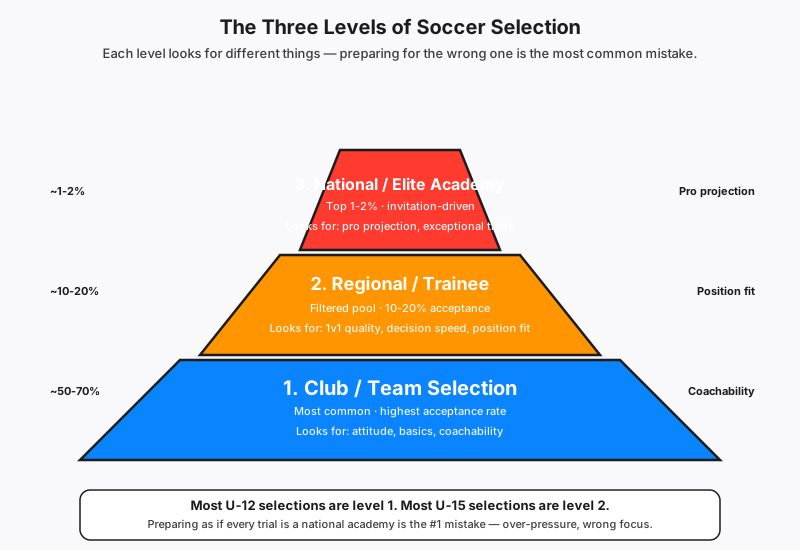
Three Types of Team Selection Trials
- Professional Club Academies — Trials for the youth development programs of professional clubs (U-12, U-15, U-18). Competition is intense, often exceeding 50:1 or even 100:1 ratios. Scouts assess not just technical ability but also soccer IQ, future potential, and character. Players may be invited by scouts or apply through open registration
- Competitive Community Clubs — Trials for top-level regional clubs. Less competitive than professional academies but still selective, typically with 5:1 to 20:1 ratios. Technical ability and decision-making are the primary evaluation criteria, and tactical fit with the team's style is also important
- Elite School Teams — Trials for schools with strong competitive track records. Physical attributes tend to carry more weight, including speed and ability to win physical challenges. Some programs also consider academic performance as a requirement
The Typical Tryout Process
- Registration and Entry — Check the club's official website or social media for tryout announcements. Deadlines close early (often 1-2 months before the event), so start gathering information well in advance
- First Round (Skills Assessment) — Testing of fundamental techniques, small-sided games, and scrimmages. The field of 50-200 participants is typically narrowed to 10-30 players
- Second Round (Game-Based Evaluation) — A more match-realistic format that evaluates decision-making, positioning, and communication. This round runs longer than the first
- Final Round (Training Sessions and Interviews) — Several days of training sessions to evaluate character and growth potential. Some clubs also conduct parent interviews
- Results Notification — Notification via phone or email. Most clubs do not provide specific reasons for unsuccessful candidates
At many top academies, tryouts are not the only factor in the decision. Scouts often evaluate players beforehand by watching league matches, regional training centers, and tournaments. For some candidates, the tryout day is simply a confirmation of what scouts have already seen.
Vaeyens et al. (2008) noted that 'accurately predicting future success from a single selection event is difficult.' This means tryouts are far from infallible — but it also means that 'not making the team' does not equal 'lacking talent.' Tryouts are one evaluation opportunity; they do not define a player's worth.
The 7 Criteria Scouts Evaluate — What Tryouts Really Assess
Building on the talent identification research of Williams & Reilly (2000), we have systematized the 7 criteria that academy and club scouts actually evaluate. Technical skill is only one-seventh of the picture.

Photo by Alfonso Scarpa on Unsplash
1. Technical Ability — Ball-Handling Fundamentals
First touch quality, passing accuracy, dribbling control, shooting precision, and more. What scouts look for at tryouts is not flashy tricks but accuracy under pressure. Can you handle the ball cleanly when a defender is closing you down? That is the evaluation point.
- Can your first touch set up the ball for your next action?
- Can you pass with both feet? (Relying on one foot alone can count against you)
- Do you have at least basic ball control on your weaker side?
2. Decision-Making and Soccer IQ — Reading the Game and Choosing the Best Option
This is one of the factors Williams & Reilly (2000) emphasized most strongly. The gap between elite and sub-elite players shows up more in 'perceptual-cognitive skills' than in physical ability — a finding reported repeatedly. At tryouts, scouts focus on your movement off the ball, spatial awareness, and speed of decision-making.
- Are you scanning the field before receiving the ball? (Frequency of checking your shoulders)
- Can you choose the right option — pass, dribble, or shoot — based on the situation?
- Can you move in coordination with teammates (third-man runs, one-twos, combination play)?
3. Physical Attributes — Strength, Speed, and Endurance
Unnithan et al. (2012) cautioned that physical factors tend to be overvalued in youth talent identification. Size differences during growth periods are largely influenced by birth month and biological maturity — current body size does not predict future physique. Experienced scouts understand this and focus not on size itself but on how a player uses their body.
- Sprint acceleration (initial burst rather than top speed)
- Base endurance to keep running for the full match
- Core strength and balance to stay on your feet through physical challenges
- Agility in change of direction (quick cutting ability)
4. Mentality and Attitude — Mental Toughness and Work Ethic
The sports development model by Cote et al. (2007) shows that psychological factors — motivation, self-regulation, and the ability to cope with adversity — are key to long-term athletic development. A player's attitude on tryout day reflects their everyday commitment.
- How do you react after making a mistake? (Can you keep your head up and move on to the next play?)
- Can you give 100% effort even when grouped with players you've never met?
- Do you keep pushing and taking on challenges when things aren't going your way?
- Do you listen to coaches attentively and maintain eye contact?
5. Communication — Using Your Voice and Connecting with Teammates
At tryouts, you're teamed up with players you've never met. Whether you can call for the ball, organize teammates, and offer positive encouragement is a point scouts pay special attention to. Calls like 'Nice!' 'Space on the right!' 'I've got cover!' — these clearly reveal your qualities as a team player.
- Can you call for the ball from teammates?
- Do you give defensive instructions and organize from the back?
- Can you respond positively when a teammate makes a mistake?
- Are you willing to talk to players you've just met?
6. Positional Awareness — What You Bring to Each Position
Tryouts often require you to play in a specific position. Versatility — the ability to play outside your primary position — is a significant plus in evaluations. Scouts think in terms of 'What position can we develop this player in?' so adaptability across multiple positions signals future potential.
- Do you deeply understand the responsibilities of your main position?
- Can you perform the basics when asked to play an unfamiliar position?
- Can you execute position-specific actions (aerial duels as a center-back, overlapping runs as a fullback, build-up play as a defensive midfielder, etc.)?
7. Growth Potential — Not Where You Are Now, but How Far You Can Go
Vaeyens et al. (2008) emphasized that youth talent identification should prioritize 'developmental trajectory and future ceiling' over 'current ability.' Skilled scouts look past present polish. They want to know how quickly a player absorbs coaching, and how much room there is for technical growth.
- Do you immediately try to apply coach feedback during the tryout?
- Is there room for your range of play (your toolkit) to expand?
- Do you have a strong coordination foundation (general athletic ability)?
- Do you show genuine passion for soccer and eagerness to learn?
You don't need to score perfectly in all 7 categories. Scouts are looking for 'What makes this player stand out?' Having one clear strength and demonstrating it during the tryout is what matters most.
Preparation Timeline — A Checklist from 6 Months Out to Match Day
Tryout preparation can't be crammed overnight. A phased approach starting 6 months in advance maximizes your chances of performing at your best on the day.
6 Months Before — Building the Foundation
- Research target clubs — Find out tryout dates, registration methods, and past formats. Regularly check the club's social media and official website
- Assess where you stand — Rate yourself honestly against the 7 evaluation criteria. Ask your coach and parents for objective feedback
- Solidify technical fundamentals — Pick 1-2 weaknesses to focus on. First touch and your weaker foot should be top priorities
- Build a physical base — Work on endurance and agility. Use training appropriate for growing bodies
- Start a soccer journal — Begin recording reflections after every practice and match. Use it to track your tryout preparation progress
3 Months Before — Sharpening Game Readiness
- Gain more match experience — Actively seek out friendlies, tournaments, and regional training programs for competitive game time
- Train your decision-making — Watch match footage and analyze play choices. Practice putting into words 'why you chose that action'
- Prepare mentally — Build techniques for managing nerves (deep breathing, positive self-talk) into your practice routine
- Focus on communication — Make calling out during practice a habit. Consciously use positive and encouraging language
- Watch your target club play — Attend youth-level matches to understand the club's preferred style of play
1 Month Before — Fine-Tuning and Conditioning
- Confirm your registration — Verify deadlines, required items, and venue access. Complete all paperwork
- Identify your key selling point — Among the 7 evaluation criteria, pinpoint the one you can showcase most convincingly
- Simulate the tryout environment — Find opportunities to play with unfamiliar players (guest-training with another team, attending a soccer clinic, etc.)
- Prevent injuries — Avoid overtraining. Be disciplined about stretching and cool-downs
- Regulate your daily routine — Prioritize sleep and maintain a balanced diet
1 Week Before — Final Checks
- Reduce training load — Lower intensity to avoid carrying fatigue. Focus on light ball work and stretching
- Pack your gear — Cleats (cleaned and ready), turf shoes, training kit, water bottle, towel, and extra socks
- Confirm your route to the venue — Set a generous arrival time. If possible, do a pre-visit to an unfamiliar venue
- Perform mental rehearsal — Visualize the full tryout day: arrival, warm-up, gameplay, and finish. Walk through it in your mind
- Write goals in your soccer journal — List 1-3 specific plays or qualities you want to demonstrate at the tryout
Match Day — Morning Checklist
- Confirm you got enough sleep — Go to bed early the night before. Set two alarms
- Eat breakfast 3 hours before kickoff — Choose easily digestible foods like toast, bananas, or orange juice
- Final gear check — Forgotten items cause unnecessary mental stress
- Aim to arrive 30 minutes early — Get there with time to spare and acclimate to the environment
- Start your own warm-up — Once you arrive, begin moving on your own without waiting for instructions
Preparation is not a 'to-do list' — it's a system for reducing anxiety. By completing your preparation in advance, you create a state on match day where the only thing left to do is focus on playing.
Match-Day Mindset — 10 Points That Maximize Your Chances
Performing at 100% on tryout day takes more than technical skill — it requires preparation in both mindset and behavior. Scouts observe your actions off the ball just as closely.
From Arrival to Kickoff
- Greet coaches and staff confidently — First impressions are made right here. A clear 'Good morning' and 'Nice to meet you' with energy set the tone
- Talk to the players around you — Engaging with players you've never met sends a positive signal to scouts. Simple openers like 'What team are you with?' or 'What position do you play?' work well
- Start warming up on your own — The difference between a player who waits for instructions and one who takes initiative is unmistakable. Progress from light jogging to dynamic stretches to ball work
During Play
- Go all-out in the first 5 minutes — While first impressions aren't everything, early intensity captures scouts' attention. A passive start is the single biggest mistake to avoid
- Don't dwell on mistakes — Zero mistakes in a tryout is impossible. How quickly you reset after an error is what scouts actually evaluate. Take one deep breath and lock in on the next play
- Keep talking throughout — 'I'm open!' 'Space wide!' 'Great ball!' Vocal communication also has the benefit of easing your own nerves
- Create moments to showcase your strengths — If dribbling is your weapon, put yourself in 1v1 situations. If passing is your strength, make yourself available for the ball. Passively blending in won't show scouts who you are
After the Final Whistle
- Show full effort right to the end — The closing minutes are where differences in fitness and determination are most visible. Maintaining intensity until the final whistle signals growth potential
- Go up to coaches and thank them personally — Walk over to the coaching staff and say 'Thank you for today' on your own initiative
- Record your reflections in your soccer journal after you get home — Write down what went well, what didn't, and what you felt. Win or lose, this record becomes an invaluable asset for your next step
Scouts are not looking for 'the most skilled player.' They are looking for 'a player they want to develop.' Technique can be improved over time, but attitude, work ethic, and passion are not easily changed in a short period.
If You Don't Make It — Turning Setbacks into Growth
Not making the team is not a verdict on your talent. Research by Vaeyens et al. (2008) clearly shows that being cut at the youth level does not preclude future competitive success. Here is a strategy for bouncing back from rejection.
Facts Every Player Should Know
The soccer world is full of players who were cut from youth teams and went on to become professionals. Vaeyens et al. (2008) highlighted the problem of 'false negatives' in early talent identification — cases where genuinely talented players are overlooked. The timing of a growth spurt, physical condition on the day, rapport with the scouts — many variables influence the outcome. A single rejection never determines your future.
Unnithan et al. (2012) also noted that biological maturity significantly affects performance at the youth level. Early maturers have a physical advantage that makes them stand out in tryouts, but it is far from unusual for late maturers to catch up and surpass them in the long run.
Processing Your Emotions Immediately After
- Don't suppress the frustration — Feeling disappointed, upset, or sad is proof of how seriously you committed. You don't need to hold those emotions back
- Avoid analyzing for 3 days — Right after being cut, emotions are too raw for clear analysis. First, give yourself time to simply sit with how you feel
- Write your feelings in your soccer journal — As Pennebaker's (2018) expressive writing research demonstrates, the act of putting emotions into words promotes psychological recovery
- Talk to someone you trust — A parent, a coach, a friend — find at least one person you can share your feelings with
One Week Later — A Clear-Headed Review
- Self-assess against the 7 evaluation criteria — Write out specifically which areas were lacking
- Ask your coach for feedback — Get a perspective on weaknesses you might not see yourself
- Compare objectively with other players — Analyze 'What did the players who made it do differently?' without emotion
Three Paths Forward
- Try again at the same club — Attempt the tryout again the following year. If you can clearly demonstrate 'Here's how I've grown since last time,' the act of retrying can itself become a positive factor in evaluation
- Explore other clubs — Look at other clubs at the same level, or start one level below and prove your ability there. If the top academy didn't work out, a strong community club is the next step. Each environment is a stepping stone
- Keep growing at your current team — Even without making the cut, continue developing at your current club and demonstrate your ability through future pathways. As the developmental model by Cote et al. (2007) shows, athletic development is not linear — it progresses at different rates during different periods
Rejection is not an ending — it's a data point. If you analyze what was missing and channel it into your next action, the experience of not making the team can become an even greater catalyst for growth than if you had been selected.
The Parent's Role — What to Do (and Not Do) During Tryout Season
Parental support is a vital part of tryout preparation. But understanding the boundary between 'support' and 'interference' is essential for both the child's development and mental well-being.
What Parents Should Do
- Handle logistics — Tryout dates, venue locations, required items, registration — administrative preparation is the parent's job. Create an environment where your child can focus entirely on playing
- Manage nutrition and sleep — Ensure a balanced diet and sufficient sleep, especially during tryout season. Plan the content and timing of meals on match day in advance
- Be an emotional anchor — Accept pre-tryout nerves and post-rejection disappointment without dismissing them. Rather than rushing to say 'It'll be fine' or 'There's always next time,' first acknowledge how your child feels
- Maintain everyday support — Transportation, practice logistics, gear maintenance — provide the same steady, reliable support as always
- Keep the long view — As Vaeyens et al. (2008) point out, youth selection outcomes do not determine the future. Avoid riding the emotional roller coaster of results and instead focus on your child's overall growth journey
What Parents Should Avoid
- Piling on pressure — Statements like 'You have to make it' or 'After everything we've invested' are off-limits. Research by Cote et al. (2007) identifies excessive parental expectations as a primary driver of sports dropout
- Comparing with other children — 'But so-and-so made it' is one of the most hurtful things a child can hear. The only comparison that matters is with their past self
- Coaching from the sidelines — Shouting instructions from the stands confuses your child and lowers scouts' evaluations as well
- Interrogating about the outcome — Instead of pressing 'Why do you think you didn't make it?', wait for your child to open up on their own terms
- Making decisions for them — Whether to try again or explore a different club — ultimately, let the child own that decision
The Developmental Model of Sport Participation (DMSP) by Cote et al. (2007) demonstrates that parental involvement patterns significantly affect both the continuity of sports participation and long-term success. The ideal parental role is one that 'cheers but doesn't interfere' and 'creates the environment but doesn't make the decisions.'
The child is the main character in this tryout, not the parent. A parent's role is to quietly build the best possible conditions for their child to give it their all. Regardless of the outcome, acknowledge the courage it took to step up and try.
Frequently Asked Questions
What age should my child start attending tryouts?▾
Professional academy U-12 tryouts typically target players aged 10-12. However, there is value in experiencing the tryout atmosphere earlier. Attending a competitive community club tryout at age 9 or 10 as 'practice' is a worthwhile approach. The developmental model by Cote et al. (2007) recommends 'diverse experiences' before age 12, meaning that hyper-focusing on tryout preparation alone can actually be counterproductive. The ideal path is to keep enjoying soccer while building a strong foundation, then approach the real tryout with confidence.
Can a smaller player still make the team?▾
Absolutely. Research by Unnithan et al. (2012) shows that size differences at the youth level are largely driven by biological maturity (commonly referred to as early or late developers), and current body size does not predict future physique. Experienced scouts understand this and place greater emphasis on non-physical factors — decision-making, technical ability, soccer IQ, and mental toughness. To offset a smaller frame, focusing on first-touch accuracy, anticipation, and quality of positioning is highly effective.
After being cut, when should I start training again?▾
If there are no physical issues, take 2-3 days of rest and then return to regular training. However, if the emotional impact is significant, there is no need to force it. What matters most is not losing your love for soccer. A week away will cause virtually no decline in physical fitness. After returning, set new goals based on your post-tryout analysis, and channel your energy into daily training — this process naturally shifts your mindset forward.
Is it okay to try out for multiple clubs at the same time?▾
Yes, and in fact trying out for multiple clubs is a smarter strategy than putting all your eggs in one basket. Just be mindful of managing your condition if tryout dates are close together. Also, discuss priorities as a family in advance in case you receive multiple offers. Factor in commute to the training facility, the club's development philosophy, and balance with schoolwork — make a well-rounded decision.
Am I at a disadvantage if I haven't been to a soccer academy or regional training program?▾
Attending a regional training center or soccer academy does not directly determine whether you make the team. That said, these environments offer match experience with unfamiliar players, which helps you acclimate to conditions similar to a real tryout. As Williams & Reilly (2000) demonstrated, the most important factors in talent identification are a player's actual playing ability and perceptual-cognitive skills. It's not about which program you're in — what separates those who make it from those who don't is the quality of daily practice and reflection.
References
- [1] Williams, A. M., & Reilly, T. (2000). “Talent identification and development in soccer” Journal of Sports Sciences, 18(9), 657-667. Link
- [2] Vaeyens, R., Lenoir, M., Williams, A. M., & Philippaerts, R. M. (2008). “Talent Identification and Development Programmes in Sport: Current Models and Future Directions” Sports Medicine, 38(9), 703-714. Link
- [3] Unnithan, V., White, J., Georgiou, A., Iga, J., & Drust, B. (2012). “Talent identification in youth soccer” Journal of Sports Sciences, 30(15), 1719-1726. Link
- [4] Cote, J., Baker, J., & Abernethy, B. (2007). “Practice and Play in the Development of Sport Expertise” Handbook of Sport Psychology (3rd ed.), pp. 184-202, Wiley.
Related Articles
Traits of Kids Who Excel in Soccer — 5 Growth Factors Backed by Sports Science
16 min read
The Truth About the Golden Age — Neuroscience Reveals Optimal Training by Age Group
11 min read
Mental Training and the Soccer Notebook Habit — The Science of Writing Your Way to a Stronger Mind
9 min read
The Complete Guide to Choosing a Youth Soccer Club — 7 Evaluation Criteria and How to Make the Right Decision
14 min read
The Complete Guide to Soccer Journals — How Pros Build the Habit of Reflection
7 min read
Track Your Growth with Footnote
Just record your matches — AI analyzes every 5 games. Visualize growth with PVS Score. All features free during beta.
30-second signup · No credit card required
Last updated: 2026-05-06 ・ Footnote Editorial