The Truth About the Golden Age — Neuroscience Reveals Optimal Training by Age Group
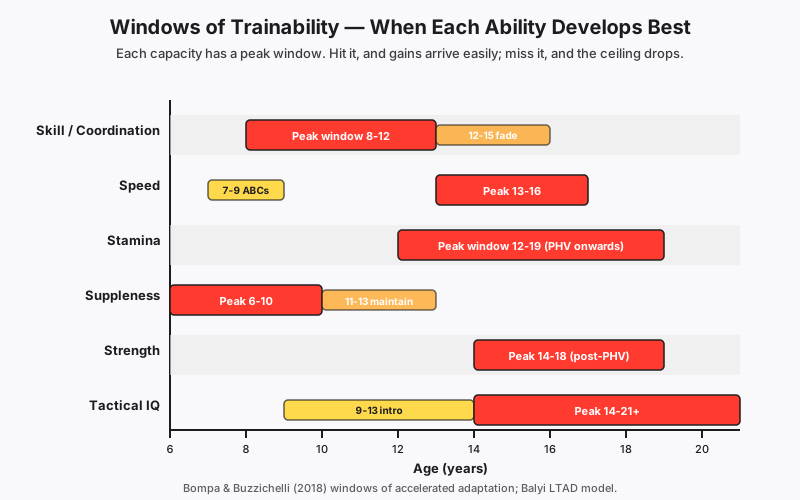
The Golden Age (ages 9-12) is a period well-suited for motor skill acquisition, but the notion that 'it's too late if you miss this window' is neuroscientifically incorrect. As Scammon's growth curves show, the nervous system reaches approximately 95% of adult levels by age 12, yet the brain's neural plasticity continues throughout life. This article explains optimal training approaches from the Pre-Golden Age through the Post-Golden Age, grounded in the LTAD (Long-Term Athlete Development) framework and the latest neuroscience evidence.
What Is the Golden Age — Scammon's Growth Curves and the Science of Neural Development
The Golden Age refers to the period around ages 9-12, when the nervous system undergoes rapid development. According to Scammon (1930), the nervous system develops remarkably early compared to other organ systems, reaching approximately 95% of adult levels by age 12.

Photo by Steve DiMatteo on Unsplash
The concept of the 'Golden Age' originates from the growth curves published in 1930 by American medical scientist Richard Scammon (Scammon's Growth Curves). Scammon classified human body growth into four patterns — general (skeletal and muscular), neural (brain and nervous system), lymphoid (immune system), and genital (reproductive glands) — and demonstrated that each reaches its peak of development at a different time.
The 'Window' Revealed by the Neural Growth Curve
The neural growth curve is remarkably distinctive. The nervous system, which is already at approximately 25% of adult levels at birth, reaches about 90% by age 6 and approximately 95% by age 12. This period of rapid development is precisely why it is called the 'Golden Age.' During this time, when neural circuits form at high speed, the acquisition of new movement patterns — that is, skill learning — takes place in a physiologically advantageous environment.
The Mechanism of Myelination
The key to skill acquisition lies in myelination. Myelin is a fatty sheath that wraps around nerve fibers, accelerating the transmission speed of electrical signals by up to 100 times. When a movement is practiced repeatedly, myelination of the neural circuits involved in that movement is promoted, allowing the movement to be executed faster, more accurately, and with less conscious effort. Ages 9-12 are a period when this myelination is particularly active.
Synaptic Pruning
Equally important is synaptic pruning. The infant brain forms an excess of synaptic connections, and from infancy through adolescence, infrequently used connections are eliminated (pruned). This process operates on the 'use it or lose it' principle. Gaining diverse movement experiences during the Golden Age means keeping a wide range of neural circuits marked as 'in use,' thereby preserving a broad foundation for future athletic ability.
Key point: The Golden Age is not a 'magic window' but rather 'a period when the nervous system develops especially rapidly.' Experiences during this time are important, but that does not mean 'only this period matters.'
Pre-Golden Age (Ages 5-8) — Diverse Movement Experiences Through Play Are Most Important
During the Pre-Golden Age (ages 5-8), diverse movement experiences through play are more effective for building the neural foundation than learning specific sport techniques. In the LTAD framework, this is positioned as the 'FUNdamentals' stage.
In the LTAD (Long-Term Athlete Development) framework proposed by Balyi & Hamilton (2004), ages 5-8 are defined as the 'FUNdamentals' stage. As the name suggests, the top priority is combining fun (FUN) with fundamental movement skills (Fundamentals).
Fundamental Movement Skills to Develop During This Period
- Running, jumping, throwing — Locomotor skills (locomotion)
- Catching, kicking, striking — Manipulative skills (manipulation)
- Balance, rotation, landing — Stability skills (stability)
- Rhythm and timing — Physical coordination to music and rhythmic cues
- Spatial awareness — Understanding the positional relationship between one's body, surrounding objects, and other people
The Scientific Reason Multi-Sport Is Essential
If a child specializes exclusively in soccer during this period, their footwork may improve, but there is a risk that neural circuits for movement patterns such as throwing, catching, and rotating will not be sufficiently formed before synaptic pruning takes hold. Research by Ford et al. (2012) found that athletes who specialized in a single sport early had higher injury risk and elevated rates of burnout.
What Parents Should Keep in Mind
- Ensure at least two different types of physical activity per week (e.g., soccer plus swimming, gymnastics, tag, etc.)
- Use 'Did you have fun?' and 'Did you try something new?' as evaluation criteria rather than 'How well did you perform?'
- Prioritize free play where children create their own challenges over adult-directed repetitive drills
- Avoid excessive pressure around winning and results; instead, acknowledge effort and the learning process
LTAD principle: International longitudinal studies show that athletes who specialize early at ages 5-8 may lead their peers in the short term, but tend to be surpassed by multi-sport athletes after age 15.
Golden Age (Ages 9-12) — A Prime Window for Skill Acquisition, but Not 'Magic'
During the Golden Age (ages 9-12), the nervous system approaches maturity, and the efficiency of acquiring complex motor skills is at its highest. However, it is important to understand that this period's advantage is 'special but not exclusive.'

Photo by Matthew Osborn on Unsplash
The LTAD framework positions this period as the 'Learning to Train' stage. At this stage, when fundamental movement abilities have already been established, it is considered optimal to begin introducing sport-specific technical training in earnest.
Why Skill Acquisition Is Efficient During This Period
From a neuroscience perspective, there are three reasons why skill acquisition is highly efficient during this period. First, the nervous system has reached a high level of maturity, providing the neural foundation needed to process complex coordination patterns. Second, myelination is actively progressing, meaning the efficiency of reinforcing neural circuits through repetitive practice is high. Third, the stable hormonal environment before puberty allows athletes to focus on technique without being disrupted by rapid physical changes.
Soccer Training to Focus on During This Period
- Ball mastery — Learning diverse patterns of touch, dribbling, and turning with both feet
- Kicking technique — Differentiating between inside, instep, and outside kicks and improving accuracy
- 1v1 attacking and defending — Fundamentals of feints, spacing, and body positioning
- Cognitive skills — Building the habit of scanning, improving decision-making speed, and learning basic positioning
- Introduction to group tactics — Small-sided combinations such as 2v1 and 3v2
Why It's Not 'Magic'
When the Golden Age concept becomes overly mythologized, it creates anxiety among parents and coaches that they must 'perfect everything during this period.' However, as motor learning research by Anderson & Sidaway (1994) demonstrates, the mechanisms for acquiring motor skills function regardless of age. The Golden Age is the period when efficiency is 'at its highest' — not 'the only' period. New skills can be acquired after age 13, after age 20, and beyond.
Important: The 'quality' of practice is far more decisive than the 'quantity.' Ten hours per week of deliberate practice is more effective for skill improvement than 20 hours per week of rote repetition.
For parents: It is natural for children at this age to say 'I want to play more soccer.' However, ensure that the total weekly activity time does not exceed the child's age (in years) multiplied by one hour (e.g., no more than 10 hours per week for a 10-year-old). This is the safety guideline recommended in the position statement by Myer et al. (2015).
Post-Golden Age (Ages 13-15) — Dramatic Physical Changes and Tactical Maturation
The Post-Golden Age (ages 13-15) is a period of adapting to the dramatic physical changes of puberty while experiencing a dramatic leap in tactical understanding and decision-making ability. Temporary instability in technique is a normal part of development, and there is no need for alarm.
Corresponding to the 'Training to Train' stage in the LTAD framework, this period brings the greatest physical and psychological changes. Rapid growth spurts (PHV: Peak Height Velocity) can temporarily reset the body awareness athletes had built up.
How Puberty's Physical Changes Affect Performance
- Rapid height increase — Changes in limb proportions cause temporary instability in ball control and running form
- Musculoskeletal development — Bone growth outpaces muscle growth, temporarily reducing flexibility. The risk of growth-related conditions such as Osgood-Schlatter disease and Sever's disease increases
- Hormonal fluctuations — Surges in testosterone and estrogen lead to greater emotional volatility, affecting concentration and motivation
- Widening physical differences — The gap between early and late maturers becomes most pronounced, creating significant physical ability differences even within the same school year
Prefrontal Cortex Development and the Leap in Tactical Understanding
On the other hand, this period sees rapid development of the prefrontal cortex — the brain region responsible for judgment, planning, and abstract thinking. What was 'instinctively good play' up through the Golden Age can now be understood logically as 'why that play was effective.' Cognitive training such as analysis using tactical boards, reviewing match footage, and understanding game models begins to yield significant results at this stage.
Training Priorities for This Period
- Technique reconstruction — Fine-tuning form to match physical changes (prioritize stabilizing existing skills rather than rushing to add new ones)
- Deepening tactical understanding — Introduce position-specific roles, team tactics, and situational decision-making training in earnest
- Mental health support — Provide psychological support for loss of confidence and temporary performance plateaus caused by physical changes
- Injury prevention — Consistently implement stretching, warm-up, and cool-down routines to prevent growth-related conditions
- Addressing the Relative Age Effect (RAE) — Ensure equal opportunities not only for early maturers but also for late maturers
For parents of late-maturing athletes: It is not uncommon for players who are physically smaller at age 13 to catch up and surpass their peers by age 17 and beyond. Barcelona's Xavi and Iniesta both reached the pinnacle of world soccer despite their small stature. Physical differences at this age do not predict future ability.
'Too Late' Is a Myth — Neural Plasticity Lasts a Lifetime
'It's too late if you missed the Golden Age' is scientifically incorrect. The brain's neural plasticity is maintained throughout life, and acquiring new motor skills remains possible after adolescence. Multiple studies show that later specialization correlates with reaching elite-level performance.
As the term 'Golden Age' has taken on a life of its own, misconceptions have spread — such as 'you can't become a top player unless you start soccer by age 10' or 'if skills aren't perfected during the Golden Age, it's too late.' However, this clearly contradicts the findings of neuroscience.
Neural Plasticity Does Not Disappear With Age
The brain's neural plasticity — the formation of new neural connections and strengthening of existing ones — is maintained throughout life. While plasticity is indeed higher during the Golden Age, it does not 'drop to zero' afterward; it simply 'gradually becomes less efficient.' In fact, adult professional athletes continue to acquire new skills. Cristiano Ronaldo dramatically changed his playing style in his late 30s, and Robert Lewandowski developed new finishing patterns at age 34.
Evidence for Later Specialization
Research by Ford et al. (2012) compared the childhood activity patterns of elite and sub-elite soccer players and found that elite players had lower rates of early specialization and more experience with 'deliberate play' and multi-sport participation. In other words, players who 'gained diverse experiences and specialized later' tended to reach higher ultimate performance levels than those who 'started early and improved quickly.'
- Zlatan Ibrahimovic — Practiced taekwondo and soccer simultaneously as a youth. The body balance and acrobatic movement cultivated through martial arts shaped his one-of-a-kind playing style
- Roger Federer — Played soccer, basketball, badminton, skiing, and other sports until age 12. His specialization in tennis came relatively late
- Shohei Ohtani — Also experienced badminton and swimming in middle school. Multi-sport experiences laid the foundation for his two-way pitching and hitting ability
'Deliberate Practice' Quality Trumps Both Volume and Starting Age
Motor learning research by Anderson & Sidaway (1994) demonstrates that 'deliberate practice' — with appropriate feedback and progressive task design — has a more decisive impact on skill acquisition than age or starting point. What matters is not 'when you started' but 'how you practice.' Even starting soccer at age 13, it is entirely possible to grow under high-quality deliberate practice and excellent coaching.
The most important thing: For a child, 'too late' is not about missing the Golden Age — it's about losing the passion for sports. Burnout caused by early specialization is the true risk of something being 'too late.'
References
- [1] Scammon, R. E. (1930). “The measurement of the body in childhood” In Harris, J. A., Jackson, C. M., Paterson, D. G., & Scammon, R. E. (Eds.), The Measurement of Man, University of Minnesota Press, 173-215.
- [2] Balyi, I., & Hamilton, A. (2004). “Long-term athlete development: trainability in childhood and adolescence” Olympic Coach, 16(1), 4-9.
- [3] Ford, P. R., Ward, P., Hodges, N. J., & Williams, A. M. (2012). “The role of deliberate practice and play in career progression in sport: the early engagement hypothesis” High Ability Studies, 23(1), 65-75. Link
- [4] Myer, G. D., Jayanthi, N., DiFiori, J. P., Faigenbaum, A. D., Kiefer, A. W., Logerstedt, D., & Micheli, L. J. (2015). “Sport specialization, part I: does early sports specialization increase negative outcomes and reduce the opportunity for success in young athletes?” Sports Health, 7(5), 437-442. Link
- [5] Anderson, D. I., & Sidaway, B. (1994). “Coordination changes associated with practice of a soccer kick” Research Quarterly for Exercise and Sport, 65(2), 93-100. Link
Related Articles
Multi-Sport Participation for Elementary-Age Athletes — The Scientific Case Against Early Specialization and a Practical Guide to Cross-Training
8 min read
Cross-Training for Junior-High Soccer Players — A Strategic Approach to Standing Out at Tryouts
9 min read
Traits of Kids Who Excel in Soccer — 5 Growth Factors Backed by Sports Science
16 min read
The Science of Core Training for Kids — Age-Specific Programs and Their Impact on Soccer
15 min read
Soccer Training to Get Faster — 5 Methods Proven by Sprint Science
14 min read
Track Your Growth with Footnote
Just record your matches — AI analyzes every 5 games. Visualize growth with PVS Score. All features free during beta.
30-second signup · No credit card required
Last updated: 2026-05-06 ・ Footnote Editorial