20 Tactical Revolutions That Changed Soccer — From Catenaccio to the Inverted Full-Back, Traced Through the Great Managers and Players
The history of soccer is a series of tactical revolutions. The WM formation invented by Herbert Chapman in the 1920s, Catenaccio in the 1960s, Total Football in the 1970s, Tiki-Taka in the 2000s, and the Inverted Full-Back of today — in every era, visionary managers have swept the world with tactical innovations that overturned conventional wisdom. This article examines 20 tactics that genuinely shaped the global game, presented chronologically alongside the specific managers, players, and clubs that brought them to life.
The Early Revolutions — The Birth of Formations (1920s–1950s)
The starting point of soccer tactics. An era when 'everyone runs wherever they like' gave way to structured formations.
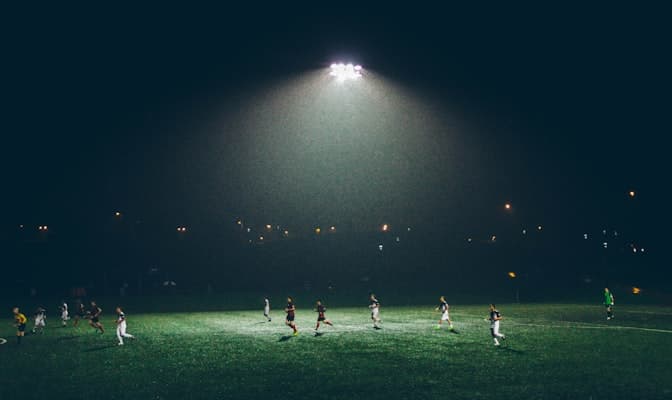
Photo by Abigail Keenan on Unsplash
1. The WM Formation — Herbert Chapman (Arsenal, 1925–1934)
In response to the 1925 offside-rule change (from three defenders to two), Arsenal manager Herbert Chapman devised the 3-2-2-3 (W-M) formation. It dramatically improved defensive stability compared to the prevailing 2-3-5 and established the concept of the 'half-back,' creating the first clear division between attacking and defensive duties. Arsenal won the league five times in the 1930s with this system — a revolutionary tactical breakthrough.
2. The Mighty Magyars — Gusztáv Sebes (Hungary, 1950–1954)
Built around Ferenc Puskás, the Hungarian national team deployed center-forward Nándor Hidegkuti as a deep-lying false center-forward, recording a 31-match unbeaten run over four years. Their 6-3 demolition of England at Wembley in 1953 — the 'Match of the Century' — signaled the end of the WM era. Hidegkuti's withdrawn role was the prototype for the 'false 9' that Messi would perfect 60 years later.
Italian Intelligence — The Art of Defensive Tactics (1960s–1980s)
'To win, you must first stop conceding.' Italian masterminds elevated defensive play to an art form.
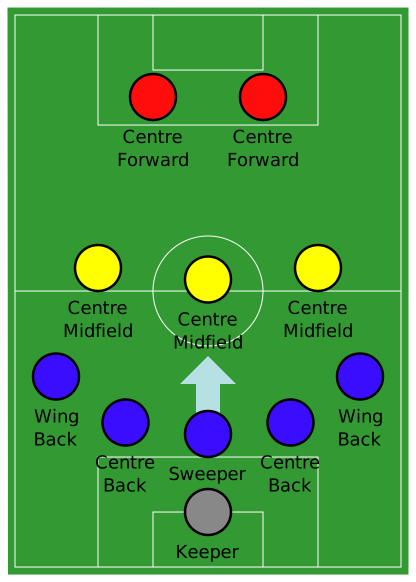
3. Catenaccio — Helenio Herrera (Inter Milan, 1960–1968)
Meaning 'the chain' or 'door-bolt' in Italian, Catenaccio placed a sweeper (libero) behind the back line and combined strict man-marking with devastating counter-attacks. Herrera's Inter, with Armando Picchi as libero and Sandro Mazzola and Jair as creative outlets, won back-to-back European Cups (1964–65). Criticized as negative, it nonetheless embedded the 'beauty of the 1-0 victory' into Italian soccer's DNA.
4. Zone Press — Arrigo Sacchi (AC Milan, 1987–1991)
The culmination — and revolution — of Italian defensive tactics. Sacchi shifted from man-marking to zonal defense, with a coordinated four-man back line that weaponized the offside trap. His AC Milan, featuring Franco Baresi, Paolo Maldini, Ruud Gullit, and Marco van Basten, won consecutive European Cups (1989–90). His demand that the distance from the defensive line to the attacking line stay within 25 meters is the direct ancestor of the modern high press.
The core of Sacchi's revolution: 'Don't chase the player on the ball — eliminate the space.' This was heresy in man-marking-obsessed Italy, yet it became the foundation of modern defensive principles.
The Dutch Dream — Total Football (1970s)
Every player can play every position. The most romantic tactical philosophy in soccer history, uniting freedom and structure on the pitch.
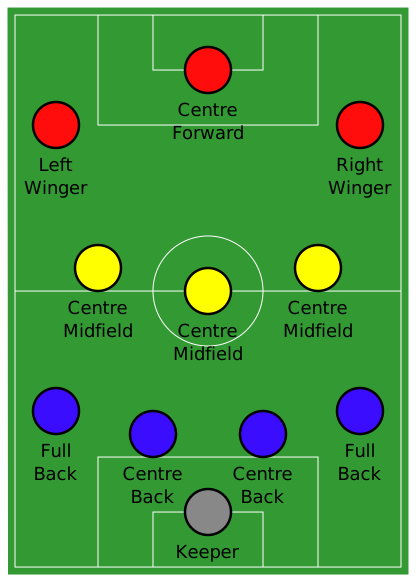
5. Total Football — Rinus Michels (Ajax & Netherlands, 1970–1974)
Centered on Johan Cruyff, this revolutionary system had every player fluidly interchanging positions. Defenders joined the attack; forwards dropped back to defend. Positions were not fixed — 'space' determined each player's role. Ajax won three consecutive European Cups (1971–73), and the Netherlands reached the 1974 World Cup final. Cruyff's positional interchanges and coordinated pressing connect directly to Guardiola's football 50 years later.
6. Cruyff's Barcelona — The Dream Team (FC Barcelona, 1988–1996)
After retiring as a player, Cruyff took charge at Barcelona and transplanted the Total Football philosophy to Catalonia. With Ronald Koeman as the ball-playing anchor in defense and Pep Guardiola as the midfield conductor, he delivered Barcelona's first Champions League title (1992) and four consecutive La Liga crowns. This 'Dream Team' laid the groundwork for the Tiki-Taka that Guardiola would later perfect. The emphasis on La Masia (the youth academy), the commitment to possession, and the belief in beautiful soccer — it all started here.
The Possession Revolution — Tiki-Taka and Its Evolution (2000s–2010s)
Dominate the opponent by keeping the ball. The golden age when possession football conquered the world.
7. Tiki-Taka — Pep Guardiola (FC Barcelona, 2008–2012)
With the midfield trio of Xavi Hernández, Andrés Iniesta, and Sergio Busquets, plus Lionel Messi deployed as a 'false 9,' Barcelona wielded 70%+ possession as a weapon, winning three La Liga titles and two Champions League trophies. Stringing together over 800 passes per match, they defended by denying opponents the ball — an attack-and-defense-in-one possession style dubbed 'Tiki-Taka' that clubs worldwide rushed to imitate.
8. The False 9 — Messi × Guardiola (2009–2012)
In a 2009 Champions League match against Roma, Guardiola first deployed Messi as a false 9 — dropping from the center-forward position deep into midfield. As Messi pulled center-backs out of position, the space left behind was exploited by overlapping wingers. The concept reached its apex in the 2009 CL final (2-0 vs. Manchester United). It spawned a generation of 'withdrawn forwards,' including Roberto Firmino at Liverpool and Antoine Griezmann at Atlético Madrid.
9. Spain's Tiki-Taka — Luis Aragonés & Vicente del Bosque (2008–2012)
Extending Barcelona's philosophy to the national team, Spain achieved an unprecedented three consecutive major-tournament victories: Euro 2008, the 2010 World Cup, and Euro 2012. Iniesta's extra-time winner against the Netherlands in the 2010 World Cup final remains iconic. No national team had ever demonstrated such sustained possession dominance. This era witnessed both the zenith and the decline of Tiki-Taka.
The limits of Tiki-Taka: At the 2014 World Cup, Spain were eliminated in the group stage, including a 1-5 rout by the Netherlands. It proved that 'possession for possession's sake' was not enough to win — and accelerated the rise of the next tactical revolution: Gegenpressing.
The Press Revolution — Gegenpressing and High Lines (2010s)
'The best moment to attack is the instant you win the ball back.' Pressing tactics rewrote the rulebook.
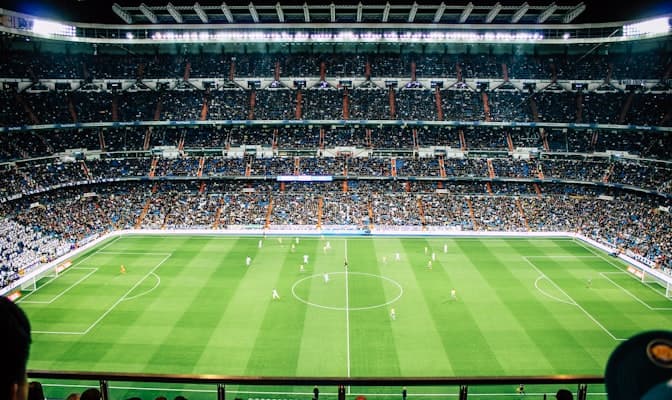
Photo by Thomas Serer on Unsplash
10. Gegenpressing — Jürgen Klopp (Borussia Dortmund, 2008–2015)
German for 'counter-pressing,' Gegenpressing prioritizes an immediate, all-hands press the moment the ball is lost to win it back as quickly as possible. Klopp's Dortmund, with Robert Lewandowski, Marco Reus, and Mario Götze, won back-to-back Bundesliga titles (2011–12) and reached the 2013 Champions League final. The philosophy that 'the most dangerous moment is not when you have the ball, but when you win it back' became the definitive antithesis of Tiki-Taka.
11. Heavy Metal Football — Klopp (Liverpool, 2015–2024)
At Liverpool, Klopp evolved Gegenpressing by pairing it with a fluid front three of Mohamed Salah, Sadio Mané, and Roberto Firmino. Firmino served as the press trigger, while Salah and Mané finished on the counter. The result was a Champions League title (2019) and a Premier League crown (2020), forging 'the greatest rivalry in Premier League history' with Guardiola's Manchester City.
12. Bielsa's High Line — Marcelo Bielsa (Athletic Bilbao & Leeds, 2011–2022)
Nicknamed 'El Loco' (The Madman), Bielsa combined an extreme high line with man-marking-oriented pressing in aggressive formations like 3-3-1-3. At Bilbao, he wrested the Copa del Rey from Barcelona; at Leeds, he won promotion from the Championship. Guardiola once called him 'the manager who best understands soccer.' Bielsa's coaching tree is vast — Pochettino, Simeone, and Gallardo among them — his tactical influence immeasurable.
Defensive Pragmatism — The Counter-Attack Renaissance (2010s)
'Beautiful football' is not the only football. The tactics of the realists who prioritize results.
13. Counter-Attack Tactics — José Mourinho (Inter Milan, 2008–2010)
Mourinho elevated the 'park the bus' approach — derided by purists — into an art form. In the 2010 Champions League semifinal against Barcelona, his Inter, featuring Samuel Eto'o, Wesley Sneijder, and Diego Milito, shut down Tiki-Taka at Camp Nou. They went on to beat Bayern Munich 2-0 in the final, delivering the Italian club's first treble in 45 years. It was the pinnacle of the 'neutralize the opponent's strengths' school of thought.
14. Atlético's Defensive Block — Diego Simeone (Atlético Madrid, 2011–present)
Simeone brought Atlético La Liga titles (2014, 2021) and two Champions League runner-up finishes. His relentlessly drilled 4-4-2 low and mid-block, anchored by Diego Godín, Koke, and Antoine Griezmann, inflicted 'organized pain' on Barcelona and Real Madrid year after year. The final-day La Liga comeback over Barcelona in 2014 showed the world the resilience of a truly defensive side.
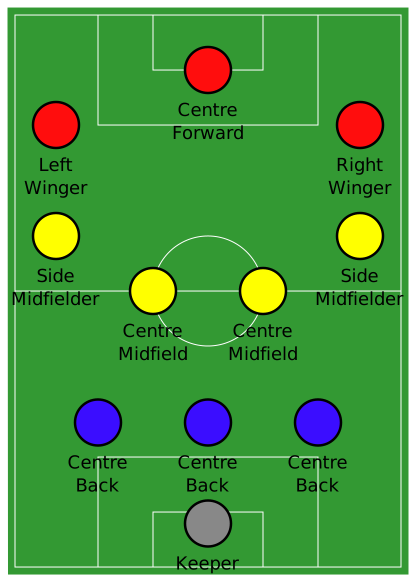
15. The Back Five / 3-4-3 — Antonio Conte (Juventus & Chelsea, 2011–2018)
Conte gave the 3-back + wing-back 3-4-3 (becoming a 5-4-1 without the ball) a modern makeover. At Juventus he won three consecutive Serie A titles; at Chelsea he claimed the 2016-17 Premier League with Victor Moses and Marcos Alonso as wing-backs, N'Golo Kanté and Nemanja Matić as the double pivot providing defensive solidity, and Eden Hazard and Diego Costa leading the attack. The 3-4-3 wave he started swept across world football, inspiring clubs everywhere to experiment with three at the back.
Modern Positional Play — The Next Stage of Guardiola's Evolution (2010s–2020s)
What lies beyond Tiki-Taka. The concept of positional play raised soccer's tactical intelligence to a new dimension.
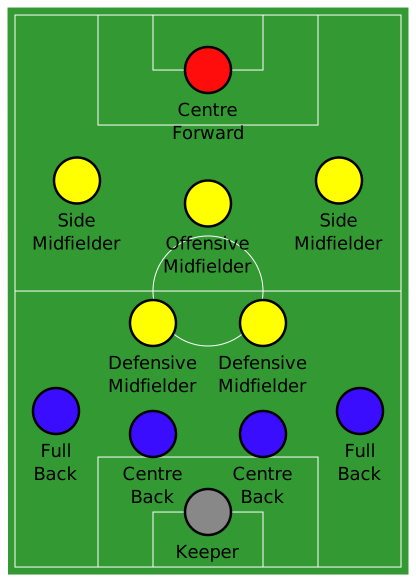
16. Positional Play (Juego de Posición) — Guardiola (Bayern Munich & Man City, 2013–present)
The tactical system Guardiola evolved from his Barcelona-era Tiki-Taka. The pitch is divided into five vertical lanes, with at least one player occupying each lane to create 'structural superiority.' The goal is not to pass for passing's sake but to take up the right positions so that passing lanes emerge automatically. Three consecutive Bundesliga titles at Bayern and four straight Premier League titles plus a Champions League crown (2023) at Manchester City demonstrated its fully realized form.
17. The Inverted Full-Back — Guardiola (Manchester City, 2022–)
Instead of hugging the touchline in attack, the full-back cuts inside to occupy central midfield, a revolutionary reinterpretation of the role. João Cancelo and Kyle Walker were its primary practitioners, and the concept was a cornerstone of City's 2022-23 treble. By moving the full-back centrally, the wingers (Phil Foden, Bernardo Silva) receive vast space on the flanks while the team simultaneously secures a numerical advantage in midfield. The idea traces back to Guardiola's use of Philipp Lahm at Bayern and is now imitated by clubs worldwide.
18. The Five-Lane Theory — The Science of Spatial Domination
The pitch is divided into five vertical lanes — left flank, left half-space, center, right half-space, right flank — with particular emphasis on controlling the half-spaces (the zones between each center-back and full-back). Kevin De Bruyne and David Silva's ability to unlock defenses from the half-space is a textbook application of this theory. Adopted not only by Guardiola but also by younger coaches like Nagelsmann and Ten Hag, the five-lane model has become a 'common language' of the modern game.
The Latest Trends — Tactical Evolution in the 2020s
Vertical Tiki-Taka, the sweeper-keeper, the false winger — soccer tactics continue to evolve at pace.

Photo by Jeffrey F Lin on Unsplash
19. Vertical Tiki-Taka — Hansi Flick (Bayern Munich, 2019–2021)
A fusion of Guardiola's possession game and Klopp's Gegenpressing into a vertically direct brand of possession football. Flick's Bayern, with Lewandowski, Müller, Kimmich, and Alphonso Davies, won an all-conquering sextuple including the Champions League in 2019-20 — going through the tournament unbeaten. Rather than holding possession with lateral passes, the team attacked goal at pace through vertical combinations: a new concept of Tiki-Taka built for speed.
20. The Sweeper-Keeper & the Build-Up Revolution — Manuel Neuer & Ederson
A goalkeeper who sweeps behind the high defensive line outside the penalty area and acts as the first passer in the build-up — the sweeper-keeper has become an indispensable role in the modern game. Manuel Neuer (Bayern Munich) was the trailblazer, and Ederson (Manchester City), Alisson Becker (Liverpool), and Marc-André ter Stegen (Barcelona) have carried the torch. Building from the back is now practiced by every Premier League club, and distribution quality has become a primary criterion in goalkeeper recruitment.
On the cutting edge: In 2024-25, new tactical currents keep emerging — Arteta's shape-shifting formations at Arsenal, De Zerbi's 'relational play' at Marseille, and Slot's balanced 4-3-3 at Liverpool. The evolution of tactics never stops.
Tactical Evolution Timeline — A Century of Change at a Glance
All 20 tactics plotted chronologically, showing how each emerged as an antithesis to what came before.

Photo by Robert Collins on Unsplash
- 1925 — WM Formation (Chapman, Arsenal): Adapting to the offside-rule change
- 1950 — The Mighty Magyars (Sebes, Hungary): The prototype false center-forward
- 1960 — Catenaccio (Herrera, Inter): Libero + man-marking + counter-attack
- 1970 — Total Football (Michels, Ajax): Fluid positional interchange
- 1988 — Zone Press (Sacchi, AC Milan): From man-marking to zonal defense
- 1988 — Cruyff's Barcelona (Dream Team): The foundation of Tiki-Taka
- 2008 — Tiki-Taka (Guardiola, Barcelona): The zenith of possession dominance
- 2009 — The False 9 (Messi × Guardiola): Redefining the forward
- 2008 — Spain's Golden Era (Aragonés & Del Bosque): Three consecutive titles
- 2010 — Counter-Attack Tactics (Mourinho, Inter): The answer to Tiki-Taka
- 2011 — Gegenpressing (Klopp, Dortmund): The philosophy of immediate recovery
- 2011 — Bielsa's High Line: Extreme attacking press
- 2011 — 3-4-3 / Back Five (Conte): The return of the wing-back
- 2014 — Simeone's Defensive Block (Atlético): Organized pain
- 2015 — Positional Play (Guardiola, Bayern → Man City): The five-lane theory
- 2019 — Vertical Tiki-Taka (Flick, Bayern): High-speed possession
- 2015 — The Fluid Front Three (Klopp, Liverpool): Press and counter fused
- 2020 — The Sweeper-Keeper Goes Mainstream (Neuer, Ederson)
- 2022 — The Inverted Full-Back (Guardiola, Man City): Reinventing the full-back
- 2024 — The Five-Lane Theory Goes Global (adopted by clubs worldwide)
Tactical evolution is a cycle of problem and solution. When one tactic rises to dominance, a counter-tactic appears, which in turn provokes a counter to the counter. This dialectic is the driving force that has kept soccer captivating for over a century.
Frequently Asked Questions
What is the difference between Tiki-Taka and positional play?▾
Tiki-Taka refers to a 'playing style' characterized by rapid short passing, while positional play is a 'tactical concept' that creates numerical and qualitative superiority through optimal positioning on the pitch. Guardiola himself dislikes the term 'Tiki-Taka' and calls his approach 'positional play.' It helps to think of Tiki-Taka as one expression of the broader positional-play framework.
What is the difference between Gegenpressing and a high press?▾
A high press is a general term for disrupting the opponent's build-up from an advanced position on the pitch. Gegenpressing (counter-pressing) is more specific: it refers to the all-out effort to win the ball back in the few seconds immediately after losing it. Gegenpressing is a subset of the high press, focused specifically on the transition moment between attack and defense.
Why is the inverted full-back so effective?▾
Traditional full-backs stay wide in attack, but inverted full-backs tuck inside to add numbers in central midfield. This delivers three benefits: (1) numerical superiority in midfield, (2) wide-open space on the flank for the winger, and (3) the ability to counter-press centrally the moment the ball is lost. At Guardiola's Manchester City, Cancelo and Walker fulfilled this role and were instrumental in the 2022-23 treble.
Why should youth players study these tactics?▾
Understanding tactical history helps players grasp 'why' they should be in a certain position and 'why' they should press at a certain moment. When every action on the pitch has intent behind it, in-game decision-making speeds up. With Footnote's match-recording and AI-analysis features, players can objectively see how their own play measures up in tactical terms.
References
- [1] Wilson, J. (2008). “Inverting the Pyramid: The History of Football Tactics” Orion Publishing Group.
- [2] Perarnau, M. (2016). “Pep Guardiola: The Evolution” Arena Sport.
- [3] Cox, M. (2017). “The Mixer: The Story of Premier League Tactics” HarperCollins.
- [4] Honigstein, R. (2018). “Klopp: Bring the Noise” Yellow Jersey Press.
Related Articles
The Complete Cross-Training Guide for Soccer — 20 Science-Backed Sports That Transfer to the Pitch
15 min read
Anticipation and Reading the Game — The Science of Prediction That Racket Sports Can Teach You
11 min read
Spatial Cognition — The Science of Reading Space, Trained Through Team Sports
10 min read
The Modern SB (#2/#3 Role) — Classic Full-Back, Attacking Wing-Back, and Inverted Full-Back: Side-Back Evolution
9 min read
Metacognition Training — The Science Behind 'Thinking Soccer' and How to Develop It Through Journaling
12 min read
Track Your Growth with Footnote
Just record your matches — AI analyzes every 5 games. Visualize growth with PVS Score. All features free during beta.
30-second signup · No credit card required
Last updated: 2026-05-06 ・ Footnote Editorial