The Modern SB (#2/#3 Role) — Classic Full-Back, Attacking Wing-Back, and Inverted Full-Back: Side-Back Evolution
The SB (Side Back / Full Back, #2 and #3) has evolved from the classic Maldini/Cafú template into the attacking wing-back (Trent Alexander-Arnold, Achraf Hakimi) and now the inverted full-back (João Cancelo, Joshua Kimmich) — fullbacks who drift centrally and function as midfielders. Bradley et al. (2010) shows the modern SB covers 11.5 km per match with 50+ sprints, a workload comparable to wingers. Pep Guardiola's inverted full-back at Manchester City revolutionized the role: the SB tucks into central midfield, performing CMF-grade build-up. This article defines three archetypes (classic SB, attacking WB, inverted FB), maps four functions (defense, crossing, build-up, sprint endurance), explains five metrics, and outlines youth development priorities.
Evolution of the SB — From Defender to Hybrid Midfielder
The 1990s SB was defense-first. The 2000s saw Cafú/Roberto Carlos standardize attacking participation. The 2010s brought Trent Alexander-Arnold, who redefined the SB as an assist machine. The 2020s have brought the inverted full-back — fundamentally restructuring the position.

Photo by Tim Mossholder on Unsplash
1990s — Defense-First SB Era (Maldini / Bergomi / Early Roberto Carlos)
The 1990s SB stayed wide and defended. Paolo Maldini anchored Milan's left back for 25 seasons, world-best in 1v1 defending against wingers. Total distance was 9-10 km, sprint count around 30 — roughly half the load of the modern SB (11.5 km / 50 sprints).
2000s — The Attacking SB Era (Cafú / Roberto Carlos / Lahm)
Brazil's Cafú and Roberto Carlos made attacking SB play global. Cafú motored up and down the right flank for the full 90, balancing crossing and press resistance. Roberto Carlos buried 35m direct free-kicks (the legendary 1997 banana FK vs France). Philipp Lahm played both fullbacks at Bayern with a technician's profile, enabling tactical flexibility.
2010s — The Trent Alexander-Arnold Revolution
Liverpool academy product Trent Alexander-Arnold posted AM-level assist totals from right back. 13 assists in 2019-20 — the most ever by a Premier League SB. xA 0.32 puts him at AM level. He shifted SB evaluation from 'defense' to 'assists.'
2020s — Pep's Inverted Full-Back Revolution
Pep Guardiola's inverted full-back at Manchester City — João Cancelo, Joshua Kimmich, late-career Lahm — pulls the SB into central midfield, where they perform CMF-grade build-up. In the 2022-23 UCL-winning Manchester City, Stones inverted from right SB to DMF, forming a three-DM triangle in a flexible 4-1-2-3.
The modern SB is no longer a 'wide defensive specialist.' It is a complete position requiring two-way play, build-up, and stamina. With inverted full-backs becoming standard, SBs frequently double as CMFs or even AMs.
Three Archetypes — Classic SB, Attacking WB, Inverted FB
Modern SBs split into three archetypes by attack/defense balance and movement: classic SB (defense-heavy), attacking WB (line-breaking), inverted FB (drifts central).
1. Classic SB
- Placement — fullback in 4-4-2 / 4-2-3-1 / 5-3-2
- Movement — defends the line; limited overlapping
- Required skills — 1v1 defense, aerials, crossing, line management
- Examples — Antonio Rüdiger (when at SB), peak César Azpilicueta, Fabio Coentrão
- Profile — defense-specialized, limited attacking participation
2. Attacking Wing-Back
- Placement — WB in 3-5-2 / 3-4-3, attacking SB in 4-3-3
- Movement — runs the full flank for 90 minutes — between SB and WG
- Required skills — sprint, crossing, 1v1 dribbling, stamina
- Examples — Achraf Hakimi (PSG), Theo Hernández (Milan), Alphonso Davies (Bayern), Andrew Robertson (Liverpool)
- Profile — when attacking, threatens like a winger
3. Inverted Full-Back
- Placement — SB in 4-3-3 who tucks into CMF / DMF when attacking
- Movement — defends as SB; drifts into central midfield in possession
- Required skills — CMF-grade pass quality, ball retention, cognition
- Examples — João Cancelo (peak Manchester City), Joshua Kimmich (Bayern), late-period Trent Alexander-Arnold, John Stones (CB → SB → DMF)
- Profile — SB/CMF hybrid; the most technically demanding archetype
Inverted FB is the central tactical trend of the late 2020s. Perfected at Manchester City under Pep, now spreading to Arsenal, Bayern, Real Madrid, and other top clubs.
Four Functions — Defense / Crossing / Build-Up / Sprint Endurance
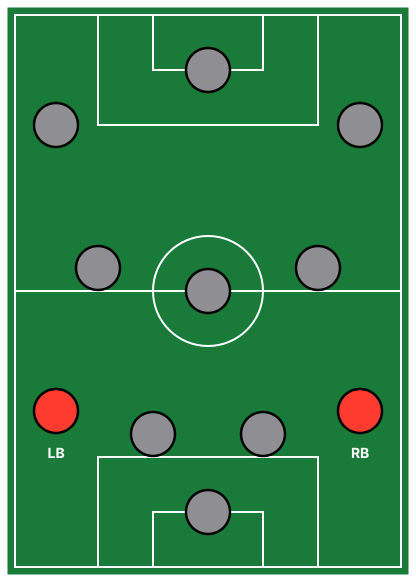
A modern SB combines four functions: 1v1 defense against wingers, crossing from the flank, build-up participation, and 90 minutes of high-intensity running. Mix shifts by archetype, but all four must be performed at minimum.
Function 1: Defensive Duty
1v1 defense against opposing wingers is the most important function. Top Premier League SBs hit 60-70% in 1v1s. Peak Trent 65%, Robertson 68%, Hakimi 62%. SBs with weak defense don't get selected even with strong attacking output (e.g., Marcelo's reduced minutes in late-period Real Madrid).
Function 2: Crossing
Cross to the CF/WG from the flank. Trent's 13 assists in 2019-20 is the all-time Premier League SB record. Top crossing accuracy is 30-40%. Modern SBs must also switch to early crosses and through-balls.
Function 3: Build-Up
Receive from the GK/CB and distribute to CMF/WG. Inverted full-backs must hit 88-92% pass completion — CMF level. Cancelo (peak) 91%, Kimmich 92%, Trent 90%.
Function 4: Sprint Endurance
Sustained high-intensity running for 90 minutes is the SB's physical core. Bradley et al. (2010) shows SBs cover 11.5 km, post 50-60 sprints, and spend 12%+ of match time running >20 km/h. Hakimi, Davies, and Theo Hernández are the world's fastest fullbacks at 35+ km/h max speed.
Of the four, build-up and sprint endurance are rising fastest in evaluation weight. Pep-style teams require build-up accuracy (88%+ pass completion) as a minimum; attacking systems require 50+ sprints per match.
Five Metrics for Evaluating an SB — 1v1 Defense, xA, Progressive Carries, Pass %, Sprints
Clean sheets alone miss the modern SB. 1v1 defensive win rate, xA, progressive carries, pass completion, and sprint count cover the spectrum.

Photo by PAUL MCWILLIAM on Unsplash
1. 1v1 Defensive Win %
Share of 1v1s won (defender keeps WG from beating them or crossing). SB standard: 55-70%. Top tier: 65-75%. Robertson 68%, peak Trent 65%, Hakimi 62%, Davies 70%.
2. xA (Expected Assists)
Probability that a delivered pass leads to a goal. Top SB tier: 0.20-0.40 per 90. Trent 0.32, Robertson 0.28, Hakimi 0.24 — AM level.
3. Progressive Carries
Dribbles advancing 5+ meters toward goal. SB standard: 5-10 per match. Attacking WB: 10-15. Davies 12.5, Hakimi 11.8, Theo Hernández 13.2 — league elite.
4. Pass Completion %
SB standard: 82-88%. Inverted FB tier: 88-92%. Cancelo (peak) 91%, Kimmich 92%, Stones 95% — CMF-comparable. Below 85% disqualifies in Pep-style teams.
5. Sprint Count (≥25 km/h)
High-speed runs. SB standard: 50-70 per match. Attacking WB: 60-80. Davies 65, Hakimi 60, Theo Hernández 62. SBs sustain a winger's load (50-70) for the full 90.
Roughly 25 SBs globally are above average across all five metrics. Footnote's PVS weights all five for the SB position, surfacing whether a player skews classic, attacking WB, or inverted FB.
Youth SB Development — Sprint, Bilateral Foot, Cognition, Ball Control: The Four Pillars
Aspiring SBs must train sprint endurance (90-minute repeatability), bilateral foot accuracy, cognition (full-pitch awareness), and ball control (essential for inverted FB).
1. Sprint Endurance
SBs run 11.5 km and 50+ sprints per match. By U-15, develop both max speed (10m sprint) and middle-distance capacity (YoYo Test L18+). Rumpf et al. (2016) shows that age 12-15 max-speed training is the strongest predictor of adult max speed.
2. Bilateral Skill
Left SB needs left-foot crossing accuracy; right SB needs right-foot — but both feet are needed if the player will rotate sides. Memmert (2021) found that 60:40 strong:weak through age 12 leads to balanced bilateral output. Lahm and Kimmich are archetypal two-footed both-side SBs.
3. Field Awareness
SBs must read a wide swath of the pitch — coordination with CB, position relative to CMF, opposing winger movement, all simultaneously. Roca et al. (2011) showed elite SBs scan 1.3× more than CBs. From U-13 onward, scan three reference points (inside, outside, behind) before receiving.
4. Ball Control
To aim for inverted FB, build CMF-grade ball control: tight-space turns, holding off a defender at your back, two-footed first touch. From U-12, sequence 'ball retention → cognition → ball control' in training.
The most overlooked SB development priorities are 'ball control' and 'cognition,' not just sprinting. Build weak-foot accuracy from U-12, sprint and tactical understanding from U-15, and central-midfield drills from U-18 if aiming for inverted FB.
Case Studies — Four Archetypes in Practice
We analyze Trent Alexander-Arnold (attacking SB / inverted FB hybrid), Achraf Hakimi (attacking WB perfected), João Cancelo (inverted FB original), and Andy Robertson (balanced defender).
Trent Alexander-Arnold — The Crossing Revolution Origin
Liverpool academy, lifelong Liverpudlian. Broke through as right SB in the 2018-19 UCL-winning team. 13 assists in 2019-20 — the most ever by a Premier League SB. AM-level chance creation from RB. Late period: Klopp inverted him toward midfield, and his CMF/DMF aptitude emerged. xA 0.32 — winger-grade.
Achraf Hakimi — Attacking WB Perfected
Moroccan international, Real Madrid academy, then Borussia Dortmund and Inter, then PSG in 2021. Max speed 36 km/h (league-elite), 60 sprints per match, 11.8 progressive carries — league-leading. In attack, contributes like a winger; in defense, holds 62% in 1v1. The modern attacking WB benchmark.
João Cancelo — The Inverted FB Original
Portuguese international, Benfica academy, then Valencia/Inter/Juventus, then Manchester City in 2019. Pep developed him to invert from either fullback into CMF. Selected to the 2021-22 PFA Premier League Team of the Season. Pass completion 91%, 9.5 progressive passes per match — CMF-level. The symbol of inverted FB tactical innovation.
Andy Robertson — The Balanced Defender
Scottish international, Queen's Park academy, Hull City, then Liverpool in 2017. The defensive counterweight to Trent — defense-balanced SB. League-best 68% 1v1 defensive rate. xA 0.28 and 55 sprints per match — above-average attacking output too. Anchors Liverpool's asymmetric LB/RB tactics.
All four share three traits: 90-minute high-intensity running, two-footed accuracy, and field awareness. Beyond physical traits, tactical understanding and weak-foot accuracy are the core of the modern SB.
Summary — The SB Has Evolved from "Wide Defender" to "Hybrid Midfielder"
Single-function SB play no longer survives at the top level. The three archetypes share the same baseline: high two-way output, 90-minute running, and ball-control accuracy. Building sprint + bilateral foot + cognition + ball control in youth opens the path to elite SB play.
Key takeaways:
- Evolution — defense-first (1990s) → attacking SB (2000s) → assist-machine (2010s) → inverted FB (2020s). Role expanded into central midfield
- Three archetypes — classic SB, attacking WB, inverted FB
- Four functions — defense, crossing, build-up, sprint endurance
- Five metrics — 1v1 defense, xA, progressive carries, pass completion, sprint count
- Youth development — sprint, bilateral foot, cognition, ball control. Weak foot from U-12, sprint from U-15, central drills from U-18
Footnote auto-computes the five SB metrics from match records and surfaces them as a Player Value Score (PVS) benchmarked against age-appropriate peers. "Am I closer to a classic SB, attacking WB, or inverted FB?" becomes visible.
References
- [1] Bradley P.S., Sheldon W., Wooster B., Olsen P., Boanas P., Krustrup P. (2010). “High-intensity running in English FA Premier League soccer matches” Journal of Sports Sciences.
- [2] Bradley P.S., Ade J.D. (2018). “Are current physical match performance metrics in elite soccer fit for purpose or is the adoption of an integrated approach needed?” International Journal of Sports Physiology and Performance.
- [3] Roca A., Ford P.R., McRobert A.P., Williams A.M. (2011). “Identifying the processes underpinning anticipation and decision-making in soccer” Cognition, Technology & Work.
- [4] Memmert D. (2021). “Match Analysis: How to Use Data in Professional Sport” Routledge.
- [5] Rumpf M.C., Lockie R.G., Cronin J.B., Jalilvand F. (2016). “Effect of different sprint training methods on sprint performance over various distances: A brief review” Journal of Strength and Conditioning Research.
- [6] Wallace J.L., Norton K.I. (2014). “Evolution of World Cup soccer final games 1966-2010: Game structure, speed and play patterns” Journal of Science and Medicine in Sport.
- [7] Tenga A., Holme I., Ronglan L.T., Bahr R. (2010). “Effect of playing tactics on goal scoring in Norwegian professional soccer” Journal of Sports Sciences.
- [8] Hewitt A., Greenham G., Norton K. (2016). “Game style in soccer: what is it and can we quantify it?” International Journal of Performance Analysis in Sport.
Related Articles
The Modern CB (#4 Role) — Classic Stopper, Ball-Playing CB, and the Modern Libero Revival
9 min read
The Modern WG (Winger) Role — Classic, Inverted, and Inside Forward, the Three-Type Evolution
9 min read
The Modern DM (#6 Role) — Destroyer, Deep-Lying Playmaker, and Single Pivot: Defensive Midfielder Evolution
9 min read
Soccer Position Aptitude Guide — Find Your Best Position Through Physique, Personality & Playing Style
17 min read
Soccer Training to Get Faster — 5 Methods Proven by Sprint Science
14 min read
Track Your Growth with Footnote
Just record your matches — AI analyzes every 5 games. Visualize growth with PVS Score. All features free during beta.
30-second signup · No credit card required
Last updated: 2026-05-09 ・ Footnote Editorial