The Modern WG (Winger) Role — Classic, Inverted, and Inside Forward, the Three-Type Evolution
The winger is no longer just a crosser. Pep Guardiola's Barcelona/Manchester City, Klopp's Liverpool, and modern Real Madrid all rely on inverted wingers (Salah, Mbappé) cutting in from the opposite-foot flank, and on inside forwards (Vinicius, Sané, Doku) drifting into central zones. Bradley et al. (2010)'s Premier League analysis shows wingers cover the most total distance (~12.0 km) and rack up the most high-speed sprints (60+ at 25 km/h, more than CFs and FBs). This article defines three archetypes — classic, inverted, and inside forward — and walks through their tactical roles, required skills, key metrics, and developmental priorities.
Evolution of the Winger — From Crosser to Cutting-In Goal Threat
Through the 1990s, wingers ran the touchline and crossed: the "classic" model. In the 2000s, Robben/Ribéry showed how powerful opposite-foot placement could be. The 2010s mainstreamed the inverted winger (Messi/Salah). The 2020s brought inside forwards (Vinicius/Sané) who drift centrally as auxiliary strikers.

Photo by Salah Regouane on Unsplash
1990s — Classic Winger Era (Giggs / Figo / Beckham)
Through the 1990s, wingers hugged the touchline, beat their man, and crossed. Ryan Giggs, Luís Figo, and David Beckham represent the type. Placement was strong-foot side: Giggs (left-footed) on the left, Beckham (right-footed) on the right. Crosses accounted for over 30% of their match actions (UEFA Technical Reports, 1998-2000).
2000s — Opposite-Foot Placement Emerges (Robben / Ribéry / Cristiano Ronaldo)
Arjen Robben thrived at Chelsea as a right winger (left-footed), drifting inside to shoot. Franck Ribéry mirrored him at Bayern (left, right-footed). Cristiano Ronaldo broke through at Manchester United as a left winger (right-footed) and built the prototype of the goal-scoring inverted winger.
2010s — The Inverted Winger Revolution (Messi / Salah / Mbappé)
At Pep Guardiola's Barcelona, Lionel Messi played as a right winger (left-footed) and scored at striker volumes via combinations with the false 9. Klopp's Liverpool standardized the model with Salah right (left-footed) and Mané left (right-footed), each clearing 30+ league goals. Kylian Mbappé became the world's best inverted winger as a left-foot-in-the-air predator at PSG and Real Madrid.
2020s — The Inside Forward (Vinicius / Sané / Doku)
Real Madrid's Vinicius Jr., Manchester City's Leroy Sané, and Jeremy Doku drift centrally so often that the line between winger and second striker blurs. Wallace & Norton (2014)-style tracking shows over 60% of these players' touches happen within the central 18-meter penalty-area corridor.
The evolution arc points inward: "beat the fullback and cross" → "cut inside and shoot" → "operate as an auxiliary striker." In the top leagues of 2025, the pure classic winger is now a minority profile.
The Three Archetypes — Classic, Inverted, and Inside Forward
Modern wingers split into three archetypes by foot placement (strong foot inside or outside) and movement pattern (line breaking vs. cutting in vs. central drifting). Each demands a different skill set.
1. Classic Winger
- Placement — strong-foot side (right-footed on right, left-footed on left)
- Movement — line break, then cross from the byline
- Required skills — sprint, 1v1, crossing accuracy
- Examples — Bukayo Saka (Arsenal), early Riyad Mahrez, historically Beckham/Giggs
- xA — high / shot volume — medium
2. Inverted Winger
- Placement — opposite-foot side (right-footed left, left-footed right)
- Movement — cut inside to shoot, or switch to far flank
- Required skills — ball retention, post-cut shooting accuracy, switching long balls
- Examples — Salah (Liverpool, right wing/left foot), Mbappé (left/right), Bernardo Silva
- xA — medium / shot volume — high
3. Inside Forward
- Placement — nominal winger but operates as a second striker
- Movement — drift centrally and play in parallel with the CF
- Required skills — space creation, final pass, finishing
- Examples — Vinicius Jr. (Real Madrid), Leroy Sané, Phil Foden
- xA — high / shot volume — high
The three are not fixed. Salah is fundamentally inverted, but in some Liverpool game states he becomes an inside forward, drifting centrally to combine with the CF.
Four Functions — 1v1 / Cutting In / Pressing Trigger / Goal Penetration
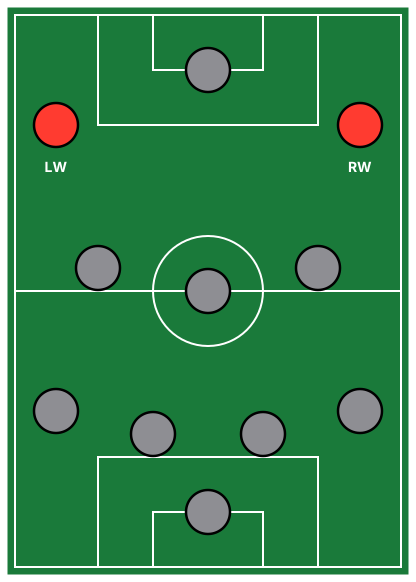
A modern winger must perform four functions: 1v1 dribbling, cutting in to create attacks, leading the pressing line, and penetrating into the box. The mix shifts by archetype, but no archetype zeroes out any of the four.
Function 1: 1v1 (One-on-One)
The classic winger function. Statsbomb data for the 2023-24 Premier League shows top-five wingers attempt 8-12 take-ons per match with 50-65% success. Vinicius Jr. averaged 4.5 successful take-ons per match, league-leading. Mbappé averaged 4.1. The 1v1 dribble is one of the highest xT (Expected Threat) actions in soccer.
Function 2: Cutting In
The defining function of the inverted winger. Cutting inside from the touchline (1) opens shooting angles, (2) sets up combinations with the central runners, and (3) enables long switches to the far flank. Salah averages 3.2 cut-ins per match in Liverpool's 2023-24 internal data, with 40% ending in shots.
Function 3: Pressing Trigger
In Klopp's gegenpressing and Pep's high press, the winger initiates pressure on the opposing CB. The angle and timing — pressing diagonally from inside-out — closes the wide passing lane and isolates the FB. Liverpool's 2018-19 UCL-winning Salah and Mané each pressed 18-22 times per match, matching or exceeding their CF Firmino.
Function 4: Goal Penetration
Not crossing — scoring. Of Vinicius Jr.'s 24 league goals in 2023-24, 76% came from inside the penalty area. Modern coaches rate goal-scoring wingers above crossing wingers.
Function balance shifts by archetype: classic emphasizes 1v1 + crossing, inverted emphasizes cutting + shooting, inside forward emphasizes goal penetration + space creation.
Five Metrics for Evaluating a Winger — xA, xG, Take-on Rate, Sprints, Progressive Carries
Crossing accuracy alone cannot capture modern winger value. Five axes — xA (Expected Assists), xG (Expected Goals), take-on success rate, sprint count, and progressive carries — cover the spectrum of what wingers actually do.

Photo by franco alva on Unsplash
1. xA (Expected Assists)
Statistical probability that a delivered pass leads to a goal, including crosses, through-balls, and lobs. Top Premier League wingers average 0.30-0.45 xA per 90 (Bukayo Saka 0.42, Bruno Fernandes 0.38).
2. xG (Expected Goals)
Expected goal value of the winger's own shots. Inverted wingers reach striker territory: 0.40-0.65 per 90 (Salah 0.55, Mbappé 0.62).
3. Take-on Success Rate
Share of attempted dribbles that beat the defender. 65%+ is elite, 50% is standard. Vinicius Jr. hit 64% in 2023-24, Doku 71% (league high).
4. Sprint Count (≥25 km/h)
High-speed runs as defined in Bradley et al. (2010). Wingers average 50-70 per match, the highest of any position — ahead of CFs (35-50) and FBs (45-60). Wingers must combine endurance and explosiveness.
5. Progressive Carries
Dribbles that advance the ball 5+ meters toward goal while in possession. Wingers lead the league at 8-15 per match. Mbappé led the 2024-25 La Liga with 13.8 per match.
Globally, perhaps 30 wingers are above average across all five axes simultaneously. Footnote's PVS weights these five for the winger position, so youth players can see exactly which axis is their weakest.
Youth Development for Wingers — Bilateral Foot, Sprint, Cognition
Aspiring wingers must build three pillars: bilateral foot accuracy, sprint capacity, and full-pitch awareness. Cutting off the weak foot in youth ends an inverted-winger career before it starts.
1. Bilateral Skill
Inverted placement is now standard, so two-footed shooting and passing are mandatory. Memmert (2021) showed that a 60:40 strong-to-weak foot ratio during the Golden Age (6-12) leads to balanced bilateral output in adulthood. Skipping the weak foot at U-12 is structurally costly later.
2. Sprint Capability
Wingers run 50-70 sprints per match. Maximum-speed work (10m sprints) by U-15 sets the ceiling. Rumpf et al. (2016) showed that age 12-15 max-speed training (plyometrics + acceleration drills) is the strongest predictor of adult max speed.
3. Field Awareness
Sitting wide forces wingers to scan the central runners constantly. Roca et al. (2011) found wingers should average 1.5+ scans per second of off-ball time. From U-13 onward, players should habitually check four points (both touchlines, central, line) before receiving.
The most overlooked development priorities are "post-cut shooting" and "weak-foot accuracy" — not crossing. Use both feet from U-12, master cut-in patterns from U-15, and the path to top-flight winger play opens up.
Case Studies — Four Archetypes in Practice
We analyze Mohamed Salah (inverted), Vinicius Jr. (inside forward), Bukayo Saka (classic), and Kingsley Coman (hybrid) to show how each archetype is executed at the elite level.
Mohamed Salah — The Inverted Winger Perfected
Salah came up through Egypt's El Mokawloon, then moved through Basel, Chelsea, and Roma before arriving at Liverpool in 2017. As a right winger (left-footed), he refined the cut-in-and-shoot pattern to its limit: 32 league goals in 2017-18 won the Premier League Golden Boot. Klopp gave him a striker's shot volume by routing him into the central shot zone, not the touchline.
Vinicius Jr. — The New-Generation Inside Forward
Brazilian Flamengo academy. Even as a U-17, he balanced touchline penetration with central drifting. After 2018 with Real Madrid and under Carlo Ancelotti, he became a left winger who functions as a second CF — 24 league goals and the UCL-winning MVP in 2023-24, with a 64% take-on rate and 65 sprints/match. The modern winger's high-water mark.
Bukayo Saka — The Modern Classic
Arsenal's Hale End academy. Originally an LB/LWB, Mikel Arteta developed him as a right-footed right winger. The classic line-break-and-cross template, augmented with cut-ins and pass combinations. League-leading 0.42 xA in 2023-24. Not just a touchline player — a both-modes winger.
Kingsley Coman — The Hybrid
PSG academy. Two-footed and effective on either flank, Coman switches between classic, inverted, and inside-forward modes within a single match at Bayern Munich. Trainability — tactical understanding plus adaptability — is his core asset. The fruit of working both positions and both feet through youth.
All four share three traits: "two-footed," "high sprint count," and "can cut inside." Even classic-style wingers in 2025 need weak-foot accuracy and central penetration as standard equipment.
Summary — The Winger Has Become "Goal Threat + Creator," Not Just a Crosser
Modern wingers cannot survive on a single function. The three archetypes (classic, inverted, inside) all require two-footedness, sprint capacity, awareness, and shooting accuracy. Building all four in youth is the path to top-flight winger play.
Key takeaways:
- Evolution — crosser (1990s) → opposite-foot cut-in (2000s) → inverted (2010s) → inside forward (2020s). The role moves inward
- Three archetypes — classic, inverted, inside forward. Distinguished by foot placement and movement pattern
- Four functions — 1v1, cutting in, pressing trigger, goal penetration. Mix varies by archetype
- Five metrics — xA, xG, take-on rate, sprints, progressive carries
- Youth development — bilateral foot, sprint, awareness. Use both feet from U-12; build max speed by U-15
Footnote auto-computes the five winger metrics from match records and surfaces them as a Player Value Score (PVS) benchmarked against age-appropriate peers. "Which archetype am I closest to?" and "Which axis should I improve next?" become visible.
References
- [1] Bradley P.S., Sheldon W., Wooster B., Olsen P., Boanas P., Krustrup P. (2010). “High-intensity running in English FA Premier League soccer matches” Journal of Sports Sciences.
- [2] Wallace J.L., Norton K.I. (2014). “Evolution of World Cup soccer final games 1966-2010: Game structure, speed and play patterns” Journal of Science and Medicine in Sport.
- [3] Rampinini E., Coutts A.J., Castagna C., Sassi R., Impellizzeri F.M. (2007). “Variation in top level soccer match performance” International Journal of Sports Medicine.
- [4] Roca A., Ford P.R., McRobert A.P., Williams A.M. (2011). “Identifying the processes underpinning anticipation and decision-making in soccer” Cognition, Technology & Work.
- [5] Memmert D. (2021). “Match Analysis: How to Use Data in Professional Sport” Routledge.
- [6] Rumpf M.C., Lockie R.G., Cronin J.B., Jalilvand F. (2016). “Effect of different sprint training methods on sprint performance over various distances: A brief review” Journal of Strength and Conditioning Research.
- [7] Wegmann J., Hülsdünker T., Mierau A. (2018). “Spatio-temporal analysis of attacking patterns in elite soccer” Frontiers in Psychology.
- [8] Tenga A., Holme I., Ronglan L.T., Bahr R. (2010). “Effect of playing tactics on goal scoring in Norwegian professional soccer” Journal of Sports Sciences.
Related Articles
The Modern CF (#9 Role) — From Classic Striker to False 9, the Evolution of Center Forwards
9 min read
Soccer Position Aptitude Guide — Find Your Best Position Through Physique, Personality & Playing Style
17 min read
PVS (Player Value Score) — Complete Guide to Footnote's Composite Player Metric
7 min read
Decision Speed in Soccer — How Pros Decide in 0.5 Seconds, and How to Train It
5 min read
Soccer Training to Get Faster — 5 Methods Proven by Sprint Science
14 min read
Track Your Growth with Footnote
Just record your matches — AI analyzes every 5 games. Visualize growth with PVS Score. All features free during beta.
30-second signup · No credit card required
Last updated: 2026-05-09 ・ Footnote Editorial