The Modern AM (#10 Role) — Classic 10, Advanced 8, and Dropping 9: A Theory of the Creative Position
The AM (Attacking Midfielder, #10) has transformed from the fantasista creator embodied by Maradona and Zidane into the 'advanced 8' represented by Kevin De Bruyne, Jude Bellingham, and Bruno Fernandes. Bradley & Ade (2018)'s Premier League tracking shows the modern AM averages 70-90 match touches and 35-50 progressive passes — the engine of central attack. This article defines three archetypes (classic 10, advanced 8, dropping 9), maps the five required functions (vision, final pass, press resistance, set-pieces, goal penetration), explains the five evaluation metrics (xA, key passes, progressive passes, pressure-pass completion, xG), and outlines youth development priorities.
Evolution of the #10 — From Fantasista to Advanced 8
In the 1980s and 90s, AMs were fantasistas — Maradona, Platini, Zidane — judged purely on creativity and largely free of defensive duty. In the 2010s, Pep Guardiola pushed the "8" forward, and the 2020s AM is a complete midfielder who defends, breaks lines, and finishes from deep.

Photo by Salah Regouane on Unsplash
1980-90s — The Fantasista Era (Maradona / Platini / Zidane)
Diego Maradona, Michel Platini, and Zinedine Zidane defined the classic trequartista. Defensive responsibilities were minimal; they were valued for creativity alone, and the system was built around them. Match touches: 60-80. Final passes: 5-8. The role centered on "beautiful play" and "creating chances."
2000s — Riquelme / Totti / Ronaldinho — The Transition
Juan Román Riquelme, Francesco Totti, and Ronaldinho carried the fantasista flag while gradually accepting partial pressing responsibilities. Totti played alongside the false 9 at Roma, and Ronaldinho proved willing to drift wide at Barcelona.
2010s — Pep's Advanced 8 (Iniesta / Silva / De Bruyne)
Pep Guardiola pushed Iniesta and Xavi into higher zones at Barcelona, blurring the line between the 8 and the 10. At Manchester City, David Silva and Kevin De Bruyne completed the transition — defending as CMFs, then penetrating into the box. The two-mode midfielder became standard.
2020s — The Bellingham / Fernandes / Pedri Era
Today's elite AM — Bellingham (Real Madrid), Fernandes (Manchester United), Pedri (Barcelona) — combines goals, assists, and defensive contribution at high levels simultaneously. Bellingham's 2023-24 La Liga line of 19 goals, 6 assists, and 65% tackle success directly contradicts the old 'attack-only' AM stereotype.
In 2025, the pure fantasista is endangered in the top leagues. AMs who cannot defend cannot survive as advanced 8s — they sit on the bench. Exceptions exist only when creativity is extreme (e.g., late-career Özil).
Three Archetypes — Classic 10, Advanced 8, Dropping 9
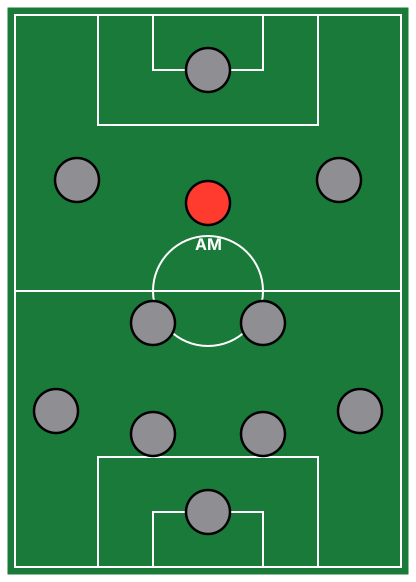
Modern AMs split into three archetypes by attacking movement and defensive role: the classic 10 (pure trequartista), the advanced 8 (CMF + AM hybrid), and the dropping 9 (a CF who frequently drifts back).
1. Classic 10
- Placement — trequartista in 4-2-3-1, or shadow striker in 3-4-2-1
- Movement — receives in the half-space between CF and DMF
- Required skills — vision, final pass, dribbling, shooting
- Examples — late-career Özil, James Maddison, Kai Havertz (depending on phase)
- Profile — limited defensive duty, valued for creativity
2. Advanced 8
- Placement — right or left interior in 4-3-3
- Movement — full-pitch, from build-up to box penetration
- Required skills — ball retention, progressive passing, box penetration, defensive contribution
- Examples — Kevin De Bruyne, Jude Bellingham, Pedri
- Profile — elite at both ends; the dominant top-flight type
3. Dropping 9 (False Trequartista)
- Placement — nominal CF in 4-3-3 but drops to AM zones constantly
- Movement — drops from CF to AM and switches with wingers
- Required skills — link-up play, first touch, creative passing
- Examples — Roberto Firmino (Liverpool), Joao Felix, sometimes Morata
- Profile — false 9 / AM hybrid
In 2025, the highest market value sits on the advanced 8: Bellingham (€103M transfer), De Bruyne (€60M+ valuation), Fernandes (€80M+) — the most sought-after profile in elite soccer.
Five Functions — Vision / Final Pass / Press Resistance / Set-Pieces / Goal Penetration
A modern AM must combine five functions: pitch-wide vision, decisive final pass, retention under pressure, set-piece accuracy, and the ability to penetrate the box and finish.
Function 1: Vision (Field Awareness)
Roca et al. (2011) showed elite AMs scan 1.8× more than typical MFs and check 5-7 reference points before receiving. Kevin De Bruyne has said publicly that "before the ball arrives, I already have three options in mind" — this is the core of pitch vision.
Function 2: Final Pass (Key Pass)
The chance-creating pass. Top Premier League AMs average 3-5 key passes per match. De Bruyne posted 18 assists in 2017-18 (league high) with 0.55 xA per 90. Through-balls, cutbacks, switches, and lobs all need to operate at high quality.
Function 3: Press Resistance
The ability to retain and progress under DMF/CMF pressure. Pedri's 2023-24 pressure-pass completion was 89%, Bellingham's 86% — league-best. Press resistance is determined less by athletic strength and more by first touch and body orientation.
Function 4: Set-Pieces
Free kicks and corners. Trent Alexander-Arnold (a RB with AM-like delivery) hit 2 direct FK goals and 8 assists from corners in 2019-20, league-leading. Bruno Fernandes' 92% penalty conversion delivers 5-7 goals to Manchester United each season.
Function 5: Goal Penetration
The defining function of the advanced 8. Of Bellingham's 19 goals in 2023-24, 13 came from inside the penalty area, mostly via late runs. The traditional '#10 has more assists than goals' is now flipped: 'goals ≥ assists' is the new standard.
Goal penetration is the function rising fastest in evaluation weight. AMs who defend properly AND penetrate the box command the highest transfer fees in soccer.
Five Metrics for Evaluating an AM — xA, Key Passes, Progressive Passes, Pressure Pass Completion, xG
Assist count alone misses the modern AM. xA, key passes, progressive passes, pass completion under pressure, and xG together capture the spectrum.

Photo by Luis Andrés Villalón Vega on Unsplash
1. xA (Expected Assists)
Probability that a delivered pass leads to a goal. Top AM tier: 0.30-0.55 per 90. De Bruyne 0.55, Bruno Fernandes 0.42, Bellingham 0.38.
2. Key Passes
Passes that lead directly to a shot (assist or not). Top AMs hit 3-5 per match. Bruno Fernandes led the league at 4.2 in 2023-24.
3. Progressive Passes
Passes advancing the ball 10+ meters toward goal. AM standard: 8-15 per match. Pedri averaged 11.4 in 2023-24 — La Liga's highest.
4. Pass Completion Under Pressure
Pass success rate while under defensive pressure. Standard: 80-85%. Top tier: 88-90%. The objective measure of press resistance.
5. xG (Expected Goals)
Expected goal value of the AM's own shots. Advanced-8 type: 0.30-0.55 per 90 (Bellingham 0.50, Foden 0.42). Classic 10: 0.20-0.30, more modest.
Globally, perhaps 20 AMs are above average across all five metrics simultaneously. Footnote's PVS weights all five for the AM position, surfacing whether a player skews classic-10 or advanced-8.
Youth AM Development — Cognition, Bilateral Foot, and Core
Aspiring AMs must train cognition (vision/scanning), bilateral foot accuracy, and core strength (the foundation of press resistance). The era of "natural genius alone makes an AM" is over.
1. Cognitive Ability
Vestberg et al. (2012)'s cognitive-test research showed elite AMs score 35% higher than typical MFs on the Design Fluency Test. Build the 'scan → first touch' habit from U-12: scan the pitch at least once per second, and have the next option ready before the ball arrives.
2. Bilateral Skill
An AM must pass to either side. Predictable weak-foot output lets defenders read passing lanes. De Bruyne is right-footed, but his left-foot long balls are world-class. Memmert (2021) found that 60:40 strong:weak ratio through age 12 leads to balanced bilateral output in adulthood.
3. Core Strength
Press resistance comes from the core, not raw athletic strength: the stability to absorb a hit, the rotational power to turn while shielding the ball. From U-13, build in bodyweight core (planks, side bridges, hangs) for 15 minutes 3× per week. Pedri and Bellingham both name core training as the area where they spend the most time.
The biggest mistake in AM development is "polish technique, ignore defense." From U-15 onward, train recovery runs, CMF transitions, and aerial duels — develop a complete midfielder, not a pure attacker.
Case Studies — Four Archetypes in Practice
We analyze Kevin De Bruyne (advanced 8 at its peak), Jude Bellingham (next-generation), Bruno Fernandes (hybrid), and Pedri (evolved classic 10).
Kevin De Bruyne — Advanced 8 Perfected
Belgian, raised in the Genk academy. Through Chelsea, Wolfsburg, then Manchester City from 2015. Pep Guardiola completed his right-IH role; 18 assists in 2017-18 led the Premier League. The original prototype of the box-penetrating 8: 80 touches, 12 progressive passes, 0.55 xA per match as career-typical.
Jude Bellingham — The Next-Generation Symbol
Birmingham City academy. Moved to Borussia Dortmund at 17. €103M transfer to Real Madrid at 20. La Liga 2023-24: 19 goals, 6 assists, 65% tackle success. Defends, attacks, and finishes simultaneously at world-best levels. The next-generation profile that breaks the old 'AMs don't defend' stereotype completely.
Bruno Fernandes — The Hybrid
Sporting CP, then Manchester United from 2020. Functions as both classic 10 (in-the-pocket chance creator) and advanced 8 (CMF/AM swing). Captain, set-piece taker, 92% PK conversion, league-fourth corner-assist count. Top contributor (goals + assists combined) at the club for five straight seasons.
Pedri — The Evolved Classic 10
Las Palmas → Barcelona La Masia. Pure technician with 89% pressure-pass completion (world-best) — does not lose the ball even with four defenders around him. Often called Iniesta's heir, but his 70% tackle success makes him a modern complete AM, not a pure throwback fantasista.
All four share two traits: "off-ball cognition" and "timing of box penetration." Pure-technician AMs are filtered out at the top level — cognition + running + defense is now the bar.
Summary — The AM Has Evolved from "Fantasista" to "Complete Midfielder"
Single-function creativity no longer survives at AM. The three archetypes share the same baseline: high two-way output, box penetration ability, and press resistance. Cognition + bilateral foot + core, built in youth, opens the path to elite AM play.
Key takeaways:
- Evolution — fantasista (1980-90s) → transition (2000s) → advanced 8 (2010s) → complete midfielder (2020s). Defensive duty keeps expanding
- Three archetypes — classic 10, advanced 8, dropping 9. Distinguished by placement and movement
- Five functions — vision, final pass, press resistance, set-pieces, goal penetration
- Five metrics — xA, key passes, progressive passes, pressure-pass completion, xG
- Youth development — cognition, bilateral foot, core. Scanning habit from U-12, weak-foot accuracy from U-13, core training from U-15
Footnote auto-computes the five AM metrics from match records and surfaces them as a Player Value Score (PVS) benchmarked against age-appropriate peers. "Am I closer to a classic 10 or an advanced 8?" and "Which axis should I improve next?" become visible.
References
- [1] Bradley P.S., Ade J.D. (2018). “Are current physical match performance metrics in elite soccer fit for purpose or is the adoption of an integrated approach needed?” International Journal of Sports Physiology and Performance.
- [2] Roca A., Ford P.R., McRobert A.P., Williams A.M. (2011). “Identifying the processes underpinning anticipation and decision-making in soccer” Cognition, Technology & Work.
- [3] Vestberg T., Gustafson R., Maurex L., Ingvar M., Petrovic P. (2012). “Executive functions predict the success of top-soccer players” PLOS ONE.
- [4] Memmert D. (2021). “Match Analysis: How to Use Data in Professional Sport” Routledge.
- [5] Wallace J.L., Norton K.I. (2014). “Evolution of World Cup soccer final games 1966-2010: Game structure, speed and play patterns” Journal of Science and Medicine in Sport.
- [6] Tenga A., Holme I., Ronglan L.T., Bahr R. (2010). “Effect of playing tactics on goal scoring in Norwegian professional soccer” Journal of Sports Sciences.
- [7] Hewitt A., Greenham G., Norton K. (2016). “Game style in soccer: what is it and can we quantify it?” International Journal of Performance Analysis in Sport.
- [8] Bradley P.S., Sheldon W., Wooster B., Olsen P., Boanas P., Krustrup P. (2010). “High-intensity running in English FA Premier League soccer matches” Journal of Sports Sciences.
Related Articles
The Modern CF (#9 Role) — From Classic Striker to False 9, the Evolution of Center Forwards
9 min read
The Modern WG (Winger) Role — Classic, Inverted, and Inside Forward, the Three-Type Evolution
9 min read
Soccer Position Aptitude Guide — Find Your Best Position Through Physique, Personality & Playing Style
17 min read
Decision Speed in Soccer — How Pros Decide in 0.5 Seconds, and How to Train It
5 min read
What Is Soccer IQ? The 3 Cognitive Components Identified by Vestberg's Research
6 min read
Track Your Growth with Footnote
Just record your matches — AI analyzes every 5 games. Visualize growth with PVS Score. All features free during beta.
30-second signup · No credit card required
Last updated: 2026-05-09 ・ Footnote Editorial