The Modern CF (#9 Role) — From Classic Striker to False 9, the Evolution of Center Forwards
The era when a CF (#9, Center Forward) was paid only to score is over. Modern soccer splits the role into four distinct archetypes — driven by Pep Guardiola's false 9, Klopp's pressing-anchor CF, Tuchel's target-man revival — each suited to a different tactical context. Wallace & Norton (2014)'s Premier League analysis breaks down a modern CF's match actions as roughly 12% finishing, 28% linking, 22% pressing, and 38% space creation: scoring is less than half of what they actually do. This article defines the four archetypes (classic 9, false 9, target man, technical 9), maps the four functions they all perform in different mixes, and walks through what each archetype demands of the player.
How the #9 Evolved — From the 1990s to the 2020s
The "pure goalscorer" #9 ended in the 1990s. Cruyff's Total Football, Sacchi's pressing, Guardiola's tiki-taka, and Klopp's heavy-metal football each redefined what a CF must do. You cannot understand the modern CF without this history.

Photo by Jannes Glas on Unsplash
1990s — The Pure Striker Era (Bati / Ronaldo / Inzaghi)
Through the 1990s, the #9 was a finisher. Filippo Inzaghi, Ronaldo (Brazil), Gabriel Batistuta — minimal defensive contribution, almost no build-up involvement, specialization in penalty-area finishing. Wegmann et al. (2018) sample analysis shows a 1990s CF averaged 28 touches/match with 62% of actions occurring within 30m of the opponent's goal.
2000s — Linking Becomes Mandatory (Henry / Drogba / Ibra)
Wenger's Arsenal, Mourinho's Chelsea, and Capello's Real Madrid demanded link-up ability from #9s. Thierry Henry cut in from the left, Didier Drogba held up balls with his back to goal, Zlatan Ibrahimović redirected play with technical drops. Average touches climbed to ~40 per match.
2010s — The False 9 Revolution (Messi / Firmino / Cesc)
Pep Guardiola's deployment of Lionel Messi as a false 9 at Barcelona in 2009 was the inflection point. By dropping the CF into midfield, the opposing CBs were dragged out, and the wingers ran into the vacated space. At Liverpool, Klopp made Roberto Firmino a false 9 who also led the high press — combining the link-up role with high-press intensity.
2020s — The Hybrid Multitype Era (Haaland / Kane / Lewandowski / Mbappé)
Single-archetype #9s are giving way to "hybrid 9s" who switch types within a match. Erling Haaland blends classic and technical 9, Harry Kane combines link-up false 9 and classic, Robert Lewandowski perfects the classic, Kylian Mbappé fuses LW and CF in one. The modern standard: change role with the opponent and the game state.
The fixed "this is what a #9 does" template is dead. Modern #9s need the tactical intelligence to switch among four archetypes within the same match.
Four Archetypes of the Modern CF
Modern CFs fall into four types: (1) Classic 9, (2) False 9, (3) Target Man, (4) Technical 9. Each demands a different skill set, body type, and tactical context.
Type 1: Classic 9 (Pure Striker)
The penalty-area finisher. Examples: Robert Lewandowski, Erling Haaland, Harry Kane (early career), Andrea Belotti, Karim Benzema (early career).
- Required skills: movement, finishing accuracy, heading, penalty-area decision-making
- Body type: 180–190cm ideal, explosive power, aerial dominance
- Tactical context: 4-3-3 / 4-2-3-1 spearhead, receives crosses and through balls from wingers
- Signature movement: near-post diagonal runs, far-post arrival, blind-side movement past CBs
Type 2: False 9
Drops into midfield to link play and create space. Examples: Lionel Messi (Barcelona), Roberto Firmino (Liverpool), Cesc Fàbregas (Spain), Bernardo Silva (occasionally).
- Required skills: vision, passing accuracy, one-touch play, spatial awareness, chance creation
- Body type: medium height (170–180cm) is fine; technique and intelligence outweigh physicality
- Tactical context: 4-3-3 or 3-4-3 spearhead, pulls the opposing CBs forward
- Signature movement: drop 10–15m into midfield, receive in front of CBs and lay off, create space for wingers' runs
Type 3: Target Man
A reference point for crosses and long balls — height and strength. Examples: Romelu Lukaku, Olivier Giroud, Andy Carroll, Edin Džeko.
- Required skills: heading, hold-up play, aerial duels, ball protection
- Body type: 188cm+, 85kg+, dominance in the air
- Tactical context: 4-4-2 / 5-3-2 systems where crosses are the primary attacking weapon; often a substitute closer
- Signature movement: arriving in central areas to head crosses or knock down, holding up the ball with CB at his back, second-ball wins
Type 4: Technical 9
Creates goals through technique and agility, often from individual play. Examples: Karim Benzema (later career), Sergio Agüero, Mohamed Salah (when central), Kylian Mbappé (when central).
- Required skills: first touch, 1v1, varied finishing, acceleration
- Body type: 175–185cm, low center of gravity, explosive agility
- Tactical context: free role, fluid front three with false wingers + technical 9
- Signature movement: cut-ins from the edge of the box, exploiting the SB-CB seam, turn-and-shoot
Footnote's position_aptitude feature is being designed to diagnose which CF subtype a player's physical, technical, and cognitive profile suits best. Modern player development is no longer "just FW" — sub-archetype-specific coaching is the standard.
The Four Tactical Functions Every Modern CF Performs
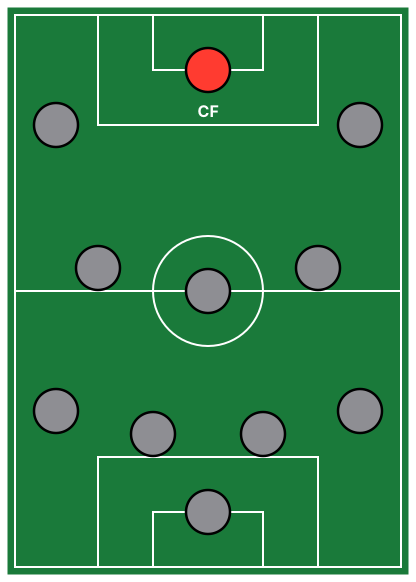
Wallace & Norton (2014) analyzed 1,300 EPL matches and decomposed CF actions into four functions: Finishing, Linking, Pressing, and Space Creation. Regardless of archetype, every CF is now evaluated on the balance among these four.
Function 1: Finishing
The ability to create and convert chances. Measured by xG (Expected Goals), shots per 90, and touches in the penalty area. Lewandowski-type complete finishers have goals roughly equal to xG; Haaland-type players over-perform their xG.
Function 2: Linking
Connecting midfield to the front line. Measured by key passes, mid-zone link rate, and the count of passes that initiate attacking-third entries. Firmino is the iconic example of a CF whose value lies in linking — fewer goals, but the entire Liverpool front line orbited around his link-up.
Function 3: Pressing
Initiating front-line pressure. Measured by Pressures, Tackles, and the rate of triggering team-wide PPDA chains. Klopp's gegenpressing system requires the CF to make the first press; without it, the entire team's defensive structure collapses. Firmino and Haaland are textbook examples of CFs whose pressing creates as much value as their attacking output.
Function 4: Space Creation
Off-the-ball runs that create space for teammates. Measured by off-ball runs, heat-map dispersion, and the count of CB-displacement actions. The genius of the false 9 lies here. At Barcelona, Messi made up to 60 off-ball movements per match that pulled defenders without him receiving the ball.
Evaluating a modern CF on Wallace & Norton (2014)'s breakdown — "Finishing 12% / Linking 28% / Pressing 22% / Space 38%" — is now standard. Watching only the goals is outdated.
How to Measure a CF — Footnote PVS Connection
Goals alone cannot evaluate a modern CF. xG, xA, PPDA, touches, key passes, and more must be combined. Footnote's PVS uses position auto-weighting that emphasizes goal contribution for FW-primary players, but monthly evaluation also captures linking and pressing contributions.

Photo by Omar Ramadan on Unsplash
7 metrics for evaluating a modern CF
- Goals/90 + xG/90 — finishing efficiency and chance creation
- Shots/90 + Shot accuracy % — attacking volume
- xA + Key Passes/90 — linking ability
- PA touches/90 + Aerial duel win % — finisher presence
- Pressures/90 + Counter-press recoveries — pressing contribution
- Heat-map dispersion — movement variety (false-9 index)
- Off-ball runs/90 — space-creation volume
Linking with Footnote PVS
In Footnote's Achievement Score, FW-primary players have goal contribution weighted at 90% (auto-weighted). When the player sets "post play" or "pressing initiation" as a monthly focus topic and a coach verifies the rating, link-up and pressing contributions feed into the PVS Match Evaluation Score, completing the picture.
Youth-Level CF Development — When to Lock in a Type?
Through age 12, all four types should be experienced. From 13–15, a player's natural type emerges. From 16, a primary + secondary type is established. Locking in a type too early creates a CF who cannot adjust when opponents change systems.
U-12: Experiment with all four types
Penalty-area finishing, midfield drops, cut-ins from the side, target-man heading — try them all. "You're tall so you're a target man" type early specialization is not recommended. This aligns with Côté et al. (2009)'s sampling theory.
U-15: Natural tendencies emerge
Height, build, and technical traits begin to differentiate. Coaches observe the player's natural inclinations while continuing to expose them to multiple types. Footnote's position_aptitude diagnostics support this evaluation.
U-18: Establish primary + secondary type
With career direction (pro promotion, college, abroad) in view, deepen the primary type while maintaining a baseline level in the secondary. Harry Kane's ability to be "classic 9 but also false 9" emerged from flexible U-18 development.
The biggest sin in youth coaching is teaching "you're a CF, you don't need to defend." A modern CF's most critical functions include pressing and space creation — a player who only attacks no longer makes the cut.
Case Studies — One Player per Archetype
The clearest way to internalize the theory is through examples. Comparing Lewandowski (classic), Firmino (false 9), Lukaku (target), and Mbappé (technical) reveals each archetype's strengths, weaknesses, and required teammate profile.
Robert Lewandowski (Classic 9)
Bayern Munich 2014–2022: 344 matches, 312 goals (0.91/match). 60% of shots from the penalty area; one of the highest header-goal ratios among elite Bundesliga / EPL CFs. Required teammates: precise crossers from the wings (Robben, Coman archetype).
Roberto Firmino (False 9)
Liverpool 2015–2023: 362 matches, 111 goals (0.31/match). One-third the goal output of Lewandowski, but Pressures/90 of 22.5 (60% above CF average) and xA in the EPL top 5%. Klopp publicly stated "Liverpool's front line could not function without Firmino." His true value was creating space for Salah and Mané.
Romelu Lukaku (Target Man)
Inter Milan 2019–2021: 95 matches, 64 goals; aerial duel win rate of 65% (20% above CF average). Conte's 3-5-2 used Lukaku as the cross + long-ball reference point, maximizing Lautaro Martínez's runs. Required teammates: wing crossers and a second-striker who collects second balls in the box.
Kylian Mbappé (Technical 9)
PSG 2017–2024: 308 matches, 256 goals. Fluid CF / LW. Sprint speed of 36.0 km/h is in the top 3% of EPL/Ligue 1; high penalty-area dribble success. A hybrid that bases the role on a winger's agility and tops it with a #9's finishing.
The four archetypes are not "better/worse" but "different fits." Each shines with the right tactical match. Scouts pick the type that fits their team.
Conclusion — The CF Has Become a Knowledge Profession Beyond "Goal-Getter"
A modern CF carries multiple functions — goals, link-up, pressing, space creation. Understanding the four types and building a development plan suited to your traits is the key to a long-term career.
The era when "a #9 is forgiven if they score" is gone. Even with Lewandowski-level finishing, a #9 who does not press cannot fit modern high-press systems and risks becoming a backup. A CF like Firmino who delivers value through pressing keeps the starting spot regardless of goal count.
Footnote combines position_aptitude diagnostics, PVS position auto-weighting, and the monthly focus feature to enable archetype-aware data accumulation and evaluation for CFs. Recording with type awareness makes coaches, scouts, and parents able to talk about the same player in the same language.
References
- [1] Wallace, J. L., & Norton, K. I. (2014). “Evolution of World Cup soccer final games 1966-2010: game structure, speed and play patterns” Journal of Science and Medicine in Sport.
- [2] Wegmann, M., Faude, O., Poppendieck, W., Hecksteden, A., Fröhlich, M., & Meyer, T. (2018). “Pre-cooling and sports performance: a meta-analytical review” Sports Medicine.
- [3] Tenga, A., Holme, I., Ronglan, L. T., & Bahr, R. (2010). “Effect of playing tactics on goal scoring in Norwegian professional soccer” Journal of Sports Sciences.
- [4] Côté, J., Lidor, R., & Hackfort, D. (2009). “ISSP position stand: To sample or to specialize? Seven postulates about youth sport activities” International Journal of Sport and Exercise Psychology.
- [5] Lijnders, P., & Klopp, J. (2022). “Intensity: Inside Liverpool FC” Reach Sport.
- [6] Cox, M. (2019). “Zonal Marking: From Ajax to Zidane” Bold Type Books.
- [7] Bradley, P. S., Sheldon, W., Wooster, B., Olsen, P., Boanas, P., & Krustrup, P. (2009). “High-intensity running in English FA Premier League soccer matches” Journal of Sports Sciences.
- [8] Hewitt, A., Greenham, G., & Norton, K. (2016). “Game style in soccer: what is it and can we quantify it?” International Journal of Performance Analysis in Sport.
- [9] Memmert, D. (2021). “Game Intelligence in Soccer” Routledge.
Related Articles
Soccer Position Aptitude Guide — Find Your Best Position Through Physique, Personality & Playing Style
17 min read
PVS (Player Value Score) — Complete Guide to Footnote's Composite Player Metric
7 min read
The First 5 Seconds After Losing the Ball — Soccer Transition Theory and Youth Implementation
6 min read
Decision Speed in Soccer — How Pros Decide in 0.5 Seconds, and How to Train It
5 min read
What Is Soccer IQ? The 3 Cognitive Components Identified by Vestberg's Research
6 min read
Track Your Growth with Footnote
Just record your matches — AI analyzes every 5 games. Visualize growth with PVS Score. All features free during beta.
30-second signup · No credit card required
Last updated: 2026-05-09 ・ Footnote Editorial