PVS (Player Value Score) — Complete Guide to Footnote's Composite Player Metric
PVS (Player Value Score) is a composite metric custom-designed by Footnote, expressed on a 0–100 scale as a weighted combination of Achievement (records and stats, 50%) + Coach (verification and rating, 30%) + Consistency (recording continuity, 20%). Unlike single-dimensional metrics — goals + assists, ELO, Match Rating — PVS automatically applies position-aware weighting (defenders are scored on clean sheets, forwards on goal contribution), incorporates coach verification, and credits long-term recording continuity. The result is a fairer, more comparable evaluation tailored for youth players. This article walks through the precise definition, calculation logic, how it compares to traditional metrics, and how to read the number correctly.
What Is PVS — A Three-Axis Composite of Achievement × Coach × Consistency
PVS is Footnote's proprietary player value score, integrating three axes — match-data achievement, coach verification, and recording continuity — into a single 0–100 number. The weighting shifts across phases (Phase 1: no video → Phase 3: full video analytics) as data availability increases.

Photo by Mark McNeill on Unsplash
PVS stands for Player Value Score, designed to express "where this player currently stands" in a single number. Soccer is a multi-dimensional sport, and any single metric — just goals, just minutes — fails to capture a player fairly. This is especially true at the youth level, where playing time and opponent quality vary enormously, demanding a relative metric rather than an absolute one.
PVS combines three components in a weighted average. The Phase 1 formula (no video data) is:
PVS_phase1 = Achievement × 0.50 + Coach × 0.30 + Consistency × 0.20
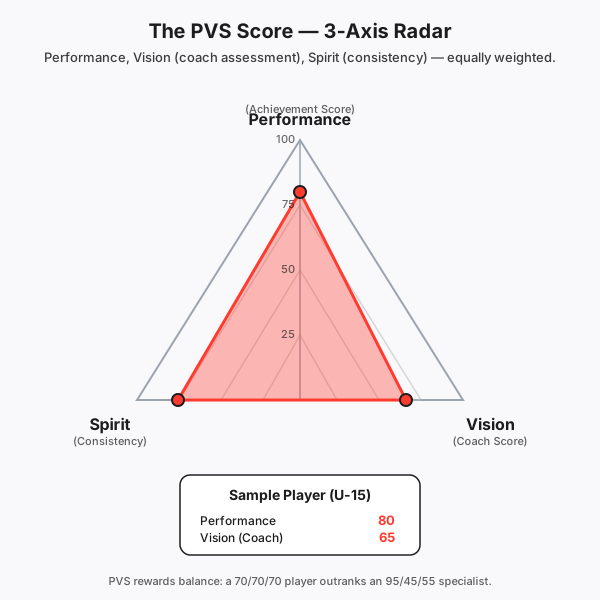
Achievement is computed from match data, Coach from coach verification + ratings, Consistency from recording continuity. Each is independently normalized to a 0–100 scale.
Why these three axes
- Achievement alone — a strong-team bench player would rank below a weak-team star, distorting the picture
- Coach alone — leaves out players without a coach and is vulnerable to subjective bias
- Consistency alone — would reward simply logging every day with no real performance
- → Measuring all three independently and combining them means only players who are strong AND recognized AND persistent reach high PVS
Achievement Score — Position-Aware Auto-Weighting
Achievement Score combines minutes contribution, scoring/defensive contribution, and team-result contribution. Position-specific weighting is applied automatically: forwards are weighted on goal contribution, defenders on clean sheets.
Phase 1 Achievement Score formula:
Achievement = MinutesContribution × 0.40 + AutoWeightedStat × 0.40 + WinContribution × 0.20
AutoWeightedStat is computed from the player's position distribution over the past 3 months. Attack roles (FW/MF) and defensive roles (DF/GK) are tallied as ratios, which then dynamically weight goal contribution vs. clean sheet score.
Examples of automatic position weighting
- Predominantly FW: attack_rate=0.9 → goal contribution weighted at 90%, clean sheets at 10%
- Predominantly DF: defense_rate=0.85 → clean sheets at 85%, goal contribution at 15%
- MF (mixed): attack_rate=0.6, defense_rate=0.4 → balanced 60:40 evaluation
- Position not yet logged: 50/50 split (auto-adapts as the player's role evolves)
Even on a 0–0 scoreless draw, a defender earns a high clean-sheet score and is rated fairly. PVS structurally solves the long-standing "defenders cannot be measured by goals + assists" problem.
Coach Score — Balancing Verification and Subjective Rating
Coach Score is a function of whether the coach verifies match records, and the rating they give (Good / Okay / Needs Work). When a player has no assigned coach, the 30% weight is redistributed to Achievement and Consistency, so coach-less players are not penalized.
Coach Score formula (when a coach is assigned):
Coach Score = 30 + (verification_rate_3mo × weighted_avg_rating × 70)
Rating mapping and match-type weighting:
- Rating scores: Good = 1.00 / Okay = 0.65 / Needs Work = 0.30 / Unrated = 0.65 (treated as "Okay")
- Match-type weighting: Official match = 2.0 / Friendly = 1.0
- Base score of 30: even with a coach assigned and zero verifications, the player gets a 30-point baseline as recognition of organizational membership
How players without a coach are handled
Many youth players don't have an officially assigned coach. In those cases, Footnote sets Coach Score to N/A and redistributes the 30% weight to Achievement (now 65%) and Consistency (now 35%). The PVS doesn't get unfairly suppressed by coach absence.
Coach verification is a strong credibility booster, not a requirement. Players without a coach can still reach high PVS purely through strong data and continuous recording.
Consistency Score — Proof of Sustained Recording
Consistency Score combines recording density, current streak, and longevity. The cap is set so that simply logging every day for a short period doesn't hit max — only sustained engagement reveals true value.
Consistency = recording_density × 0.50 + streak_factor × 0.30 + longevity_factor × 0.20
- recording_density = min(active_days_last_90 / 60, 1.0) × 100
- streak_factor = min(current_streak_days / 30, 1.0) × 100
- longevity_factor = min(months_since_first_record / 24, 1.0) × 100
Why 24 months caps longevity
The 24-month cap on longevity matches when scouts are most active in tracking high-school players. A player who starts at age 15 (start of high school) hits maximum longevity around age 17 — exactly when scouting activity peaks. An 18-month cap would top out mid-second-year (16.5), too early for serious scouting interest.
How PVS Differs From Traditional Metrics
Traditional soccer metrics — Match Rating, ELO, goals + assists, minutes — each measure one dimension or one context. None evaluate youth players comprehensively. PVS was designed to fill those gaps.

Photo by Krzysztof Dubiel on Unsplash
Comparison: PVS vs. Traditional Metrics
- Goals + assists — only evaluates attacking players, unfairly penalizes DF/GK, no continuity dimension
- Match Rating (e.g. SofaScore) — only available for professional matches, doesn't apply to youth, position adjustment is opaque
- ELO rating — team-level relative metric, doesn't capture individual performance
- Minutes played — measures volume, not quality
- PVS — fixes all of the above: three-axis composite, works without a coach, position auto-aware, includes continuity
Soccer Deviation Score (relative ranking)
Footnote also computes a "Soccer Deviation Score" derived from PVS: (PVS - peer_position_mean) / peer_position_stddev × 10 + 50. This expresses statistical relative position. Display bands:
- < 40 — developing
- 40–50 — average
- 50–60 — upper tier
- 60–70 — top schools / academy level
- 70+ — national elite
How to Read PVS — Beyond the Absolute Number
PVS is most informative as a rate of change and broken down by component, not as a static absolute. A 5-point monthly gain is a meaningful jump; a low subscore on a specific component is a training-direction hint.
✅ Recommended interpretations
- Don't fixate on the current PVS — prioritize the rate of change (growth acceleration)
- Decompose by component — Achievement high but Consistency low means "plays well in matches but doesn't log between them"
- Use the Soccer Deviation Score for peer comparison — 50 is the mean; above 50 means upper tier
- Look at 3-month rolling — month-to-month noise is high; 3-month smoothing reveals the trend
❌ Common misinterpretations to avoid
- Treating PVS as an "absolute skill score" — only meaningful within a peer group and decomposed by component
- Overreacting to short-term swings — a 2–3 point fluctuation after one match is normal
- Comparing players by PVS alone — without accounting for position, age, and maturity band, the comparison is unfair
Evolution Toward Phase 2 and Phase 3
PVS expands across phases as video data becomes available. Phase 2 introduces qualitative AI analysis; Phase 3 incorporates quantitative computer-vision metrics. Each phase reduces dependency on coach verification and self-evaluation.
PVS weights shift by phase:
- Phase 1 (no video) — Achievement 50% / Coach 30% / Consistency 20%
- Phase 2 (qualitative AI) — Achievement 35% / Coach 25% / Qualitative AI 25% / Consistency 15%
- Phase 3 (quantitative CV) — Achievement 20% / Coach 25% / Quantitative AI 45% / Consistency 10%
Once video analytics are integrated, objective measures — sprint speed, pass maps, heatmaps — enter PVS, reducing reliance on coach verification and self-evaluation. The metric reaches a level professional scouts can trust.
References
- [1] Footnote Editorial Team (2026). “Footnote Design Doc §10.13: PVS Specification” Footnote internal documentation.
- [2] Vestberg, T., Gustafson, R., Maurex, L., Ingvar, M., & Petrovic, P. (2012). “Executive Functions Predict the Success of Top-Soccer Players” PLoS ONE. Link
Related Articles
What Is Soccer IQ? The 3 Cognitive Components Identified by Vestberg's Research
6 min read
How to Review a Match --- What Pro Scouts Look For and Proven Recording Techniques
7 min read
Growth Mindset and the Soccer Journal — How to Raise Players Who Believe in Effort Over Talent
9 min read
Metacognition Training — The Science Behind 'Thinking Soccer' and How to Develop It Through Journaling
12 min read
The Complete Tryout Guide — 7 Evaluation Criteria Top Academies Look For and How to Prepare
15 min read
Track Your Growth with Footnote
Just record your matches — AI analyzes every 5 games. Visualize growth with PVS Score. All features free during beta.
30-second signup · No credit card required
Last updated: 2026-05-08 ・ Footnote Editorial