How Many Hours Should a Youth Soccer Player Sleep? Research-Backed Guide for Each Age
The National Sleep Foundation's expert-panel recommendation for youth soccer players is 9–12 hours for ages 6–12, 8–10 hours for ages 13–15, and 8–10 hours for ages 16–17. In Mah et al. (2011)'s landmark Stanford study, basketball players who extended their sleep to roughly 10 hours per night ran sprints 0.7 seconds faster, improved free-throw accuracy by 9%, and reported significantly better mood and energy. Conversely, Vyazovskiy & Walker (2010) showed that sleep deprivation reduces prefrontal cortex activity by up to 25%, undermining decision speed and attention. This article explains how sleep affects growth hormone, cognitive function, injury risk, and performance — and gives an evidence-based action plan.
How Much Sleep Should a Soccer Player Get? Recommendations by Age
Sleep recommendations follow the National Sleep Foundation's expert-panel consensus. Younger players need more, but every age in the youth window has 8 hours as the minimum floor.

Photo by Liz Vo on Unsplash
Recommended sleep ranges by age
- Preschool (3–5) — 10–13 hours (including naps)
- Elementary (6–12) — 9–12 hours
- Middle school (13–15) — 8–10 hours
- High school (16–17) — 8–10 hours
- Adult (18+) — 7–9 hours
These come from Hirshkowitz et al. (2015), the National Sleep Foundation's expert-panel consensus drawing on 18 specialists from six professional societies (sleep medicine, pediatrics, neuroscience). Multiple studies show athletes benefit from staying near the upper bound of these ranges, which means youth soccer players should aim for the upper half of the recommended window.
"Seven hours is fine on a school night" is a misconception. Chronically sleeping less than that as a 13-year-old measurably degrades cognition, physical performance, and growth-hormone secretion.
Growth Hormone and Sleep — Why "Sleep Makes You Grow" Is Literally True
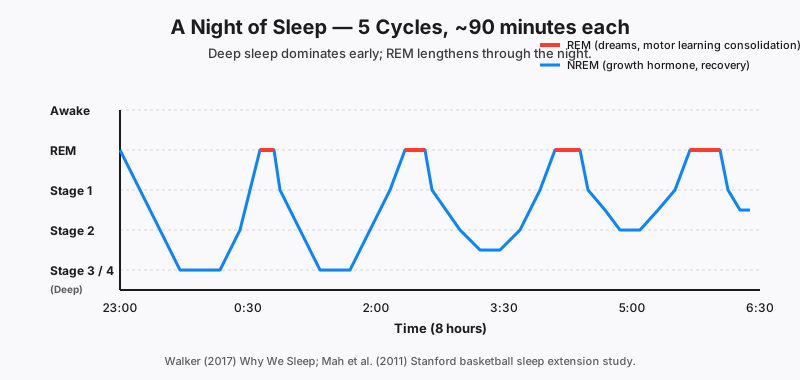
Over 70% of growth hormone (GH) secretion happens during deep N3 (slow-wave) sleep. Sleep quantity and quality are direct inputs to height, muscle development, and bone density.
Growth hormone is released by the pituitary and drives bone growth, muscle development, tissue repair, and metabolic regulation. Takahashi et al. (1968) — the classic study on this — showed that 70–80% of GH secretion is concentrated in deep (N3) sleep. Deep sleep clusters in the first 3–4 hours after sleep onset, so staying up late and shortening sleep cuts directly into the most productive window of GH release.
How to maximize deep sleep
- Consistent bed and wake times — a stable circadian rhythm reaches N3 faster and deeper
- Cut blue light an hour before bed — phone and laptop screens delay melatonin secretion
- Bedroom temperature 18–20°C (64–68°F) — lower core body temperature increases deep sleep
- No food within 3 hours of bed — digestion interferes with deep sleep
- Finish hard exercise 3 hours before bed — sympathetic nervous system needs time to wind down
The folk wisdom that "kids who want to grow should be in bed by 10 PM" tracks the biology: peak GH secretion occurs 3–4 hours after sleep onset, so going to bed at 10 PM puts the GH peak around 1–2 AM.
Sleep and Soccer Performance — The Mah Study
Stanford's Mah et al. (2011) showed that simply extending basketball players' sleep from ~6.5 hours to ~10 hours dramatically improved sprints, shooting accuracy, and self-rated condition. Comparable benefits have been documented in soccer.
Mah et al. (2011) put 11 male collegiate basketball players on a 5–7 week protocol of 10 hours in bed per night. The results:
- Sprint time (282 ft) — 16.2s → 15.5s (0.7s faster)
- Free-throw accuracy — 7.9 → 8.8 of 10 (+9%)
- Three-point accuracy — 10.2 → 11.6 of 14 (+14%)
- Reaction time — significantly improved
- Self-reported mood and energy — improved across all measures
Soccer-specific evidence follows the same direction. Fullagar et al. (2015) reports that sleep extension significantly improves sprint and agility performance in elite youth players.
Cognitive impact
Vyazovskiy & Walker (2010) found that sleep deprivation reduces prefrontal cortex activity by up to 25%, degrading decision speed, sustained attention, and working memory. All three components of Soccer IQ — executive function, working memory, attention shifting — are directly impacted by sleep.
Adding training volume while cutting sleep is counterproductive. Volume gets reversed by cognitive degradation. Quality > quantity, and quality rests on sleep.
Sleep Deprivation and Injury Risk
Milewski et al. (2014) followed 112 middle and high school athletes for 21 months and found that those averaging less than 8 hours of sleep had ~1.7× the injury rate of peers with 8+ hours. Sleep is the simplest, highest-leverage injury prevention available.
Milewski et al. (2014) tracked 112 adolescent athletes over 21 months, examining the relationship between chronic sleep duration and injury rate. Athletes averaging less than 8 hours of sleep were approximately 1.7× more likely to be injured during the season than peers averaging 8+ hours.
The mechanism is multi-factor:
- Slower reaction time — collisions cannot be avoided in time
- Attentional lapses — misreading position, intent, and surroundings
- Reduced balance and motor control — landings and direction changes lose precision
- Slower recovery between sessions — repeat loading on incompletely repaired tissue
- Reduced GH — micro-injuries don't repair as quickly
Before asking "is this training load too much?" ask "is this sleep enough?" Sleep is the largest single lever in injury prevention.
Pre- and Post-Match Sleep Strategy — A 7-Day Protocol
Sleep history over the week before a match matters more than just the night before. Pre-match power naps, post-match recovery sleep — each has an evidence-based optimal pattern.
Match week (7 days out)
Build a "sleep bank" starting one week before the match. Reilly & Edwards (2007) showed that sleep habits over the 7-day window predict performance more than the single night before.
- 7 days to 2 days before — push toward the upper recommended bound (10 hours for middle and high school)
- Match eve — go to bed 30 minutes earlier than usual to absorb pre-match nerves cutting into sleep
- Match morning — open the curtains and get sunlight on waking (suppresses melatonin → faster alertness)
Match-day power nap
For afternoon matches (2 PM or later), take a 20–30 minute power nap 2–3 hours before kickoff. Beyond 45 minutes you enter deep sleep and pay a sleep-inertia penalty on waking.
Post-match recovery sleep
Roberts et al. (2019) reports that post-match sleep is critical for muscle damage repair, glycogen resynthesis, and tactical-memory consolidation. Refuel within 1–2 hours of the final whistle and turn in earlier than usual.
10 Habits to Improve Sleep Quality (Youth Player Edition)
Quantity matters, but stacking quality habits multiplies the benefit. The following 10 interventions have research support and are low-friction.

Photo by Jaspinder Singh on Unsplash
- Same sleep and wake times daily — keep weekday/weekend gap under 1 hour
- Sunlight on waking — resets the circadian clock (5–10 minutes is enough)
- Phone and laptop off 1 hour before bed — preserves melatonin
- Bedroom 18–20°C — lower core body temp deepens sleep
- No food within 3 hours of bed — digestion blocks deep sleep
- No caffeine within 3 hours of bed — half-life is 5–6 hours
- Total darkness — blackout curtains, sleep mask if needed
- Pre-bed stretching or light reading — engages parasympathetic system
- Naps capped at 20–30 minutes — keeps the night sleep intact
- At least 30 min of activity daily — even on rest days, light movement deepens night sleep
Conclusion — Sleep Is the Third Pillar Alongside Training and Nutrition
Soccer development rests on three pillars: training, nutrition, and sleep. Training and nutrition get most of the attention, but sleep is the most-neglected and the highest-leverage. The research consistently shows that sufficient sleep underwrites cognition, physical performance, and injury prevention.
For a developing soccer player, sleep is not "rest" — it is an active developmental process during which growth hormone is released, muscles repair, tactical learning consolidates, and cognition recovers.
Modern youth players are pulled by school, training, social media, and chronic sleep deprivation is the default. Before adding training volume, restore sleep to at least 8 hours (ideally 9–10) — that single change yields the largest performance gain available.
An extra hour of sleep at the start of the night beats an extra hour of training at the end. That is what produces the player who keeps growing.
References
- [1] Hirshkowitz, M., Whiton, K., Albert, S. M., et al. (2015). “National Sleep Foundation's sleep time duration recommendations: methodology and results summary” Sleep Health. Link
- [2] Mah, C. D., Mah, K. E., Kezirian, E. J., & Dement, W. C. (2011). “The effects of sleep extension on the athletic performance of collegiate basketball players” Sleep. Link
- [3] Vyazovskiy, V. V., & Walker, M. P. (2010). “Sleep and the cognitive consequences of inadequate rest” Frontiers in Neuroscience.
- [4] Milewski, M. D., Skaggs, D. L., Bishop, G. A., Pace, J. L., Ibrahim, D. A., Wren, T. A., & Barzdukas, A. (2014). “Chronic lack of sleep is associated with increased sports injuries in adolescent athletes” Journal of Pediatric Orthopaedics.
- [5] Takahashi, Y., Kipnis, D. M., & Daughaday, W. H. (1968). “Growth hormone secretion during sleep” Journal of Clinical Investigation.
- [6] Fullagar, H. H. K., Skorski, S., Duffield, R., Hammes, D., Coutts, A. J., & Meyer, T. (2015). “Sleep and athletic performance: the effects of sleep loss on exercise performance, and physiological and cognitive responses to exercise” Sports Medicine.
- [7] Reilly, T., & Edwards, B. (2007). “Altered sleep–wake cycles and physical performance in athletes” Physiology & Behavior.
- [8] Roberts, S. S. H., Teo, W.-P., & Warmington, S. A. (2019). “Effects of training and competition on the sleep of elite athletes: a systematic review and meta-analysis” British Journal of Sports Medicine.
Related Articles
What Is Soccer IQ? The 3 Cognitive Components Identified by Vestberg's Research
6 min read
Nutrition Guide for Junior Soccer Players — An Evidence-Based Plan for Optimal Growth
16 min read
The Complete Match Day Preparation Guide for Soccer — From the Night Before to Post-Match Recovery
11 min read
Traits of Kids Who Excel in Soccer — 5 Growth Factors Backed by Sports Science
16 min read
Injury Prevention Guide for Junior Soccer Players — FIFA 11+ Kids and Evidence-Based Prevention Programs
16 min read
Track Your Growth with Footnote
Just record your matches — AI analyzes every 5 games. Visualize growth with PVS Score. All features free during beta.
30-second signup · No credit card required
Last updated: 2026-05-08 ・ Footnote Editorial