U-12 / U-15 / U-18 — Age-Specific Development Roadmap for Soccer Players
A soccer player's development requires age-specific load and stimulation, and missing the window for one age cannot be made up later. U-12 (ages 6–12) is the Golden Age — peak neural development and the maximization window for technique. U-15 (ages 13–15) is the puberty transition, where physical instability is offset by building tactical understanding and decision speed. U-18 (ages 16–17) is the consolidation phase — specialty crystallizes and match performance stabilizes under high pressure. This article integrates Bompa's Long-Term Athlete Development (LTAD) model with FIFA / JFA age-group guidelines to give a practical roadmap of what to build, what to avoid, and the role of parents and coaches at each stage.
Why Age-Specific Optimization Matters — The LTAD Model
Bompa's Long-Term Athlete Development (LTAD) model shows that human physical, cognitive, and psychological development each have "windows of trainability," and missing those windows means losing capacity that cannot be recovered later. Soccer development follows the same principle.

Photo by Ferdinand Stöhr on Unsplash
Tudor Bompa's LTAD model (2009) synthesizes four decades of sports science to show that different abilities are most efficiently trained at different ages. Neural-system development peaks at 8–12, hormonal change is dominant at 12–15, and cardiovascular and anaerobic systems become most adaptable at 15–18. Loading the right system at the right time maximizes long-term potential.
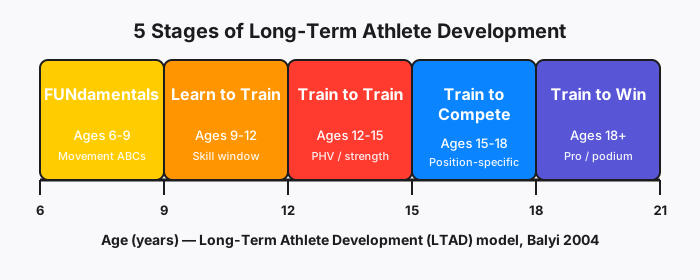
Heavy strength training in the Golden Age, physical-only emphasis at U-15, tactical concepts introduced first at U-18 — these are classic age mismatches that structurally degrade a player's ceiling.
FIFA Coaching Education and JFA's coaching guidelines use the same framework: U-12 (pre-Golden Age + Golden Age), U-15 (post-Golden Age), and U-18 (post-age) each set different priorities. This article synthesizes these into a practical roadmap.
U-12 (Ages 6–12) — Maximizing Technique in the Golden Age
U-12 is the peak of neural development — motor patterns get etched into the brain. The mix should be 70% technique, 15% tactics, 10% physical, 5% mental. Physical training is not banned but is limited to body-weight and play-based work.
Four abilities to develop
- Technical — 70%: ball control, first touch, dribbling, passing, shooting fundamentals
- Tactical — 15%: 1v1, 2v1, 3v3 small-sided games and decision-making
- Physical — 10%: coordination, agility, body-weight and play-based fitness
- Psychological — 5%: enjoyment, autonomous thinking, fearlessness around mistakes
U-12 pitfalls
- Weight training — risk of growth-plate injury and disruption of the endocrine system
- Tactical drill overload — robs technique-acquisition time
- Win-at-all-costs culture — produces players afraid to fail
- Early specialization — forfeits the cross-training upside (see the Early Specialization article)
Recommended training structure
3–4 sessions per week, 60–90 minutes each. Each session: 20–30 min of technical drills + 30–45 min of small-sided games (4v4 or 5v5) + 10–15 min of free play. The coach's role is more about setting the environment than giving instructions.
Multiple studies (e.g. Côté et al., 2009) show that U-12 players who cross-train (basketball, swimming, gymnastics, martial arts) once or twice a week outperform soccer-only peers in both physical and cognitive measures.
U-15 (Ages 13–15) — Tactical Understanding and Decision Speed Through the Instability
U-15 is the puberty transition — height, skeleton, and hormones change rapidly. Technique can temporarily regress ("adolescent skill loss"). Shift to 40% technical, 35% tactical, 15% physical, 10% mental, and use the window to push tactical understanding forward.

Photo by Jeffrey F Lin on Unsplash
Four abilities to develop
- Technical — 40%: technique at match speed, two-footed symmetry, finishing
- Tactical — 35%: positioning, support angles, transition, tactical anticipation
- Physical — 15%: aerobic capacity, anaerobic endurance. Strength via body-weight + light load
- Psychological — 10%: self-analysis, goal-setting, communication, metacognition
Handling adolescent skill loss
During Peak Height Velocity (PHV), changes in limb proportions cause a temporary regression in technique (Pearson et al., 2006). This is normal developmental noise, typically resolving within 3–6 months. Increasing volume out of panic is counterproductive — frame the period as technical recalibration.
U-15 pitfalls
- Excessive physical loading — endocrine instability in early puberty raises injury risk under heavy load
- Position lock-in — flexibility is lost for later phases. Encourage multi-position experience
- Tactical rote learning — without verbalizing the why, players cannot generalize
- Underprioritizing sleep — middle-schoolers need 8–10 hours (the GH secretion window)
Recommended training structure
4–5 sessions per week, 90–120 minutes. 25–30 min technical drills + 40–50 min tactical work (positional games, 4v4+2, 6v6+GK) + 20–30 min match-play. Adding 1–2 sessions of tactical video analysis per month accelerates decision speed.
U-18 (Ages 16–17) — Specialty Consolidation and Match-Performance Stability
U-18 hits peak adaptability for cardiovascular and anaerobic systems — physical training pays maximum dividends. Shift to 30% technical, 35% tactical, 25% physical, 10% mental, with focus on stabilizing match performance.
Four abilities to develop
- Technical — 30%: precision under high pressure, position-specific skill, set pieces
- Tactical — 35%: game-model understanding, opponent analysis, situational role execution, leadership
- Physical — 25%: strength, power, VO2max, durability under impact
- Psychological — 10%: pressure tolerance, pre-match routine, self-recovery
Career-aware design
U-18 is the major branching point for career paths (pro promotion / college / overseas / retirement). Scout activity peaks during the second and third years of high school, and Footnote's longevity_factor maxes at 24 months — designed so a player who starts at 15 hits maximum continuity right when scouts are most active.
U-18 pitfalls
- Overtraining — exam pressure and career stress overlap; annual periodization matters
- Career-ending injuries — ACL, lower back. A serious injury at 17 dramatically narrows future options
- Mental health blindspot — pro-track athletes show elevated rates of depression and disordered eating compared to peers (Reardon et al., 2019)
- Premature path commitment — keeping multiple options open often beats early commitment
Recommended training structure
5–6 sessions per week, 90–120 minutes. Integration of technical, tactical, and physical work. Periodization (competition / preparation / transition phases) becomes essential. Building a habit of monthly review and self-analysis (Footnote's monthly review feature) supports long-term development.
Japan vs. Europe — Age-Group System Differences
Japan uses an April-1 cohort cutoff (matching the school year), while Europe and FIFA use January 1, and the U.S. uses August 1. The Relative Age Effect (RAE) means birth-month timing has measurable career consequences.
- Japan — April 1 cutoff. Mismatch with school year shifts the category
- FIFA / Europe — January 1 cutoff. U-15 = 14 or younger on Dec 31
- U.S. — August 1 cutoff (aligned with school year)
The Relative Age Effect (RAE) is a well-documented bias: in Europe and South America, January-March births are over-represented in elite youth selection; in Japan, April-June births dominate (Helsen et al., 2005). Footnote's maturity_band (advanced / on_track / delayed) helps surface this bias and adjust evaluation.
A parent's worry that "my child is a late bloomer and will be passed over" has scientific grounding. Sustained recording and a long-term view counteract the RAE bias.
Conclusion — Age-Specific Loading Is Not Recoverable If Missed
Technique at U-12, tactical understanding and decision speed at U-15, specialty and match-performance stability at U-18. Hitting each window with the right load is the only way to maximize long-term potential.
This roadmap is grounded in the globally standardized LTAD model and FIFA / JFA guidelines. Respecting individual variation while adhering to the priority order at each age remains the most rational approach.
Footnote's IDP (Individual Development Plan) feature lets coaches set goals per player and track progress through monthly reviews. Designing IDPs around age-appropriate priorities is the most practical operational tool for long-term development.
References
- [1] Bompa, T. O., & Carrera, M. (2009). “Conditioning Young Athletes (2nd ed.)” Human Kinetics.
- [2] Côté, J., Lidor, R., & Hackfort, D. (2009). “ISSP position stand: To sample or to specialize? Seven postulates about youth sport activities that lead to continued participation and elite performance” International Journal of Sport and Exercise Psychology.
- [3] Pearson, D. T., Naughton, G. A., & Torode, M. (2006). “Predictability of physiological testing and the role of maturation in talent identification for adolescent team sports” Journal of Science and Medicine in Sport.
- [4] Helsen, W. F., Van Winckel, J., & Williams, A. M. (2005). “The relative age effect in youth soccer across Europe” Journal of Sports Sciences.
- [5] Vestberg, T., Gustafson, R., Maurex, L., Ingvar, M., & Petrovic, P. (2012). “Executive Functions Predict the Success of Top-Soccer Players” PLoS ONE. Link
- [6] Reardon, C. L., Hainline, B., Aron, C. M., et al. (2019). “Mental health in elite athletes: International Olympic Committee consensus statement” British Journal of Sports Medicine.
- [7] Faigenbaum, A. D., Kraemer, W. J., Blimkie, C. J. R., et al. (2009). “Youth resistance training: updated position statement paper from the National Strength and Conditioning Association” Journal of Strength and Conditioning Research.
Related Articles
The Truth About the Golden Age — Neuroscience Reveals Optimal Training by Age Group
11 min read
Traits of Kids Who Excel in Soccer — 5 Growth Factors Backed by Sports Science
16 min read
What Is Soccer IQ? The 3 Cognitive Components Identified by Vestberg's Research
6 min read
How Many Hours Should a Youth Soccer Player Sleep? Research-Backed Guide for Each Age
7 min read
Nutrition Guide for Junior Soccer Players — An Evidence-Based Plan for Optimal Growth
16 min read
Track Your Growth with Footnote
Just record your matches — AI analyzes every 5 games. Visualize growth with PVS Score. All features free during beta.
30-second signup · No credit card required
Last updated: 2026-05-08 ・ Footnote Editorial