Traits of Kids Who Excel in Soccer — 5 Growth Factors Backed by Sports Science
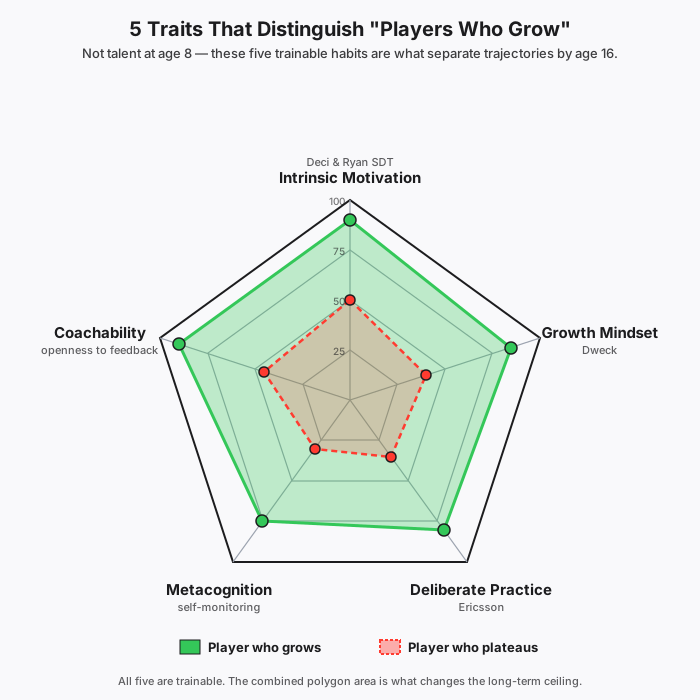
The gap between children who excel in soccer and those who plateau is not about inborn talent. Self-Determination Theory (Deci & Ryan, 2000), growth mindset research (Dweck, 2006), deliberate practice theory (Ericsson et al., 1993), and the Long-Term Athlete Development model (Cote et al., 2007) all point to five psychological traits: **intrinsic motivation, a growth-oriented mindset, quality of practice, self-reflection, and coachability**. Every one of these can be developed after birth; there is no scientific basis for early "talent screening." This article unpacks each of the five traits using peer-reviewed research and presents a concrete development framework built around the soccer journal.
Trait 1: Intrinsic Motivation — What Self-Determination Theory Reveals About the 'Self-Driven' Child
The defining trait of children who excel in soccer is that they practice on their own initiative. According to Deci & Ryan's (2000) Self-Determination Theory, intrinsic motivation arises only when three basic psychological needs are met: autonomy, competence, and relatedness. No amount of extra training will sustain growth if the child feels forced into it.

Photo by Jorge Alberto Vega Barrera on Unsplash
"That kid is out kicking the ball whether anyone tells him to or not" -- it is a line parents of thriving young players repeat often. The force behind this self-driven behavior is what psychology calls intrinsic motivation. Self-Determination Theory (SDT), systematized by Deci & Ryan (2000) in Psychological Inquiry, identifies three basic psychological needs that must be satisfied for intrinsic motivation to emerge.
Three Basic Psychological Needs -- How to Fulfill Them on the Pitch
- Autonomy -- The sense of "I chose this myself." Let players pick part of the training menu, voice their position preferences, and write their own goals in a journal. Even small choices satisfy this need
- Competence -- The feeling of "I can do this" and "I'm getting better." Setting challenges at the right difficulty, managing goals in small steps, and making growth visible through a soccer journal all reinforce competence
- Relatedness -- The security of "I belong with my teammates and coach." Psychological safety within the team, individualized feedback from the coach, and unconditional support from parents form the foundation
The critical insight is that severely undermining even one of these three needs causes intrinsic motivation to collapse rapidly. For example, a player may have autonomy in training, but if bullying erodes relatedness, motivation drops. A child may feel competent after scoring a goal, but if a parent says "There are kids way better than you," autonomy is damaged. Supporting all three needs in balance is the scientifically grounded path to raising a self-driven child.
The Decisive Difference from Extrinsic Motivation
"Practice and you'll get a reward" or "If you want to play in the match, do your extra drills" -- these are extrinsic motivation approaches. Deci & Ryan's (2000) theory shows that extrinsic motivation can prompt short-term action, but the behavior tends to vanish the moment the reward or pressure disappears. In soccer, players sustained only by extrinsic drivers are prone to burnout and dropping out when the environment changes -- say, transitioning from club to school teams. Players with deep-rooted intrinsic motivation, on the other hand, keep finding drive from within regardless of circumstance.
Footnote's soccer journal is designed so that players set their own goals, record reflections, and visualize their growth. This structure simultaneously satisfies autonomy and competence, providing built-in support for all three needs in Self-Determination Theory.
What Parents Can Do Today -- 'Autonomy-Supportive' Communication
The fastest change parents can make is in everyday conversation. Instead of "How was practice today?" try "What did you decide to work on by yourself today?" Instead of "Go practice your shooting," ask "What do you think is the most important thing for you to practice right now?" This autonomy-supportive style of interaction is how SDT-based intrinsic motivation is cultivated. Whether the child's answer is "correct" is beside the point -- the experience of thinking for themselves and making their own choice is what fulfills the autonomy need.
Trait 2: Growth Mindset -- How Children Who Learn from Failure Are Wired
Dweck's (2006) research on growth mindset describes the belief that "ability can be developed through effort." Children who excel in soccer process mistakes not as proof that they lack talent, but as clues for future growth. This difference in mental framing produces dramatic gaps in development speed even when training volume is identical.

Photo by Md Mahdi on Unsplash
In her 2006 book Mindset: The New Psychology of Success, Professor Carol Dweck showed that a person's beliefs about talent fundamentally shape their learning behavior. Players with a fixed mindset -- "ability is set in stone" -- interpret failure as proof of their limits. Players with a growth mindset -- "ability grows through effort" -- interpret failure as evidence that there is still room to improve.
Two Mindsets in Action on the Youth Soccer Field
The contrast is strikingly visible in youth soccer. Consider a player who just got beaten in a one-on-one. A fixed-mindset player thinks "The opponent was just too good" or "I have no sense for defending" and takes a passive position the next time the same situation arises. A growth-mindset player analyzes specifics -- "I closed down too tight" or "My body angle was wrong" -- and adjusts on the next attempt. Over a few months the gap in defensive ability between the two becomes enormous.
- Weak-foot training -- A fixed-mindset child thinks "My strong foot is enough" and skips practice. A growth-mindset child thinks "It's bad now, but it'll improve with work" and puts in the reps
- Trying a new position -- A fixed-mindset child refuses: "I'm comfortable where I am." A growth-mindset child accepts: "I'll gain a new perspective"
- Matches against stronger opponents -- A fixed-mindset child feels "There's no point in a game we can't win." A growth-mindset child sees "This is the match where my weaknesses show the most"
- Receiving feedback from the coach -- A fixed-mindset child hears "I got criticized." A growth-mindset child hears "I got shown where to improve"
How You Praise Shapes Your Child's Mindset
Dweck's most actionable finding is that the way adults praise children directly shapes mindset formation. Person-based praise -- "Wow, you're so talented" -- reinforces a fixed mindset. Process-based praise -- "Great job chasing that ball down and never giving up" or "Your body positioning has really improved since last time" -- nurtures a growth mindset. This is a conscious, changeable behavior: with effort from parents and coaches, a child's mindset can shift.
Writing "What I learned today" and "What I'll try next" in a soccer journal is the act of converting failure into material for process improvement. Footnote's journal feature is designed to reinforce a growth mindset as part of everyday routine.
Trait 3: Deliberate Practice -- The Science of Why Quality Beats Quantity
Deliberate practice theory, proposed by Ericsson et al. (1993), demonstrated the performance gap between "mindlessly logging hours" and "targeting weaknesses with a clear goal." Children who excel in soccer stand out not by how long they train, but by what they focus on and what they try to improve during every single session.
In their 1993 paper "The Role of Deliberate Practice in the Acquisition of Expert Performance," published in Psychological Review, K. Anders Ericsson, Ralf Th. Krampe, and Clemens Tesch-Romer identified the conditions that practice must meet for expert-level skill acquisition. Their concept of deliberate practice requires four elements.
- A clear improvement goal -- Not a vague "I want to get better" but a specific target like "Improve the accuracy of my left-foot inside kick"
- Difficulty slightly beyond current ability -- A challenge level that is neither too easy nor overwhelming
- Immediate feedback -- The ability to see the results of one's performance right away
- Opportunities for repetition and correction -- Repeated attempts at the same task with adjustments based on feedback
The '10,000-Hour Rule' Misconception -- Volume Alone Won't Get You There
Ericsson's research is often misread as "anyone can become an expert by practicing for 10,000 hours," but Ericsson himself explicitly rejected this interpretation. The 10,000-hour figure refers specifically to accumulated deliberate practice; mindless ball-kicking or going-through-the-motions sessions do not count. In youth soccer, a child who trains three hours a day but repeats the same drills on autopilot will be outpaced by one who trains for just one hour with a conscious focus -- say, "Today I'm working on the angle of my weak-foot first touch."
Ford et al. (2009): Structural Differences in Youth Soccer Training
Ford, Ward, Hodges, and Williams (2009), publishing in the Journal of Sports Sciences, examined the differences in training activities between elite and sub-elite youth soccer players. They found that elite players spent significantly more time in deliberate play -- voluntary, enjoyment-driven soccer activities -- between ages 6 and 12, with a sharp increase in deliberate practice after age 13. Sub-elite players, by contrast, spent more time in structured training from an early age, yet their sessions lacked the intentionality and focus that characterized elite-level practice.
The implication is significant. During the early primary school years, self-directed play rooted in fun builds intrinsic motivation, while the ratio of deliberate practice should increase gradually from late primary school into middle school. Imposing rigorous repetitive drills at a very young age may yield short-term technical gains but risks undermining long-term development.
Setting one goal before practice and reflecting on it in a soccer journal afterward -- that cycle is the core of deliberate practice. Footnote lets players record per-session goals and reflections, then compare them against past entries to visualize progress and refine future targets.
Trait 4: Metacognition (Self-Reflection) -- Why Players Who Review Their Own Performance Improve Faster
Metacognition is the ability to think about one's own thinking. Toering et al. (2009) found in their youth soccer study that players who scored higher in reflection were significantly more likely to reach the elite level. Ask "How was practice?" and one child says "Fine." Another says "My decision-making was slow during the passing drill -- the problem was my positioning." That gap is the metacognition gap.
Metacognition refers to the ability to monitor one's own cognitive processes -- the capacity to ask, objectively, "What was I thinking?", "Was my decision right?", and "Why did I move that way in that situation?" Toering, Elferink-Gemser, Jordet, and Visscher (2009) studied Dutch youth soccer players in the Journal of Sports Sciences, investigating the relationship between components of self-regulated learning and performance level.
The results were unambiguous. Players who scored higher in reflection, effort, and self-efficacy were significantly more likely to belong to elite clubs (academies under Dutch Eredivisie teams). Reflection, in particular, remained a significant predictor even after controlling for physical talent. In other words, given two players of equal physical ability, the one with stronger reflection skills is more likely to reach the elite level.
How High-Metacognition Players Think During a Match
Players with strong metacognition monitor their performance in real time during play. For instance: "I'm rushing right now and can't see the passing lanes -- let me settle on the ball for a moment." Or: "The press is fast -- I need to decide within two touches or I'll lose possession -- find a teammate I can play to first time." This real-time self-monitoring and adjustment is what people really mean when they say a player has "high soccer IQ."
The Most Powerful Tool for Building Metacognition -- Putting It Into Words in a Soccer Journal
Because metacognition is tacit knowledge, it does not develop unless trained deliberately. The most effective method is verbalization. Building the habit of answering three questions in a soccer journal after every practice and match will progressively strengthen metacognitive ability.
- What happened (describe the facts) -- "In the 15th minute of the second half during a counter-attack, I was unmarked on the right but chose to pass instead of shoot"
- Why did I decide that way (analyze the thought process) -- "I wasn't confident in my shot. Given the angle against the goalkeeper, it felt too tight"
- What will I do next time (form an improvement hypothesis) -- "In the same situation, I'll first check whether a shooting lane exists before deciding. I'll drill shots at various angles to the keeper to build that instinct"
This three-step reflection mirrors exactly the process Toering et al. (2009) measured. Initially, a parent or coach may need to guide the questions, but once the habit takes hold, the player can do it independently. That is the automation of metacognition -- the point at which a player truly begins to "think their way through the game."
Footnote's soccer journal provides a structured format for recording post-match and post-practice reflections. By reviewing accumulated entries, players gain an objective view of their own thought patterns and decision-making tendencies, accelerating metacognitive growth.
Trait 5: Coachability and Social Skills -- Why Kids Who Know How to Learn from Others Accelerate
Cote, Baker, and Abernethy's (2007) Long-Term Athlete Development model (LTAD) showed that "diverse sporting experiences" and "high-quality coach-athlete relationships" during the youth phase are decisive for long-term growth. Beyond technique and fitness, the ability to absorb coaching (coachability) and to build relationships with teammates are the fifth trait of children who excel.
In their 2007 paper "Practice and play in the development of sport expertise" in the British Journal of Sports Medicine, Cote, Baker, and Abernethy mapped out the optimal pathway for long-term athlete development. Their Developmental Model of Sport Participation (DMSP) divides elite-athlete development into three stages: the sampling years (ages 6-12), during which children enjoy multiple sports; the specializing years (ages 13-15), during which they narrow their focus; and the investment years (age 16 onward), during which they commit to specialized training. At every stage, the quality of the coach-athlete relationship is paramount.
What Coachability Really Means -- It Is Not Just 'Being Obedient'
Coachability is not blind compliance with whatever a coach says. It is the active ability to receive feedback, understand it, and integrate it into one's own play. Highly coachable players exhibit three responses to coaching input. First, they listen -- they grasp the content of the feedback accurately. Then they try -- they test it in practice. Finally, they report back -- they tell the coach what happened when they applied it. This two-way communication loop is what accelerates growth.
- Behavior of a highly coachable player -- After receiving feedback, they try it in practice and then ask the coach, "I tried it this way -- is that right?" If it doesn't work, they follow up: "What should I adjust?"
- Behavior of a player low in coachability -- They hear the feedback but don't change, or try once and give up with "I knew that wouldn't work." They interpret coaching as a personal attack: "That coach just doesn't like me"
How Teammate Relationships Fuel Growth
As Deci & Ryan's (2000) Self-Determination Theory underscores, strong teammate relationships are a foundation for intrinsic motivation. But the value of relatedness extends well beyond motivation. Everyday exchanges with teammates -- "If you'd released the pass a bit earlier I could have made that run" or "Thanks for covering for me on that play" -- are mutual feedback opportunities. Feedback from ten teammates is richer and more multidimensional than feedback from a single coach. Children who excel listen to their teammates and use those perspectives to build a fuller picture of what they need to improve.
Cote et al.'s (2007) DMSP model further notes that diverse sporting experiences and play during the sampling years (ages 6-12) contribute to social skill development. Exposure to different sports, different teams, and different coaching styles broadens both coachability and social competence. Early specialization -- committing to a single sport from a very young age -- risks limiting these developmental opportunities.
Footnote lets players log coach feedback and track their own efforts and outcomes in response. By visualizing the cycle of coaching input, practice application, and reflective review, coachability is strengthened in a structured, measurable way.
An Integrated Framework for Nurturing All Five Traits -- A Practical Guide by Age Group
The five growth factors are not independent; they reinforce one another. Intrinsic motivation fuels deliberate practice. Metacognition sustains a growth mindset. Coachability turns feedback into higher-quality training. Here we present a framework for developing all five traits in a balanced, age-appropriate way.
Early Primary School (Ages 6-9): Fun and Autonomy Come First
As Cote et al.'s (2007) DMSP model indicates, this is the sampling phase. Children should enjoy multiple sports and develop ball sense and motor skills through play. The overriding priority at this stage is to build the foundation of intrinsic motivation. "I love soccer" and "Kicking the ball is fun" -- these emotions are the starting point of all growth. Parents should focus praise consistently on process (challenges attempted, fun had) rather than results (wins, goals scored).
- Intrinsic motivation -- Ask "What was the most fun thing today?" rather than dwelling on the score
- Growth mindset -- Use "not yet" instead of "can't do it." Reframe inability as a work in progress
- Deliberate practice -- At this age, emphasize deliberate play. Protect time for free, unstructured play
- Metacognition -- Start with simple reflection: "What was your favorite play today?"
- Coachability -- Encourage diverse sporting experiences so children get comfortable with different coaching styles
Late Primary School (Ages 10-12): Introduce Metacognition and Practice Quality
This is the age when a soccer journal can be introduced in earnest. At first, a parent or coach can sit alongside the child and ask guiding questions. Set one goal before practice and reflect on it afterward: "How did I do against my goal?" This simple cycle simultaneously develops deliberate practice and metacognition. It is also the right time to start writing down coach feedback in the player's own words, which reinforces coachability.
Middle School (Ages 13-15): Toward a Self-Sustaining Growth Cycle Across All Five Traits
In Cote et al.'s (2007) DMSP model this is the specializing phase. As commitment to soccer deepens, all five traits should be cultivated consciously. The player sets their own goals (autonomy and deliberate practice), seeks out challenges (growth mindset), verbalizes their thinking in reflection (metacognition), and actively solicits feedback from coaches and teammates (coachability). When these five elements mesh like gears, a self-sustaining growth cycle takes hold. It is at this stage that people around the player begin to recognize them as someone who truly excels in soccer.
Important: These five traits are not something a child is born with -- they are built. It is never too late to start at any age. Today's conversation, today's single journal entry, can be the catalyst for growth.
Frequently Asked Questions
Does my child lack talent? Is there any hope they'll improve in soccer?▾
Judging a child's future by "talent" is not scientifically sound. Dweck's (2006) growth mindset research demonstrated that the very belief "talent is fixed" actively hinders development. Ericsson et al.'s (1993) deliberate practice theory likewise shows that expert-level skill is better explained by the quality and volume of practice than by innate gifts. What your child needs is not a talent diagnosis but an environment that nurtures the five growth factors in this article -- intrinsic motivation, growth mindset, practice quality, metacognition, and coachability. All of these are capabilities that can be developed.
At what age do the traits of a child who will excel become visible? Can you spot them early?▾
As Cote et al.'s (2007) DMSP model shows, ages 6-12 are the sampling phase, and predicting future performance from results or skill level at this stage is unreliable. Many professional players, in fact, showed no standout talent during their youth. The traits of a player who excels become clearer with age, but that is not inborn talent emerging -- it is the cumulative result of the right environment and habits. The most important thing is to be patient and keep building on a foundation of fun and autonomy.
Will keeping a soccer journal really help my child improve?▾
Simply writing in a journal has limited impact. What matters is what is written and how. Toering et al.'s (2009) research showed that the quality of reflection -- not the act of writing itself -- correlates with performance level. A journal entry that says "Today was good" and one that says "My weakness today was the direction of my first touch. I wasn't turning my body toward my next action on the trap. Tomorrow I'll practice lifting my head during the trap to check where I'm passing next" operate at entirely different levels of metacognition. Footnote's soccer journal is designed to structurally guide this kind of high-quality reflection.
My child is improving more slowly than peers. Should we increase training volume?▾
As Ericsson et al.'s (1993) deliberate practice theory makes clear, the key to growth is not the quantity of practice but its quality. Simply adding more hours raises the risk of burnout and injury. Instead, examine what the child is consciously focusing on during existing sessions. Setting one specific goal before practice and reflecting on it afterward -- just introducing this deliberate practice cycle can dramatically change the rate of improvement within the same training time. From a growth mindset perspective, it is also vital to compare the child with their own past self rather than with other children.
As a parent, what is the single most important thing I can do for my child's growth?▾
Based on Deci & Ryan's (2000) Self-Determination Theory, the most important thing is autonomy support. Concretely, this means letting the child make as many soccer-related decisions as possible, recognizing process rather than results, and showing unconditional love. Conditional praise -- "You're great because you won" or "That was bad because you lost" -- reinforces extrinsic motivation and erodes intrinsic motivation. Questions like "What kind of challenge did you take on today?" or "What was fun?" simultaneously satisfy the three basic psychological needs of autonomy, competence, and relatedness, building the foundation for a child who excels.
References
- [1] Deci, E. L., & Ryan, R. M. (2000). “The 'what' and 'why' of goal pursuits: Human needs and the self-determination of behavior” Psychological Inquiry, 11(4), 227-268. Link
- [2] Dweck, C. S. (2006). “Mindset: The New Psychology of Success” Random House (Book).
- [3] Ericsson, K. A., Krampe, R. T., & Tesch-Romer, C. (1993). “The role of deliberate practice in the acquisition of expert performance” Psychological Review, 100(3), 363-406. Link
- [4] Cote, J., Baker, J., & Abernethy, B. (2007). “Practice and play in the development of sport expertise” Handbook of Sport Psychology, 3rd ed., 184-202. Wiley.
- [5] Ford, P. R., Ward, P., Hodges, N. J., & Williams, A. M. (2009). “The role of deliberate practice and play in career progression in sport: The early engagement hypothesis” High Ability Studies, 20(1), 65-75. Link
Related Articles
Metacognition Training — The Science Behind 'Thinking Soccer' and How to Develop It Through Journaling
12 min read
Growth Mindset and the Soccer Journal — How to Raise Players Who Believe in Effort Over Talent
9 min read
Mental Training and the Soccer Notebook Habit — The Science of Writing Your Way to a Stronger Mind
9 min read
The Science of Core Training for Kids — Age-Specific Programs and Their Impact on Soccer
15 min read
Soccer Training to Get Faster — 5 Methods Proven by Sprint Science
14 min read
Track Your Growth with Footnote
Just record your matches — AI analyzes every 5 games. Visualize growth with PVS Score. All features free during beta.
30-second signup · No credit card required
Last updated: 2026-05-06 ・ Footnote Editorial