Soccer Training to Get Faster — 5 Methods Proven by Sprint Science
Being "fast" in soccer is not about your 50-meter dash time. Research by Faude et al. (2012) revealed that 96% of the sprints that create decisive moments in a match are short-distance accelerations of 30 meters or less. What soccer demands is not top speed but "explosive power in the first five steps," "quickness in changes of direction," and "the ability to accelerate while controlling the ball." By correctly applying the principles of ground reaction force from biomechanics research, optimizing stride frequency, and following age-appropriate progressive training, players of any age group can reliably improve their sprint ability.
Soccer Sprints Are Different from Track — Why Straight-Line Speed Alone Won't Win
According to Stolen et al. (2005), sprints during a soccer match average just 10 to 15 meters, and the majority involve changes of direction, reactions to opponents, or ball possession. The abilities required are fundamentally different from the straight-line speed of a 100-meter dash.

Photo by Jakub Klucký on Unsplash
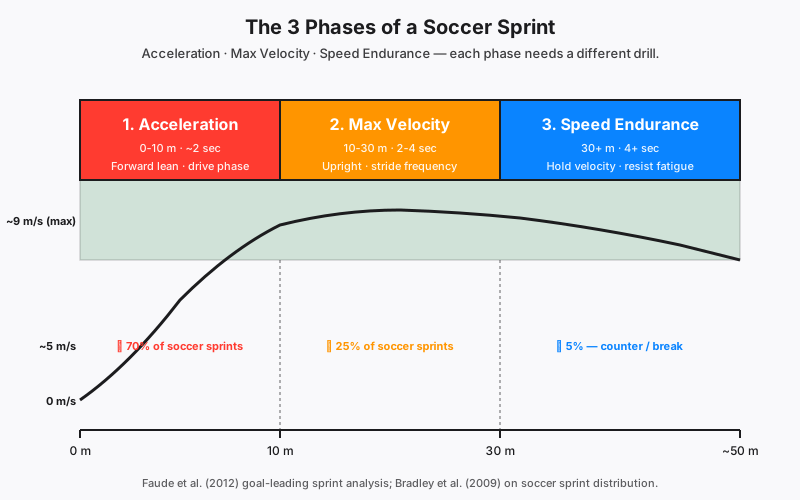
In the 100-meter dash, a runner accelerates in one direction, reaches top speed around the 60-meter mark, and maintains it — that is what decides the race. But sprinting in soccer is entirely different. When Faude et al. (2012) analyzed 360 goals in the Bundesliga, the average distance of goal-scoring sprints was just 17.1 meters. The contest is decided before the player ever reaches top speed.
Four Defining Characteristics of Soccer Sprints
- Multi-directional — Soccer involves frequent sprints not only forward but also diagonally, laterally, and backward. Cometti et al. (2001) reported that soccer players outperform track sprinters in change-of-direction tests
- Importance of the acceleration phase — The first 5 to 10 meters of acceleration matter more than top speed. According to Stolen et al. (2005), over 80% of in-game sprints end before the player reaches maximum velocity
- Sprinting with the ball — Dribbling sprints are 10 to 15% slower than pure sprints (Stolen et al., 2005). The ability to accelerate while maintaining ball control is a skill that does not exist in track and field
- Reactive sprints — Soccer sprints are not pre-planned; they occur as reactions to opponents' movements, ball trajectory, or teammates' runs. Cognitive decision-making and sprint ability are inseparably linked
Given these characteristics, the approach of "just run more to get faster" is clearly insufficient. Straight-line track sprinting and soccer sprinting differ in muscle activation patterns, neural recruitment patterns, and energy systems. Improving soccer-specific sprint ability requires specialized training that replicates the movements demanded in actual matches.
Speed in soccer is not equal to a 50m dash time. "Explosive power in the first three steps" x "quickness in direction changes" x "speed of decision-making" — this combination determines how fast you are on the pitch.
The Science of Sprinting — Biomechanics of Ground Reaction Force, Stride, and Arm Swing
Sprint speed is determined by stride length multiplied by stride frequency. However, the latest biomechanics research shows that the biggest difference between fast and slow athletes lies in the magnitude and direction of the force they apply to the ground.
Physically, sprint speed is the product of two factors — stride length (distance per step) and stride frequency (steps per second). However, simply trying to lengthen the stride causes the foot to land in front of the body, creating a "braking" effect. Conversely, trying to increase frequency alone leads to a choppy, inefficient gait.
Ground Reaction Force (GRF) — The Source of Speed
Ground contact time gets shorter the faster the runner. At top speed, elite sprinters have a ground contact time of approximately 0.08 to 0.09 seconds. However, for soccer players, what matters is not ground contact time at top speed but the direction of force applied to the ground during the acceleration phase (first 10 meters). During acceleration, ground contact time is longer at 0.15 to 0.20 seconds, but how much horizontal force the player generates to propel the body forward during that time determines acceleration ability.
Stride Mechanics — Balancing Length and Frequency
- Acceleration phase (0-10 m) — Keep stride length short and frequency high. Lean the body forward at 45 degrees and land the foot directly under or slightly behind the body. Think of "pushing the ground like a piston"
- Transition phase (10-20 m) — Gradually raise the torso while extending stride length. Maintain frequency as the rising hip position naturally widens the stride
- Top speed phase (20 m+) — Soccer players rarely reach this phase, but when they do, both stride length and frequency are maximized. The foot contacts the ground directly under the body in a "clawing" motion
Arm Swing — The Overlooked Propulsion Engine
Arm swing is estimated to contribute approximately 10% of sprint speed. Proper arm use controls trunk rotation and efficiently transfers lower-body force into the ground. Keep the elbow at roughly 90 degrees and swing from the shoulder in a large arc. Hold the hands in a light fist (as if holding an egg) and drive from chin height down to the hip. For younger players, the cue "punch your elbows through the wall behind you" is highly effective.
The correct coaching cue is not "take bigger steps" but "push the ground harder." Stride length increases naturally as a result of ground reaction force. Deliberately trying to lengthen the stride causes braking on contact and actually makes you slower.
5 Training Methods to Sprint Faster
A meta-analysis by Meylan et al. (2009) identified the most effective training methods for improving sprint ability in youth athletes. Combining the following five methods enables systematic sprint improvement regardless of age or developmental stage.

Photo by Nicolas Hoizey on Unsplash
Method 1: Acceleration Drills — Make the First Five Steps Explosive
These are specialized drills that strengthen the acceleration phase (0-10 m), the most critical in soccer. By repeatedly producing maximum force over short distances, the nervous system learns the pattern of generating large forces instantaneously.
- Wall drives — Place hands on a wall with the body at a 45-degree angle. Rapidly drive each knee up one at a time. 10 reps x 3 sets. A foundational drill that builds the sensation of "pushing the ground backward"
- Standing start sprints — Sprint 10 m at full effort from a standstill. 3-5 reps. Focus on "making the first three steps faster" each time. 60-second rest between reps
- Falling starts — From an upright position, lean forward and sprint the moment you begin to fall. Learn to convert the body's falling momentum into propulsion. 5 reps x 2 sets
- Resisted sprints (banded) — Attach a resistance band around the waist and have a partner apply light resistance during a 10 m sprint. Overloads the acceleration mechanics. Recommended for U-12 and above
Method 2: Change of Direction and Agility Drills — Building On-Pitch "Speed"
Most sprints in soccer involve a change of direction rather than a straight line. Cometti et al. (2001) showed that professional soccer players are not significantly different from track athletes in a 10 m straight sprint, yet they are significantly superior in change-of-direction tests. The following drills develop this ability.
- 5-10-5 shuttle (Pro Agility Test) — Start at the center, sprint 5 m right, turn and sprint 10 m left, turn and sprint 5 m right. 3 reps at full effort, 90-second rest. Maximizes the deceleration-turn-reacceleration cycle
- T-drill — Set up cones in a T shape. Sprint 10 m forward, shuffle 5 m left, shuffle 10 m right, shuffle 5 m left, backpedal 10 m. Trains transitions in every direction within a single drill
- Mirror drill — Two players face each other; one moves randomly while the other mirrors. 10 seconds x 5 sets. The most game-realistic drill for reactive agility
- Reactive agility (with cognitive load) — Sprint direction is determined by reacting to a coach's voice, hand signal, or colored cones. Training cognitive decision-making and sprinting simultaneously develops game-relevant speed
Method 3: Plyometrics — Maximizing Muscle-Tendon Elasticity
Plyometrics (jump-based training) are among the most effective methods for enhancing the stretch-shortening cycle (SSC) of muscle-tendon units and reducing ground contact time. The meta-analysis by Meylan et al. (2009) reported that plyometric training improved 10 m sprint times by an average of 2-3% in youth athletes.
- Ankle hops — Jump continuously using only ankle power while keeping the knees nearly straight. Focus on minimizing ground contact time. 20 reps x 3 sets. Suitable for all ages
- Squat jumps — Jump for maximum height from a squat position, then land and immediately jump again. 5 reps x 4 sets. The key is "short ground contact." Recommended for U-10 and above
- Bounding — Leap forward alternating legs over 20 m. Maximize hang time and distance per bound. An excellent drill for feeling stride propulsion. 3 reps x 2 sets
- Drop jumps (step off a box and jump immediately) — Step off a 20-30 cm box and jump for maximum height the instant you land. Minimizing ground contact time trains reflexive force production. Recommended for U-12 and above. Increase box height progressively
Method 4: Running Form Improvement — Get Faster Just by Changing Your Technique
Many youth players have never received formal sprint coaching and run with inefficient form. The following drills ingrain correct sprint mechanics. Ideally, incorporate them into the warm-up twice per week.
- A-skip — Skip forward while driving the knee high. Lift the knee to hip height and maintain dorsiflexion (toes pulled up). 20 m x 4 reps. A foundational drill for proper knee lift and ankle angle
- B-skip — A progression of the A-skip. After driving the knee up, extend the leg forward and then pull it back down to make ground contact. Develops the "pawing" ground-contact pattern. 20 m x 4 reps
- High-knee run — Rapidly alternate lifting each knee while standing in place. Coordinate arm swing simultaneously to strengthen upper-lower body linkage. 10 seconds x 5 sets. Directly improves stride frequency
- Arm swing drill — Sit on the ground and swing the arms at full effort. Elbows at 90 degrees, swing from the shoulders, and ensure no lateral deviation. 30 seconds x 3 sets. Surprisingly, improving arm swing alone often produces measurable gains in sprint time
Method 5: Resistance Training (by Age Group) — Building the Foundation of Force
The Youth Physical Development Model by Lloyd & Oliver (2012) outlines the appropriate type and intensity of resistance training for each age group. The belief that "weight training is dangerous for children" has been scientifically debunked, but an age-appropriate program is essential.
- U-8 to U-10 (bodyweight only) — Squats, lunges, push-ups, and planks. The goal is to learn proper movement patterns through play. This is about "movement pattern acquisition," not "building muscle"
- U-10 to U-12 (introducing light loads) — Medicine ball throws (2 kg), banded resisted runs, and mini-hurdle drills. Gradually introduce light external loads that stimulate neural activation
- U-12 to U-15 (structured programs) — Goblet squats, Romanian deadlifts (light dumbbells), and hip thrusts. Twice per week, 8-12 reps x 2-3 sets. Perfect form is a non-negotiable prerequisite
- U-15 and above (full strength training) — Barbell squats, power cleans, and deadlifts. Aimed at improving maximal strength and explosive power. 2-3 sessions per week. Always performed under the supervision of a qualified coach
The five methods complement one another. Plyometrics train the SSC, resistance training builds the force foundation, form drills improve efficiency, and acceleration drills plus agility convert it all into game-ready speed — this chain is what produces breakthroughs in sprint performance.
Age-Specific Approaches — What to Focus on from U-8 to U-15
The Youth Physical Development Model by Lloyd & Oliver (2012) indicates that "windows of sensitivity" exist for sprint ability development. Approaches matched to the neural and musculoskeletal development of each age group are essential for maximizing long-term sprint potential.
U-8 (Ages 7-8): Coordination Games
This is a period of rapid neural development. The top priority is exposing players to complex movement patterns through play. Tag games, relays, and obstacle courses with varied movements build the foundation of sprint ability. Do not frame these as sprint "practice" — design an environment where running ability develops naturally as a result of having fun.
- Recommended activities — Tail tag, animal walks (bear crawl, frog jumps, crocodile walk), mini relays, ladder drills (in a playful manner)
- Things to avoid — Long-distance running, repeated sprints, structured weight training, excessive competition or time trials
- Key point — Games that naturally involve multi-directional movement, sudden stops, and rapid accelerations are ideal. Rather than instructing players to "run faster," create situations that make them want to run fast
U-10 (Ages 9-10): The Golden Age of Agility
Neural plasticity is at its peak at this age, making it the most effective window for agility training. Systematically introduce soccer-specific movements such as changes of direction, feints, and reacceleration from sudden stops. Whether a strong agility foundation is built at this age significantly influences performance in later years.
- Recommended activities — Cone drills (T-drill, zigzag, figure-eight), mirror drills, reaction games, mini-hurdle drills, introducing A-skips and B-skips
- Things to avoid — High-intensity plyometrics (drop jumps, etc.), long-distance running, burnout from excessive repetition
- Key point — This is the time to begin teaching "correct form." However, keep instruction brief and specific. Just two cues — "swing your arms more" and "lift your knees higher" — can produce significant changes
U-12 (Ages 11-12): Focused Acceleration Development
At this age, players are on the threshold of the growth spurt and entering the optimal window for intensively developing acceleration. High-quality repetitions of short sprints (10-20 m) engrain explosive first steps. Formal introduction of plyometrics also becomes appropriate.
- Recommended activities — 10 m acceleration sprints (from various starting positions), squat jumps, bounding, bodyweight resistance training (lunges, squats, hip bridges), sprint form drills
- Things to avoid — Heavy weight training, exercises that place excessive load on growth plates, training to exhaustion
- Key point — Individual variation in the growth spurt is large at this age. Players experiencing a rapid increase in height may see a temporary decline in coordination ("the awkward phase"). Prioritize maintaining movement quality without rushing
U-15 (Ages 13-15): Integrating Strength
As testosterone production increases significantly at this age, the effectiveness of strength training skyrockets. Structured strength training is now integrated on top of the coordination, agility, and acceleration foundation built in earlier years. This is potentially the age group where the largest gains in sprint performance can be achieved.
- Recommended activities — Barbell squats (with a qualified coach), Romanian deadlifts, introduction of power cleans, weighted jumps, resisted sprints, high-quality 20-30 m sprint repetitions
- Things to avoid — Testing one-rep max (1RM), excessive volume, ignoring recovery periods
- Key point — Introduce the concept of periodization by separating "speed days" and "strength days." During the competitive season, maintain sprint volume while reducing weights; concentrate on building strength during the off-season
Each age group has its "most effective training." Handing weights to a U-8 player is pointless, and relying solely on coordination games for a U-15 player is insufficient. Stacking age-appropriate stimuli in the right sequence is the path to maximizing long-term sprint ability.
5 Common Mistakes — Training That Actually Slows You Down
Some well-intentioned training practices can actually reduce sprint ability. Based on scientific evidence, here are the mistakes to avoid and their correct alternatives.
Mistake 1: Trying to Build Speed Through Long-Distance Running
"Just run more" is a persistent misconception in soccer coaching. A review by Stolen et al. (2005) notes that excessive long-distance running can convert Type II (fast-twitch) fibers into Type I (slow-twitch) fibers, potentially reducing sprint ability. Endurance is necessary, but 5K runs will not make you faster. High-intensity interval training (HIIT) is more effective for building endurance while also preventing loss of sprint ability.
Mistake 2: Extended Static Stretching Before Sprints
Multiple studies have shown that performing static stretches lasting 30 seconds or more before a match or sprint session temporarily reduces muscle-tendon elasticity and decreases sprint performance by 3 to 5%. Use dynamic stretches (leg swings, high knees, carioca steps, etc.) in the pre-sprint warm-up and save static stretching for the post-training cool-down.
Mistake 3: Neglecting Arm Swing
Poor arm swing is a surprisingly common cause of slow sprinting. Players who swing their arms in small motions at their sides, players who swing asymmetrically, players who clench their fists and tense their shoulders — all of these patterns diminish lower-body propulsion. Practicing arm swing alone for just five minutes, twice a week, can improve overall sprint form.
Mistake 4: Sprint Training Every Day
Improving sprint ability requires neural adaptation, and the nervous system needs a minimum of 48 hours to recover. High-intensity sprinting every day leads to chronic fatigue from insufficient recovery, which actually decreases performance. Limit dedicated sprint training to 2-3 sessions per week. Alternate with ball-work sessions and recovery days to maximize neural adaptation.
Mistake 5: Sprint Training in a Fatigued State
Some coaches make players sprint as "punishment runs" at the end of practice, but sprinting while fatigued only ingrains broken form. Furthermore, full-effort sprinting with fatigued muscles dramatically increases the risk of hamstring strains. Sprint training should be performed at the beginning of practice, immediately after the warm-up, when the body is at its freshest.
"Quality over quantity" is the cardinal rule of sprint training. Running 3 reps at maximum quality in a fully recovered state is far more effective than grinding out 10 reps while fatigued.
FAQ — Answering Sprint Training Questions with Science
Here are answers to the most frequently asked questions about sprint training from parents and coaches, backed by sports science research.
The following FAQ addresses the most common questions about improving sprint ability in youth soccer players. All answers are grounded in scientific research.
References
- [1] Stolen, T., Chamari, K., Castagna, C. & Wisloff, U. (2005). “Physiology of soccer: an update” Sports Medicine.
- [2] Faude, O., Koch, T. & Meyer, T. (2012). “Straight sprinting is the most frequent action in goal situations in professional football” Journal of Sports Sciences.
- [3] Meylan, C. & Malatesta, D. (2009). “Effects of in-season plyometric training within soccer practice on explosive actions of young players” Journal of Strength and Conditioning Research.
- [4] Lloyd, R. S. & Oliver, J. L. (2012). “The Youth Physical Development Model: a new approach to long-term athletic development” Strength and Conditioning Journal.
- [5] Cometti, G., Maffiuletti, N. A., Pousson, M., Chatard, J. C. & Maffulli, N. (2001). “Isokinetic strength and anaerobic power of elite, subelite and amateur French soccer players” International Journal of Sports Medicine.
Related Articles
How Track and Field Transfers Sprint Speed, Agility, and Endurance to Soccer
11 min read
Pacing Strategy — The Science of Surviving 90 Minutes, Borrowed from Endurance Sports
10 min read
The Truth About the Golden Age — Neuroscience Reveals Optimal Training by Age Group
11 min read
Metacognition Training — The Science Behind 'Thinking Soccer' and How to Develop It Through Journaling
12 min read
Mental Training and the Soccer Notebook Habit — The Science of Writing Your Way to a Stronger Mind
9 min read
Track Your Growth with Footnote
Just record your matches — AI analyzes every 5 games. Visualize growth with PVS Score. All features free during beta.
30-second signup · No credit card required
Last updated: 2026-05-06 ・ Footnote Editorial