How Track and Field Transfers Sprint Speed, Agility, and Endurance to Soccer
During a soccer match, players cover an average of 10 to 12 km, yet high-intensity sprints account for only 1 to 11% of total distance. As Haugen et al. (2014) demonstrated, however, it is precisely these few percent of sprints that determine goals and assists. Track and field is the only sport that scientifically deconstructs the act of running and allows each component — acceleration, top-speed maintenance, deceleration with direction change, and repeated-sprint ability — to be optimized in isolation. Middle-distance running builds high-intensity intermittent exercise capacity, jumping events develop explosive power, and sprint technique improves running economy itself. The range of qualities that track and field can transfer to soccer is far broader than most players realize.
Why Track and Field Transfers to Soccer
Soccer is fundamentally a running sport. According to Stolen et al. (2005), roughly 96% of total match distance consists of running actions. Track and field is the only form of cross-training that optimizes running ability from the ground up.

Photo by Nicolas Hoizey on Unsplash
The relationship between soccer and running seems intuitively obvious, yet the actual transfer mechanisms are deep and multilayered. In a comprehensive review published in the British Journal of Sports Medicine, Stolen et al. (2005) analyzed the physical demands of soccer in detail: 10 to 12 km of running, 150 to 250 sprints, and 700 to 800 changes of direction per match. Soccer is a sport in which both the quality and the quantity of running directly determine the outcome.
There are three reasons why track and field stands out as cross-training for soccer.
- Direct movement similarity — The vast majority of locomotion in soccer is running itself. Technical improvements gained in track and field transfer directly to running economy on the pitch
- Isolation and targeted development — Acceleration, top speed, endurance, and explosive power can each be trained through dedicated events. Soccer practice alone cannot achieve this level of specificity
- Quantifiable progress tracking — Times and distances provide clear, objective metrics for measuring growth. They offer a way to quantify improvements in soccer-related running ability
Think back to a match moment when you were one step too slow. That step is more likely to be reclaimed through track technique than through soccer practice alone.
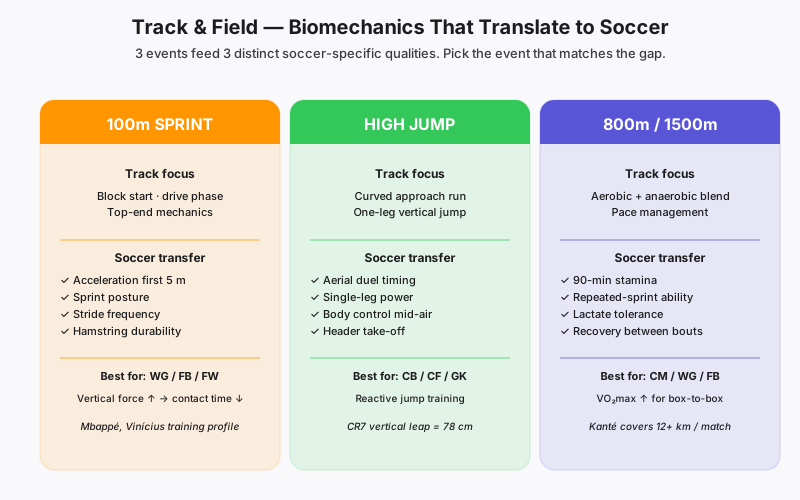
Sprint Mechanics — The Science of Acceleration and Top Speed
Research by Haugen et al. (2014) showed that the vast majority of sprints in soccer are under 20 m, making acceleration capacity far more decisive than top speed. Sprint technique from track and field scientifically optimizes this acceleration phase.

Photo by Jonathan Chng on Unsplash
In a study published in the International Journal of Sports Physiology and Performance, Haugen et al. (2014) revealed the reality of in-match sprinting: roughly 90% of sprints are under 30 m, and most are short acceleration bursts of 10 to 20 m. In other words, what decides a match situation is not your 100 m time but how fast you can accelerate through the first 5 to 10 m.
Optimizing the Acceleration Phase
Start technique in track sprinting provides a systematic understanding of the physics of acceleration. Cometti et al. (2001) compared 10 m sprint times between soccer players and sprinters and found that sprinters were significantly faster. The difference was attributed primarily to the following technical elements.
- Forward lean — Tilting the torso to approximately 45 degrees during acceleration maximizes the horizontal component of ground-reaction force. Many soccer players do not lean forward enough when accelerating
- Ground-contact pattern — During the acceleration phase, the foot strikes behind the body's center of mass and pushes forward. Track athletes have the sensation of "driving into the ground" deeply ingrained in their motor patterns
- Arm-drive contribution to propulsion — Hinrichs (1987) showed that arm swing contributes up to 10% of sprint speed. Soccer players often overlook the importance of arm drive, yet track drills can improve it dramatically
Raising the Top-Speed Ceiling
Haugen et al. (2014) also reported that elite soccer players reach top sprint speeds of 30 to 34 km/h — a substantial gap compared to elite sprinters who exceed 40 km/h. Much of this gap is trainable. In the top-speed phase, the decisive factors are shorter ground-contact time, faster hip extension, and quicker knee lift. Track drills such as stride-outs, high knees, and bounding target these elements directly.
Ninety percent of soccer sprints are under 30 m. Acceleration quality, not top speed, decides the outcome. Track-sprint techniques — forward lean, ground contact, arm drive — translate directly into scoring chances.
Middle-Distance Running and High-Intensity Intermittent Capacity
Soccer's fitness demands are not about sustaining a steady jog for 90 minutes but about repeating high-intensity sprints with incomplete recovery. Middle-distance training (800 m to 1500 m) strengthens the physiological foundation of this intermittent capacity.
Stolen et al. (2005) reported that the average interval between sprints during a soccer match is 60 to 90 seconds. That means 90 minutes of cycling through all-out sprints, incomplete recovery, and another all-out effort. This "high-intensity intermittent exercise capacity" (HIIE) is one of the most important physical qualities defining soccer performance.
Physiological Overlap Between Middle-Distance Running and Soccer
The 800 m is an event that pushes both aerobic and anaerobic energy systems to their limits. Spencer et al. (2005) demonstrated that the energy-supply profile during soccer's high-intensity phases closely mirrors that of 800 m to 1500 m running — roughly 60 to 70% aerobic and 30 to 40% anaerobic.
- Maximal oxygen uptake (VO2max) — Efficiently improved through middle-distance training. In soccer, it directly determines how fast a player recovers between sprints
- Lactate threshold (LT) — Raised by tempo runs at middle-distance pace. In soccer, it governs how long a player can sustain high-intensity running
- Running economy — The ability to run at a given speed with less energy. Improved by form correction in middle-distance training, it reduces total energy expenditure across 90 minutes of soccer
- Lactate-buffering capacity — The ability to clear lactate during repeated high-intensity bouts. Directly enhanced by middle-distance interval training
Practical Guidelines for Middle-Distance Training
When incorporating middle-distance training, soccer players should favor intermittent sessions that mimic match conditions rather than long, slow runs. For example, 6 x 400 m intervals with 90-second recovery jogs closely simulate the sprint-recovery cycle encountered during a game. Research by Bangsbo et al. (2006) on the Yo-Yo Intermittent Recovery Test confirmed that this type of interval training significantly improves test scores.
Soccer endurance is not the ability to run long. It is the ability to sprint flat-out, recover briefly, and sprint flat-out again. Middle-distance running trains exactly this capacity.
Jumping Events — Explosive Power and Plyometrics
The techniques behind the long jump, high jump, and triple jump develop the explosive power essential for heading duels, sprint initiation, and changes of direction. Stolen et al. (2005) demonstrated that vertical-jump ability is a distinguishing marker of elite soccer players.
Soccer is filled with "explosive moments": aerial challenges for headers, sudden accelerations, and sharp decelerations into direction changes. What all of these share is the need to produce maximal force in a very short time — explosive power. In their review, Stolen et al. (2005) reported that vertical-jump height is a statistically significant marker separating elite from sub-elite soccer players.
Abilities That Transfer from Jumping Events to Soccer
- Rate of force development (RFD) at takeoff — The long-jump takeoff delivers maximal force into the ground within 0.10 to 0.15 seconds. It shares the same neuromuscular mechanism as the initial burst in a soccer sprint
- Stretch-shortening cycle (SSC) efficiency — The hop, step, and jump of the triple jump exploit the muscle stretch-shortening cycle at peak efficiency. Changes of direction in soccer — deceleration followed by acceleration — are a continuous chain of SSC actions
- Airborne body control — The Fosbury Flop trains mid-air postural awareness. This transfers directly to aerial balance during heading duels
- Converting run-up speed into vertical force — The long-jump approach converts horizontal velocity into vertical force at takeoff. The same biomechanical principle applies to the planting step before a soccer shot
The Scientific Evidence for Plyometrics
At the heart of jump-event training lies plyometrics. A meta-analysis by Markovic (2007) found that plyometric training improves vertical-jump ability by an average of 8% and sprint speed by 3%. When applied to soccer players, jump drills such as depth jumps, box jumps, and bounding have been shown to simultaneously improve sprint acceleration and heading reach.
A player who jumps high is also a player who runs fast — because the neuromuscular mechanism for transmitting force into the ground is the same. Jump-event training strengthens the foundation of every explosive action in soccer.
Running-Form Optimization — Better Mechanics, Better Soccer
Two players running at the same speed can expend vastly different amounts of energy. By optimizing form through track drills, soccer players develop the running economy needed to cover 90 minutes on less fuel.
The research team behind Haugen et al. (2014) noted that soccer players have considerably more room for improvement in running form than track athletes. Because soccer players devote their time to ball skills and tactical sessions, they rarely receive instruction on how to run itself. Yet improving running form offers an exceptionally high return on investment — a 10% gain in mechanical efficiency translates into a meaningful energy reserve in the final minutes of a match.
Form Elements That Track Drills Can Improve
- Arm drive — A straight, front-to-back arm swing generates propulsive force. Soccer players tend to swing laterally, wasting energy. A "high-knees plus arm-drive" drill corrects this quickly
- Foot-strike position — Striking the ground directly beneath or slightly ahead of the center of mass is most efficient. A heel-first overstride creates braking force and slows the runner down
- Knee lift — High-knee drills develop the stride length needed for speed. Insufficient knee lift shortens the stride, forcing a higher turnover rate to maintain the same pace
- Pelvic stability — Lateral sway of the pelvis during running reduces propulsive efficiency. Skipping and bounding drills from track training build the stability needed to keep the pelvis level
- Relaxation — At top speed, tension is the enemy. Track stride-outs (wind sprints) teach the sensation of holding high speed in a relaxed state
Adapting to Soccer-Specific Running
When transferring straight-line track technique to soccer, sport-specific demands must be considered. Soccer requires running with the head up to scan the field, keeping a lower center of gravity to prepare for sudden direction changes, and dribbling with the ball at the feet — all of which differ from a pure linear sprint. The key is to build a correct-form foundation through track and field, then adapt it to the soccer context. There is no adaptation without a foundation.
Most soccer players try to "run fast." Track athletes try to "run efficiently." That difference in mindset creates a decisive gap in late-match sprints.
Logging Track Training in Footnote
To maximize how much track work transfers to soccer, the key is to record not just times but also what you focused on and what you can apply to a match — putting it into words.
When incorporating track and field as cross-training, using the following perspectives in your Footnote practice log will help you consciously maximize transfer to soccer.
Sample Sprint-Practice Log Entry
- Session content — "6 x 30 m acceleration sprints. Focused on arm drive and forward lean. Fastest time: 4.5 s"
- Verbalizing body feel — "From the third rep, my arm swing started drifting sideways. When I consciously drove my arms front-to-back, the difference in propulsion was obvious"
- Transfer point to soccer — "The forward-lean sensation during acceleration is identical to the first step of a run behind the defensive line. Will try this consciously in the next match"
- Numerical data — "10 m split: 1.9 s. 30 m time: 4.5 s — improved from 4.7 s last week. Arm-drive correction is paying off"
Sample Interval-Training Log Entry
For middle-distance interval sessions, pay attention to how recovery times change and log it: "5 x 400 m, 90-second recovery. Rep 1: 74 s, Rep 5: 82 s. Recovery was inadequate and times dropped in the second half. Same root cause as fewer sprints in the second half of a match — lactate-processing capacity needs work." By linking track data to specific match issues, the purpose behind each training session becomes clear.
Footnote's periodic AI analysis can track correlations between track-training frequency and match performance. Patterns like "During the four weeks I did sprint drills once a week, my self-assessed sprint-related match performance trended upward" build motivation to keep cross-training consistent.
Track times are quantitative indicators of your soccer weapons. When you can write about how a 0.2-second improvement in your 30 m sprint translated into a specific match situation, your cross-training log becomes evidence of growth.
Frequently Asked Questions
Won't too much track training cut into soccer skill practice?▾
One or two sessions per week at 30 to 40 minutes each should not significantly affect soccer skill training. In fact, sprint drills such as high knees and bounding can be incorporated into warm-ups, requiring no additional time at all. Because running-form improvements carry over to every running action on the pitch, the return on investment is exceptionally high.
How important is a 100 m time for a soccer player?▾
Acceleration over 10 to 30 m matters far more than the 100 m time itself. Research by Haugen et al. (2014) confirmed that the vast majority of in-match sprints are under 30 m. While 100 m training can raise top speed, if the goal is transfer to soccer, the emphasis should be on acceleration runs of 30 m or less and standing-start sprints.
Isn't running form in track different from running in soccer?▾
There are certainly soccer-specific differences — running with the head up to scan the field, preparing for sudden direction changes, and so on. However, the fundamental principles of efficient arm drive, proper foot-strike position, and core stability are universal. The most effective approach is to build a correct running foundation through track and field, then layer soccer-specific adaptations on top.
Is it safe for youth players to start track training?▾
Yes — in fact, youth is the ideal time to experience a variety of movement patterns. Growth-plate safety must be considered, however. High-intensity plyometrics such as depth jumps are safer once the body is more mature, typically from middle school onward. At the elementary level, low- to moderate-intensity drills like skipping, bounding, and relay games are recommended for developing the joy of running and sound basic form.
Any tips for logging track training in Footnote?▾
Record both objective data (times, reps, recovery durations) and subjective observations (form cues, fatigue level). The key extra step is to verbalize at least one way the session connects to a match situation — for example, "Forward-lean focus during 30 m acceleration sprints → first step of runs behind the back line." Linking track technique to soccer actions consciously promotes transfer.
References
- [1] Haugen, T. A., Tonnessen, E., Hisdal, J., & Seiler, S. (2014). “The role and development of sprinting speed in soccer” International Journal of Sports Physiology and Performance, 9(3), 432-441. Link
- [2] Stolen, T., Chamari, K., Castagna, C., & Wisloff, U. (2005). “Physiology of soccer: An update” Sports Medicine, 35(6), 501-536. Link
- [3] Cometti, G., Maffiuletti, N. A., Pousson, M., Chatard, J. C., & Maffulli, N. (2001). “Isokinetic strength and anaerobic power of elite, subelite and amateur French soccer players” International Journal of Sports Medicine, 22(1), 45-51. Link
- [4] Spencer, M., Bishop, D., Dawson, B., & Goodman, C. (2005). “Physiological and metabolic responses of repeated-sprint activities” Sports Medicine, 35(12), 1025-1044. Link
- [5] Bangsbo, J., Iaia, F. M., & Krustrup, P. (2008). “The Yo-Yo intermittent recovery test: A useful tool for evaluation of physical performance in intermittent sports” Sports Medicine, 38(1), 37-51. Link
- [6] Markovic, G. (2007). “Does plyometric training improve vertical jump height? A meta-analytical review” British Journal of Sports Medicine, 41(6), 349-355. Link
- [7] Hammami, A., Gabbett, T. J., Slimani, M., & Bouhlel, E. (2018). “Does cross-training improve physical fitness in youth soccer players? A systematic review” Biology of Sport, 35(4), 361-369.
- [8] Hinrichs, R. N. (1987). “Upper extremity function in running. II: Angular momentum considerations” International Journal of Sport Biomechanics, 3(3), 242-263.
Related Articles
Verbalization Accelerates Transfer -- Why Writing Makes Skills from Other Sports Carry Over to Soccer
11 min read
The Science Behind How Verbalization Improves Soccer — How 'Writing' and 'Thinking' Connect in the Brain
6 min read
Metacognition Training — The Science Behind 'Thinking Soccer' and How to Develop It Through Journaling
12 min read
How to Review a Match --- What Pro Scouts Look For and Proven Recording Techniques
7 min read
Esports x Soccer — How Gaming Sharpens Tactical Vision, Decision Speed, and Transfers to Real Play
11 min read
Track Your Growth with Footnote
Just record your matches — AI analyzes every 5 games. Visualize growth with PVS Score. All features free during beta.
30-second signup · No credit card required
Last updated: 2026-05-06 ・ Footnote Editorial