How Martial Arts Build Duel Strength, Body Control, and Mental Toughness for Soccer
The players who win 1v1 duels in soccer are not necessarily faster than their opponents — they use their center of gravity differently. Vieten et al. (2007) demonstrated that experienced martial artists possess significantly superior dynamic balance compared to non-practitioners, while Paillard et al. (2006) reported that judokas outperform athletes from other sports, including soccer, in postural control. Center-of-gravity manipulation developed through martial arts, the ability to anticipate an opponent's next move, and composure under physical pressure — these three capabilities go to the heart of what decides 1v1 duels on the pitch.
What Transfers from Martial Arts to Soccer — Three Pillars
Martial arts and soccer share a fundamental structure: controlling your own body while destabilizing your opponent's center of gravity in a contested situation. This common structure provides the basis for skill transfer, consistent with Thorndike's (1901) identical-elements theory.

Photo by Anastase Maragos on Unsplash
At first glance, martial arts and soccer appear to be entirely different sports. Yet the essence of a soccer 1v1 — shoulder charges, shielding, aerial duels, beating a defender on the dribble — is body control in a contested situation. That is precisely the skill domain martial arts train most systematically.
The three pillars of transfer
- Center-of-Gravity Control — The ability to keep your own center of gravity low while disrupting your opponent's balance. Judo's kuzushi (off-balancing), wrestling's takedown defense, and karate's fighting stance all transfer directly to shielding and physical contests in soccer.
- Anticipation — The ability to predict an opponent's next move by reading shifts in body weight, gaze, and posture. Blais & Bherer (2007) showed that martial arts practitioners anticipate opponents' actions earlier than non-practitioners.
- Pressure Tolerance — The capacity to make calm decisions while under simultaneous physical contact and psychological pressure. Match experience in martial arts builds the mental stability needed during contact situations in soccer.
Crucially, the skills that transfer are not general physical attributes like raw strength. They are advanced perceptual-motor skills — disrupting and defending balance, reading an opponent's intentions. These are domains that martial arts train systematically in ways that conventional soccer training alone cannot replicate.
Martial arts do not train "strength." They train the ability to control your body when someone is actively trying to move it — the single most important and most difficult skill to develop for winning 1v1 duels in soccer.
Center-of-Gravity Control — From Judo and Wrestling to Shielding and Aerial Duels
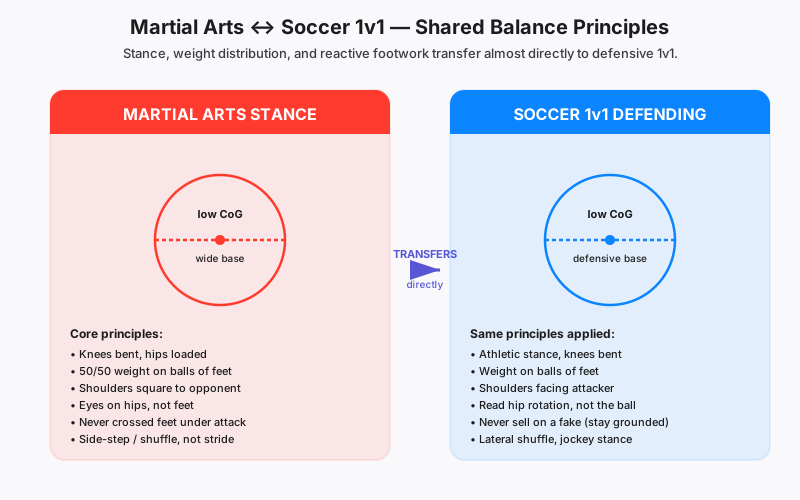
Paillard et al. (2006) reported that judokas demonstrate significantly superior postural control compared to non-athletes in both eyes-open and eyes-closed conditions. This center-of-gravity control transfers directly to shoulder charges, shielding, and maintaining balance during aerial challenges in soccer.

Photo by Thao LEE on Unsplash
In a study published in Neuroscience Letters, Paillard et al. (2006) compared postural control among judokas, soccer players, and non-athletes using a force platform. Judokas exhibited significantly less postural sway than the other two groups, particularly in the eyes-closed condition. This indicates that judo training develops a highly refined postural control system based on proprioception rather than vision.
Transfer mechanisms to soccer
- Shielding — Holding possession while absorbing an opponent's push. The ability to "stay grounded under pressure," cultivated through judo's grip fighting (kumi-te), transfers directly.
- Shoulder charges — Legal shoulder-to-shoulder contact to displace an opponent. The low-center-of-gravity impact technique refined in wrestling translates into effective, fair physical play in soccer.
- Aerial duels — Maintaining balance while contesting a header under contact. The dynamic balance of martial artists documented by Vieten et al. (2007) contributes to core stability in the air.
- Dribbling under contact — Carrying the ball without going down when an opponent challenges physically. The trunk stability developed through martial arts creates a decisive advantage.
Vieten et al. (2007) measured the balance ability of experienced karate, judo, and taekwondo practitioners, confirming that martial artists hold a pronounced advantage specifically under dynamic conditions — when external forces are applied or when standing on unstable surfaces. Contact situations in soccer are precisely these dynamic conditions. The balance martial arts develop is not static balance; it is the ability to recover stability after being disrupted — exactly what soccer demands.
The essence of judo is kuzushi-tsukuri-kake: breaking your opponent's balance while maintaining your own. That is the 1v1 duel in soccer, distilled to its core.
— Parallels between judo's foundational principles and soccer's contested play
1v1 Anticipation — Reading Your Opponent's Weight Shift
Blais & Bherer (2007) reported that martial arts practitioners outperform non-practitioners in visual-attention distribution and response inhibition. The ability to read "which way an opponent's center of gravity is moving" in a split second transfers to both defending and dribbling in soccer.
In martial arts competition, the speed at which you anticipate your opponent's next action directly determines the outcome. In judo, while gripping the sleeve and collar, and in wrestling, while locked in a clinch, athletes read subtle changes in their opponent's muscle tension, weight distribution, and gaze direction to predict the next technique. This anticipatory ability was validated in cognitive-science terms by Blais & Bherer (2007) in Acta Psychologica.
Three layers of anticipation trained by martial arts
- Haptic feedback — Sensing the direction and magnitude of an opponent's force through your hands and body while grappling. In soccer, this transfers to the ability to detect, through shoulder contact, which way an opponent is shifting their weight.
- Visual-cue detection — Predicting the next move from the angle of an opponent's shoulders, the direction of their knees, and the placement of their feet. In soccer, this corresponds to reading the direction of a feint from a dribbler's shoulder orientation.
- Pattern recognition — Learning, from experience, the probability distribution of what follows a specific movement. In soccer, this transfers to the in-match adaptability of reading an opponent's tendencies.
This anticipatory ability is most powerful on the defensive side of soccer. A defender facing a dribbler must predict the direction of attack not just from ball movement but from the opponent's center of gravity, shoulders, and hips. Martial artists have accumulated thousands of hours of training in "reading information from an opponent's body," giving them greater accuracy and speed in these reads compared to players trained exclusively in soccer.
The defender who "never gets beaten" in a 1v1 is not the fastest player on the pitch. They have already read the attacker's move before it happens. Martial arts are the most efficient way to develop this anticipatory eye.
Mental Toughness — Overcoming Fear of Contact and Staying Composed Under Pressure
Bernards et al. (2017) reported that martial arts training significantly improves self-efficacy and stress tolerance. The mental fortitude built through martial arts directly underpins composure in soccer's most intense contact situations.
Martial arts do not only transfer physical skills. Becoming comfortable with full-body contact is arguably the area with the widest individual variation at the youth level and the hardest mental attribute to train through soccer alone.
Three mental attributes martial arts develop
- Desensitization to contact — Accumulated experience of grappling, being thrown, and pushing against opponents reduces the fear response to physical contact. In soccer, this translates to fearlessness in aerial duels, commitment to tackles, and confidence when shielding the ball under pressure.
- Decision-making under load — Martial arts competition is an exercise in choosing the optimal response while being pinned, locked, or on the verge of being thrown — simultaneous physical and psychological pressure. In soccer, this transfers to pass selection under a high press and accurate decision-making during late-game fatigue.
- Instant recovery from failure — In martial arts, the fundamental response to being thrown is to get back up; to being scored on is to score back. This "reset immediately after a mistake" mental pattern transfers to the recovery mindset needed after conceding a goal or misplacing a pass in soccer.
In a study published in the International Journal of Sports Science & Coaching, Bernards et al. (2017) found that athletes who completed an eight-week martial arts training program showed improved self-efficacy, reduced perceived stress, and greater willingness to embrace challenge situations. The marked improvement in tolerance for "stress involving physical contact" is particularly relevant for reducing the fear that many young soccer players feel during contact play.
Physical weakness is not always solved by strength training. When the real barrier is a fear of contact, martial arts remove it at the root.
Judo vs. Wrestling vs. Karate — Comparing Transfer Characteristics for Soccer
"Martial arts" is a broad category. Judo, wrestling, and karate each transfer different skills to soccer. Choosing the discipline that aligns with your position and areas for improvement maximizes the crossover benefit.
When selecting a martial art for soccer cross-training, the most effective choice depends on what you need to develop. Understanding the distinct transfer profile of each discipline is essential.
Judo — The foundation for shielding and aerial duels
Judo's defining advantage is center-of-gravity control while clinched with an opponent. Training to maintain your own balance while off-balancing a gripping partner transfers most directly to shielding, shoulder charges, and aerial challenges. Judo's ukemi (breakfall techniques) also serve as injury prevention during in-game falls. As Paillard et al. (2006) demonstrated, judo is the martial art that most effectively develops proprioception-based balance.
Wrestling — Low-center power and a physical foundation
Wrestling specializes in "driving into an opponent" and "exploding from a low stance." In soccer, this pays off when a striker backs into a defender for hold-up play, or when a defender closes down a dribbler to win possession. Wrestling builds coordinated, full-body force production, making it the ideal foundation for players who need to compete physically despite a smaller frame.
Karate — Reaction speed and spacing management
What sets karate apart from other martial arts is its management of striking distance (ma-ai). The ability to read the gap between yourself and an opponent, precisely controlling the moment you enter and exit attack range, transfers to managing spacing when defending against dribblers. Vieten et al. (2007) confirmed that experienced karateka demonstrate particularly strong reaction speed and dynamic balance — attributes that underpin the ability to react instantly to an attacker's first move in a 1v1.
Position-specific recommendations: Center-backs and fullbacks benefit most from judo (aerial duels and contact). Strikers and center-forwards gain the most from wrestling (hold-up play and body leverage). Wingers and wide midfielders are best served by karate (spacing management and reaction speed).
Logging Martial Arts Cross-Training in Footnote
When recording martial arts sessions in Footnote, the key is not documenting what you did — it is articulating what transfers to soccer. Clearly identifying transfer points changes how you approach your next soccer training session.
When logging martial arts cross-training in Footnote, use the ALR framework — Abstraction, Language, Re-application (see related articles for details). Below are recording points specific to martial arts.
Recording examples
- Log the session and what you felt physically — Example: "20 min of judo randori. When my partner drove into me, dropping my hips and lowering my center of gravity let me hold my ground."
- Articulate the transfer point to soccer — "The sensation of dropping my hips to absorb pressure is exactly the same as shielding when a defender leans into me. I'll test this in the next match when a forward backs into me."
- Set an experiment goal for your next soccer session — "In tomorrow's small-sided game, I'll consciously apply judo's 'drop-the-hips' technique when shielding the ball."
- Reflect on the experiment's outcome — "Tried the low-center shielding from judo. I held the ball under pressure more often, but going too low narrowed my passing vision — need to find the right height."
Footnote's AI analysis, generated every five matches, can detect correlations between periods of martial arts cross-training and self-assessed duel win rate or ball-retention rate. Patterns like "my aerial confidence improved after starting judo" or "my 1v1 defending is more stable in weeks with karate sessions" emerge over time, giving you objective insight into which martial art and training frequency work best for you.
Martial arts alone do not make you better at soccer. Transfer happens only when you reinterpret the principles learned in martial arts within the context of soccer and put them into words.
Frequently Asked Questions
Can I start martial arts with no prior experience? What is the right age to begin?▾
Absolutely. Judo and wrestling clubs that welcome beginners as young as six or seven exist worldwide. As cross-training for soccer, one session per week is enough to generate meaningful transfer effects. Start with the basics — breakfalls in judo, stance work in wrestling — and focus on becoming comfortable in body-on-body situations.
Won't injuries from martial arts interfere with soccer?▾
Under proper coaching, martial arts do not carry significantly higher injury risk than other sports. In fact, learning judo's ukemi (breakfall techniques) can prevent injuries during in-game falls on the soccer pitch. That said, schedule management is important: avoid hard sparring in the lead-up to matches to minimize the risk of bruises or sprains.
Does the best martial art depend on my soccer position?▾
Yes. Center-backs and fullbacks, who contest aerial duels and absorb heavy contact, benefit most from judo. Strikers who need hold-up play and physical leverage against defenders gain the most from wrestling's low-center-of-gravity techniques. Wingers and wide midfielders, who rely on spacing management and quick reactions against defenders, are best served by karate. Match the martial art to your specific development needs for maximum transfer.
How often should I train martial arts?▾
For soccer cross-training, once per week for 60 to 90 minutes is ideal. It is important not to cut too deeply into your primary soccer training time. Martial arts provide high-quality contact and balance training even in short sessions, so long hours are unnecessary.
How should I log martial arts sessions in Footnote?▾
Go beyond simply recording what you did. Always note which soccer scenario the skill transfers to. For example: "Practiced kuzushi (off-balancing) in judo today — the feeling of disrupting my partner's center of gravity is identical to destabilizing an opponent during a shoulder charge." Write this transfer point in Footnote's reflection section, then follow up with the result of applying it in your next soccer session. This creates a complete transfer cycle.
References
- [1] Vieten, M., Riehle, H., & Seidel, M. (2007). “The influence of martial arts training on balance abilities” Proceedings of the 25th International Symposium on Biomechanics in Sports, 492–495.
- [2] Paillard, T., Costes-Salon, M. C., Lafont, C., & Dupui, P. (2002). “Are there differences in postural regulation according to the level of competition in judoists?” British Journal of Sports Medicine, 36(4), 304–305. Link
- [3] Paillard, T., Noé, F., Rivière, T., Marion, V., Montoya, R., & Dupui, P. (2006). “Postural performance and strategy in the unipedal stance of soccer players at different levels of competition” Journal of Athletic Training, 41(2), 172–176.
- [4] Blais, C. & Bherer, L. (2007). “Transfer effects of cognitive training in martial arts” Acta Psychologica, 125(1), 88–101.
- [5] Bernards, J. R., Sato, K., Haff, G. G., & Bazyler, C. D. (2017). “Current research and statistical practices in sport science and a need for change” Sports, 5(4), 87. Link
- [6] Thorndike, E. L. & Woodworth, R. S. (1901). “The influence of improvement in one mental function upon the efficiency of other functions” Psychological Review, 8(3), 247–261.
- [7] Paillard, T. (2012). “Effects of general and local fatigue on body balance control: A review” Neuroscience & Biobehavioral Reviews, 36(1), 162–176. Link
Related Articles
Verbalization Accelerates Transfer -- Why Writing Makes Skills from Other Sports Carry Over to Soccer
11 min read
The Science Behind How Verbalization Improves Soccer — How 'Writing' and 'Thinking' Connect in the Brain
6 min read
Mental Training and the Soccer Notebook Habit — The Science of Writing Your Way to a Stronger Mind
9 min read
Growth Mindset and the Soccer Journal — How to Raise Players Who Believe in Effort Over Talent
9 min read
The Art of 1v1 Duels — What Martial Arts, Fencing & Basketball Teach Us About Winning Individual Battles
10 min read
Track Your Growth with Footnote
Just record your matches — AI analyzes every 5 games. Visualize growth with PVS Score. All features free during beta.
30-second signup · No credit card required
Last updated: 2026-05-06 ・ Footnote Editorial