How Rugby Builds Physicality, Contact Tolerance, and Tactical Intelligence for Soccer
Rugby and soccer share a fundamental structure: two teams battling for possession of a ball across an open field. Gabbett (2016), publishing in the British Journal of Sports Medicine, analyzed the relationship between training load and injury across a large cohort of rugby players, demonstrating that progressive contact training builds genuine injury resilience. Duthie et al. (2003) showed that rugby's physiological demands drive combined development in sprint capacity, endurance, and strength, while Deutsch et al. (2007) provided the first detailed quantification of physical demands during match play. Contact tolerance, defensive-line organization, offload decision-making, and repeated high-intensity efforts — every one of these qualities transfers directly to soccer performance.
What Transfers from Rugby to Soccer — Four Pathways
Rugby and soccer share similar field dimensions, team sizes, and frequency of attack-defense transitions — satisfying many of the conditions for skill transfer under Thorndike's (1901) identical-elements theory. Both physical and cognitive transfer pathways benefit soccer players.

Photo by Max Leveridge on Unsplash
The overlap between rugby and soccer is greater than most people assume. Field dimensions (soccer 105 m × 68 m vs. rugby 100 m × 70 m), team size (15 vs. 11), frequency of transitions between attack and defense, and the repeating pattern of sprints interspersed with jogging — these structural similarities create rich transfer pathways from rugby to soccer.
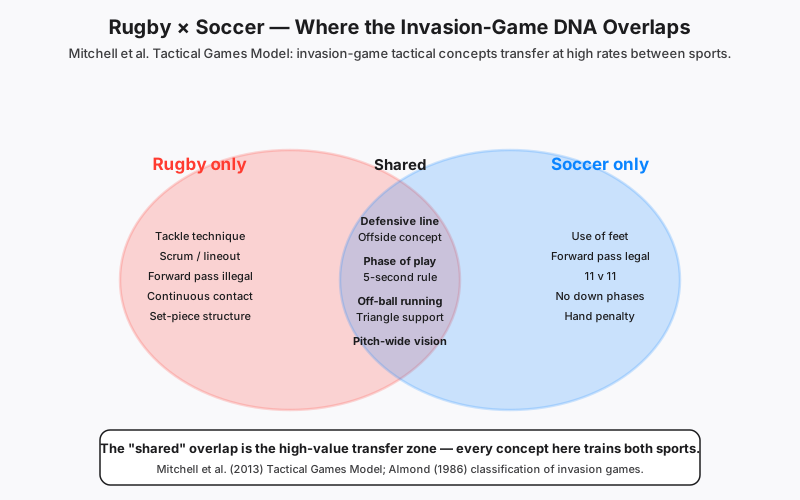
Four Transfer Pathways
- Contact tolerance and physical robustness — Routine collisions in tackles, rucks, and mauls eliminate the fear of contact that holds many soccer players back in physical duels
- Defensive-line organization and cohesion — Rugby's defensive line demands that every player holds the same depth and advances simultaneously. This organized defending transfers directly to backline management in soccer
- Offload decision-making — The split-second decision to pass to a teammate while being tackled shares the same cognitive architecture as delivering a through ball under pressure in soccer
- Repeated high-intensity efforts (RHIE) — The intermittent high-intensity pattern quantified by Deutsch et al. (2007) closely mirrors the sprint-repeat demands of a soccer match
The critical insight is that transfer from rugby goes far beyond raw physicality. Rugby is a sport in which players execute tactical decisions while absorbing physical contact. That daily practice of making cognitive judgments under bodily duress translates into superior decision-making under pressing pressure in soccer — an exceptionally valuable form of cognitive transfer.
Rugby does not just build strength. It trains the ability to think while being hit and to deliver a pass while being brought down — a simultaneous physical-cognitive load that fundamentally raises a player's match intensity in soccer.
Contact Tolerance and Physical Robustness — Building a Body and Mind That Don't Shy Away
Gabbett's (2016) landmark study demonstrated that progressive increases in contact-training load actually reduce injury risk. The routine collision experience of rugby builds both physical and psychological robustness for soccer's contact situations.

Photo by Max Leveridge on Unsplash
Gabbett's (2016) landmark paper in the British Journal of Sports Medicine analyzed the relationship between training load and injury in rugby league players. The core finding was that while sudden spikes in load increase injury risk, progressive and sustained contact training effectively adapts the body to contact. In other words, a body that regularly experiences collisions develops structurally superior tolerance to impact.
Elements of Contact Tolerance That Transfer to Soccer
- Impact absorption — The reflexive sequence trained through rugby tackles — bracing on contact then absorbing the force — directly reduces the damage taken during shoulder charges and sliding challenges in soccer
- Rapid recovery from ground contact — Rugby demands that a tackled player gets back on their feet immediately. This "down-and-up" pattern transfers to play continuity in soccer, where staying on the ground means losing the moment
- Psychological desensitization — Regular exposure to intense physical contact eliminates the fear response. Players naturally develop the mental readiness to contest aerial duels and commit to tackles in soccer without hesitation
- Body-angle management during contact — The precise control of shoulder height, head position, and body angle drilled in rugby tackling technique transfers to safe and legal charging form in soccer
Duthie et al. (2003), in their comprehensive review in Sports Medicine, analyzed the full spectrum of physical qualities required by rugby, emphasizing that strength, power, speed, and endurance are not deployed in isolation but in an integrated manner. Soccer demands the same integrated deployment — physical qualities must fire together in the instant of contact. Rugby is one of the few sports that routinely trains this integrated physical expression.
A physically strong player is not the one with the heaviest bench press. It is the one who can integrate full-body force at the moment of contact and transition instantly into the next action after being brought down.
— Summarized from Duthie et al. (2003)
Defensive-Line Organization — How Rugby's Backfield Discipline Transfers to Soccer's Line Control
Rugby's defensive line operates on a simple principle: every player holds the same depth and advances together to eliminate the opponent's time and space. This concept of organized defending transfers directly to offside-trap execution and high pressing in soccer.
The single most important concept in rugby defense is line speed. The entire defensive line pushes forward in unison, denying the opposition time and space to operate. If even one defender lags behind, the resulting gap invites an offload pass and a line break. This demand for collective cohesion maps with striking precision to soccer's defensive requirements.
Shared Defensive Principles
- Uniform line depth — In rugby, a single player stepping ahead or falling behind creates a gap. Soccer's backline works identically: the moment one defender breaks the line, runners exploit the space behind
- Synchronized advance (line speed) — Rugby's defensive line surges forward on the whistle. Soccer's high press and high line operate on the same principle — the entire team pushes up in coordinated pressure
- Constant communication — Rugby defenders maintain a running vocal dialogue, sharing information with adjacent players. The same communication skills are essential for controlling the offside line among soccer center-backs and full-backs
- Gap recognition and adjustment — Rugby defenders adjust spacing in real time based on the attacking formation. Soccer requires the same ability to modify inter-defender distances as play develops
Den Hartigh et al. (2018), publishing in Frontiers in Psychology, showed that movement synchronization among teammates correlates with performance in team sports. Rugby's defensive line is a training environment that pushes this synchronization to its limit, directly strengthening the spatial and temporal coordination with teammates that organized soccer defending demands.
A large share of goals conceded in soccer trace back to a broken defensive line. Rugby's defensive drills engrain the importance of line discipline into muscle memory in a way that pure soccer training rarely matches.
Offload Decision-Making as Through-Ball Training — Cognition Under Contact
A rugby offload requires the player to maintain visual scanning while being tackled, identify a teammate's position, and deliver an accurate pass — all under extreme physical duress. This cognitive judgment under bodily load shares the same neural architecture as delivering a through ball or final pass under pressing pressure in soccer.
The offload is one of the most cognitively demanding skills in rugby. While being driven backward by a tackler, the ball carrier must keep a wide field of vision, locate a supporting teammate in the split second before hitting the ground, and execute an accurate pass — all while the body absorbs violent impact. This ability to maintain perception and make optimal decisions under physical stress transfers directly to soccer's pressure-laden passing game.
Mechanisms of Cognitive Transfer
- Visual scanning under physical load — The ability trained through rugby offloads — to keep scanning the field while absorbing contact — transfers to soccer's demand for finding passing lanes while being body-checked by an opponent
- Pre-decision preparation — Rugby players prepare their passing options before the tackle arrives. In soccer, this corresponds to the habit of pre-scanning — having a plan for the ball before it arrives at your feet
- Instantaneous risk-reward calculation — A successful offload creates a line break; a failed one means a turnover. The speed of this risk assessment transfers directly to through-ball decision-making in soccer
Wheeler et al. (2013), in the International Journal of Sports Science & Coaching, evaluated rugby players' decision-making through video-based judgment tests and confirmed that higher-level players demonstrated significantly more accurate pre-contact decisions. This parallels the cognitive profile of elite soccer playmakers who have already decided their next action before the ball reaches them.
Soccer players who can deliver an accurate through ball or final pass at the exact moment pressure arrives are exceptionally rare. This ability is difficult to develop through judgment drills in a static environment alone. The accumulated experience of making decisions while physically being hit — exactly what rugby provides — is a uniquely effective training method.
"My decision-making slows down under pressure" — rugby's offload experience attacks this problem at its root. The sheer volume of decisions made while the body is under duress builds genuine cognitive resilience.
Conditioning — How Repeated High-Intensity Efforts Transform Soccer Endurance
Deutsch et al. (2007) quantified the physical demands of professional rugby match play and showed that the repeating pattern of short sprints, contacts, and jogging closely mirrors soccer's in-game activity profile. Rugby conditioning builds the body that can still run hard in the final minutes of a soccer match.
Deutsch et al. (2007), publishing in the Journal of Science and Medicine in Sport, used GPS and video analysis to produce a detailed breakdown of movement patterns during professional rugby league matches. Their study was the first to quantify the average frequency, recovery intervals, and combination patterns of Repeated High-Intensity Efforts (RHIE), revealing that rugby demands not just endurance but the specific capacity to recover and repeat — over and over again.
Conditioning Parallels Between Rugby and Soccer
- Intermittent high-intensity pattern — Both sports demand repeated short sprints (3–6 seconds) interspersed with jogging or walking (30–90 seconds) across a 90-minute window. Deutsch et al. reported that this pattern occurs roughly 70–80 times per rugby match
- Post-contact sprinting — Rugby requires players to get up immediately after a tackle and sprint. In soccer, the transition sprint after a duel is often the difference between winning and losing possession
- Intensity maintenance in the second half — Gabbett (2016) showed that proper training-load management is essential for sustaining performance in the closing stages. In soccer, the ability to keep running in the final 15 minutes directly influences match outcomes
Austin & Kelly (2013), in the Journal of Strength and Conditioning Research, analyzed total distance covered, high-intensity running distance, and sprint counts per match for professional rugby players. Notably, rugby players maintain their running output while absorbing contacts throughout — a fundamentally different kind of endurance from that of pure running sports. In soccer, the players who dominate matches are precisely those whose running capacity does not drop after physical duels.
When incorporating rugby fitness training as cross-training for soccer, combination drills are particularly effective: repeated tackle-bag hits followed by sprints, or groundwork (get-ups) paired with change-of-direction runs. These "contact-plus-run" circuits target the exact conditioning demands that soccer players face.
Being able to run is not enough. Being able to run after being hit — that is the fitness quality soccer truly demands, and it is the quality rugby trains more efficiently than any other sport.
Recording Rugby Cross-Training in Footnote
When logging insights from rugby sessions in Footnote, classify each observation under one of the four transfer pathways — contact tolerance, line organization, decision-making, or endurance. This structured verbalization maximizes the transfer effect.
When recording rugby cross-training in Footnote, keep the four transfer pathways introduced in this article at the forefront of your mind. Following the ALR framework of Abstraction, Language, and Reapplication (see related articles for details), structured journaling is the key that converts raw rugby experience into measurable soccer growth.
Recording Examples by Transfer Pathway
- Contact tolerance — "Practiced leading with the shoulder in tackling drills. If I hit at the same angle during a shoulder charge in soccer, I can push the opponent off the ball without conceding a foul."
- Line organization — "Did a rugby defensive drill where I had to advance at the same time as the player next to me. Same principle as controlling the offside line in soccer — calling out and staying level is everything."
- Decision-making — "Offload pass practice. I read my teammate's position just before being tackled and got the pass away. Same feeling as staying calm under a press in soccer and finding the through ball."
- Endurance — "Ten sets of tackle-then-get-up-then-sprint. Directly builds the fitness needed for transition sprints after duels in soccer."
Footnote's AI analysis, triggered every five matches, can track performance changes during periods when rugby cross-training is being recorded. Observations such as "my self-rated duel win rate has improved since starting rugby" or "the coach praised my defensive organization" accumulate as data, letting you objectively identify which elements of rugby are making the biggest impact on your soccer game.
Writing is what turns rugby practice into soccer practice. Simply noting which of the four transfer pathways each session falls under transforms a vague physical experience into structured learning.
Frequently Asked Questions
Can I start rugby as soccer cross-training even if I've never played before?▾
Absolutely. Starting with tag rugby (no tackling) lets you learn rugby's tactical elements — defensive-line work, offload decisions, and spatial awareness — without any contact risk. As you grow comfortable, you can progress gradually to touch rugby and then mini rugby. Gabbett (2016) specifically emphasizes the importance of progressive load increases.
How often should I incorporate rugby sessions?▾
As soccer cross-training, once a week for 60–90 minutes is a good baseline. Sessions that include contact should be scheduled at least two days away from a soccer match. Non-contact sessions like tag rugby or passing drills can be done on the same day as soccer training, since the load is easier to manage.
Won't rugby injuries affect my soccer?▾
Gabbett's (2016) research shows that managing training load progressively reduces injury risk. For cross-training purposes, there is no need to play full-contact matches. Using tackle pads for contact drills and adjusting drill intensity keeps the risk low. It is also important to reduce contact intensity in the lead-up to important soccer matches.
Do the benefits of rugby cross-training differ by soccer position?▾
Yes. Center-backs and full-backs benefit most from defensive-line organization and contact tolerance. Central midfielders can learn decision-making and field vision from rugby's playmaker position (fly-half). Strikers gain from the rugby runner's technique of driving forward through contact, which directly improves hold-up play. Wingers and attacking full-backs benefit from the rugby wing's instinct for finding space and accelerating into it — a skill that transfers to counter-attacking in soccer.
How should I record rugby cross-training in Footnote?▾
Use the four transfer pathways from this article — contact tolerance, line organization, decision-making, and endurance — as your classification framework. For example: "Tag rugby defensive drill → same principle as calling the offside line in soccer." Always verbalize the shared principle between rugby and soccer. Then use the reflection field to record how you applied the insight in an actual soccer context, completing the transfer cycle.
References
- [1] Gabbett, T. J. (2016). “The training-injury prevention paradox: should athletes be training smarter and harder?” British Journal of Sports Medicine, 50(5), 273–280. Link
- [2] Duthie, G., Pyne, D., & Hooper, S. (2003). “Applied physiology and game analysis of rugby union” Sports Medicine, 33(13), 973–991. Link
- [3] Deutsch, M. U., Kearney, G. A., & Rehrer, N. J. (2007). “Time-motion analysis of professional rugby union players during match-play” Journal of Science and Medicine in Sport, 10(1), 45–51. Link
- [4] Austin, D. J. & Kelly, S. J. (2013). “Professional rugby league positional match-play analysis through the use of global positioning system” Journal of Strength and Conditioning Research, 27(1), 14–19.
- [5] Den Hartigh, R. J. R., Niessen, A. S. M., Frencken, W. G. P., & Meijer, R. R. (2018). “Selection procedures in sports: Improving predictions of athletes' future performance” European Journal of Sport Science, 18(9), 1191–1198. Link
- [6] Wheeler, K. W., Askew, C. D., & Sayers, M. G. (2010). “Effective attacking strategies in rugby union” European Journal of Sport Science, 10(4), 237–242.
- [7] Thorndike, E. L. & Woodworth, R. S. (1901). “The influence of improvement in one mental function upon the efficiency of other functions” Psychological Review, 8(3), 247–261.
- [8] Gabbett, T. J., Jenkins, D. G., & Abernethy, B. (2012). “Physical demands of professional rugby league training and competition using microtechnology” Journal of Science and Medicine in Sport, 15(1), 80–86. Link
Related Articles
Verbalization Accelerates Transfer -- Why Writing Makes Skills from Other Sports Carry Over to Soccer
11 min read
How to Review a Match --- What Pro Scouts Look For and Proven Recording Techniques
7 min read
Metacognition Training — The Science Behind 'Thinking Soccer' and How to Develop It Through Journaling
12 min read
Mental Training and the Soccer Notebook Habit — The Science of Writing Your Way to a Stronger Mind
9 min read
How Chess Transfers Tactical Thinking, Anticipation, and Pattern Recognition to Soccer
10 min read
Track Your Growth with Footnote
Just record your matches — AI analyzes every 5 games. Visualize growth with PVS Score. All features free during beta.
30-second signup · No credit card required
Last updated: 2026-05-06 ・ Footnote Editorial