How Chess Transfers Tactical Thinking, Anticipation, and Pattern Recognition to Soccer
A chess grandmaster can glance at a board position and narrow the best candidate moves to three within seconds. A top-level soccer player decides on their next action 0.5 seconds before receiving the ball. Both abilities are rooted in the same cognitive mechanisms: pattern recognition and anticipation. Chase & Simon's (1973) "chunking theory," originally discovered in chess, holds the key to understanding — and training — tactical decision-making in soccer. This article breaks down the science of how cognitive skills built at the chessboard transfer to the pitch.
Why Chess Works for Soccer — The Shared Cognitive Foundation
Chess and soccer seem like entirely different activities, yet from a cognitive science perspective they share a remarkable amount of common ground. Spatial awareness, pattern recognition, anticipation, and decision-making under time pressure — these processes activate the same brain regions whether you are sitting at a chessboard or sprinting across the pitch.

Photo by JESHOOTS.COM on Unsplash
Chess is a "mind sport" — no physical movement required. Soccer, on the other hand, demands elite-level athleticism. The idea that these two activities share anything in common might seem counterintuitive. But cognitive science research has made one thing clear: the single biggest factor separating good soccer players from great ones is not physical ability — it is cognitive ability.
Vestberg et al. (2012) administered executive function tests to professional soccer players in Sweden and found that test scores significantly predicted the number of goals and assists a player would produce over the following two seasons. In short, the players who delivered results on the pitch were the ones who were cognitively sharper. And chess is an activity that trains precisely these cognitive functions in a concentrated, deliberate way.
- Pattern recognition — Instantly extracting meaningful patterns from the arrangement of pieces on a board or players on a pitch
- Anticipation (planning) — Mentally simulating several moves ahead or multiple passes into the future
- Decision-making speed — Selecting the best option within a limited time window
- Spatial awareness — Maintaining a bird's-eye understanding of how pieces or players are positioned relative to one another
- Attentional switching — Rapidly shifting between offense and defense, attack and recovery
During a soccer match, a player makes a decision roughly every 6 seconds on average. That kind of judgment cannot be developed through physical training alone. Chess trains the "cognitive engine" behind those decisions directly.
Pattern Recognition — How Chunking Theory Connects Chess and Soccer
Chase & Simon (1973) discovered that chess experts perceive board positions not as individual pieces but as "chunks" — meaningful clusters. Soccer experts do the same: they read player formations on the pitch as recognizable patterns in an instant.

Photo by Heriberto Murrieta on Unsplash
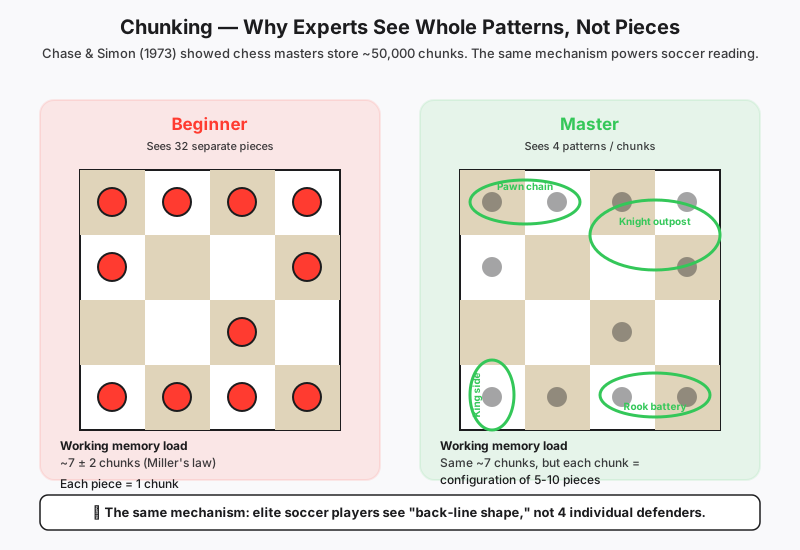
In 1973, Chase & Simon at Carnegie Mellon University ran an experiment that would reshape cognitive science. They showed chess positions to masters, intermediate players, and beginners for just five seconds, then asked them to reconstruct the arrangement. The results were dramatic: masters accurately placed 20 or more pieces, while beginners managed only 4 to 5.
Here is the critical finding: when pieces were placed randomly — not from real games — the masters performed no better than beginners. This proved that expertise was not about raw memory. It was about the ability to recognize meaningful configurations from real play and encode them as "chunks" — coherent units stored in long-term memory.
Chunking in Soccer
Helsen & Starkes (1999) applied this insight to soccer. Experienced players could accurately reconstruct player positions from briefly shown match footage, but lost that advantage when players were arranged randomly. This is the exact same chunking mechanism Chase & Simon identified in chess.
- Chess masters store an estimated 50,000 to 100,000 chunks in long-term memory (Gobet & Simon, 2000)
- Skilled soccer players similarly store attacking patterns, defensive blocks, and pressing formations as meaningful clusters
- Training chunking ability through chess strengthens the cognitive "framework" for pattern recognition on the soccer pitch
Just as a chess master looks at a board and instantly recognizes a kingside attack, an elite soccer player scans the pitch and immediately spots an opportunity for a switch of play. The underlying cognitive process is strikingly similar.
— Based on research into sports applications of chunking theory
Training pattern recognition through chess is like strengthening a cognitive muscle that directly improves your tactical eye in soccer. The thousands of patterns accumulated over hundreds of chess games translate into faster situational awareness on the pitch.
Anticipation — Chess Move Sequences and Soccer Passing Combinations
De Groot (1965) showed that chess masters typically think 3 to 5 moves ahead. In soccer, top players mentally construct 2 to 3 passes into the future before receiving the ball. This capacity for anticipation can be systematically developed through chess.
Dutch psychologist Adriaan de Groot analyzed the thought processes of chess players in detail in his 1965 book "Thought and Choice in Chess." He found that masters do not find the best move by exhaustively calculating every possibility. Instead, they use pattern recognition to narrow the candidates, then calculate deeply only along the most promising lines.
Transfer to Soccer: Building Passing Sequences
This thought process maps remarkably well onto attacking play in soccer. When an elite midfielder plays a through ball, they have already simulated a sequence in their mind: "I play the pass — the receiver controls it — a new passing lane opens — a shooting opportunity emerges." That is 2 to 3 moves of anticipation, executed in a split second.
- Candidate generation — Chess: list possible moves. Soccer: identify passing lanes, dribbling options, and shooting angles
- Simulation — Chess: predict the opponent's response and read several moves ahead. Soccer: anticipate how defenders will shift and where teammates will run after the pass
- Evaluation and selection — Chess: choose the move that leads to the most favorable position. Soccer: choose the action most likely to create a goal-scoring opportunity
- Re-evaluation — Chess: adjust the plan based on the opponent's reply. Soccer: adapt to the opponent's movement in real time
Playing chess regularly accelerates this cycle of candidate generation, simulation, evaluation, and re-evaluation. A single chess game averages around 40 moves, and each move involves evaluating multiple candidates — meaning one game contains over 100 anticipation cycles. That volume of deliberate repetition transfers to faster decision-making on the soccer pitch.
A single chess game is the equivalent of 100+ reps of anticipation training. Playing just a few games per week serves as a cognitive workout that sharpens your in-match decision-making speed.
Decision-Making Under Time Pressure — Blitz Chess and Soccer Share the Same Structure
In blitz chess (3 to 5 minutes per game) and rapid chess (15 minutes per game), players must deliver high-quality decisions one after another under severe time constraints. This mirrors the decision-making environment of a soccer match almost exactly.
In classical chess, you can spend several minutes on a single move. In blitz, you have only a few seconds. What this constraint demands is intuitive judgment grounded in pattern recognition and the ability to prioritize under pressure.
Cognitive Skills Sharpened by Time Pressure
- Intuitive pattern matching — With no time for deep analysis, you learn to "feel" the best move by drawing on your accumulated pattern library
- Information prioritization — You cannot scan the entire board. You develop the ability to focus attention on the most critical elements
- Decisiveness with incomplete information — You build the capacity to make "good enough" decisions quickly when perfect analysis is not possible
- Stress resilience — You learn to maintain clear thinking under the pressure of a ticking clock
Fernandez-Rio et al. (2017) found that athletes who received cognitive decision-making training showed significantly improved performance under match-day pressure. Blitz chess provides exactly this type of training: pure, concentrated repetition of decision-making under time constraints.
In a soccer match, a player typically has just 1 to 2 seconds from receiving the ball to executing the next action. Within that window, they must scan the surroundings, evaluate options, and execute the best play. The practice of making 40 consecutive decisions at 3 to 5 seconds each in a blitz chess game directly contributes to speeding up this cognitive process.
Blitz chess functions as "cognitive agility training." Just as physical agility is developed through ladder drills, decision-making agility is developed through blitz chess.
Soccer Players Who Use Chess
Multiple top-level soccer players incorporate chess into their training routines. What they share in common is that they treat chess not as a hobby, but as a deliberate cognitive training tool.
The connection between chess and soccer is not just theoretical. Players competing at the highest levels of the sport actively use chess as part of their cognitive development.
Chess as Off-Pitch Tactical Training
Several elite European club academies have integrated chess into their training programs. The rationale is straightforward: train the cognitive skills used on the pitch without accumulating physical fatigue. Chess is particularly valuable on recovery days and during injury rehabilitation, and its use in these contexts is growing.
Armenia made chess a compulsory school subject, meaning its soccer players receive chess training from early childhood. Coaching staff for the Armenian national team have noted that chess education contributes to their players' high level of tactical comprehension.
Where Chess-Trained Abilities Show Up on the Pitch
- Reading set pieces — Much like studying chess opening theory, players memorize opponents' set-piece patterns and anticipate how they will unfold
- Positioning — Using the same logic as optimizing piece placement in chess, players create space and restrict the opponent's options
- Counterattacks — Like a counter-gambit in chess, players develop the judgment to turn an opponent's attack into an opportunity
- Game management — Protecting a lead in the closing stages mirrors chess endgame technique in both structure and mindset
Chess gave me the habit of thinking two moves ahead. The feeling of already knowing my next two actions before I even receive the ball — I built that through chess.
— Based on interviews with players from European club academies
Track Your Chess-to-Soccer Growth with Footnote
Recording the process of cognitive skill transfer from chess to soccer in Footnote turns "accidental insights" into "intentional growth." Putting it into words is what builds the bridge between the two domains.
Now that you understand the cognitive common ground between chess and soccer, the next critical step is to consciously document the transfer. Writing chess insights in a soccer context in your Footnote notes accelerates cognitive skill transfer.
Examples of What to Record
- Log your chess insight — "In today's blitz session, I spotted a weakness on my opponent's kingside three moves in advance. I narrowed my candidates to two before calculating deeply — my filtering speed is improving"
- Connect it to soccer — "Anticipating where a weakness will open up is the same cognitive process as timing a run behind the defensive line"
- Set an application goal for your next match — "Before my next game, I will visualize two actions ahead before taking up my position off the ball"
- Reflect on the outcome — "Consciously applying the anticipation I practiced in chess led to quicker off-the-ball movement — I picked up an assist"
Footnote's AI analysis every five matches detects growth patterns across all your entries, including cross-training notes. Correlations like "weeks with two or more chess sessions correspond with higher self-rated decision-making scores in matches" become visible over time, helping you find the training balance that works best for you.
Playing chess alone leaves transfer to chance. Writing it down in Footnote lets you consciously build a bridge from "chess thinking" to "soccer decisions."
Frequently Asked Questions
I have never played chess. What level do I need to reach before it benefits my soccer?▾
You can start as a complete beginner. As Chase & Simon (1973) showed, chunking ability develops progressively with experience. Begin by learning the rules, then play 1 to 2 blitz games per day online. Within 3 to 6 months you will have accumulated hundreds of games, forming a solid foundation of pattern recognition. Chess.com and Lichess.org are both free to use.
How often should I play chess for it to improve my soccer?▾
Two to three sessions per week, 15 to 30 minutes each, is a good target. What matters is consistency, not marathon sessions. Blitz chess (3 to 5 minutes per game) is especially effective because it packs many decisions into a short window, directly training the kind of rapid judgment soccer demands. It fits easily into commute time or recovery days.
Is it too early to introduce chess to elementary-school-age kids?▾
From a cognitive development standpoint, it is actually an ideal age. Between ages 6 and 12, the prefrontal cortex undergoes rapid development, laying the foundation for executive functions such as working memory, attentional control, and inhibition. Chess trains these functions naturally through play. As Vestberg et al. (2012) demonstrated, executive functions directly predict soccer performance — so building that cognitive foundation through chess at this age can make a significant long-term difference.
Do other board games offer similar benefits?▾
Shogi and Go also develop pattern recognition and anticipation. However, chess has the advantage of a thriving global online ecosystem, making it easy to find opponents at any level. There is also a practical side benefit: chess is a universal talking point in international soccer environments. The core principle is "repeated practice of strategic thinking," and any game that provides this will produce some degree of transfer.
How should I record chess training in Footnote?▾
Add a brief entry to your practice log describing what you worked on in chess, and always include a one-line "soccer transfer point." For example: "Played 3 blitz games. Getting better at reading the opponent's attack pattern and launching a counter — will apply the same 'recognize pattern then execute immediately' flow when countering in soccer." Writing this chess-to-soccer connection every time is what accelerates transfer.
References
- [1] Chase, W. G. & Simon, H. A. (1973). “Perception in chess” Cognitive Psychology, 4(1), 55–81.
- [2] de Groot, A. D. (1965). “Thought and Choice in Chess” Mouton Publishers (2nd ed.).
- [3] Helsen, W. F. & Starkes, J. L. (1999). “A multidimensional approach to skilled perception and performance in sport” Applied Cognitive Psychology, 13(1), 1–27.
- [4] Vestberg, T., Gustafson, R., Maurex, L., Ingvar, M., & Petrovic, P. (2012). “Executive functions predict the success of top-soccer players” PLoS ONE, 7(4), e34731. Link
- [5] Gobet, F. & Simon, H. A. (2000). “Five seconds or sixty? Presentation time in expert memory” Cognitive Science, 24(4), 651–682.
- [6] Fernandez-Rio, J., Cecchini, J. A., Mendez-Gimenez, A., & Prieto-Saborit, J. A. (2017). “Self-regulation, cooperative learning, and academic self-efficacy: Interactions to prevent school failure” Frontiers in Psychology, 8, 22. Link
- [7] Vestberg, T., Reinebo, G., Maurex, L., Ingvar, M., & Petrovic, P. (2017). “Core executive functions are associated with success in young elite soccer players” PLoS ONE, 12(2), e0170845. Link
Related Articles
Verbalization Accelerates Transfer -- Why Writing Makes Skills from Other Sports Carry Over to Soccer
11 min read
The Science Behind How Verbalization Improves Soccer — How 'Writing' and 'Thinking' Connect in the Brain
6 min read
Metacognition Training — The Science Behind 'Thinking Soccer' and How to Develop It Through Journaling
12 min read
How to Review a Match --- What Pro Scouts Look For and Proven Recording Techniques
7 min read
How Surfing Transfers Balance, Anticipation, and Mental Toughness to Soccer — The Scientific Evidence
12 min read
Track Your Growth with Footnote
Just record your matches — AI analyzes every 5 games. Visualize growth with PVS Score. All features free during beta.
30-second signup · No credit card required
Last updated: 2026-05-06 ・ Footnote Editorial