The Science Behind Yoga for Soccer: Flexibility, Focus, Breathing, and Injury Prevention
Hamstring strains, ankle sprains, lower back pain — many of the injuries that plague soccer players stem from poor flexibility and inadequate balance. Polsgrove et al. (2016) demonstrated that a 10-week yoga program significantly improved flexibility and balance in college athletes. Gothe & McAuley (2015) further showed that yoga enhances executive function, including concentration and attentional control. This article examines the scientific evidence behind yoga's impact on soccer performance and injury prevention, covering both the physical and mental dimensions.
Why Yoga Works for Soccer — Integrated Body-Mind Training
Yoga is far more than stretching. It simultaneously develops flexibility, balance, breathing control, and concentration — all abilities essential to soccer. Its greatest advantage is that it builds these capacities safely and at low intensity.

Photo by Margaret Young on Unsplash
Soccer demands explosive sprints, sharp changes of direction, aerial body control, and sustained concentration over 90 minutes. These abilities depend on more than just strength and speed. Insufficient flexibility raises the risk of hamstring injuries. Poor balance leads to falls during contact play. Lapses in focus result in poor decision-making.
Yoga addresses all of these challenges in a single, integrated practice. Asanas (poses) develop the balance between flexibility and strength. Pranayama (breathwork) regulates the autonomic nervous system. Dhyana (meditation) sharpens attention and focus. The combination of these three elements delivers multi-dimensional benefits for soccer players.
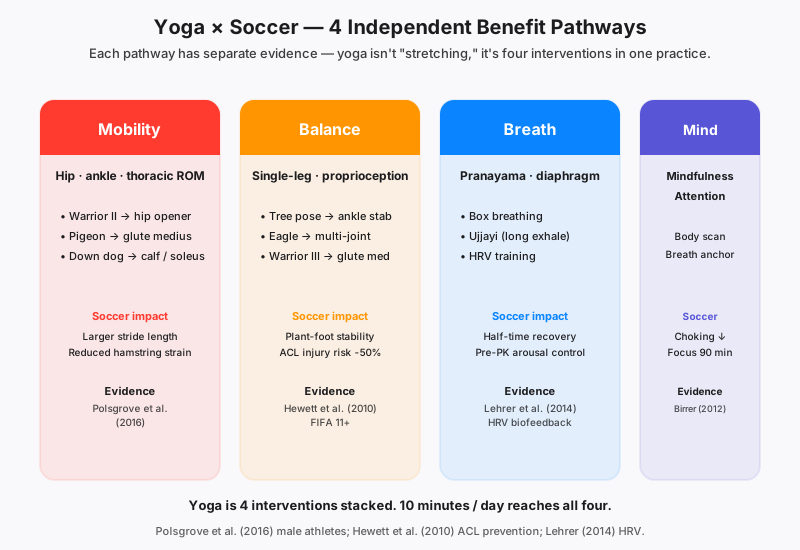
- Flexibility — Expanded range of motion for injury prevention and improved kicking mechanics
- Proprioception — Heightened body-position awareness for better balance and body control
- Breathing control — Composure under pressure and sustained endurance during matches
- Concentration — Sustained attention over 90 minutes and mental clarity in critical moments
- Recovery — Low-intensity active recovery that accelerates muscle repair
Yoga is not just about getting flexible. It is an integrated cognitive-physical training system that simultaneously develops body awareness, breathing control, and mental focus — directly addressing the multifaceted demands of soccer.
Flexibility and Injury Prevention — How Yoga Reduces Muscle Injury Risk
A systematic review by Cramer et al. (2013) found that yoga produces significant improvements in chronic pain relief and flexibility. Since reduced hamstring flexibility is a primary risk factor for the most common soccer injury, yoga targets the root cause.

Photo by Vitaly Gariev on Unsplash
Muscle injuries are the most frequent type of injury in soccer, with hamstring strains alone accounting for roughly 12-16% of all injuries. According to the UEFA Injury Study, professional soccer players experience an average of two muscle injuries per season. One of the primary risk factors is inadequate flexibility, particularly in the hamstrings.
How Yoga Improves Flexibility
Cramer et al. (2013) conducted a meta-analysis of 10 randomized controlled trials (RCTs) and confirmed that yoga produces significant benefits for musculoskeletal pain reduction and flexibility improvement. Unlike conventional static stretching, yoga stretches muscles while simultaneously activating antagonist muscles, gradually expanding range of motion in rhythm with breathing.
- Progressive range-of-motion gains — By deepening poses gradually in sync with breathing, the stretch reflex threshold of the muscle spindles is progressively raised
- Improved viscoelasticity of the muscle-tendon complex — Prolonged holds improve connective tissue elasticity, increasing resilience against sudden stretching forces
- Simultaneous strength and flexibility development — Poses like Warrior and Chair strengthen the lower limbs while improving hip joint mobility
Polsgrove et al. (2016) tested the effects of a 10-week Bikram yoga program on college athletes. The yoga group showed significant improvements in flexibility (sit-and-reach test) and balance (single-leg stand test) compared to the control group. Notably, these gains were achieved with a relatively modest commitment of just two 60-minute sessions per week.
Two yoga sessions per week are enough to produce significant improvements in flexibility and balance (Polsgrove et al., 2016). Reducing time lost to injury is one of the most cost-effective investments in long-term player development.
Proprioception and Balance — How Yoga Sharpens Your Body's Internal Map
Yoga balance poses such as Tree Pose and Warrior III systematically train proprioception — the ability to sense where your body is in space. This capacity directly translates to body control, aerial duels, and stability during contact play in soccer.
Proprioception is the ability to perceive joint angles, muscle tension, and bodily acceleration, allowing you to know exactly where your body is in space and what posture it is in. In soccer, this is essential for body control during headers, maintaining balance while jostling with opponents, and postural stability through changes of direction.
How Yoga Enhances Proprioception
Yoga balance poses heighten proprioceptor sensitivity — in the muscle spindles, Golgi tendon organs, and joint receptors — by requiring conscious maintenance of unstable positions. Furthermore, yoga's characteristic emphasis on body awareness — noticing which muscles are active and where your center of gravity lies — dramatically refines the precision of body perception.
- Tree Pose (Vrksasana) — Directly transfers to standing-leg stability during kicking. Simultaneously trains sole-of-foot sensation and core control
- Warrior III — Single-leg balance while leaning forward mirrors the body control needed for rapid deceleration from sprints and shooting technique
- Half Moon Pose (Ardha Chandrasana) — Lateral weight shifting and rotational balance improve stability during side steps and turns
Improved proprioception also directly contributes to injury prevention. Diminished proprioception is a primary risk factor for ankle sprains, and numerous studies have demonstrated that balance training effectively prevents recurrence. Yoga balance poses provide a systematic and safe method for this type of proprioceptive training.
Every action in soccer happens on one leg — kicking, trapping, turning. Single-leg stability determines the quality of your play. Yoga balance poses are purpose-built to develop exactly this capacity.
Breathwork — Controlling Performance Under Pressure
Pranayama (yogic breathwork) is a technique for consciously regulating the autonomic nervous system. It serves as a physiological switch that enables players to execute penalty kicks, free kicks, and decisive shots with composure in high-pressure moments.
A penalty kick in the dying minutes. A free kick with a one-goal margin. A one-on-one chance in front of goal. In soccer's most decisive moments, the outcome hinges not just on technical ability but on the capacity to manage tension. Heart rate spikes, breathing becomes shallow, muscles tighten — this is sympathetic nervous system overactivation (the fight-or-flight response), and it significantly degrades the precise motor actions that soccer demands.
How Breathing Regulates the Autonomic Nervous System
Pranayama activates the parasympathetic nervous system through conscious breath control, counteracting sympathetic overactivation. In particular, extending the exhalation stimulates the vagus nerve, lowering heart rate and reducing muscle tension.
- Nadi Shodhana (alternate nostril breathing) — Alternating between nostrils balances the autonomic nervous system and promotes mental stability
- Ujjayi breathing (ocean breath) — Constricting the back of the throat creates resistance on the exhale, lengthening it and activating the parasympathetic response. Can be practiced during play
- 4-7-8 breathing — Inhale for 4 seconds, hold for 7, exhale for 8. A rapid stress-reduction technique executable in the seconds before a penalty or free kick
A meta-analysis by Buhlmayer et al. (2017) demonstrated that mindfulness and meditation-based interventions produce significant effects on sports performance — particularly attention, anxiety regulation, and the ability to enter a flow state. Breathwork is the core technique within mindfulness practice and one of the most immediately effective performance tools available.
Breathing is the only conscious access point to the autonomic nervous system. A player who can control their breathing is a player who can control their body under pressure.
— Synthesis of findings from sports psychology research on breathing control
Mindfulness and Concentration — Sustaining Attention for a Full 90 Minutes
Gothe & McAuley (2015) found that yoga practitioners scored significantly higher than non-practitioners on executive function tests measuring attentional control, working memory, and cognitive flexibility. The sustained attention required during a soccer match can be trained through yoga's meditative components.
Maintaining high-level concentration across 90 minutes of soccer (60-70 minutes at youth level) is just as demanding as sustaining physical endurance. Research shows that the increase in poor decisions during the second half is driven not only by physical fatigue but also by cognitive fatigue — the depletion of attentional resources.
How Yoga Enhances Executive Function
Gothe & McAuley (2015) compared executive function between yoga practitioners and non-practitioners at the University of Illinois. The yoga group performed significantly better across all tests — task switching, working memory, and cognitive inhibition. The researchers attributed this to yoga's inherent demand for focused attention on physical movement, which effectively serves as repeated executive function training.
A meta-analytical review by Buhlmayer et al. (2017) synthesized 16 studies on mindfulness interventions in sport and confirmed that mindfulness training produces moderate-to-large effect sizes on sports performance. Particularly notable was the increased frequency of achieving flow states — the mental state of complete absorption where performance reaches its peak.
Practical Benefits on the Pitch
- Sustained decision-making in the second half — Attentional endurance built through mindfulness reduces the drop-off in concentration during the closing stages of a match
- Mental reset after mistakes — The ability to let go of errors immediately and redirect attention to the next play
- Selective attention — The ability to filter out irrelevant information on the pitch and focus on what matters most: opponents' movements, open space, and teammates' positioning
- Metacognitive awareness — Recognizing when your own concentration is fading and consciously restoring it
When a talented player 'disappears' during stretches of a match, it is usually not a problem of technique or fitness — it is a problem of concentration. Yoga-based mindfulness is scientifically validated training for this invisible form of endurance.
Track Your Yoga-Soccer Progress with Footnote
Recording the physical and mental insights gained from yoga in Footnote transforms vague feelings like 'I was in good form today' into clear understanding of why you performed well. Building a habit of putting bodily sensations and mental states into words fundamentally strengthens your self-management as a player.
The benefits of yoga often end at 'I got more flexible' or 'I felt relaxed.' But by logging specific observations in Footnote, you can make the cause-and-effect relationship between yoga and your soccer performance visible.
What to Record — Examples
- Physical observations — 'My hip range of motion in Warrior II felt wider than last week. This should translate to a bigger kicking arc'
- Breathing notes — 'Practiced 4-7-8 breathing during my pre-match warm-up. Felt noticeably calmer at kickoff'
- Concentration insights — 'Did 5 minutes of morning meditation. Felt like my focus held more consistently in the second half'
- Transfer points — 'The ground-gripping sensation I focused on during Tree Pose — trying to apply that to my plant foot when shooting'
Footnote's five-match analysis lets you compare your self-rated performance between weeks when you practiced yoga and weeks when you did not. Once patterns emerge — for example, 'In weeks with two or more yoga sessions, my self-ratings for balance and concentration are consistently higher' — that evidence becomes a powerful motivator to stick with the practice.
The essence of yoga is turning attention inward — toward your own body and mind. Transferring that self-observation into your soccer journal dramatically elevates your capacity for self-management as a player.
Frequently Asked Questions
What style of yoga is best for soccer players?▾
It depends on your goal. For flexibility, Vinyasa or Ashtanga yoga (dynamic flow styles) are most effective. For recovery, Restorative yoga or Yin yoga (long-hold styles) work best. For concentration, Yoga Nidra (meditation-based) is the strongest option. A practical approach for soccer players is to use Vinyasa on training days to build dynamic flexibility, and Restorative yoga on rest days to support recovery.
How often should I practice yoga to see results in my soccer?▾
Polsgrove et al. (2016) found significant improvements after 10 weeks of practicing just twice a week for 60 minutes per session. Daily practice is not necessary — consistency at two to three times per week is what matters. Even short daily routines, such as five minutes of morning breathwork or stretching, can contribute to better concentration and body awareness.
Will yoga before a match make my muscles too relaxed?▾
Prolonged static stretching immediately before a match can temporarily reduce muscle power output. If you practice yoga pre-match, keep static pose holds short (under 15 seconds) and focus on dynamic flow sequences instead. Breathwork, on the other hand, is highly effective for pre-match tension management with no negative effect on muscle output. The optimal approach is to use breathwork before matches and save full yoga sessions for post-training or recovery days.
Is yoga beneficial for young or adolescent soccer players?▾
Extremely. During growth spurts, bone growth outpaces the flexibility of muscles and tendons, increasing the risk of growth-related conditions such as Osgood-Schlatter disease and Sever's disease. Maintaining flexibility through yoga helps prevent these conditions. Yoga also serves as an accessible and engaging way to develop concentration and body control at a young age. However, avoid pushing extreme flexibility, as excessive mobility can lead to joint instability. Always match the intensity to the player's developmental stage.
How should I log yoga practice in Footnote?▾
Add a brief note about your yoga session to your training log, and always include a connection to soccer. For example: 'Restorative yoga, 30 min. Hamstrings feel less tight — will focus on extending my follow-through in long kicks tomorrow.' Or: '3 sets of 4-7-8 breathing before the match — felt less nervous and played aggressively from the opening whistle.' The key is to put changes in bodily sensation into words.
References
- [1] Polsgrove, M. J., Eggleston, B. M., & Lockyer, R. J. (2016). “Impact of 10-weeks of yoga practice on flexibility and balance of college athletes” International Journal of Yoga, 9(1), 27–34. Link
- [2] Gothe, N. P. & McAuley, E. (2015). “Yoga and cognition: A meta-analysis of chronic and acute effects” Psychosomatic Medicine, 77(7), 784–797. Link
- [3] Cramer, H., Lauche, R., Haller, H., & Dobos, G. (2013). “A systematic review and meta-analysis of yoga for low back pain” Clinical Journal of Pain, 29(5), 450–460. Link
- [4] Bühlmayer, L., Birrer, D., Röthlin, P., Faude, O., & Donath, L. (2017). “Effects of mindfulness practice on performance-relevant parameters and performance outcomes in sports: A meta-analytical review” Sports Medicine, 47(11), 2309–2321. Link
- [5] Vestberg, T., Gustafson, R., Maurex, L., Ingvar, M., & Petrovic, P. (2012). “Executive functions predict the success of top-soccer players” PLoS ONE, 7(4), e34731. Link
- [6] Ekstrand, J., Hägglund, M., & Waldén, M. (2011). “Epidemiology of muscle injuries in professional football (soccer)” American Journal of Sports Medicine, 39(6), 1226–1232. Link
- [7] Gothe, N. P., Khan, I., Hayes, J., Erlenbach, E., & Damoiseaux, J. S. (2019). “Yoga effects on brain health: A systematic review of the current literature” Brain Plasticity, 5(1), 105–122. Link
Related Articles
Verbalization Accelerates Transfer -- Why Writing Makes Skills from Other Sports Carry Over to Soccer
11 min read
Mental Training and the Soccer Notebook Habit — The Science of Writing Your Way to a Stronger Mind
9 min read
Growth Mindset and the Soccer Journal — How to Raise Players Who Believe in Effort Over Talent
9 min read
Metacognition Training — The Science Behind 'Thinking Soccer' and How to Develop It Through Journaling
12 min read
Flexibility and Mobility — The Science Behind How Yoga, Ballet, and Gymnastics Prevent Soccer Injuries
10 min read
Track Your Growth with Footnote
Just record your matches — AI analyzes every 5 games. Visualize growth with PVS Score. All features free during beta.
30-second signup · No credit card required
Last updated: 2026-05-06 ・ Footnote Editorial