Flexibility and Mobility — The Science Behind How Yoga, Ballet, and Gymnastics Prevent Soccer Injuries
Roughly 30% of muscle injuries in soccer occur in the hamstrings, and one of the greatest risk factors is insufficient flexibility (Witvrouw et al., 2003). However, 'flexibility' and 'mobility' are distinct concepts, and static stretching alone cannot prevent injuries. Hip mobility from yoga, ankle and spinal control from ballet, full-body coordinated range of motion from gymnastics — these three movement arts have spent decades refining body-control methodologies that offer scientifically grounded approaches to reducing injury risk in soccer players.
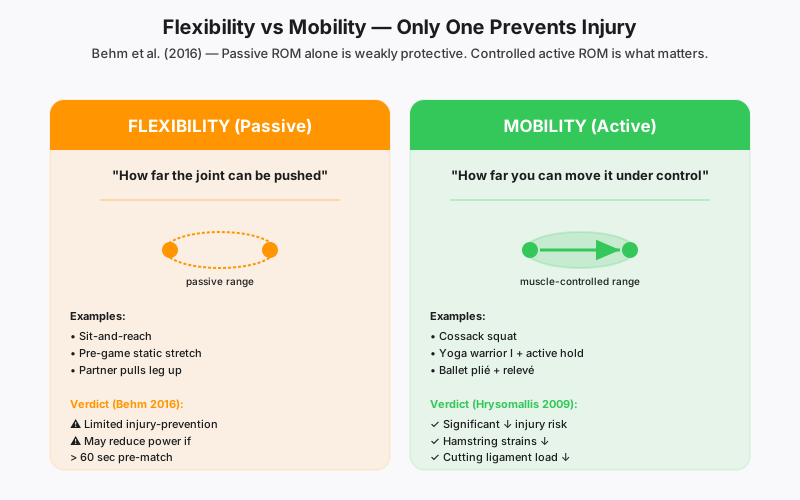
Flexibility vs. Mobility — Which One Actually Prevents Soccer Injuries?
A systematic review by Behm et al. (2016) found that passive range of motion (passive ROM) alone has limited injury-prevention value. The most effective approach combines active range of motion (active ROM) with neuromuscular control.

Photo by Emily Sea on Unsplash
'Flexibility' refers to how far a joint can move passively, while 'mobility' refers to the range through which you can move a joint under your own muscular control. What Behm et al. (2016) made clear is that soccer players need not the kind of passive flexibility required for doing the splits, but the active mobility to control their joints throughout movement.
When Soccer Demands Flexibility and Mobility
- Shooting — When hip flexion and external rotation mobility are limited, the lumbar spine compensates with excessive rotation, increasing the risk of lower back pain
- Decelerating after a sprint — Insufficient hamstring eccentric strength and flexibility leads to muscle strains during rapid deceleration from high-speed running (Witvrouw et al., 2003)
- Changing direction — Restricted ankle and knee mobility increases ligament loading during cutting movements
- Sliding tackles — Insufficient hip abduction range of motion raises the risk of adductor muscle injuries
A meta-analysis by Hrysomallis (2009) reported a significant negative correlation between balance ability and injury risk. The key insight is that balance ability is essentially synonymous with the capacity to maintain neuromuscular control across the full range of motion. In other words, it is not enough for a joint to move — you must be able to control it all the way to the end of its range. Yoga, ballet, and gymnastics all possess well-developed methodologies for training this 'controlled mobility.'
What soccer players need is not looseness but controlled mobility — the ability to maintain muscular control all the way to the limits of joint range of motion. That is what prevents injuries.
How Yoga Benefits the Hips and Hamstrings — The Core of Soccer Injury Prevention
An RCT by Polsgrove et al. (2016) found that a 10-week yoga program improved hamstring flexibility by an average of 23% while also producing significant gains in balance and core stability.
Hamstring injuries are the leading cause of time lost during the soccer season, with recurrence rates exceeding 30% (Ekstrand et al., 2016). The conventional preventive measure — Nordic hamstring curls — focuses on eccentric strength but cannot address the separate dimensions of flexibility and neuromuscular control. Yoga fills this gap.
Yoga Poses and Principles That Transfer to Soccer
- Downward Dog (Adho Mukha Svanasana) — Sustained lengthening of the hamstrings and gastrocnemius. The process of pressing the heels toward the floor teaches the sensation of 'active stretching' — stretching while engaging the muscles. This directly protects the hamstrings during sprinting
- High Lunge (Virabhadrasana I) — Simultaneously lengthens the hip flexors (iliopsoas) while activating the glutes of the rear leg. Addresses the anterior hip tightness that restricts stride length in soccer
- Pigeon Pose (Eka Pada Rajakapotasana) — Improves flexibility in the deep external rotators (piriformis, obturator internus). Expands hip external rotation range during shooting and reduces lumbar compensation
- Triangle Pose (Trikonasana) — Demands adductor lengthening and balance control simultaneously. Reduces the risk of adductor injuries during sliding movements
In the RCT conducted by Polsgrove et al. (2016) with college athletes, the group that practiced yoga for 60 minutes twice a week over 10 weeks improved hamstring flexibility (Sit-and-Reach) by 23% and significantly increased single-leg balance hold time. What makes yoga particularly noteworthy is that it requires muscle activation during holds — this is not passive stretching. As a result, range of motion expansion and strength gains occur simultaneously.
The core value of yoga lies in its 'active stretching' — engaging muscles while lengthening them. The mechanism of action is fundamentally different from passive static stretching where muscles are simply pulled.
How Ballet Transforms Ankle and Spinal Flexibility — The Foundation for Direction Changes and Trunk Control
A review by Koutedakis & Jamurtas (2004) reported that ballet dancers possess 20-30% greater ankle dorsiflexion and plantarflexion range of motion compared to other athletes, while also maintaining superior joint stability. This combination of expanded range and high stability directly benefits soccer cutting performance and injury prevention.
The most remarkable physical attribute of ballet dancers is their ability to maintain perfect balance within extreme ranges of motion. Rising onto the toes in relevé and then spinning on one leg pushes ankle musculature and proprioception to their limits. According to Koutedakis & Jamurtas (2004), ballet dancers average 8-12 degrees greater ankle dorsiflexion than general athletes — yet their ligament injury rates are lower.
Ballet Training Methods and Their Transfer to Soccer
- Plié (knee bends) — A movement that simultaneously bends the knees and ankles deeply. Expands ankle dorsiflexion range of motion and enables explosive recovery from deep squat positions. Transfers directly to low-center-of-gravity ball retention in soccer
- Relevé (rising onto the toes) — Training to support body weight at the end range of ankle plantarflexion. Strengthens the peroneal and tibialis posterior muscles, directly preventing ankle sprains
- Port de bras (arm movements) and spinal coordination — In ballet, arm movements are controlled as extensions of the trunk. This expands thoracic spine rotational mobility, making body feints and torso rotations in soccer smoother and more fluid
- Arabesque (single-leg stand with rear leg raised) — Simultaneously demands hip and knee stability in the standing leg and coordinated hamstring-glute engagement in the raised leg. Develops both the stability and range of motion needed for kicking
The greatest benefit soccer players gain from ballet training is the combination of ankle mobility and stability. Ankle sprains are the most frequent acute injury in soccer; a meta-analysis by Fong et al. (2007) reported that they account for roughly 25% of all sports injuries. Ballet barre work systematically develops the ability to 'move through a wide range while maintaining stability at every point.' As little as 15-20 minutes per week of foundational barre exercises (plié, tendu, relevé, passé balance) can produce meaningful results.
How Gymnastics Expands Full-Body Mobility — Plus the Bonus of Coordination and Aerial Awareness
Research by Jemni et al. (2006) demonstrated that gymnasts surpass athletes from other sports in full-body joint range of motion while simultaneously ranking among the highest in power output. This is proof that flexibility and power are not mutually exclusive.
Gymnastics demands what seems like a contradiction: using every joint through its maximum range of motion while generating maximum power. In measurements of Olympic gymnasts by Jemni et al. (2006), shoulder, hip, and spinal range of motion all fell in the top 10% of athletes, while vertical jump and power metrics were equally high.
Gymnastics Mobility Training and Its Transfer to Soccer
- Bridge (back bend) — Requires extreme shoulder flexion and thoracic extension range of motion. Ensures adequate spinal mobility for overhead kicks and heading in soccer, preventing excessive load on the lumbar spine
- Straddle forward fold and side bends — Dynamic flexibility of the adductors and hamstrings. While gymnasts achieve splits beyond 180 degrees, 140-150 degrees is sufficient for soccer players. What matters is being able to control this range with muscles engaged
- Handstand — Demands scapular upward rotation and total trunk alignment. Transfers to increased throw-in distance and improved aerial body control
- Rotational awareness training — Forward, backward, and lateral rotation drills train the vestibular system. This translates directly to getting up quickly after being tackled and controlling body position in the air during soccer
Soccer players do not need the full gymnastics training repertoire, but the concept of 'dynamic flexibility' should be adopted wholeheartedly. Specifically, incorporating gymnastics-style dynamic stretches (leg swings, arm circles, inchworms, the World's Greatest Stretch) into warm-ups provides pre-play range of motion without any static stretching. The review by Behm et al. (2016) also supports that pre-exercise dynamic stretching has a more positive effect on performance than static stretching.
What gymnastics proves is that 'flexible = weak' is a myth. Maximum mobility and maximum power can coexist. Build dynamic flexibility training into your warm-up routine.
Evidence-Based Flexibility Programming — Frequency, Intensity, and Timing
Behm et al. (2016) identified the conditions that maximize flexibility training effectiveness: at least three sessions per week, 30-60 second holds per position, and dynamic stretching before exercise with static stretching afterward.
Weekly Flexibility Training Plan for Soccer Players
- Pre-training (daily, 10 min) — Dynamic stretches only. Leg swings (10 reps in each direction), 5 inchworms, 3 World's Greatest Stretches per side. No static stretching (risk of performance decrease)
- Post-training (daily, 10 min) — Static stretches. Hold each position for 30 seconds x 2 sets: hamstrings, hip flexors, quadriceps, and adductors. Combines cool-down benefits with ROM improvement
- Twice per week (rest day or light day, 30 min) — Yoga- or ballet-based mobility session. Systematically work through full-body range of motion with emphasis on the hips and ankles
- Once per month (60 min) — Full-body range-of-motion assessment. Use the FMS (Functional Movement Screen) or similar tool to identify asymmetries and restrictions, then set priority areas for the following month
Three Non-Negotiable Principles
- Stop before pain — Pushing past the limit of range of motion triggers the muscle spindle's protective reflex, which actually increases stiffness. Staying within a 'comfortable stretch' promotes tissue remodeling
- Control with breathing — Holding your breath triggers the Valsalva effect, raising muscle tension. The yogic technique of expanding range of motion on the exhale is the most efficient approach
- Track asymmetries — Croisier et al. (2008) reported that a flexibility difference exceeding 15% between sides significantly elevates injury risk. Correcting asymmetries should be the top priority
An important caveat: a meta-analysis by Kay & Blazevich (2012) showed that prolonged static stretching immediately before a match or high-intensity training temporarily reduces muscle power output. Always choose dynamic stretching before practice, and reserve static stretching for post-training sessions or dedicated off-day mobility work.
Track It with Footnote — Making Flexibility Gains Visible
Flexibility improves gradually over weeks to months of consistent work. Use Footnote to regularly record changes in your range of motion and build the habit of objectively evaluating your training effectiveness.
Unlike strength or speed, flexibility gains are not immediately felt, making it one of the hardest areas to stay motivated. That is precisely why tracking matters. Footnote recommends recording monthly range-of-motion checks alongside your day-to-day flexibility training log.
Key Points for Tracking Flexibility
- Monthly ROM measurements — Record numbers from simple tests such as Sit-and-Reach, hip external rotation angle, and ankle dorsiflexion angle. Photos of your positions add further objectivity
- Asymmetry tracking — Log side-to-side differences each month (e.g., 'right hamstring 5 cm tighter than left') and monitor improvement trends
- Cross-training log — Track sessions like 'yoga 30 min' or 'ballet barre 15 min' to maintain awareness of how often you work on flexibility
- Correlation with injuries — Compare periods of consistent flexibility training against injury occurrence to see the preventive effect firsthand
After three months of records, patterns in your flexibility progress will emerge. Observations like 'zero ankle sprains during the month I did yoga twice a week' or 'my cutting got sharper after starting ballet' — when subjective impressions align with objective data, flexibility training transforms from something you 'should probably do' into something you cannot afford to skip.
Frequently Asked Questions
Can being too flexible actually be a disadvantage in soccer?▾
Excessive flexibility (joint hypermobility) can increase injury risk when it is not accompanied by adequate muscular control. However, as Behm et al. (2016) point out, expanding range of motion under muscular control carries no downsides. Gymnasts being simultaneously flexible and powerful is the proof. The goal is 'flexible and strong' — being merely 'flexible' is not enough.
Is it true that stretching before a match hurts performance?▾
A meta-analysis by Kay & Blazevich (2012) showed that static stretches held for more than 60 seconds can temporarily reduce muscle power output by 3-5%. Dynamic stretches (leg swings, inchworms, etc.), on the other hand, actually improve performance. The conclusion: use only dynamic stretching before a match, and save static stretching for afterward.
Of yoga, ballet, and gymnastics, which should a soccer player prioritize?▾
It depends on your injury profile. Players with recurring hamstring or hip issues should start with yoga. Those who frequently sprain their ankles should try ballet. If whole-body coordination is the challenge, gymnastics is the best fit. When in doubt, start with yoga — it is the most accessible and covers the hamstrings and hips, the two most injury-prone areas.
Is flexibility training safe for youth players who are still growing?▾
At appropriate intensity, it is both safe and recommended. During growth spurts, bones grow faster than muscles and tendons can lengthen, creating a period of relative tightness where flexibility work is especially important. However, excessive stretching that causes pain can harm growth cartilage, so always stay within the range of a 'comfortable stretch.'
How long does it take to see real results from flexibility training?▾
Research by Weppler & Magnusson (2010) found that stretching at least three times per week for 3-4 weeks produces significant improvements in range of motion. However, tissue remodeling — actual structural changes in connective tissue — takes 8-12 weeks. Expect nervous-system adaptations to deliver immediate gains in the first four weeks, followed by gradual, lasting improvements at the tissue level.
References
- [1] Witvrouw, E., Danneels, L., Asselman, P. et al. (2003). “Muscle flexibility as a risk factor for developing muscle injuries in male professional soccer players” American Journal of Sports Medicine.
- [2] Behm, D. G., Blazevich, A. J., Kay, A. D. & McHugh, M. (2016). “Acute effects of muscle stretching on physical performance, range of motion, and injury incidence in healthy active individuals: a systematic review” Applied Physiology, Nutrition, and Metabolism.
- [3] Hrysomallis, C. (2009). “Relationship between balance ability, training and sports injury risk” Sports Medicine.
- [4] Polsgrove, M. J., Eggleston, B. M. & Lockyer, R. J. (2016). “Impact of 10-weeks of yoga practice on flexibility and balance of college athletes” International Journal of Yoga.
- [5] Koutedakis, Y. & Jamurtas, A. (2004). “The dancer as a performing athlete: physiological considerations” Sports Medicine.
- [6] Jemni, M., Sands, W. A., Friemel, F. et al. (2006). “Any effect of gymnastics training on upper-body and lower-body aerobic and power components in national and international male gymnasts?” Journal of Strength and Conditioning Research.
- [7] Kay, A. D. & Blazevich, A. J. (2012). “Effect of acute static stretch on maximal muscle performance: a systematic review” Medicine & Science in Sports & Exercise.
- [8] Ekstrand, J., Walden, M. & Hagglund, M. (2016). “Hamstring injuries have increased by 4% annually in men's professional football, since 2001: a 13-year longitudinal analysis of the UEFA Elite Club Injury Study” British Journal of Sports Medicine.
Related Articles
Verbalization Accelerates Transfer -- Why Writing Makes Skills from Other Sports Carry Over to Soccer
11 min read
The Science Behind Yoga for Soccer: Flexibility, Focus, Breathing, and Injury Prevention
10 min read
Ballet x Soccer -- How Body Awareness, Change of Direction, and Core Control Become Weapons on the Pitch
11 min read
How Swimming Transforms Cardiovascular Fitness, Upper-Body Strength, and Recovery for Soccer Players
10 min read
Core and Axis -- How Ballet, Gymnastics, and Yoga Build Soccer's Unshakable Foundation
11 min read
Track Your Growth with Footnote
Just record your matches — AI analyzes every 5 games. Visualize growth with PVS Score. All features free during beta.
30-second signup · No credit card required
Last updated: 2026-05-06 ・ Footnote Editorial