Core and Axis -- How Ballet, Gymnastics, and Yoga Build Soccer's Unshakable Foundation
Kicking distance, posture control in aerial duels, staying upright through physical contact in 1v1s -- the core is the foundation of virtually every action on the pitch. Yet equating core training with sit-ups is a serious misconception. As Kibler et al. (2006) demonstrated, the true role of the core is to provide a stable fulcrum from which the limbs can move, requiring coordinated activation of the deep musculature, not just superficial strength. Ballet, gymnastics, and yoga each train the core from a different angle, and combining all three builds what can only be described as an unshakable axis for soccer.
Core Stability vs. Core Strength -- Which Does Soccer Demand?
Core training has two dimensions: stability and strength. Soccer requires both, but their proportions and contexts differ clearly.

Photo by Gordon Cowie on Unsplash
Core stability is the ability to hold the lumbo-pelvic region in an appropriate position so the trunk does not collapse when the limbs move. Core strength, by contrast, is the maximal force the core musculature can produce -- the power generated through the trunk during kicks and headers. In their Sports Medicine review, Kibler et al. (2006) showed that the core functions as the "origin of the proximal-to-distal kinetic chain" in sport.
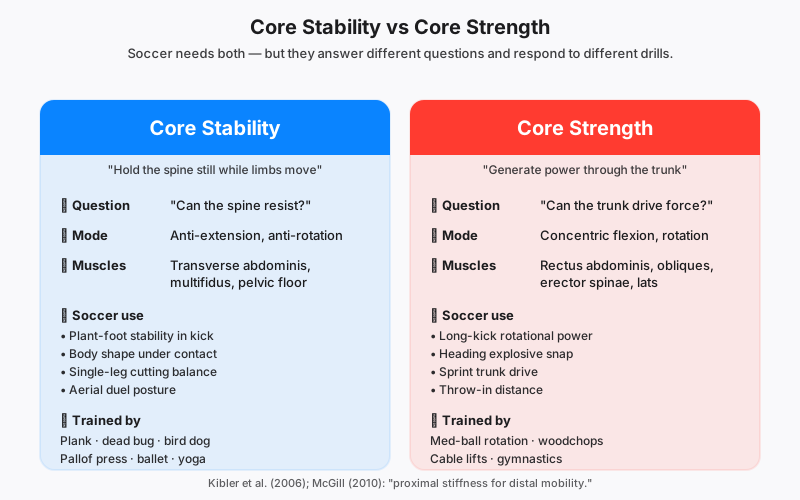
Two Roles of the Core in Soccer Movements
- Stability-dominant situations -- Maintaining balance under contact, stabilizing the pelvis during single-leg kicking, and resisting rotation through the trunk during directional changes
- Strength-dominant situations -- Generating rotational power for long-range kicks, producing explosive trunk and neck force for headers, and contributing to propulsion during sprint acceleration
McGill (2010) described the core's athletic function as "proximal stiffness for distal mobility." In other words, when the core is properly braced, the legs and arms can move faster and more accurately. This is intuitively obvious in a soccer kick: the more stable the trunk on the plant-leg side, the more freely the kicking leg can accelerate.
Holding a plank for 30 seconds and delivering an accurate kick while being pushed by an opponent are entirely different abilities. Soccer core training must develop both stability under dynamic conditions and the power to generate movement.
Willson et al. (2005) reviewed evidence linking reduced core stability to lower-extremity injury risk, reporting that it is a predictor of ACL injuries, particularly in female athletes. Core training is indispensable for both performance enhancement and injury prevention, and ballet, gymnastics, and yoga each contribute to both through unique mechanisms.
Ballet's Contribution -- Axial Alignment and Anti-Gravity Control
The ballet concept of "pulling up" is an anti-gravity control that elongates the spine against gravitational force. Establishing this vertical axis fundamentally improves postural control and single-leg stability in soccer.
In ballet, the instruction to "pull up through the body" is constant. Far from a mere pursuit of aesthetic posture, it is a biomechanically sophisticated skill: maintaining neutral spinal alignment while sustaining activation of the anti-gravity muscles -- the multifidus, transversus abdominis, and pelvic floor. Koutedakis & Jamurtas (2004) reported that ballet dancers demonstrate superior core stability compared with athletes in general.
The "Vertical Axis" Ballet Builds
Ballet barre work centers on exercises in which the dancer stands on one leg while moving the other in various directions. Training to keep the pelvis level and the spine untwisted throughout is what establishes the "axis." Because kicking in soccer is fundamentally a single-leg action, a player without this vertical axis will tilt the pelvis during the kick, causing the swinging leg's trajectory to waver and reducing both accuracy and distance.
Transfer Points to Soccer
- Pelvic stability during kicks -- The level pelvis drilled in ballet fondu (single-leg bend) directly supports plant-leg stability at the moment of the kick
- Vertical axis in the air -- The sensation of continuously lifting the trunk during jumps improves posture control at peak height when heading the ball
- Trunk position while running -- Runners with the "pull-up" sensation resist anterior pelvic tilt, improving stride efficiency
- Recovery after contact -- A well-established vertical axis lets a player return instantly to a neutral position after absorbing an external force
Ballet's "pull-up" is the ability to elongate the spine continuously against gravity. Players who possess this sense recover their axis quickly after contact and transition faster into their next action.
Gymnastics' Contribution -- Rotational Power and Aerial Control
A gymnast's core is pushed to the limit in both static stability and explosive rotational force. This coexistence of "stability and explosion" transfers to shooting power and aerial duels in soccer.
In competitive gymnastics, athletes spin the body at high speed in floor tumbling passes and then brake completely on landing; on the horizontal bar, they generate rotational energy while assuming a precise aerial posture at release. The sport demands constant alternation between "generating rotation" and "instant stabilization." Sands et al. (2012) showed that gymnasts' core muscles surpass those of athletes in other sports in both power and stiffness.
Rotational Power and Its Link to Kicks and Shots
Breaking down the soccer kick reveals a kinetic chain: pelvic rotation, trunk rotation, thigh acceleration, and lower-leg snap. In their biomechanics study, Lees et al. (2010) demonstrated that trunk rotational velocity contributes significantly to ball speed. The rotational power developed through gymnastics directly reinforces the "strength at the origin" of this kinetic chain.
Posture Control in the Air
The gymnast's technique of altering the body's axis of rotation mid-flight applies directly to aerial play in soccer. In heading, bicycle kicks, and mid-air challenges, the ability to adjust posture after takeoff and make contact in an optimal position is essentially a gymnastics-derived aerial control skill. The "tightening of the core in the air" after the jump is what determines both the force and directional accuracy of a header.
- Floor-exercise rotational force -- The ability to spin the trunk at high speed transfers to the power of long-range shots
- Landing deceleration -- The ability to stabilize the core instantly upon ground contact transfers to landing after headers and to braking from a sprint
- Handstand-based anti-gravity strength -- The muscular endurance to hold the trunk in extension contributes to core stability during sprints
The trunk control a gymnast displays when sticking a landing after a somersault -- that same ability is what lets a soccer player head the ball in the air and transition into the next play without losing balance.
Yoga's Contribution -- Deep Stabilizer Activation and Breath Integration
Yoga is one of the few training methods that consciously activates the deep stabilizers -- the transversus abdominis, multifidus, and pelvic floor. Its integration of breathing with core control elevates the quality of trunk regulation at a fundamental level.
The deep core muscles -- the transversus abdominis, multifidus, and pelvic floor -- activate predictively, roughly 30 to 50 milliseconds before limb movement, to stabilize the spine in a feedforward mechanism (Hodges & Richardson, 1997). Because these muscles are difficult to activate consciously, they have traditionally been considered hard to train through conventional methods. Yoga offers an effective solution to this challenge.
How Yoga Activates the Deep Stabilizers
Holding yoga asanas (poses) demands low-load, sustained isometric contractions. Imai et al. (2010) showed that multifidus and transversus abdominis activity increases during yoga pose holds on unstable surfaces. Single-leg balance poses such as Vrksasana (Tree Pose) and Virabhadrasana III (Warrior III) require sustained deep-muscle activation.
Integrating Breath and Core Control
Yoga's most distinctive contribution is the integration of breathing (pranayama) with core activity. The diaphragm is part of the deep core musculature, meaning that breathing patterns directly affect core stability. Hodges et al. (2007) reported that respiration and postural control share the same muscle groups, and that when respiratory demand rises during high-intensity exercise, postural stability declines. Yoga breathing practice develops the ability to maintain core stability even under heavy respiratory load.
- Late in a match -- The core is less likely to collapse even when breathing becomes labored from fatigue, preserving postural control across the full 90 minutes
- Playing immediately after a sprint -- Kicking and heading accuracy improve even when the player is out of breath
- Psychological pressure -- The deep core muscles continue to function properly even under stress, when breathing tends to become shallow
A player whose kicking accuracy holds up in stoppage time despite heavy breathing has learned to decouple respiration from core control. Yoga builds precisely that kind of "breath-proof core."
Integration into Soccer Movements -- Combining the Three Disciplines
Practicing ballet's axial alignment, gymnastics' rotational power, and yoga's deep stabilizer activation in isolation is not enough. The quality of transfer depends on the process of integrating them into soccer-specific movement contexts.
Each of the three disciplines strengthens a different aspect of the core, but ultimately those gains must be integrated into soccer movements. The following framework is designed to maximize the contribution of all three within a weekly schedule.
How the Three Disciplines Complement Each Other
- Ballet (axis + alignment) -- Imprints the "blueprint" of correct core positioning into the nervous system. Establishes the reference point for posture
- Yoga (deep muscles + breath) -- "Automates" the axis established by ballet through feedforward control of the deep stabilizers and breath integration
- Gymnastics (power + explosiveness) -- "Layers on" rotational power and aerial control on top of the stability built by ballet and yoga
Sample Weekly Program
- Monday (before soccer practice) -- Yoga breathing and deep stabilizer activation (10 min). Flip the core "switch" on before practice begins
- Wednesday (after soccer practice) -- Ballet barre elements (15 min). Reaffirm the axis while fatigued
- Saturday (standalone training day) -- Gymnastics-style rotational training (20 min). Perform power work in a fresh state
- Match-day warm-up -- Yoga diaphragmatic breathing + ballet pull-up (5 min). Enter the match with the core in its optimal state
The critical step is to follow every cross-training session with a "transfer to soccer movements." For example, after ballet single-leg balance work, hit a few instep kicks; after gymnastics rotation drills, take some shots. Linking the new core sensations to a soccer context while they are still fresh increases the rate of transfer.
Do not be satisfied with practicing the three disciplines in isolation. Always finish with a soccer movement. While the core sensations are fresh, perform kicks or headers so the body associates the feeling with "this is what stability feels like when I play."
Recording in Footnote -- Putting Core Changes into Words
The effects of core training are not immediately obvious. That is precisely why verbalizing "what you feel inside your body" and recording it matters -- it makes long-term patterns of change visible.
Core changes manifest not as visible differences but as internal body sensations. "My axis stopped wobbling when I kick." "I felt more composure in the air." "I stopped getting knocked off balance so easily." Verbalizing and recording these subtle shifts is the key to maximizing the benefits of core training.
Five Points to Record
- What you did -- e.g., "Yoga Virabhadrasana III, 30 seconds each side x 3 sets"
- Where in the core you felt it -- e.g., "Fatigue around the left multifidus. Felt activation in an area I normally underuse"
- Which soccer action it relates to -- e.g., "Seems directly connected to stability when kicking off the left leg"
- Comparison with last time -- e.g., "Last week my pelvis tilted after 30 seconds of holding; this week I kept it nearly level"
- On-pitch feedback (add after practice or a match) -- e.g., "Left-foot kicking accuracy clearly improved. Core was stable and the swinging leg tracked consistently"
Categorize Under Three Core Types
- Stability (ballet / yoga origin) -- Observations about axis maintenance, single-leg balance, anti-rotation, and postural control
- Power (gymnastics origin) -- Observations about rotational force, explosive trunk movements, and aerial control
- Endurance (yoga origin) -- Observations about breath integration, maintaining stability under fatigue, and sustained postural control
Footnote's AI analysis every five matches visualizes correlations between the type and frequency of core training and match performance. Discovering patterns such as "passing accuracy holds up in the second half during weeks with yoga" or "shot speed increases the day after gymnastics-style training" will clarify which core training combination works best for you.
Core improvement unfolds over weeks to months. Even if each individual entry feels too small to matter, the accumulated data lets the AI detect patterns. Never skip recording those subtle sensations.
Frequently Asked Questions
At what age should core training begin?▾
Bodyweight core training can be introduced safely as early as the lower elementary grades. Core training with external loads (weights), however, should wait until the skeleton has matured. Ballet barre work, basic yoga poses, and fundamental gymnastics mat exercises are all bodyweight-based and suitable for growing athletes. The key is to approach the work with a learning mindset -- "feeling how to use the core correctly" -- rather than a "building muscle" mindset.
If I can hold a plank for a long time, is my core strong enough?▾
No. A plank is merely one indicator of static core endurance. Soccer demands stability in motion, rotational power, and anticipatory deep-muscle activation. McGill (2010) stated that "stiffness, not endurance, is what matters," arguing that 10 seconds of high-intensity core bracing contributes more to sports performance than a two-minute plank. Because ballet, gymnastics, and yoga each develop core control under different dynamic conditions, they are far more comprehensive than planks alone.
If I could only pick one of the three disciplines, which would be most effective?▾
It depends on the player's weaknesses. Ballet is the priority for a player with poor posture whose body sways during kicks; yoga for a player whose core falls apart late in matches; and gymnastics for a player who lacks shooting power or aerial presence. Ideally, all three should be combined -- even 10 to 15 minutes of each per week fills the "gaps" in core ability.
How long does it take to feel the effects of core training?▾
Changes in deep-muscle activation patterns begin to appear as neural adaptations within two to four weeks. Sensations like "my axis feels more stable when I kick" or "I am harder to knock off balance" are the first signs. Structural changes involving muscle hypertrophy require eight to twelve weeks, but since soccer performance depends more on the quality of neural control than on muscle size, it is important to notice and record those early sensory changes.
How should I log core training in Footnote?▾
Record the content of your core training and the internal body sensations you noticed in Footnote's practice log. Specifying which of the three categories -- "stability," "power," or "endurance" -- applies makes it easier for the AI analysis to detect correlations between core training and soccer performance. Writing specifically about "which soccer actions changed" is especially valuable for tracking the degree of transfer.
References
- [1] Kibler, W. B., Press, J., & Sciascia, A. (2006). “The role of core stability in athletic function” Sports Medicine, 36(3), 189–198. Link
- [2] Willson, J. D., Dougherty, C. P., Ireland, M. L., & Davis, I. M. (2005). “Core stability and its relationship to lower extremity function and injury” Journal of the American Academy of Orthopaedic Surgeons, 13(5), 316–325.
- [3] McGill, S. M. (2010). “Core training: Evidence translating to better performance and injury prevention” Strength and Conditioning Journal, 32(3), 33–46. Link
- [4] Hodges, P. W. & Richardson, C. A. (1997). “Contraction of the abdominal muscles associated with movement of the lower limb” Physical Therapy, 77(2), 132–142.
- [5] Hodges, P. W., Heijnen, I., & Gandevia, S. C. (2001). “Postural activity of the diaphragm is reduced in humans when respiratory demand increases” Journal of Physiology, 537(3), 999–1008. Link
- [6] Koutedakis, Y. & Jamurtas, A. (2004). “The dancer as a performing athlete: Physiological considerations” Sports Medicine, 34(10), 651–661. Link
- [7] Lees, A., Asai, T., Andersen, T. B., Nunome, H., & Sterzing, T. (2010). “The biomechanics of kicking in soccer: A review” Journal of Sports Sciences, 28(8), 805–817. Link
- [8] Imai, A., Kaneoka, K., Okubo, Y., Shiina, I., Tatsumura, M., Izumi, S., & Shiraki, H. (2010). “Trunk muscle activity during lumbar stabilization exercises on both a stable and unstable surface” Journal of Orthopaedic and Sports Physical Therapy, 40(6), 369–375. Link
Related Articles
Verbalization Accelerates Transfer -- Why Writing Makes Skills from Other Sports Carry Over to Soccer
11 min read
Ballet x Soccer -- How Body Awareness, Change of Direction, and Core Control Become Weapons on the Pitch
11 min read
The Science Behind Yoga for Soccer: Flexibility, Focus, Breathing, and Injury Prevention
10 min read
Flexibility and Mobility — The Science Behind How Yoga, Ballet, and Gymnastics Prevent Soccer Injuries
10 min read
How Martial Arts Build Duel Strength, Body Control, and Mental Toughness for Soccer
10 min read
Track Your Growth with Footnote
Just record your matches — AI analyzes every 5 games. Visualize growth with PVS Score. All features free during beta.
30-second signup · No credit card required
Last updated: 2026-05-06 ・ Footnote Editorial