Anticipation and Reading the Game — The Science of Prediction That Racket Sports Can Teach You
Elite soccer players read the direction of a pass before the ball is struck. Goalkeepers commit to their dive while the shooter is still mid-motion. This ability to anticipate is a decisive factor that separates the talented from the rest — and, remarkably, science shows it can be trained more efficiently through racket sports than through soccer practice alone. The capacity to 'read the future from an opponent's body,' honed in tennis or table tennis, operates through the same cognitive mechanism on the pitch.
What Is Anticipation — The Cognitive Skill That Separates Elite Players
According to Williams & Ward's (2003) comprehensive review, the single greatest factor distinguishing elite from non-elite athletes is not physical ability but 'perceptual-cognitive skill' — specifically anticipation, the ability to predict what will happen next from an opponent's movements.

Photo by Avesta on Unsplash
Anticipation is the cognitive ability to predict an outcome before it is determined, based on cues from an opponent's movements, posture, and the surrounding environment. In their review published in Perceptual-Cognitive Expertise in Sport, Williams & Ward (2003) confirmed that elite athletes consistently demonstrate a significant advantage over non-elites in this ability.
Why anticipation is so decisive
In soccer, the ball takes roughly 0.4 to 0.6 seconds to reach the goal. The fastest human reaction time is about 0.2 seconds. This means that reacting after the ball has been struck is physically too late in many situations. A goalkeeper saving a penalty, a defender intercepting a pass, a midfielder choosing which direction to press — all of these depend on starting to move before the ball is kicked.
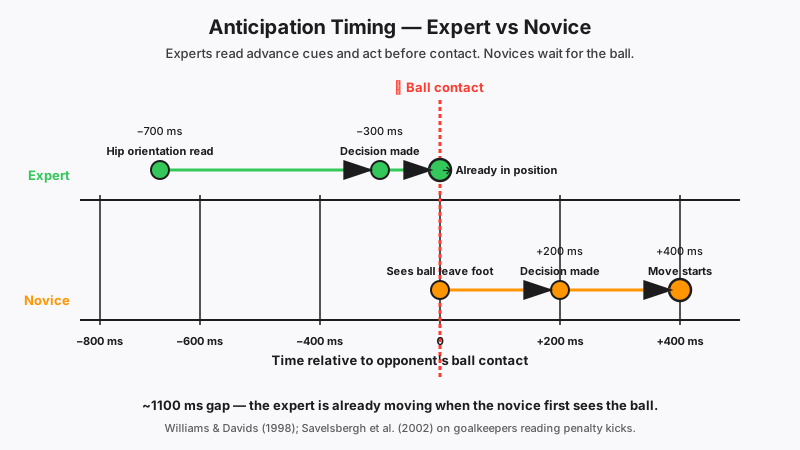
- Goalkeeper shot-stopping — Savelsbergh et al. (2002) found that elite goalkeepers predict shot direction during the roughly 200 ms window between the kicker's plant-foot landing and ball contact, using cues from the non-kicking foot angle and trunk lean
- Defender interceptions — Roca et al. (2011) showed that elite defenders rely on the opponent's body orientation as a primary predictive cue
- Midfielder decision speed — Ward & Williams (2003) demonstrated that elite midfielders outperform non-elites in both the accuracy and speed of situational assessment
Anticipation is not 'intuition.' It is a trained cognitive skill that processes body-based cues from opponents at a subconscious level — and it improves with the right kind of practice.
Visual Search Strategies — Where Elite Players Look
Eye-tracking research by Vaeyens et al. (2007) has revealed that elite athletes employ a distinctive visual search strategy characterized by fewer fixations combined with greater use of peripheral vision. This pattern is consistent across different sports.

Photo by Ben White on Unsplash
Advances in eye-tracking technology have made it possible to pinpoint exactly where on an opponent's body elite athletes focus when making predictions. The key finding: experts look at the trunk, hips, and shoulder rotation — not the ball or the extremities.
A common pattern across sports
In a study published in Research Quarterly for Exercise and Sport, Abernethy & Zawi (2007) analyzed the visual search patterns common to elite players across racket sports — tennis, badminton, and squash. Regardless of the specific sport, the following characteristics were consistently observed.
- Initial fixation on the trunk and shoulders — Before the point of contact, players direct their gaze to the opponent's trunk and shoulder alignment to read the overall direction of movement
- Short fixations across multiple areas — Rather than lingering on one spot, they rapidly scan several body segments
- Use of peripheral vision — While fixating centrally on the trunk, they simultaneously process racket or foot movement through peripheral vision
- Early information pickup — They extract useful cues at the very beginning of the action (from the start of the backswing)
The same visual search pattern applies in soccer. In a study published in Research Quarterly for Exercise and Sport, Williams & Davids (1998) showed that when elite soccer players defended in one-on-one situations, they concentrated their gaze on the opponent's hips and trunk to predict changes in dribbling direction.
The root of expert anticipation lies in the selection of information sources. While novices track the ball, experts watch the body parts that produce the outcome.
— Williams & Ward, 2003
Why Racket Sports Are a Training Ground for Anticipation
In a study published in the Journal of Experimental Psychology, Abernethy et al. (2005) demonstrated that racket-sport experts outperformed novices on prediction tasks even in a racket sport they had never played. This proves that prediction skill contains a 'general component' that transfers between sports.
Why are racket sports particularly well-suited for training anticipation? Because they create environmental conditions that force prediction at an exceptionally high frequency.
How racket sports force anticipation
- Extreme time pressure — A tennis serve exceeding 200 km/h reaches the opposite court in roughly 0.4 seconds. A table tennis smash arrives in about 0.2 seconds. Pure reaction is not enough — anticipation becomes a survival requirement
- High repetition rate — A single set of tennis produces around 60 'predict-then-verify' cycles; a table tennis game produces around 40. This far exceeds the number of one-on-one prediction opportunities in a soccer match
- Immediate feedback — If the prediction is correct, you return the ball; if wrong, you lose the point. The outcome is instantly and unambiguously clear
- Visibility of opponent intent — In racket sports, the opponent's entire body is always visible. Body orientation, backswing, and weight transfer provide abundant predictive cues
Abernethy et al.'s (2005) transfer experiment
Abernethy et al. (2005) conducted a groundbreaking experiment: they asked tennis experts to predict shot direction in squash, and squash experts to predict shot direction in tennis. Both groups predicted significantly more accurately than novices in the unfamiliar sport. This demonstrates that prediction skill has both a 'sport-specific component' and a 'general component,' and that the latter transfers across racket sports.
In just one hour of racket-sport practice, a player can experience dozens to hundreds of 'predict-then-verify' cycles. Accumulating that volume of prediction repetitions in soccer training alone is extremely difficult. This is the source of transfer.
From Court to Pitch — How Prediction Skills Transfer
Roca et al. (2013) reported that soccer players with multi-sport backgrounds outperformed soccer-only players on prediction tasks. The 'cognitive framework' for prediction built through racket sports is applied within the soccer context.
The mechanism by which anticipation developed in racket sports transfers to soccer can be understood at three levels.
Three levels of transfer
- Transfer of visual search patterns — The strategy of 'watching the trunk to predict what the extremities will do' transfers directly. The pattern of reading shot direction from shoulder orientation in tennis is structurally identical to reading pass direction from hip orientation in soccer
- Transfer of temporal prediction — The sense of timing involved in 'predicting the outcome at the earliest stage of an action' transfers. The ability to read shot direction from the angle of a tennis backswing maps directly onto reading kick direction from the early phase of a shooting motion in soccer
- Transfer of probabilistic reasoning — The meta-cognitive skill of 'predicting the next action from situational cues' transfers. Reading 'at this score and this position, a cross-court shot is most likely' in tennis employs the same cognitive process as reading 'in this situation, a through ball is coming' in soccer
Williams & Ford (2008) explained why these transfers occur through their 'common foundation model of perceptual-cognitive skill.' According to their framework, anticipation in opponent-based sports consists of two layers: sport-specific knowledge and general perceptual-cognitive processing ability. Sport-specific knowledge (a particular player's tendencies, the meaning of a specific formation, etc.) does not transfer, but general processing ability (detecting body-based cues, chunking movement patterns, etc.) does.
Real-world transfer examples
- Goalkeepers with tennis backgrounds tend to have higher penalty save rates — the visual search habit of reading trunk rotation was developed on the tennis court
- Midfielders with table tennis backgrounds tend to have higher interception rates — the rapid-fire prediction decisions were drilled through table tennis
- Defenders with badminton backgrounds tend to be stronger in one-on-one situations — the ability to read directional changes from an opponent's weight shift transfers directly
What transfers is not 'tennis knowledge' but the cognitive framework for reading the future from an opponent's body. This framework functions in any opponent-based sport.
Deliberate Anticipation Practice — Concrete Methods for Building Prediction Skill
In a study published in Research Quarterly for Exercise and Sport, Farrow & Abernethy (2002) demonstrated that video-based prediction training significantly improved tennis players' return performance on the actual court. Anticipation is a skill that can be deliberately trained.
To develop prediction skills efficiently, it helps to supplement regular training with deliberate practice specifically focused on anticipation. Each of the following approaches is supported by research evidence.
Anticipation practice through racket sports
- Tennis return practice (prediction-focused version) — Before the serve is struck, call out your prediction of where it will go. Compare with the actual result and identify the cues you used
- Table tennis block drills — Practice predicting your opponent's smash direction based solely on body orientation. The extreme time constraints force prediction development
- Badminton receiving — Predict smash direction from the angle of the opponent's racket during the backswing. The simple 'racket angle = outcome' relationship makes this ideal for early-stage learning
Integrating anticipation into soccer training
- 'Prediction declarations' in 1v1 defense — Before the opponent receives the ball, predict internally whether they will go right or left. Compare with the actual outcome and track your accuracy rate
- Video analysis prediction drills — Pause match footage and predict where the next pass will go before pressing play. Williams et al. (2002) validated the effectiveness of this method
- Occlusion training for goalkeepers — Stop shot footage just before the moment of contact and predict the direction. Gradually move the occlusion point earlier to train earlier cue detection
- 2v2 mini-games with gaze constraints — Play with the rule 'defend by watching only the opponent's hips.' This forces prediction based on trunk information
The key across all prediction practice is combining it with 'outcome verification' and 'cue verbalization.' Articulating something like 'That prediction was correct — the cue was the opponent's left shoulder opening up' promotes metacognition and accelerates improvement in prediction accuracy.
Improvement in prediction skill depends not on the quantity of experience but on its quality. The process of deliberately attending to cues, verifying outcomes, and verbalizing patterns is essential.
— Farrow & Abernethy, 2002
Recording Your Anticipation Growth with Footnote
Prediction ability is hard to quantify, but by using Footnote's growth-recording features to build a cycle of 'becoming aware of predictions, verbalizing them, and accumulating patterns,' you can develop anticipation through metacognitive practice.
When recording the growth of your prediction skills, reflecting along these four dimensions is especially effective.
- Prediction accuracy — In today's practice or match, how many times did you predict and how many were correct? A rough sense is fine — just put a number to it
- Cues used — What did you base your prediction on? Be specific: 'the opponent's plant-foot angle,' 'shoulder rotation,' 'weight distribution'
- Timing — When did you predict? 'Before they received the ball,' 'the moment they took their first touch,' 'at the start of their shooting motion'
- Cross-sport connections — Insights like 'the habit of watching shoulders that I built in tennis helped me in a 1v1 in soccer today'
Example recording entries
- 'In 1v1 defense today, I read the opponent's direction change from their hip orientation — got it right 2 out of 3 times'
- 'After doing tennis return practice, I noticed my awareness of watching the opponent's body was heightened during soccer training'
- 'The speed-prediction skills I built in table tennis seem to be helping me read through balls'
- 'During penalty practice, I focused on the kicker's plant-foot direction and read the shot correctly. The shoulder-watching drills from tennis are paying off'
- 'I'm still watching feet too much. Next week I'll focus on reading the trunk'
Prediction ability does not show up in statistics overnight, but after three to four weeks of consistent recording, patterns of 'situations you can read' start to emerge. This accumulation is exactly the process that transforms conscious prediction skills into unconscious instinct.
Recording tip: Log these three steps every time — 'I predicted, it was right/wrong, and here's why.' This reflection cycle strengthens the cognitive framework that underlies anticipation.
Frequently Asked Questions
Is prediction ability an innate talent?▾
No. Williams & Ward's (2003) comprehensive review consistently shows that prediction skills improve with appropriate training. In Farrow & Abernethy's (2002) study, just four weeks of video-based prediction training significantly improved tennis return performance. The anticipation displayed by elite athletes is the accumulation of years of deliberate practice, not an inborn gift.
Is there an ideal age to start tennis or table tennis?▾
No specific 'critical period' for anticipation development has been clearly identified. However, Ford et al. (2009) found that athletes who experienced multiple sports before age 12 tended to show advantages in perceptual-cognitive skills later on. That said, prediction skills improve even in adulthood, so it is never 'too late.' What matters most is whether you practice prediction deliberately.
Can watching games or video alone improve prediction ability?▾
Yes, to a degree. Williams et al.'s (2002) video-based training study showed that a group practicing prediction with video improved their prediction performance on the actual field. However, the most effective approach is combining video practice with real play. Use video to learn 'what to look for,' then apply that knowledge during actual play — this two-stage process is the most efficient.
Can predicting too early make you vulnerable to feints?▾
This is an important point. Jackson et al. (2006) showed that elite athletes adjust their 'confidence level' in predictions depending on the situation. They commit to early predictions when cues are clear, but delay their judgment when the risk of a feint is high. This 'prediction inhibition' is itself a trainable skill. Mixing intentional feints into 1v1 drills teaches players to distinguish when to commit and when to hold back.
How many times per week should I play racket sports to see benefits?▾
No study has established a definitive optimal frequency, but the transfer effect of prediction skills depends on quality rather than quantity. Even one or two sessions per week of about 30 minutes of racket sports can provide sufficient learning stimulus — as long as you consciously focus on reading the opponent's body to predict. Rather than playing mindlessly, set a specific task each session, such as 'today I will watch the opponent's shoulders' or 'I will read direction from backswing angle.'
References
- [1] Williams, A. M., & Ward, P. (2003). “Perceptual-cognitive expertise in sport: Exploring new horizons” Quest.
- [2] Abernethy, B., Zawi, K., & Jackson, R. C. (2005). “Expertise and attunement to kinematic constraints” Journal of Experimental Psychology: Human Perception and Performance.
- [3] Roca, A., Ford, P. R., McRobert, A. P., & Williams, A. M. (2011). “Identifying the processes underpinning anticipation and decision-making in a dynamic time-constrained task” Cognitive Processing.
- [4] Farrow, D., & Abernethy, B. (2002). “Can anticipatory skills be learned through implicit video-based perceptual training?” Research Quarterly for Exercise and Sport.
- [5] Vaeyens, R., Lenoir, M., Williams, A. M., Brewer, J., & Philippaerts, R. M. (2007). “The effects of task constraints on visual search behavior and decision-making skill in youth soccer players” Journal of Sport and Exercise Psychology.
- [6] Savelsbergh, G. J. P., Williams, A. M., Van Der Kamp, J., & Frankl, P. (2002). “Visual search, anticipation and expertise in soccer goalkeepers” Journal of Sports Sciences.
- [7] Williams, A. M., & Ford, P. R. (2008). “Expertise and expert performance in sport” International Review of Sport and Exercise Psychology.
- [8] Abernethy, B., & Zawi, K. (2007). “Pickup of essential kinematics underpins expert perception of movement patterns” Research Quarterly for Exercise and Sport.
Related Articles
Verbalization Accelerates Transfer -- Why Writing Makes Skills from Other Sports Carry Over to Soccer
11 min read
Tennis × Soccer — The Science Behind How Anticipation, Footwork, and Rotational Movement Transfer to the Pitch
11 min read
Table Tennis x Soccer — The Science of Transferring Reaction Speed, Anticipation, and Decision-Making to the Pitch
11 min read
How Chess Transfers Tactical Thinking, Anticipation, and Pattern Recognition to Soccer
10 min read
Spatial Cognition — The Science of Reading Space, Trained Through Team Sports
10 min read
Track Your Growth with Footnote
Just record your matches — AI analyzes every 5 games. Visualize growth with PVS Score. All features free during beta.
30-second signup · No credit card required
Last updated: 2026-05-06 ・ Footnote Editorial