Spatial Cognition — The Science of Reading Space, Trained Through Team Sports
In soccer, the ability to 'read space' — instantly perceiving the positions of teammates and opponents, then predicting where space will open next — influences match performance as much as technique or physicality. Voss et al.'s (2010) meta-analysis showed that team-sport athletes significantly outperform non-athletes on spatial cognition tasks. Basketball hones court vision and teammate-movement prediction, volleyball trains trajectory prediction in three-dimensional space, and chess pushes pattern recognition and forward planning to their limits. By integrating insights from all three, soccer players can dramatically sharpen their spatial awareness.
Why Spatial Cognition Creates the Difference in Soccer
Oppici et al. (2017) showed that perceptual-cognitive skills — including spatial awareness — are the strongest predictors of tactical performance in soccer players. The more technical ability converges across a squad, the more spatial cognition becomes the decisive factor in winning and losing.

Photo by Growtika on Unsplash
Twenty-two players move simultaneously across a soccer pitch. Making the right decision in this complex environment requires far more than tracking the ball — you need to 'see' the positions of 10 teammates and 11 opponents, the direction and speed each player is moving, and how all of that will change in the next moment.
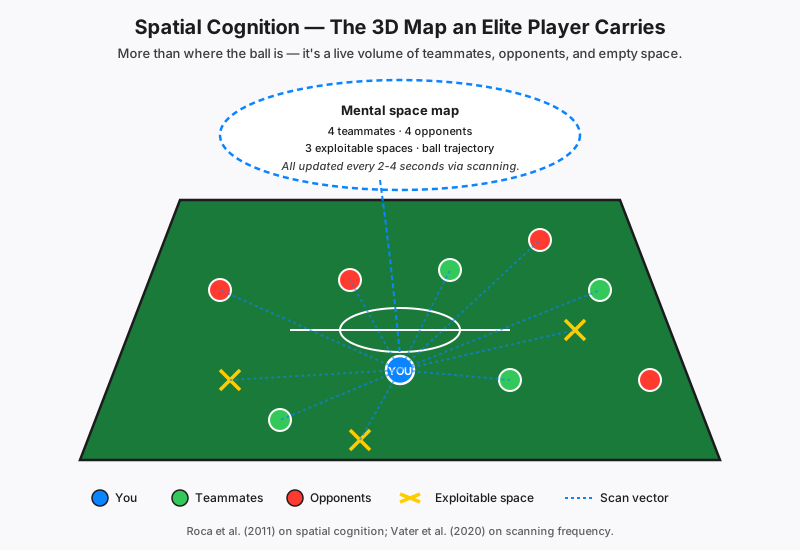
Three Levels of Spatial Cognition
- Static Spatial Cognition — The ability to perceive the current arrangement of players on the field. Seeing 'where space exists right now.'
- Dynamic Spatial Cognition — The ability to factor in each player's movement vector and predict 'where space will open next.'
- Tactical Spatial Cognition — The ability to understand shifting team formations from a bird's-eye perspective and envision play two to three moves ahead. This is what coaches call 'reading the game.'
Ward & Williams (2003) reported that the biggest gap between elite youth players and sub-elite peers lies in anticipatory positioning — recognizing space and taking up the optimal position before even receiving the ball. A player who can do this consistently outperforms a technically equal rival, because the decision is already made before the ball arrives.
Spatial cognition is soccer's 'invisible skill.' A player whose decision-making is finished before the ball arrives holds a 0.5- to 1-second advantage over one who starts thinking only after receiving it.
How Basketball Sharpens Court Vision
Basketball packs 10 players into a small court where offense and defense switch every 24 seconds. Mangine et al. (2014) demonstrated that NBA players' court-vision test scores correlate significantly with assist totals, proving that spatial awareness directly drives performance.
Basketball's greatest contribution to soccer spatial cognition is training players to predict teammate movement in a high-speed environment. Off-ball actions in basketball — pick-and-rolls, cuts, and screens — are structurally identical to soccer's third-man runs and off-the-ball movement.
Cognitive Skills Basketball Develops
- Peripheral Vision Use — A ball handler watches the defender in front while detecting open teammates in peripheral vision. This mirrors the cognitive structure of a soccer passer scanning for options.
- Spacing Awareness — Five players maintain proper distances so they never collapse each other's space. This sense of spacing is the foundation of positional play in soccer.
- Timing Synchronization — Passer and receiver share a mutual understanding of 'when and where.' This transfers directly to through-ball timing and run-timing coordination in soccer.
- Read-and-Adjust Positioning — Instantly relocating in response to a teammate's drive. This applies directly to support-movement patterns in soccer.
Basketball's shot clock (24 seconds) acts as an excellent constraint that forces rapid spatial decision-making. Introducing a similar timer constraint into soccer training — for example, 'complete the attack within 5 seconds of receiving the ball' — can accelerate the speed of spatial processing.
Practical Drill: 3-on-3 Half-Court
When soccer players play 3-on-3 basketball, dribbling technique is beside the point. What matters is the cognitive process of constantly judging 'where can I move to receive a pass?' The tight space and rapid transitions between attack and defense train high-speed spatial processing.
An elite point guard isn't watching the ball. They're reading the entire court and calculating where space will open in two seconds. This is exactly the ability demanded of a soccer playmaker.
— Basketball spatial intelligence research
How Volleyball Builds 3D Spatial Processing
Volleyball is the only major team sport in which the ball must never touch the ground — players are constantly forced to predict trajectories in three-dimensional space. Piras et al. (2014) found that volleyball players significantly outperform athletes from other sports on ball-landing-point prediction tasks.
In soccer, situations involving the ball in the air — heading, long-ball clearances, dealing with crosses — tend to cluster at the most critical moments of a match. The ability to predict trajectory in three-dimensional space is the cognitive skill that volleyball trains most efficiently.
3D Spatial-Cognition Elements Volleyball Develops
- Trajectory Prediction — Instantly calculating a ball's landing point from its initial speed, angle, and spin. This transfers to long-ball handling in soccer and goalkeeper positioning.
- Timing Judgment — Adjusting to within tenths of a second when the ball reaches its peak and when to jump. This maps directly onto heading duels in soccer.
- Multiple Object Tracking — Simultaneously monitoring the ball, setter, and attacker (Multiple Object Tracking). This applies to set-piece defending in soccer.
- In-Air Body Control — Maintaining balance and adjusting direction while airborne. This underpins acrobatic soccer skills such as overhead kicks and diving headers.
Casanova et al. (2013) reported that volleyball players outscored soccer players on dynamic visual acuity tests — tracking moving objects. This finding suggests that volleyball's 3D tracking training can complement and enhance soccer players' spatial cognition.
Applying This to Soccer
Incorporating basic volleyball drills — underhand passes and overhand sets — into warm-up routines lets players repeatedly practice the 'predict, move, time the contact' sequence for airborne balls. This is especially effective for improving long-ball handling by center-backs and goalkeepers.
The 'landing-point prediction' that volleyball develops determines whether a soccer player can start moving to the optimal position the instant a long ball is played. Being just 0.3 seconds quicker to react can dramatically change the win rate in aerial duels.
What Chess Teaches About Pattern Recognition and Forward Planning
De Groot's (1965) and Chase & Simon's (1973) chess research demonstrated that experts perceive the board not as individual pieces but as meaningful positional patterns — 'chunks.' This cognitive structure is remarkably similar to tactical spatial cognition in soccer.
A chess grandmaster can accurately reproduce the positions of 20–25 pieces after a five-second glance at a game position, yet performs no better than a novice with random piece arrangements (Chase & Simon, 1973). This gap reflects pattern-recognition ability, not memory capacity — the same mechanism that lets a soccer player grasp an entire field of players in an instant.
Cognitive Skills That Transfer from Chess to Soccer
- Chunking (Recognizing Meaningful Clusters) — Perceiving multiple player positions as a single meaningful pattern. Instantly judging 'the weak point of this 4-3-3 shape is here.'
- Forward Planning (Expanding the Search Tree) — Projecting two to three moves ahead from the current arrangement. 'If I pass here, the opponent shifts this way, and that space opens.'
- Positional Judgment — Prioritizing 'good positioning' that gradually restricts the opponent's options over flashy individual plays. This is the philosophy of positional play in soccer.
- Tempo Control — Intentionally managing the pace of play. Deciding between a rapid counter and a patient build-up, and shifting between tempos.
Fernandez & Bornn (2018) proposed a 'pitch control model' for soccer that visualizes which team dominates each area of the field. This is essentially a translation of chess's concept of board control into soccer — demonstrating that chess-style thinking maps directly onto spatial cognition on the pitch.
How to Apply Chess Thinking to Soccer
Studying chess itself has value, but a more direct approach is tactical-board analysis. Pause match footage and give yourself five seconds to absorb every player's position, then predict 'what happens next.' This cycle of instant board evaluation followed by forward planning mirrors the chess thought process. Players with chess experience have been observed to adapt to this exercise more quickly.
Great soccer players don't 'see more' of the field. They read more patterns from the same information. Like a grandmaster scanning the board, they perceive the entire field as a single structure.
— Insights from spatial cognition and sport-expertise research
An Integrated Approach to Transferring Spatial Intelligence onto the Pitch
To transfer the spatial cognition skills gained from these three disciplines into soccer, Thorndike's (1901) identical-elements theory tells us we must consciously extract the shared cognitive processes and embed them in practice design.
Basketball's 2D court vision, volleyball's 3D spatial processing, and chess's pattern recognition — here is a framework for integrating all three spatial-cognition skills into soccer.
Integrated Spatial-Cognition Training Design
- Scanning Practice (from Basketball) — Build the habit of checking over your shoulder before receiving the ball to map out teammates and opponents. Consciously adopt the gaze pattern of a point guard constantly surveying the full court.
- 3D Prediction Drills (from Volleyball) — Practice predicting the landing point of long balls and crosses, then moving early. Apply the decision process used in volleyball reception.
- Pattern Recognition Training (from Chess) — Show brief clips of match footage and predict player positions and the next passage of play. This mirrors chess's board-memorization task in structure.
- Constrained Small-Sided Games (Integrated) — Run small-sided games with added cognitive load through constraints such as 'scan before every touch' or a '3-second rule.'
Age-Appropriate Approaches
- U-10 to U-12 — Build a broad spatial-cognition foundation through multi-sport experience (basketball, volleyball, tag rugby, etc.). Multi-sport participation at this stage is a decisive factor in later spatial-cognition ability.
- U-13 to U-15 — Shift toward soccer-specific spatial training (video analysis, scanning habits, positional-play concepts) while maintaining one other-sport session per week.
- U-16 and above — Refine game intelligence. Focus on video analysis and chess-style forward-planning drills, designing training environments with high cognitive load.
McGuckian et al. (2018) showed that in-game scanning frequency (head-turn count) positively correlates with pass completion rate. Beyond developing spatial-cognition ability itself, players must turn the information-gathering behavior that deploys that ability into a habit — only then is the transfer complete.
Spatial-cognition transfer is complete only when 'the ability to see' is paired with 'the habit of looking.' The cognitive skills sharpened by basketball, volleyball, and chess translate into on-pitch performance only when combined with a scanning habit during play.
Recording Spatial-Cognition Growth with Footnote
Gains in spatial awareness are hard to observe with the naked eye, but by putting the quality of your decisions into words on Footnote, you can track how your cognitive skills are evolving over time.
Spatial cognition becomes a stable, reliable skill only when you reflect on 'why was I able to make that decision?' Recording the following points after matches and training sessions helps make the invisible visible.
Spatial-Cognition Recording Template
- Scanning Self-Assessment — A subjective rating (A / B / C) of how often you checked your surroundings before receiving the ball.
- Moments Your Anticipation Was Right — Record moments when you predicted 'space will open here,' moved there, and actually received the ball.
- Moments Your Decision Was Late — Specifically note situations where you noticed space too late or a lack of scanning led to a delayed decision.
- Insights from Other Sports — Put into words any spatial-cognition discoveries from basketball or volleyball practice, linking them to soccer.
As entries accumulate, cognitive growth becomes visible in the writing itself: 'Fewer moments of insufficient scanning,' 'Anticipation accuracy improving,' 'Better positioning when receiving the ball.' Because spatial cognition is difficult to quantify, putting it into words is the most effective way to feel your progress.
Combining with Video Analysis
When match footage is available, review the frequency and timing of your head turns, then record findings on Footnote. Combining objective data with subjective observations surfaces specific improvement points — for example, 'If I had scanned at that moment, I would have spotted the space behind the defensive line.'
Frequently Asked Questions
Is spatial cognition an innate talent?▾
No. The meta-analysis by Voss et al. (2010) clearly shows that spatial cognition improves with training. Team-sport athletes outperform non-athletes on spatial tasks, and this advantage includes a practice effect that cannot be explained by innate selection alone. Multi-sport experience before U-12 is particularly effective for building the foundations of spatial awareness.
Can I develop pattern recognition even if I have never played chess?▾
Yes. Chess is one useful tool, but the same cognitive process can be trained with soccer-footage 'board memorization' exercises. Watch 3–5 seconds of a match clip, pause it, and try to recall every player's position. Doing this two to three times a week will steadily improve your pattern recognition.
Basketball or volleyball — which is more effective for soccer spatial cognition?▾
They develop different abilities, so the choice depends on your goal. If you want to sharpen passing decisions and positioning (2D spatial cognition), basketball is more effective. If you want to improve heading and long-ball handling (3D spatial cognition), volleyball excels. Ideally, experience both to develop 2D and 3D spatial cognition in a balanced way.
How long before spatial-cognition training shows results?▾
The effects of video analysis and scanning drills appear relatively quickly — many players notice subjective improvement within 4–6 weeks. On the other hand, fundamental gains in spatial cognition through multi-sport play require 6 months to a year of consistent effort. Recording weekly reflections on Footnote makes it easier to feel the incremental gains adding up.
Any tips for recording spatial-cognition growth on Footnote?▾
The most effective habit is recording just one moment per match where your anticipation proved correct. Putting a success into words forces you to consciously identify 'what did I see and why did I decide that?' — which makes the skill more repeatable. Analyzing one failure per week in a review session — 'why didn't I notice?' — also highlights specific ways to improve your scanning habits.
References
- [1] Voss, M. W., Kramer, A. F., Basak, C., Prakash, R. S., & Roberts, B. (2010). “Are expert athletes expert in the cognitive laboratory? A meta-analytic review of cognition and sport expertise” Applied Cognitive Psychology. Link
- [2] Oppici, L., Panchuk, D., Serpiello, F. R., & Farrow, D. (2017). “Long-term practice with domain-specific task constraints influences perceptual skills” Frontiers in Psychology. Link
- [3] Ward, P., & Williams, A. M. (2003). “Perceptual and cognitive skill development in soccer: The multidimensional nature of expert performance” Journal of Sport and Exercise Psychology.
- [4] Chase, W. G., & Simon, H. A. (1973). “Perception in chess” Cognitive Psychology. Link
- [5] Mangine, G. T., Hoffman, J. R., Wells, A. J., Gonzalez, A. M., & Townsend, J. R. (2014). “Visual tracking speed is related to basketball-specific measures of performance in NBA players” Journal of Strength and Conditioning Research.
- [6] Piras, A., Lobietti, R., & Squatrito, S. (2014). “Response time, visual search strategy, and anticipatory skills in volleyball players” Journal of Electromyography and Kinesiology. Link
- [7] McGuckian, T. B., Cole, M. H., Jordet, G., Chalkley, D., & Pepping, G. J. (2018). “Don't turn blind! The relationship between exploration before ball possession and on-ball performance in association football” Frontiers in Psychology. Link
- [8] Fernandez, J., & Bornn, L. (2018). “Wide Open Spaces: A statistical technique for measuring space creation in professional soccer” MIT Sloan Sports Analytics Conference.
Related Articles
Verbalization Accelerates Transfer -- Why Writing Makes Skills from Other Sports Carry Over to Soccer
11 min read
How Basketball Builds Spatial Awareness, Passing Decisions & Transition Speed — The Science of Transfer to Soccer
10 min read
How Volleyball Builds Jump Power, Aerial Body Control, and Team Communication — The Science of Cross-Training Transfer to Soccer
10 min read
How Chess Transfers Tactical Thinking, Anticipation, and Pattern Recognition to Soccer
10 min read
Conquering Fear — The Science of Mental Toughness Built Through Extreme Sports
12 min read
Track Your Growth with Footnote
Just record your matches — AI analyzes every 5 games. Visualize growth with PVS Score. All features free during beta.
30-second signup · No credit card required
Last updated: 2026-05-06 ・ Footnote Editorial