Conquering Fear — The Science of Mental Toughness Built Through Extreme Sports
Your foot trembles before a penalty kick. Your body pulls back the instant you commit to a tackle. You play a safe pass in a critical match because you are afraid to make a mistake — fear in soccer is a challenge that operates on a completely different plane from technique or fitness, and many players struggle with it without ever putting it into words. Brymer & Schweitzer (2013) found that extreme-sport participants do not eliminate fear but instead learn to act while coexisting with it, and Nieuwenhuys et al. (2008) revealed the mechanism by which fear of heights alters attentional allocation patterns during climbing. This article explains, with scientific backing, how the fear-management skills forged in extreme sports transfer to soccer performance.
Fear and Performance — What Fear Really Is in Soccer
Fear is not simply a matter of mindset. The physiological response triggered by the amygdala directly alters an athlete's attention, decision speed, and muscular output. Understanding the mechanics of fear is the first step toward mastering it.

Photo by Aziz Acharki on Unsplash
Fear is an emotional response essential to human survival. When the amygdala detects a threat, it activates the sympathetic nervous system via the hypothalamus, producing elevated heart rate, increased muscle tension, and attentional narrowing (tunnel vision). Eysenck et al.'s (2007) Attentional Control Theory demonstrated that in anxious states, stimulus-driven attention overwhelms goal-directed attention, disrupting the information processing required for the task at hand.
Common situations where fear surfaces in soccer
- Penalties and goal-scoring chances — When the consequences of failure are starkly visible, increased muscle tension and attentional narrowing reduce kicking accuracy
- Tackles and aerial duels — In plays that carry injury risk, the body unconsciously pulls back, and the resulting half-hearted challenge actually increases the likelihood of getting hurt
- Fear of compounding mistakes — A single error breeds anticipatory anxiety about the next one, narrowing the player's choices to the most conservative option available
- Freezing on the big stage — The gaze of spectators, scouts, and cameras triggers excessive self-consciousness, making it impossible to reproduce in a match what came naturally in training
The crucial point is that these fear responses do not mean a player is "mentally weak" — they are a normal defensive function of the brain. The problem is not that fear exists but that the skills to handle it are underdeveloped. Extreme sports provide the most efficient environment for training exactly those skills.
Fear cannot be erased. But the skill of acting despite fear can be trained — and extreme sports are the finest training ground for it.
Climbing and Calculated Risk — Thinking Clearly While Afraid
Climbing trains the ability to evaluate risk calmly and make logical decisions in a fear-inducing environment. Nieuwenhuys et al. (2008) showed that anxiety at height alters attentional allocation, and their findings suggest that repeated practice under these conditions structurally strengthens decision-making under fear.

Photo by A n v e s h on Unsplash
A study by Nieuwenhuys et al. (2008) in the Journal of Sport & Exercise Psychology showed that climbers' visual attention patterns shift significantly between high-altitude (fear) and low-altitude (safety) conditions. At height, attention is captured by threat-related stimuli such as the distance to the ground, and task-relevant information processing declines. Experienced climbers, however, had learned to override this attentional bias — they could redirect attention toward task-relevant information while still feeling afraid.
Three fear-management components climbing develops
- Risk-assessment ability — Judging coolly whether a move is genuinely dangerous or whether fear is inflating the perceived risk. In soccer this transfers to decisions like "Should I commit to this tackle?" or "Should I attempt this dribble?"
- Graded exposure to fear — Progressing from easy routes to harder grades raises the fear threshold step by step. In soccer the parallel is building stress tolerance by moving from low-pressure drills to match simulations to competitive fixtures
- Process focus under fear — On the wall, training yourself to think "How do I grab the next hold?" instead of "What if I fall?" In soccer this maps directly to shifting attention from "What if I miss?" to "Focus on the flight of the ball"
Hardy & Hutchinson (2007) analyzed the effect of anxiety on climbing performance through the lens of Processing Efficiency Theory and found that anxiety reduces processing efficiency but that performance effectiveness — the quality of the outcome — can be maintained through additional effort. In other words, "delivering results while feeling afraid" is a learnable skill, and climbing is an environment that forces this learning every single session.
Fear does not disappear. But climbers learn to reach for the next hold while still feeling it. That capacity is exactly what it takes to place a penalty into the top corner under pressure.
Surfing and Uncertainty Tolerance — Acting When You Cannot Control the Environment
Surfing takes place in waves — an environment that is completely beyond the athlete's control. Brymer & Schweitzer (2013) reported that repeated exposure to this uncertainty promotes entry into flow states that transcend fear.
Research by Brymer & Schweitzer (2013) in Psychology of Sport and Exercise reported that extreme-sport participants experience flow states (complete immersion) significantly more often than participants in other sports. Paradoxically, acting repeatedly in fear-inducing environments opens the door to flow. Surfing is one of the activities where this principle is most pronounced.
Three pathways through which surfing transfers to soccer mentality
- Accepting uncertainty — Waves can never be fully predicted or controlled. This environment instills the attitude of giving your best response to the wave in front of you rather than demanding perfection. A soccer match is an equally unpredictable sequence of events, and tolerance of uncertainty directly supports mental stability during play
- Instant recovery from wipeouts — Getting tumbled by a wave is routine in surfing. Staying calm instead of panicking, regaining your breath, and preparing for the next set builds the mental model behind switching on immediately after a mistake in a match
- Balancing humility before nature with decisive action — The judgment call of whether to commit to a big wave or let it pass demands an honest assessment of one's own ability — neither reckless nor timid. In soccer, this transfers to deciding whether to attempt a risky play or take the safe option
Barlow's (2002) exposure therapy theory clarified the mechanism by which repeated exposure to anxiety-provoking situations gradually diminishes the fear response (habituation). Every surfing session constitutes exposure to an unpredictable environment, and this repetition naturally builds tolerance against the anticipatory anxiety ("I don't know what's going to happen") that players feel before matches.
Farley et al. (2020) reported that surfing improves psychological well-being and stress resilience, and the parasympathetic activation triggered by exercising in the ocean should not be overlooked as a factor in stress recovery. Surfing can also function as a recovery strategy for calming excessive pre-match tension.
What surfing teaches is not how to control the wave but how to give your best when the wave is beyond your control. That is the exact mentality required in the unpredictable environment of a soccer match.
Skateboarding and Systematic Desensitization — Raising the Fear Threshold Step by Step
The process of learning skateboarding tricks mirrors the structure of systematic desensitization in psychology. Stacking small victories over fear builds a robust and methodical tolerance to it.
Trick progression in skateboarding always follows a cycle of fear, challenge, success, and then a new fear. After mastering an ollie you move on to a kickflip; once you can land it on flat ground you take it to a ledge, then to a stairset — the fear level ramps up in stages. This process is structurally identical to the systematic desensitization proposed by Wolpe (1958).
The fear-conquering process in skateboarding
- Visualization (mental rehearsal) — Before attempting a trick, you run the movement through your mind repeatedly. Creating a clear image of success suppresses the amygdala's overreaction
- Commitment (full execution of the movement) — A cardinal rule in skateboarding is that going halfway is what gets you hurt. You repeatedly experience the moment when the resolve to fully commit overrides the fear
- Normalizing failure — A new trick may take dozens of failed attempts before the first make. The understanding that failure is part of the learning process soaks in at the deepest level
- Accumulating success experiences — Memories of pushing through fear and succeeding build up as self-efficacy, fueling the drive to face the next fear. This is Bandura's (1977) self-efficacy theory in action
There are many situations where this process transfers to soccer: the fear of trying a new feint in a match for the first time, the fear of committing to a sliding tackle, the fear of failing at a trial. In every case, the foundation of resilience is the accumulated experience of conquering small fears in stages. A player who has gotten back up after falling a hundred times on a skateboard recovers faster after a mistake in a match. This is not a motivational platitude — it is the result of the brain's fear circuitry being reorganized through repeated experience.
Skaters are experts at falling. The fear of falling has not vanished — it is simply that the certainty of being able to get back up now outweighs it.
— Common wisdom in skateboarding culture
Transferring Mental Toughness to Match Day — Applying Fear-Management Skills in Competition
Fear-management skills acquired through extreme sports do not transfer to soccer automatically. A deliberate bridge is required. This section explains how to apply those skills to specific match situations.
Jones et al.'s (2002) research on mental toughness identified a set of psychological attributes common to elite athletes: self-efficacy that sustains belief in one's performance under pressure, the ability to recover quickly from setbacks, and adaptability in situations beyond one's control. These map precisely onto the capacities that extreme sports develop.
Fear-management techniques for specific match situations
- Penalties and goal-scoring chances — Apply the climbing technique of focusing only on the next hold. Narrow your focus to the ball and your swing rather than the corners of the goal or the goalkeeper. Immerse yourself in the process and let go of the outcome
- Tackles and aerial duels — Apply skateboarding's commitment principle. Going in halfway is the most dangerous thing you can do; once you decide to go, execute at full intensity. Rehearse this decisive moment repeatedly in training
- The play immediately after a mistake — Use surfing's wipeout-to-recovery mental model. After being tumbled by a wave, you do not panic — you steady your breathing and prepare for the next set. Apply the same process to resetting after an error
- High-stakes matches — Draw on the extreme-sport experience of performing while coexisting with fear. Instead of trying to eliminate fear, acknowledge that you are feeling it and then act
The key to successful transfer is verbalization. Record the psychological process you went through when overcoming fear of heights on a climbing wall, and consciously map it onto pressure situations in soccer. By connecting "the sensation of reaching for the next hold while scared on the wall" with "the sensation of striking a penalty toward the top corner" in words, you build a transfer pathway in the brain.
Connaughton et al. (2008) demonstrated that mental toughness is not an innate trait but a psychological skill that develops and is maintained through experience. Extreme sports can be positioned as an "intensive training camp for fear management" — one that accelerates this developmental process.
What fear-management transfer requires is verbalization: "I overcame fear on the wall that day. The pressure of a penalty kick has the same structure." Experience alone does not transfer. It moves only when you put it into words.
Recording Your Fear-Conquering Journey in Footnote
Growth in fear-management skills is hard to notice from the inside. Continuous recording in Footnote is essential for making that growth visible and accelerating transfer.
Fear tends to shift not in a dramatic "I conquered it" moment but in a gradual "It stopped bothering me before I realized it" kind of way — making growth impossible to recognize without records. Using Footnote to take regular snapshots of your fear management lets you track your mental development objectively.
A framework for recording fear management
- Describe the moment you felt fear — When, in what situation, and what kind of fear. The more specific you are, the easier it becomes to compare entries later (e.g., "1v1 on the right flank — I was afraid of the opponent's slide tackle and chose a lateral pass instead")
- Document how you responded to the fear — Did you avoid the situation, push through it, or end up somewhere in between? (e.g., "In the next similar situation I consciously committed and attempted a dribble past the defender")
- Connect it to an extreme-sport experience — Verbalize the link to climbing, surfing, or skateboarding (e.g., "I recalled the feeling of commitment when I cleared a high bouldering wall last week and used it to drive through the challenge")
- Track changes in fear level — Rate the intensity of fear in the same situation on a 5-point subjective scale. After three months of entries, a growth curve in fear tolerance will emerge
Footnote's periodic AI analysis detects patterns in fear-related entries and correlates them with match performance. Visualizing relationships such as the alignment between "the period when fear of tackling declined" and "the period when duel win rate improved" bridges subjective data and behavioral data, enabling an objective evaluation of the cross-training effect of extreme sports.
The day you can say "I'm not afraid anymore" may never come. But look back at your records and you will see unmistakable proof that you learned to act despite the fear. That is the essence of mental toughness.
Frequently Asked Questions
Aren't extreme sports too risky for injuries? Won't they interfere with soccer?▾
With proper progression and safety management the risk is limited. Bouldering uses walls of just 3-4 meters with thick crash pads; surfing can start with beginner-friendly small waves; skateboarding can begin on flat ground. In fact, a half-hearted approach is the most dangerous path. We recommend starting under the guidance of a qualified instructor and progressing in stages. Schedule management is key — dial down the intensity of extreme sports during match weeks.
Can't I build mental toughness through soccer training alone?▾
Soccer training does develop mental strength, but the fear-inducing situations in soccer (penalties, tackles, etc.) are hard to reproduce outside actual matches, limiting the frequency of exposure. Every extreme-sport session is a cycle of fear, coping, and mastery, offering a dramatically higher density and frequency of fear-management training. Even adding a single session per week as a complement to soccer training can efficiently reinforce the mental-toughness components identified by Jones et al. (2002).
Isn't feeling fear a bad thing in itself?▾
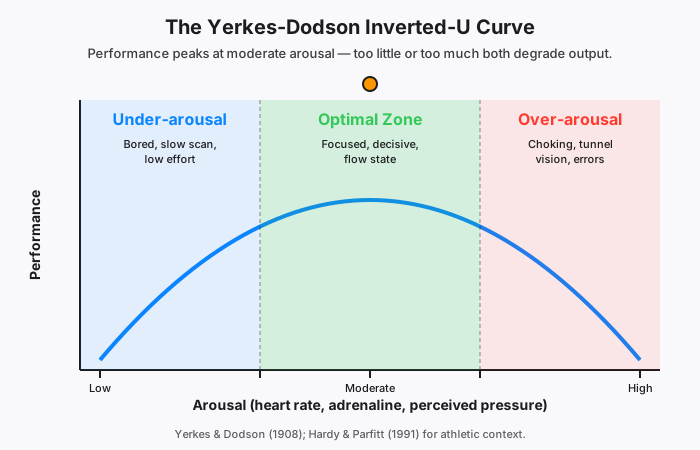
Fear is a normal defensive response of the brain and is not inherently harmful. As Eysenck et al.'s (2007) Attentional Control Theory shows, the problem lies not in fear itself but in fear excessively distorting attention and judgment. Extreme-sport training does not erase fear — it cultivates the ability to allocate attention appropriately and act even while afraid. A moderate level of fear (arousal) can actually enhance performance.
Which extreme sport is the best starting point?▾
For accessibility and ease of progression, we recommend bouldering (indoor climbing) first. Gyms are widely available in urban areas, beginner routes provide an easy on-ramp, and a session wraps up in 60-90 minutes. Skateboarding is low-cost and can be practiced near home, with very fine-grained fear progression. Surfing requires ocean access but delivers the strongest training effect for uncertainty tolerance. Ultimately, choosing the activity that genuinely interests the player is the key to sticking with it.
What is the most effective way to record fear management in Footnote?▾
In your practice or match logs, honestly describe the moments you felt fear and note how you acted. For example: "Fear of sliding in during a 1v1 on defense -> Recalled the sensation of clearing a high wall in bouldering last week and committed -> Won the ball." Verbalizing the connection to an extreme-sport experience accelerates transfer. If you consistently rate your fear level on a 5-point scale, a growth curve will become visible after about three months.
References
- [1] Brymer, E. & Schweitzer, R. (2013). “Extreme sports are good for your health: A phenomenological understanding of fear and anxiety in extreme sport” Journal of Health Psychology, 18(4), 477-487. Link
- [2] Nieuwenhuys, A., Pijpers, J. R., Oudejans, R. R. D., & Bakker, F. C. (2008). “The influence of anxiety on visual attention in climbing” Journal of Sport & Exercise Psychology, 30(4), 469-489. Link
- [3] Eysenck, M. W., Derakshan, N., Santos, R., & Calvo, M. G. (2007). “Anxiety and cognitive performance: Attentional control theory” Emotion, 7(2), 336-353. Link
- [4] Barlow, D. H. (2002). “Anxiety and its disorders: The nature and treatment of anxiety and panic (2nd ed.)” Guilford Press.
- [5] Hardy, L. & Hutchinson, A. (2007). “Effects of performance anxiety on effort and performance in rock climbing: A test of processing efficiency theory” Anxiety, Stress, & Coping, 20(2), 147-161. Link
- [6] Jones, G., Hanton, S., & Connaughton, D. (2002). “What is this thing called mental toughness? An investigation of elite sport performers” Journal of Applied Sport Psychology, 14(3), 205-218. Link
- [7] Connaughton, D., Wadey, R., Hanton, S., & Jones, G. (2008). “The development and maintenance of mental toughness: Perceptions of elite performers” Journal of Sports Sciences, 26(1), 83-95. Link
- [8] Farley, O. R. L., Harris, N. K., & Kilding, A. E. (2020). “Physiological demands of competitive surfing” Journal of Strength and Conditioning Research, 26(7), 1887-1896. Link
Related Articles
Verbalization Accelerates Transfer -- Why Writing Makes Skills from Other Sports Carry Over to Soccer
11 min read
The Science Behind How Climbing Transfers Problem-Solving, Core Stability, and Fear Management to Soccer
11 min read
How Surfing Transfers Balance, Anticipation, and Mental Toughness to Soccer — The Scientific Evidence
12 min read
The Science Behind How Skateboarding Sharpens Balance, Fearlessness, and Creativity for Soccer
11 min read
Spatial Cognition — The Science of Reading Space, Trained Through Team Sports
10 min read
Track Your Growth with Footnote
Just record your matches — AI analyzes every 5 games. Visualize growth with PVS Score. All features free during beta.
30-second signup · No credit card required
Last updated: 2026-05-06 ・ Footnote Editorial