How Surfing Transfers Balance, Anticipation, and Mental Toughness to Soccer — The Scientific Evidence
Surfing is far more than a leisure activity. Farley et al. (2020) demonstrated that surfing is a high-intensity exercise that simultaneously develops whole-body dynamic balance, cardiovascular fitness, and lower-limb power. Paillard (2017) showed that balance training on unstable surfaces broadly transfers to sports performance. The anticipation required to read waves shares its cognitive architecture with game reading in soccer, and the explosive pop-up mirrors the muscle-recruitment pattern of the sprint start. On top of all this, repeated practice in the inherently unpredictable ocean environment forges genuine mental toughness.
Why Surfing Benefits Soccer — An Overview of the Transfer Mechanisms
Surfing simultaneously engages four domains: dynamic balance, environmental anticipation, explosive power, and mental resilience. All four directly influence match performance in soccer, and the ecological-dynamics framework of Davids et al. (2008) provides the scientific basis for their transfer.

Photo by Austin Neill on Unsplash
Surfing and soccer appear to be entirely different sports, yet an exercise-science analysis reveals a striking overlap in their physical and cognitive demands. According to the ecological-dynamics theory of Davids et al. (2008), skill transfer is driven by the similarity of environmental constraints. Surfing and soccer share the following four constraint structures.
- Dynamic balance on an unstable surface — A surfboard on a wave and a soccer pitch are both environments where the support surface is never truly static. Paillard (2017) reported that balance training in unstable conditions improves performance even in stable environments
- Anticipation through environmental reading — A surfer reading the swell and a soccer player reading the opponent's movements both rely on preprocessing environmental information
- Instantaneous release of explosive power — The pop-up (standing up on the board) and the sprint start both demand maximum power output from a stationary position in the shortest possible time
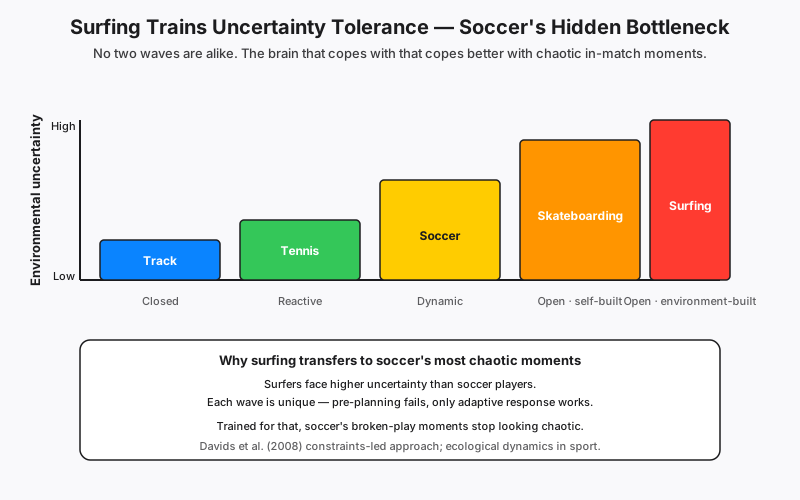
- Adaptation to an unpredictable environment — Neither ocean waves nor match situations can be fully controlled. The capacity to cope with this uncertainty is the foundation of mental toughness
In a sports-medicine review, Farley et al. (2020) confirmed that even recreational surfers who surfed just twice a week showed significant improvements in cardiovascular fitness, balance ability, and lower-limb strength. As supplementary training for soccer, surfing is an exceptionally efficient option that builds multiple physical capacities at once — all while being genuinely enjoyable.
The transfer from surfing to soccer is no coincidence. Unstable-surface balance, environmental anticipation, explosive power, and adaptation to uncertainty — because these four constraint structures align scientifically, abilities sharpened on the waves translate directly to performance on the pitch.
Dynamic Balance on an Unstable Water Surface — Postural Control That a Solid Floor Cannot Build
Paillard (2017) showed that balance training on unstable surfaces accelerates the integration of proprioceptive and vestibular systems, transferring to postural control across all sports. A surfboard on a wave is the ultimate unstable surface, and as the balance-training research of Frank et al. (2013) confirms, dynamic environments produce the highest transfer effects.

Photo by Ivo Sousa Martins on Unsplash
What makes surfing balance unique is that the support surface itself is in constant motion. A soccer pitch is essentially flat, yet situations that destabilize posture — a tackle from an opponent, a shift in center of gravity during a direction change, slipping on wet turf — occur dozens of times in a single match. Paillard's (2017) comprehensive review in Sports Medicine confirmed that balance training on unstable surfaces heightens the sensitivity of proprioceptors and shortens postural-correction reaction times.
Three Balance Systems That Surfing Trains
- Vestibular system (inner ear) — The reflex that stabilizes the head against the rocking of waves is reinforced. In soccer, this contributes to stable landings after headers and rapid recovery after sliding tackles
- Proprioceptive system (joint and muscle position sense) — The surfer detects subtle tilt changes through the soles of the feet and shifts weight accordingly. In soccer, this transfers to improved knee and ankle stability during direction changes
- Integration with the visual system — The coordination of visually tracking the moving water surface while correcting posture through the core. In soccer, this supports the multitask of maintaining balance while tracking the ball with the eyes
Frank et al. (2013) demonstrated in their balance-training research that training on unstable surfaces produces significantly greater balance improvements than training on stable surfaces, and that the gains transfer more readily to other sport-specific movements. A surfboard on a wave far exceeds any balance board in instability, and the surfer is perpetually challenged by reactive balance against the external perturbation of the waves.
Balance is not the ability to stand still — it is the ability to correct a collapsing posture in an instant. Surfing provides hundreds of repetitions of that correction response in a single session.
— Paillard, 2017 — Postural control in sport
There is a fundamental difference in stimulus quality between balance training on a flat gym floor and staying upright on a surfboard in the waves. Surfing is one of the most natural and effective ways to train reactive balance against unpredictable external forces.
Reading Waves Transfers to Reading the Game — The Shared Cognitive Architecture of Anticipation
The process of reading waves in surfing and reading the match in soccer follow the same cognitive steps: recognizing environmental patterns, predicting the next development, and positioning optimally ahead of time. The ecological-dynamics framework of Davids et al. (2008) explains this transfer mechanism.
In surfing, success hinges on a chain of anticipatory actions: reading the cycle of set waves, predicting the direction and breaking pattern of the swell, and paddling into position at the peak before the wave breaks. In soccer, the parallel is unmistakable: reading the direction of the opponent's build-up play, predicting where a passing lane will collapse, and positioning to intercept before the ball arrives. The cognitive architecture is identical.
Three Steps of Anticipation — Ocean and Pitch Compared
- Pattern recognition — Surfing: estimating wave size and arrival time from the shape and spacing of swells on the horizon. Soccer: inferring the direction of the next play from the opponent's formation, body orientation, and passing angles
- Predicting the development — Surfing: judging in advance which direction the wave will break and where the peak will form. Soccer: judging in advance where the ball will be played and where space will open up
- Positioning — Surfing: paddling to the optimal point where the wave will break. Soccer: running to an advantageous position before the ball arrives
In the ecological-dynamics theory of Davids et al. (2008), skill transfer is determined by the similarity of the information-movement coupling. By repeatedly strengthening the coupling of "processing visual environmental information, predicting the next development, and moving ahead of time" through surfing, the same cognitive pattern fires automatically in soccer matches.
The ability to wait is especially important. In surfing, you must patiently let waves pass until the right one arrives, then paddle with everything you have. In soccer, the same cognitive control governs the judgment to avoid running around aimlessly and instead time the decisive sprint — what coaches call "quality off the ball."
The eye that reads waves and the eye that reads the game use the same predictive system in the brain. The cycle of pattern recognition, development prediction, and proactive positioning that surfers repeat endlessly will reliably sharpen a soccer player's game reading.
Pop-Up Explosiveness Transfers to Sprint-Start Acceleration
The surfing pop-up — the explosive movement of going from a prone position to standing on the board in a split second — demands full-body power output in the shortest possible time from a lying start. This motor pattern matches the muscle-recruitment sequence of the soccer sprint start and the rapid recovery after a sliding tackle.
The pop-up is an explosive movement that takes the surfer from a prone paddling position to standing on the board in roughly 0.5 to 1 second. Farley et al. (2020) reported that this movement requires a sequential muscle-recruitment chain — upper limbs (push-up action), core (hip flexion to tuck the legs), lower limbs (establishing the stance) — and develops whole-body plyometric capacity.
Muscle-Recruitment Comparison: Pop-Up vs. Sprint Start
- Upper-limb push-off — Pop-up: pressing both hands hard into the board to lift the body. Sprint: the initial arm swing that drives the body forward. In both cases, upper-limb explosiveness determines starting speed
- Explosive hip flexion — Pop-up: tucking the feet under the chest. Sprint: driving the leg forward. Both demand rapid contraction of the psoas major and iliacus muscles
- Lower-limb stabilization and power output — Pop-up: establishing a stable stance the instant you stand up and catching the wave. Sprint: maximizing ground-reaction force at foot strike to accelerate. Stiffness control of the lower limbs is critical in both
- Anti-rotation of the core — Pop-up: preventing board rotation in an asymmetric stance. Sprint: preventing excessive torso rotation against the opposing movements of the arms and legs. The same anti-rotation patterns are activated
In soccer, the speed of a sprint start can be the difference between winning and losing. Whether a player is 0.1 seconds faster than the opponent in the first three steps decides the outcome of an interception or the battle at the offside line. Furthermore, the movement of getting up quickly after a sliding tackle or regaining balance after a fall is virtually identical in motor structure to the pop-up.
In an average surfing session of about 90 minutes, a surfer performs 30 to 50 pop-ups. Unlike gym burpees, the sheer fun of catching waves naturally drives up the repetition count — and that is one of surfing's greatest strengths as training.
The pop-up is a "burpee on water." Repeatedly going from prone to standing in 0.5 seconds trains both the initial speed of a sprint start and the recovery speed after a sliding tackle. And the joy of catching waves naturally pushes the rep count higher.
Why the Ocean Is a Natural Mental-Training Ground
The ocean is an environment that can never be fully controlled. According to the Blue Mind theory of Nichols (2014), proximity to water activates the parasympathetic nervous system and promotes stress recovery. Practicing a sport in this environment builds mental toughness and stress resilience simultaneously.
The mental-training benefits of surfing operate on two levels. First, there is the restorative effect of the ocean environment itself. Nichols's (2014) Blue Mind research confirmed that proximity to water lowers cortisol (the stress hormone) and shifts the nervous system toward parasympathetic dominance. As a recovery strategy for the psychological fatigue accumulated through intense soccer training and matches, surfing in the ocean is scientifically well-founded.
Characteristics of the Ocean That Build Mental Toughness
- Accepting what you cannot control — You cannot control the size or timing of the waves. The mindset of accepting what is uncontrollable and focusing on what you can control translates directly to the mentality of staying composed regardless of a referee's decision or the weather during a soccer match
- Instant recovery from wipeouts (failure) — Even after being tumbled underwater by a wave, you surface immediately and prepare for the next one. This is a body-level rehearsal of the same failure-recovery pattern needed after conceding a goal or making an error on the pitch
- Tolerance for waiting — The patience required while waiting for a set wave. This becomes the foundation for the ability to maintain focus during ball-less periods in a match, or while waiting for your turn on the bench
- Gradual conquest of fear — Starting with small waves and progressively taking on bigger ones. In soccer, the same structure applies to the gradual process of overcoming the fear of facing higher-level opponents
The second level is adaptation to uncertainty. Davids et al. (2008) noted that practicing movement in unpredictable environments cultivates adaptive decision-making. The experience of constantly making split-second judgments — "Do I take this wave or let it pass?" "How do I adjust when the wave breaks differently than expected?" — trains the ability to calmly select the best option even when a soccer match takes an unexpected turn.
The ocean does not move according to plan. The experience of finding joy, adapting, and continuing to learn within that environment transfers to soccer because matches, too, never go according to plan.
— Adaptive principles of ecological dynamics
Surfing in the ocean is simultaneously "mental training in performing your best in an environment you cannot control" and "psychological restoration through proximity to water." The composure to remain unfazed no matter what happens in a match is forged here.
Recording Your Surfing Cross-Training in Footnote
To maximize what surfing gives you, do not stop at "I caught a wave." The key is to articulate in words exactly what transfers to soccer and record it. Here is how to use Footnote's logging framework.
To use surfing deliberately as cross-training for soccer, it helps to log sessions in Footnote using the following lenses. Apply the ALR framework — Abstraction, Language, Re-application (see the related article for details) — to connect your surfing experience to concrete situations on the soccer pitch.
Example Log Entries from a Surfing Session
- Wave conditions and body sensations — "Waist-to-stomach-high waves. The board tilted left on takeoff and I corrected with right-foot weighting. My ability to sense the board angle through the soles of my feet is getting sharper."
- Anticipation and decision-making — "I let three set waves pass and rode the fourth — correct call. By not jumping at the first wave, I was able to pick a better one. I want to apply this to soccer: waiting for the right moment to release a pass instead of rushing it."
- Pop-up quality and explosiveness — "The pop-up was slow three times today and I got left behind by the wave. My upper-limb push-off is weak. I suspect the same issue affects my sprint starts."
- Mental self-observation — "I flinched for a second when a bigger wave came, but I steadied my breathing and kept paddling. I should be able to use the same coping strategy when facing a strong opponent in a match."
Confirming Transfer in Soccer Training
The important cycle is to test the transfer points you noticed during surfing in your next soccer training session and then add the results to Footnote. For example: "I tried using the sole-of-foot awareness I developed in surfing during dribbling weight shifts. I feel noticeably more stable on uneven turf than before." Record specific experiments and their outcomes.
Footnote's periodic AI analysis can detect changes in balance-related self-assessments — stability under a tackle, sharpness in direction changes — over the period in which you incorporated surfing. With three or more weeks of consistent logging, trends in transfer effects become visible.
Do not stop at "I caught a wave." Only when you articulate the connection — "faster pop-up leads to faster sprint starts" or "patience while waiting for waves leads to better off-the-ball decisions" — does the value of cross-training reach its full potential.
Frequently Asked Questions
I have never surfed before. Can I still start? How long until I see benefits for soccer?▾
With a surf school, children from around age 10 can start safely. The first few sessions will focus on learning the basics of paddling and the pop-up, but even at this stage, upper-limb strength, core stability, and postural control in the water are all being trained. Frank et al. (2013) found significant balance improvements after 4 to 6 weeks of consistent training, so even at a once-a-week pace, you can expect noticeable results within 1 to 2 months.
What if I don't live near the ocean? Are there alternatives?▾
A complete substitute is difficult, but a balance board (such as an Indo Board) can simulate the postural control demands of surfing. Some cities also have wave pools (artificial wave facilities) that allow for repetitive practice on consistent waves. However, since the unpredictability of the ocean is at the core of the mental-training benefit, we recommend incorporating at least one open-ocean session per month if at all possible.
What about injury risk? Is it safe to surf during the soccer season?▾
Surfing's injury risk is relatively low; according to Farley et al. (2020), the injury rate per 1,000 hours is lower than that of soccer. That said, it is important to avoid rocky spots and reef breaks, and to choose beach breaks with sandy bottoms. During the season, avoid surfing from two days before a match onward, and schedule sessions as a recovery activity the day after a match.
How often should I surf for the best results?▾
As cross-training for soccer, once or twice a week for 60 to 90 minutes per session is optimal. Because paddling can cause cumulative fatigue in the shoulders — potentially affecting throw-ins and goalkeeper play — schedule with upper-body recovery days in mind. During the off-season, increasing the frequency is perfectly fine.
What is the most effective way to log surfing sessions in Footnote?▾
In your training log, record the wave conditions and your own movements, and articulate at least one "transfer point to soccer." For example: "Right-foot correction during takeoff → use the same sole-of-foot awareness during cut-ins while dribbling." The key is connecting at the level of specific physical sensations rather than writing something abstract like "my balance got better." Spell out which situation and which sensation you can apply.
References
- [1] Farley, O. R. L., Abbiss, C. R., & Sheppard, J. M. (2020). “Performance analysis and physiological characteristics of surfing: A review” Journal of Strength and Conditioning Research, 34(12), 3514-3522. Link
- [2] Paillard, T. (2017). “Plasticity of the postural function to sport and/or motor experience” Neuroscience & Biobehavioral Reviews, 72, 129-152. Link
- [3] Frank, C., Kobesova, A., & Kolar, P. (2013). “Dynamic neuromuscular stabilization & sports rehabilitation” International Journal of Sports Physical Therapy, 8(1), 62-73.
- [4] Davids, K., Button, C., & Bennett, S. (2008). “Dynamics of Skill Acquisition: A Constraints-Led Approach” Human Kinetics.
- [5] Nichols, W. J. (2014). “Blue Mind: The Surprising Science That Shows How Being Near, In, On, or Under Water Can Make You Happier, Healthier, More Connected, and Better at What You Do” Little, Brown and Company.
- [6] Everline, C. (2007). “Shortboard performance surfing: A qualitative assessment of maneuvers and a sample periodized strength and conditioning program” Strength and Conditioning Journal, 29(3), 32-40. Link
- [7] Mendez-Villanueva, A. & Bishop, D. (2005). “Physiological aspects of surfboard riding performance” Sports Medicine, 35(1), 55-70. Link
- [8] Lundgren, L., Newton, R. U., Tran, T. T., Dunn, M., Nimphius, S., & Sheppard, J. M. (2014). “Analysis of manoeuvres and scoring in competitive surfing” International Journal of Sports Science & Coaching, 9(4), 663-669. Link
Related Articles
Verbalization Accelerates Transfer -- Why Writing Makes Skills from Other Sports Carry Over to Soccer
11 min read
The Science Behind Yoga for Soccer: Flexibility, Focus, Breathing, and Injury Prevention
10 min read
The Science Behind How Climbing Transfers Problem-Solving, Core Stability, and Fear Management to Soccer
11 min read
Growth Mindset and the Soccer Journal — How to Raise Players Who Believe in Effort Over Talent
9 min read
How Chess Transfers Tactical Thinking, Anticipation, and Pattern Recognition to Soccer
10 min read
Track Your Growth with Footnote
Just record your matches — AI analyzes every 5 games. Visualize growth with PVS Score. All features free during beta.
30-second signup · No credit card required
Last updated: 2026-05-06 ・ Footnote Editorial