The Science Behind How Climbing Transfers Problem-Solving, Core Stability, and Fear Management to Soccer
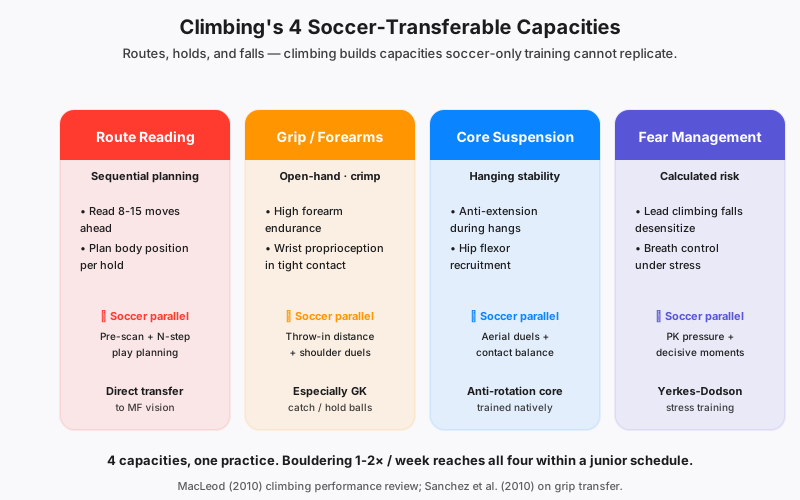
Climbing is far more than hauling yourself up a wall. Green et al. (2013) showed that climbing activates the prefrontal cortex as a high-level problem-solving activity, and Sheel et al. (2004) reported that climbers develop forearm and core muscular endurance on par with elite athletes. The instant decision-making honed through route reading, the core stability demanded on the wall, and the ability to manage fear at height -- these map directly onto the same skills soccer demands: making decisions under pressure, controlling your body axis during aerial duels, and having the courage to take on challenges without fear of failure.
Route Reading Is Problem-Solving -- The Mechanism of Cognitive Transfer
Green et al. (2013) demonstrated that route reading in climbing is a demanding cognitive task that simultaneously engages working memory, spatial reasoning, and decision-making. This cognitive load transfers directly to in-match decision-making in soccer.

Photo by Michael McKay on Unsplash
Route reading in climbing is the cognitive process of scanning the hold placements on a wall and pre-planning the optimal hand sequence, body orientation, and weight shifts. In their 2013 study, Green et al. found that when experienced climbers read a route, the prefrontal cortex and parietal association cortex showed marked activation -- a cognitive pattern strikingly similar to chess players analyzing a board position.
Shared Structure with Soccer Decision-Making
When a soccer player receives the ball during a match, they must instantly assess: Where is the open space? What are the positions of teammates and opponents? What is the most effective next action? This decision process is structurally identical to a climber reading the wall: Where is the next hold? What sequence gets me there? How should I shift my center of gravity?
- Spatial reasoning -- The ability to reverse-engineer body movements from hold placements mirrors the ability to perceive space on the pitch and calculate when to make a run
- Working memory engagement -- Holding the overall route plan in mind while focusing on the immediate next move. In soccer, this corresponds to remembering the flow of the match while concentrating on the present moment
- Real-time plan adjustment -- When the original plan fails on the wall, you must assemble a Plan B on the spot. In soccer, this transfers to the ability to switch to an alternative decision the instant a passing lane is cut off
- Decision-making under constraint -- Choosing the optimal solution while dealing with arm fatigue or reach limitations. In soccer, this underpins the ability to stay composed and make clear decisions under pressing pressure
What climbing trains is not arm strength. It is the ability to find the optimal solution under constraints in a split second -- the very cognitive skill soccer demands every moment of every match.
Grip Strength and Upper-Body Development -- From Throw-Ins to Aerial Duels
Sheel et al. (2004) reported that elite climbers' forearm muscular endurance and grip strength significantly exceed those of general athletes. This upper-body strength transfers directly to throw-ins, body contact, and goalkeeping catches in soccer.

Photo by Ryunosuke Kikuno on Unsplash
In the British Journal of Sports Medicine, Sheel et al. (2004) recorded that climbers significantly outperformed runners and swimmers with equivalent training experience on forearm flexor endurance tests. Climbing requires you to support your entire body weight through your fingers and forearms, simultaneously developing both upper-body strength and muscular endurance.
Where Upper-Body Strength Pays Off in Soccer
- Throw-ins -- Long-throw distance depends on coordinated power output across the shoulders, back, and core. The upper-body kinetic chain built through climbing transfers directly
- Aerial duels -- When heading the ball while using your arms to shield against an opponent, latissimus dorsi and scapular strength contribute to holding your position
- Goalkeeping catches and punches -- The grip strength to absorb shot impact and catch cleanly, plus the shoulder power to punch away crosses, are both efficiently developed through climbing
- Upper-body stability during contact -- If your upper body stays rigid when pushed, you maintain ball control. Granacher et al. (2011) reported that upper-body strength contributes to overall stability in sports performance
Soccer is often thought of as a 'leg sport,' but physical data from the Premier League and Bundesliga consistently show that top-tier players score higher on upper-body strength metrics. Among bodyweight training methods, climbing is one of the most natural and effective ways to develop the upper body. Unlike conventional weight training, it simultaneously builds finger holding strength, scapular stability, and back muscular endurance -- producing a body prepared for the diverse movement demands of soccer.
The upper-body development climbing provides is fundamentally different from isolated weight training. It builds 'functional strength' that links the fingertips to the scapulae and back as an integrated chain. Throw-ins, aerial duels, goalkeeping catches -- players with a strong upper body hold a clear advantage on the pitch.
Core Stability on the Wall -- How an Unstable Environment Builds True Core Strength
Giles et al. (2006) showed that core muscle activation during climbing surpasses that of static exercises like planks. The ability to stabilize the core while moving the limbs on an unstable wall surface is directly relevant to contact play and shooting in soccer.
During climbing, the core functions as a 'dynamic stabilizer.' The moment you release one hand to reach for the next hold, you will peel off the wall unless your core stays engaged. In their electromyography study, Giles et al. (2006) confirmed that activity levels in the transversus abdominis, multifidus, and obliques during climbing movements exceeded those recorded during planks, sit-ups, and other conventional core exercises.
Three Reasons Transfer to Soccer Occurs
- Stabilization in an unstable environment -- On the wall, the base of support is extremely narrow and balance is constantly disrupted, forcing you to control the core under instability. In soccer, the same 'core control under instability' is required when shooting while absorbing an opponent's charge
- Simultaneous limb-core coordination -- Climbing demands core stability while the hands and feet are in motion. In soccer, this corresponds to shielding with the upper body while manipulating the ball with the legs during a dribble
- Multidirectional stability against gravity -- The angle of the wall changes the direction of core loading, training stability in every plane. In soccer, this transfers to a core that resists contact from any of the 360 degrees around you
In a review published in the Journal of Strength and Conditioning Research, Willardson (2007) also concluded that core stability is the foundation of sports performance and that training in unstable environments is the most effective way to activate core musculature. Climbing is precisely the activity that naturally delivers this 'core training in an unstable environment.'
The purpose of core training is not to 'brace and hold' but to 'stabilize while moving.' The sensation acquired on a climbing wall translates directly to every contact situation in soccer.
— Principles of Dynamic Core Stability
Fear Management and Risk Assessment -- How Height Teaches Composure Under Pressure
Nieuwenhuys et al. (2008) reported that performing motor tasks at height improves the ability to self-regulate arousal levels. The capacity to 'act while acknowledging fear,' cultivated through climbing, transfers directly to high-pressure soccer moments such as penalty kicks and one-on-one duels.
In climbing, you must manage the primal fear of falling while executing precise hand and foot movements. In a study published in the Journal of Sport & Exercise Psychology, Nieuwenhuys et al. (2008) demonstrated that repeated training in high-altitude environments improves the ability to regulate anxiety, triggering a psychological adaptation that prevents performance degradation.
Where Fear Management Transfers to Soccer
- Composure during penalties and decisive moments -- The psychological pressure of taking a penalty in front of tens of thousands of spectators shares the same structure as the fear of reaching for the next hold at height. The ability to recognize fear yet still control the body precisely is what transfers
- One-on-one duels -- The fear of losing a physical battle to a bigger opponent. Players who have repeatedly experienced 'being scared but doing it anyway' through climbing stop avoiding physical contact
- Recovery after mistakes -- In climbing, falling is routine. The mindset of 'if you fall, you climb again' transfers to faster mental resets after conceding a goal or playing a bad pass
- Judgment with calculated risk -- Climbing teaches you not to ignore risk but to assess it accurately before acting. In soccer, this produces calculated challenges rather than reckless tackles
Hardy & Hutchinson (2007) showed within the challenge-and-threat psychological model that the cognitive ability to reappraise a difficult situation as a 'challenge' rather than a 'threat' directly affects performance. Climbing is a repeated exercise in converting a clear threat -- height -- into a challenge. This transferred cognitive pattern is what produces composure in soccer's highest-pressure moments.
What climbing teaches is not how to stop feeling fear. It teaches how to move with precision while fear is present. That is exactly the mental skill needed most in the moments that decide soccer matches -- penalties, duels, and scoring chances in stoppage time.
3D Spatial Body Awareness -- How the Wall Sharpens Body Mapping
Fuss & Niegl (2008) reported that climbing develops integrated spatial awareness across the vestibular, proprioceptive, and visual systems. The ability to know precisely where your body is in space while on the wall transfers to aerial play and positional awareness in soccer.
In climbing, you need to know exactly where your body is in three-dimensional space -- without relying solely on vision. Right hand on a hold above the head, left foot on a stance at hip height, torso angled 45 degrees to the wall surface. This perception of body position is known as 'body mapping.' Fuss & Niegl (2008) analyzed vestibular and proprioceptive activity patterns during climbing and confirmed that climbers possess significantly superior spatial awareness compared to non-climbers.
Where Body Mapping Transfers to Soccer
- Heading in the air -- Knowing your body's position and angle while airborne and meeting the ball with the forehead accurately. Aerial body awareness mirrors the sensory experience on a climbing wall
- Overhead kicks and acrobatic plays -- Precise body control in unusual postures. The 'awareness of your body's position in non-standard orientations' acquired through climbing applies directly
- Positional awareness -- A bird's-eye sense of your own location on the pitch. The climbing habit of 'constantly tracking your position relative to the entire wall' transfers here
- Safe falling -- Recognizing your body's orientation during a fall and adopting a safe landing posture. Experience with falls in climbing contributes to injury prevention
Soccer is often perceived as a 2D sport played on the ground, but there are many situations where 3D body control decides the outcome -- heading, volleys, diving headers, and goalkeeper saves, to name a few. Climbing is one of the rare activities that systematically trains spatial body awareness in three dimensions, a capacity rarely used in everyday life.
Knowing precisely where your body is in space -- this is the foundational ability behind aerial duels, acrobatic shots, and fall-related injury prevention. The 'body mapping' sharpened on a climbing wall cannot be replicated in a weight room.
Recording Climbing Cross-Training in Footnote
To maximize the benefits of climbing, you need to go beyond logging 'I climbed today' and articulate what specifically transfers to soccer. Here is how to use Footnote's recording framework for that purpose.
When using climbing as cross-training for soccer, adding the following perspectives to your Footnote practice log will help you consciously strengthen the transfer effect. Keep in mind the ALR framework -- 'Abstract, Language, Reapply' (see related articles for details).
Sample Climbing Session Log
- Problem and cognitive process -- 'Attempted a V3 problem. My initial route read planned a right-hand-left-foot-left-hand sequence, but my reach fell short and I switched to Plan B on the wall'
- Physical sensations in words -- 'On the overhang problem, my hips sagged unless I engaged my core hard. I figured out how to pull my body into the wall by activating the obliques'
- Transfer point to soccer -- 'Switching to Plan B on the wall in real time is structurally the same as adjusting my decision when a passing lane is blocked. In the next practice session I will focus on seeing alternative options calmly under pressing pressure'
- Self-observation of fear management -- 'Froze for a moment at the top when fear kicked in, but regained movement after a deep breath. I can use the same breathing control when nerves hit during a penalty'
Confirming Transfer After Soccer Practice
Take the transfer points you noticed during climbing, deliberately test them in soccer training, and log the results back in Footnote. For example: 'I used the core stability sensation from climbing while shielding the ball. I noticed my axis held up better even when pushed.' Recording specific experiments and outcomes like this accelerates transfer.
Footnote's periodic AI analysis can detect trends in self-assessed metrics -- such as physical-contact win rate or aerial-duel success rate -- during periods when climbing is part of the training mix. Even subjective data starts revealing patterns once five or more matches have been recorded.
Don't stop at 'I sent a V3 today.' Write it all the way to 'route-reading Plan B switch -> decision adjustment under pressure on the pitch.' That is when the value of cross-training is fully realized.
Frequently Asked Questions
Can I start climbing with no experience? What age is appropriate?▾
Bouldering gyms are safe for children from elementary school age onward. You begin on low walls (2-3 m) to learn the basics, so no special fitness level is required. As cross-training for soccer, one 60-90 minute session per week is enough to see meaningful benefits. Many bouldering gyms offer classes for elementary school students, allowing you to progress gradually under professional instruction.
Could I injure my fingers or hands climbing and affect my soccer?▾
With appropriate grade selection and a proper warm-up, the risk is low. Bouldering falls are typically from 3-4 m onto thick crash mats, so the risk of serious injury is limited. That said, finger joint overload requires caution -- especially for younger athletes, prolonged holds on small crimps should be avoided to protect growth cartilage. Reducing intensity during match weeks through scheduling is also important.
Bouldering or lead climbing -- which is better for soccer players?▾
Bouldering is the recommended choice for soccer cross-training. Each problem is completed in a short burst, creating a fast cycle of problem-solving, execution, and feedback that maximizes cognitive training density. Lead climbing leans more toward endurance, but it offers stronger fear-management training. If mental toughness is the primary goal, lead climbing is also a viable option.
How often should I climb?▾
Once a week for 60-90 minutes is optimal. This avoids cutting too deeply into soccer training time while allowing sufficient recovery for the fingers and forearms. Since upper-body fatigue has relatively little direct impact on soccer performance, scheduling a climbing session the day after soccer practice is an effective approach.
What is the most effective way to log climbing in Footnote?▾
Record the problem grade and details in your practice log and articulate at least one 'transfer point to soccer.' For example: 'Switched to Plan B during route reading -> applicable to decision switching under pressing pressure.' Writing this way transforms a simple climbing log into a soccer cognitive-training record. Following up in Footnote's reflection section with notes on whether you felt the transfer during the next match is equally important.
References
- [1] Green, A. L., Draper, N., & Helton, W. S. (2013). “The impact of fear of falling on climber performance and movement” International Journal of Sport Psychology, 44(2), 144-162.
- [2] Sheel, A. W., Seddon, N., Knight, A., McKenzie, D. C., & Warburton, D. E. R. (2004). “Physiological responses to indoor rock-climbing and their relationship to maximal cycle ergometry” Medicine & Science in Sports & Exercise, 36(7), 1265-1271. Link
- [3] Giles, L. V., Rhodes, E. C., & Taunton, J. E. (2006). “The physiology of rock climbing” Sports Medicine, 36(6), 529-545. Link
- [4] Nieuwenhuys, A., Pijpers, J. R., Oudejans, R. R. D., & Bakker, F. C. (2008). “The influence of anxiety on visual attention in climbing” Journal of Sport & Exercise Psychology, 30(4), 469-489. Link
- [5] Fuss, F. K. & Niegl, G. (2008). “Instrumented climbing holds and performance analysis in sport climbing” Sports Technology, 1(6), 301-313. Link
- [6] Willardson, J. M. (2007). “Core stability training: Applications to sports conditioning programs” Journal of Strength and Conditioning Research, 21(3), 979-985. Link
- [7] Granacher, U., Gollhofer, A., Hortobagyi, T., Kressig, R. W., & Muehlbauer, T. (2013). “The importance of trunk muscle strength for balance, functional performance, and fall prevention in seniors: A systematic review” Sports Medicine, 43(7), 627-641. Link
- [8] Hardy, L. & Hutchinson, A. (2007). “Effects of performance anxiety on effort and performance in rock climbing: A test of processing efficiency theory” Anxiety, Stress, & Coping, 20(2), 147-161. Link
Related Articles
Verbalization Accelerates Transfer -- Why Writing Makes Skills from Other Sports Carry Over to Soccer
11 min read
How Chess Transfers Tactical Thinking, Anticipation, and Pattern Recognition to Soccer
10 min read
Mental Training and the Soccer Notebook Habit — The Science of Writing Your Way to a Stronger Mind
9 min read
Growth Mindset and the Soccer Journal — How to Raise Players Who Believe in Effort Over Talent
9 min read
Tennis × Soccer — The Science Behind How Anticipation, Footwork, and Rotational Movement Transfer to the Pitch
11 min read
Track Your Growth with Footnote
Just record your matches — AI analyzes every 5 games. Visualize growth with PVS Score. All features free during beta.
30-second signup · No credit card required
Last updated: 2026-05-06 ・ Footnote Editorial