The Science of How Fencing Transfers Spatial Awareness, Reaction Speed, and 1v1 Tactics to Soccer
What decides the outcome of a 1v1 in soccer is spatial awareness — the ability to control the distance to your opponent in fractions of a second. Williams & Walmsley (2000) demonstrated that fencers exhibit significantly faster reaction times than non-experts, while Roi & Bianchedi (2008) reported that the physiological adaptations unique to fencing enhance explosive change-of-direction ability. Distance management, reaction speed under pressure, and reading and executing feints — all skills honed through fencing — transfer directly to the core competencies of 1v1 defending and dribble penetration in soccer.
What Fencing Brings to Soccer — Four Pillars of Transfer
The 1v1 in fencing and soccer share a common structure: controlling the distance to an opponent in a confined space and striking at the precise moment. This shared structure is what makes perceptual-motor skill transfer possible.

Photo by Nathanaël Desmeules on Unsplash
Fencing is known as a combat sport fought with swords, but its essence is a battle over distance. Controlling the exact instant you enter or exit your opponent's striking range — down to hundredths of a second — using feints to provoke a reaction, then exploiting the opening: this structure maps remarkably well onto the 1v1 in soccer, where a dribbler and a defender wage the same kind of spatial chess.
The Four Pillars of Transfer
- Distance Control — The skill of keeping the optimal distance from your opponent at all times while being aware of your attacking range and defensive zone. This directly improves the "close down or hold" decision-making in 1v1 defending in soccer.
- Reaction Time — The ability to select the optimal response within 0.2 seconds of an opponent's first movement. Williams & Walmsley (2000) showed that fencers' choice reaction times are significantly shorter than those of general athletes.
- Deception (Feints) — The skill of deliberately provoking a response from the opponent and then exploiting it. This transfers to both executing and reading feints during dribbling in soccer.
- Explosive First Step — The instantaneous acceleration from a standing start in one direction, developed through the lunge. This transfers to sprint initiation and defensive slide steps in soccer.
The reason these transfers are so effective is that fencing is an "open skill" sport — one that pushes real-time decision-making in response to an opponent's actions to its highest refinement. Soccer's 1v1 is also an open skill, and the shared foundation of rapid situational judgment is the bridge through which skills migrate.
What fencing develops is not swordsmanship. It is the perceptual-motor speed to dominate the space between you and your opponent and commit in a split second — the very ability that makes the biggest difference in a soccer 1v1.
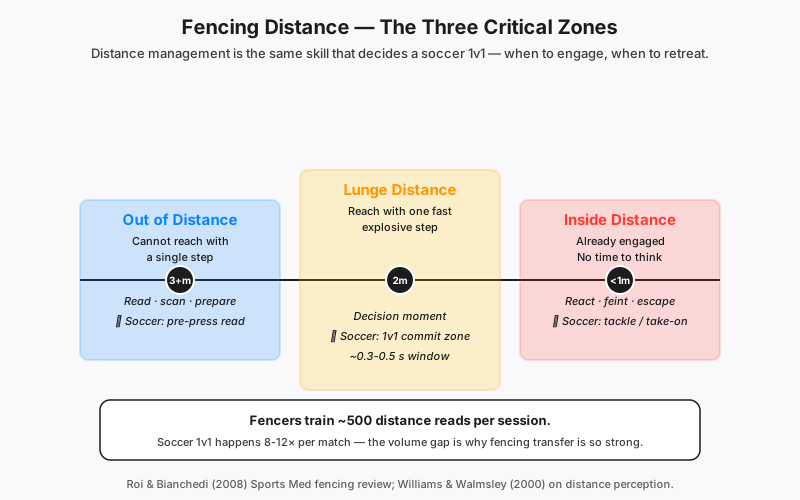
Distance Management — How a Fencer's Spatial Sense Transforms 1v1 Defending
In fencing, athletes perceive the distance to their opponent down to the millimeter, constantly aware of the boundary between the hitting zone and the safe zone. This precision in spatial perception dramatically improves both the timing of closing down and the optimal holding distance in 1v1 soccer defense.

Photo by Alev Takil on Unsplash
A fencing bout takes place on a piste measuring 14 meters by 1.5 meters. In this narrow corridor, athletes repeat forward and backward movements (advance, retreat) to control the distance from their opponent. Roi & Bianchedi (2008) reported that international-level fencers average 1,000–1,500 changes of direction per bout, and this relentless repetition builds an exceptionally precise sense of distance.
Transfer to 1v1 Defending in Soccer
- Critical Distance — In fencing, you always know exactly how far away "one more step to reach the opponent" is. In soccer, this translates to knowing whether a dribbler's next touch is within intercepting range, sharpening the timing of your challenge.
- Compressing and Releasing Distance — The fencing pattern of closing down to apply pressure and then pulling back the moment the opponent moves is structurally identical to the soccer defender's tactic of narrowing a dribbler's options and then stepping back when they commit.
- Safe Backward Movement — The fencing retreat (retraite) is the technique of moving backward quickly with a stable center of gravity while never taking your eyes off the opponent. This directly benefits delay defending in soccer — backpedaling while waiting for cover.
- Memorizing an Opponent's Range with Your Body — Fencers intuitively gauge their opponent's reach (arm plus weapon length) during a bout. In soccer, this transfers to rapidly assessing a dribbler's leg length, stride, and the gap between ball and foot to judge the probability of a breakthrough.
Gutiérrez-Dávila et al. (2013) showed that fencers' reactive movements are distance-dependent — their response patterns switch automatically based on the distance to the opponent. This "automatic response calibrated to distance" forms the foundation for a soccer defender's ability to instantly decide whether to step in, hold, or slide based on proximity.
A master fencer's entire body reacts to a one-centimeter shift in the opponent's blade tip. Transfer that spatial sense to soccer and a mere weight shift by the dribbler is enough to read the direction of the attack.
— Distance Perception and Sports Performance
Reaction Speed Under Pressure — Why Fencers Are Faster
Williams & Walmsley (2000) demonstrated that fencers excel not only in simple reaction time but also in choice reaction time — the speed of selecting the correct response from multiple options. Soccer 1v1s demand exactly this type of reaction, making fencing an optimally tailored training ground.
There are two types of reaction speed: simple reaction time (move when the stimulus appears) and choice reaction time (select the correct response from several possibilities and then move). In a soccer 1v1, the latter is what matters. Will the dribbler cut left or right? Shoot or pass? You need to make the right choice in an instant. In their study published in the Journal of Sports Sciences, Williams & Walmsley (2000) found that expert fencers held an approximately 15–20% advantage over non-experts in choice reaction time.
How Fencing Enhances Reaction Speed
- Advance-Cue Detection — Fencers repeatedly train to read "pre-signals" before the opponent's attack begins: micro-movements of the shoulder, a forward lean of the center of gravity, a change in blade angle. This shifts the starting point of the reaction from "the moment the action begins" to "before the action begins."
- Pre-Programmed Responses — Depending on distance and context, a fencer pre-loads responses: "If the opponent advances at this distance, parry; if at that distance, retreat." In soccer, this transfers to conditional preparation: "If they reach here, stick a foot in; if there, step back."
- Response Inhibition — In fencing, not reacting to a feint is just as critical as reacting to a real attack. The discipline of resisting a feint while responding only to a genuine attack directly builds feint-resilience in soccer.
The third point — response inhibition — is particularly important. Many players who struggle in 1v1 situations tend to bite on feints, causing their weight to shift too early. In fencing training, reading a feint and suppressing the urge to react is a matter of being hit or not, so this inhibition is built naturally. Gutiérrez-Dávila et al. (2013) also confirmed the superior response-inhibition abilities of fencers.
Fast reaction does not mean "moving quickly." It means "not moving until the right moment, then moving at maximum speed in that instant." Fencing drills this "wait, then explode" skill hundreds of times per bout.
Feints and Deception — Training Both the Attacker and the Reader
Roughly 60–70% of attacks in fencing involve a feint. By training the ability to execute and to detect feints at high frequency, fencing simultaneously improves the quality of dribbling feints and feint-resistance in 1v1 defense in soccer.
A fencing feint (feinte) is not merely a "fake." It is a systematic tactical tool that exploits the opponent's response patterns. The first motion provokes the opponent's parry (defensive reaction); a second attack follows from a different angle before the parry is complete. This "provoke → exploit" structure is identical to a soccer dribbling feint.
How Feint Skills Transfer to Soccer
- Simple Feint — A single fake motion to shift the opponent in one direction, then attacking the opposite side. In soccer, this corresponds to scissors or body feints. The "minimum motion size that still triggers a reaction," mastered in fencing, directly improves the economy of dribbling movements.
- Compound Feint — Combining two or more fake motions to progressively break down the opponent's response. In soccer, this maps to double touches or feint-feint-break sequences. The rhythmic variation across multiple feints learned in fencing heightens the unpredictability of dribbling.
- Counter-Time — Deliberately showing a reaction to the opponent's feint, then exploiting the moment the opponent believes the deception has worked. In soccer, this transfers to the advanced defensive technique of "pretending to be beaten by a feint while actually holding position."
A single fencing lesson (practice bout) produces 50–100 feint exchanges. This high-frequency repetition sharpens both feint execution accuracy and feint detection accuracy simultaneously. Because 1v1 opportunities in soccer practice are inherently limited, fencing cross-training functions as a compressed accumulation of feint experience.
Turner et al. (2014) showed that the fencing attack follows a temporal sequence beginning with upper-limb motion followed by lower-limb propulsion. This pattern — "signal direction with the upper body, then drive in the opposite direction with the lower body" — is structurally identical to a soccer body feint: dropping the shoulder one way while pushing the ball the other way with the opposite foot. Athletes with fencing experience can execute this pattern at a subconscious level.
"Show, make them read, then take the opposite" — this is fencing, and it is dribbling. No other sport puts you through this exchange a hundred times per match.
— Feint Tactics Theory
The Lunge and the Explosive First Step — How Fencing Propulsion Transforms Sprinting
Turner et al. (2014) reported that the fencing lunge generates explosive propulsion through simultaneous triple-joint extension at the hip, knee, and ankle. This motor pattern is an ideal explosiveness drill that transfers to sprint initiation, the first step of a direction change, and lateral slide steps in soccer.
The fencing lunge (fente) is an attacking movement in which the back foot drives off the ground and the front foot reaches forward. Reaching peak velocity within approximately 0.3–0.4 seconds from a standing start, this motion — according to Turner et al. (2014) in Sports Biomechanics — exhibits a coordinated triple-joint (hip, knee, ankle) extension pattern that is structurally similar to the acceleration phase of a sprint.
Lunge Biomechanics and Soccer Applications
- Explosive Back-Leg Extension — About 80% of the lunge's propulsive force comes from the back leg. This "push the ground and launch the body forward" pattern transfers directly to standing-start situations in soccer: a defender closing down, a goalkeeper rushing off the line.
- Front-Leg Braking and Directional Control — At lunge landing, the front leg absorbs the body's momentum while controlling the transition to the next movement. In soccer, this corresponds to the braking leg's function during a hard stop from a sprint or a change of direction.
- Horizontal Propulsion from a Low Center of Gravity — The fencing guard (garde) is a low stance with bent knees. The explosive horizontal drive from this low position closely resembles a soccer defender sprinting laterally from a slide-step position.
- Muscular Endurance Through Repeated Lunges — Roi & Bianchedi (2008) reported 200–300 lunges per bout. This volume builds muscular endurance in the quadriceps and glutes, providing the foundation for maintaining explosive movement quality across a full 90 minutes of soccer.
Gutiérrez-Dávila et al. (2013) conducted a detailed analysis of the relationship between reaction time and force output during the fencing lunge. Expert fencers showed significantly shorter time between deciding to react and reaching peak force output — meaning the body fires at maximum power the instant a decision is made. This is the neuromuscular basis of what soccer calls "first-step quickness" — the ability to explode toward the ball at full speed the moment you commit to the challenge.
Position-specific benefits in soccer: a goalkeeper's rush-out timing and initial burst, a fullback's explosive vertical acceleration, a center-back's sliding interception, a forward's first step in behind — every one of these is underpinned by the "react → maximum propulsion" pattern trained through the fencing lunge.
Logging Fencing Cross-Training in Footnote
When recording fencing sessions in Footnote, articulating changes in your sense of distance, the quality of your reactions, and the success or failure of feints accelerates the transfer to soccer 1v1 situations.
When logging fencing cross-training in Footnote, organize your entries around four layers: distance, reaction, feint, and first step. Instead of a vague "did fencing today," spelling out exactly which ability changed and how is the key to accelerating transfer.
Example Entries
- Log distance insights — Example: "In fencing I learned the exact range where my opponent's lunge can reach me. There's a half-step threshold beyond which it gets dangerous. I'll try to apply the same 'half a step from being beaten' awareness in soccer 1v1 defending."
- Log changes in reaction patterns — Example: "I got caught by feints three times, then switched to ignoring shoulder fakes and only reacting when the feet moved — success rate went up. In soccer I'll focus on the dribbler's hips instead of the shoulders."
- Log feint experiments — Example: "I feinted the same direction twice, then took the opposite on the third — my opponent fell for it completely. I'll try repeating the same directional feint and then reversing it in my soccer dribbling."
- Quantify first-step changes — Example: "After focusing on lunge push-off mechanics, my coach said my first step off the mark looked faster. I'll try to reproduce the 'push the ground with the back foot' sensation during sprints."
Footnote's AI analysis every five matches can track correlations between fencing practice days and 1v1 performance in soccer. Patterns like "I'm less likely to dive in on defense the day after fencing" or "My dribble break-through rate improves in weeks with more feint variety" become visible, giving you objective data on the optimal fencing frequency and its impact on your soccer game.
Fencing and soccer are different sports, but they are connected by the shared language of spatial dueling. When you put that shared language into your own words, the transfer accelerates.
Frequently Asked Questions
Can a complete beginner in fencing still benefit? What's the minimum age to start?▾
Significant transfer benefits can be expected even if you start from scratch. Junior fencing clubs are growing in number, and children can safely begin from around age 8–9. Because the sport uses weapons, full protective gear is worn, and the risk of injury is low when practiced under qualified instruction. Many players report noticing a change in their sense of distance within the first three months.
How often should I practice fencing for optimal results?▾
As a cross-training activity for soccer, once a week (60–90 minutes) is appropriate. Fencing demands intense concentration, so even short sessions provide high-density neural training. At once a week — four sessions a month — you will experience roughly 200–400 feint exchanges, a volume of repetition that 1v1 soccer drills alone cannot match.
Which of the three fencing disciplines (foil, épée, sabre) is best for soccer transfer?▾
If maximizing transfer to soccer is the priority, épée is the most recommended. Because the entire body is a valid target in épée, distance management is the most demanding, making it the best discipline for sharpening spatial awareness. Foil, with its right-of-way rules, teaches turn-based tactical exchanges, while sabre features rapid cutting actions and fast-paced bouts. If you're unsure, whichever discipline is available at your nearest club will work well.
Does the benefit differ depending on soccer position?▾
The greatest benefit goes to center-backs and fullbacks, who face 1v1 situations most frequently. Distance management and response inhibition (not diving in at feints) translate directly to defending. Wingers and wide midfielders benefit heavily from feint-skill transfer, and goalkeepers gain from the explosive first step of the lunge and improved reaction speed. Regardless of position, fencing is effective for every player who encounters 1v1 situations.
How should I log fencing practice in Footnote?▾
Organize your entries around four categories: distance, reaction, feint, and first step. For example: "Today's fencing takeaway: maintaining a distance just outside my opponent's lunge range and only counter-attacking the instant they commit forward → Soccer application: don't close down too early in 1v1 defense — wait for the attacker to commit." Always articulate the transfer point to soccer.
References
- [1] Williams, L. R. T. & Walmsley, A. (2000). “Response timing and muscular coordination in fencing: A comparison of elite and novice fencers” Journal of Sports Sciences, 18(4), 276–284. Link
- [2] Roi, G. S. & Bianchedi, D. (2008). “The science of fencing: Implications for performance and injury prevention” Sports Medicine, 38(6), 465–481. Link
- [3] Turner, A., Miller, S., Stewart, P., Cree, J., Ingram, R., Dimitriou, L., Moody, J., & Kilduff, L. (2014). “Strength and conditioning for fencing” Strength and Conditioning Journal, 35(1), 1–9.
- [4] Gutiérrez-Dávila, M., Dapena, J., Campos, J., & Rojas, F. J. (2013). “The effect of muscle activation on response time in the lunge and the fleche in fencing” Journal of Sports Sciences, 31(10), 1080–1091. Link
- [5] Czajkowski, Z. (2005). “Understanding fencing: The unity of theory and practice” SKA Swordplay Books.
- [6] Borysiuk, Z. & Waskiewicz, Z. (2008). “Information processes, stimulation and perceptual training in fencing” Journal of Human Kinetics, 19, 63–82. Link
- [7] Harmenberg, J., Ceci, R., Barvestad, P., Hjerpe, K., & Nyström, J. (1991). “Comparison of different tests of fencing performance” International Journal of Sports Medicine, 12(6), 573–576. Link
Related Articles
Verbalization Accelerates Transfer -- Why Writing Makes Skills from Other Sports Carry Over to Soccer
11 min read
How Martial Arts Build Duel Strength, Body Control, and Mental Toughness for Soccer
10 min read
How Chess Transfers Tactical Thinking, Anticipation, and Pattern Recognition to Soccer
10 min read
Mental Training and the Soccer Notebook Habit — The Science of Writing Your Way to a Stronger Mind
9 min read
How Basketball Builds Spatial Awareness, Passing Decisions & Transition Speed — The Science of Transfer to Soccer
10 min read
Track Your Growth with Footnote
Just record your matches — AI analyzes every 5 games. Visualize growth with PVS Score. All features free during beta.
30-second signup · No credit card required
Last updated: 2026-05-06 ・ Footnote Editorial