How Basketball Builds Spatial Awareness, Passing Decisions & Transition Speed — The Science of Transfer to Soccer
Basketball and soccer share a remarkable amount of cognitive architecture despite playing on very different surfaces. Kioumourtzoglou et al. (1998) demonstrated that basketball players possess perceptual prediction skills equal to or exceeding those of soccer players. A fast break mirrors a positive transition, a pick-and-roll echoes off-the-ball movement, and help defense parallels cover-shadowing — the key to transferring basketball's tactical principles to soccer lies in articulating these shared cognitive processes and deliberately carrying them onto the pitch.
Why Basketball Makes You a Better Soccer Player
Basketball and soccer share three core cognitive demands: rapid decision-making in tight spaces, continuous attacking-to-defending transitions, and coordinated team movement. Because the court is smaller, basketball forces an even faster decision cycle — making it an exceptionally high-load cognitive training environment.

Photo by LOGAN WEAVER on Unsplash
Both soccer and basketball belong to the 'invasion game' category — sports in which a team maintains possession to attack while switching instantly to defense upon losing the ball. Mitchell et al.'s (2013) Tactical Games Model has shown, both theoretically and empirically, that tactical understanding transfers at a high level between invasion games.
The Cognitive Load Basketball Creates
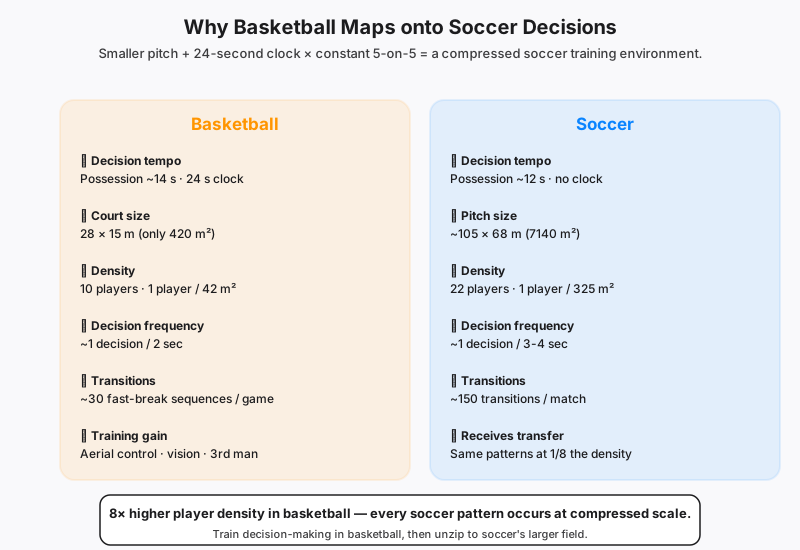
A basketball court measures 28 m × 15 m — roughly 6% of a full-size soccer pitch (105 m × 68 m), yet it packs in 10 players. This density drastically compresses decision time. The average time from receiving the ball to making a decision is about 1–2 seconds in basketball versus 2–3 seconds in soccer. Basketball consistently demands faster choices.
Three Shared Cognitive Processes
- Spatial Scanning — Reading the positions of teammates, opponents, and open space across the court or pitch. On a smaller court, scanning must be more frequent and more precise.
- Anticipation and Prediction — Projecting an opponent's next move from early cues. Memmert (2009) showed that attentional breadth in team sports is a precondition for creative play.
- Instant Decision-Making — The pass-dribble-shoot triad requires a split-second choice, and the decision structure is nearly identical in both sports.
Think of basketball as cognitive training for soccer on fast-forward. The smaller court accelerates decision speed, and the constant possession changes sharpen transition awareness.
Spatial Awareness and Court-to-Pitch Vision
Kioumourtzoglou et al. (1998) found that basketball players demonstrated visual search strategies and perceptual prediction abilities on par with high-level soccer players. These perceptual skills transfer across sports — spatial awareness honed on the court directly enhances pitch vision in soccer.

Photo by Olegs Jonins on Unsplash
Spatial awareness is the ability to continuously track the positions of yourself, teammates, opponents, the ball, and open space in real time. Basketball and soccer share this skill because both present the same cognitive challenge: finding the optimal solution within a constantly shifting spatial arrangement.
Peripheral Vision Developed Through Basketball
In basketball, a ball handler must use peripheral vision to pick up a teammate's cut or a defender's help rotation — all while dribbling without looking at the ball. This 'head-up' technique is cognitively identical to the soccer skill of scanning your surroundings while dribbling. Williams et al. (1999) showed that expert athletes extract information from peripheral vision significantly more efficiently than novices.
Building a Cognitive Map of Passing Lanes
When making a pass in basketball, a player simultaneously processes a teammate's movement, the defender's position and momentum, and the fleeting window in which a passing lane opens. This cognitive mapping process is structurally identical to reading a through-ball or a switch of play in soccer. Vestberg et al. (2012) showed that executive functions — particularly working memory and attentional control — underpin the accuracy of these cognitive maps.
Basketball's 5-v-5 format involves fewer players than soccer's 11-v-11, making positional relationships easier to grasp. Learning spatial-awareness patterns in this 'high-visibility environment' and then applying them to the greater complexity of a soccer pitch follows the motor-learning principle of progressive complexity.
Elite basketball players can draw a 'movement map' of the entire court before they release a pass. That same ability transfers directly to pitch vision in soccer.
— Summarizing the attentional framework findings of Memmert (2009)
Fast Breaks and Transitions — How Attacking-Defending Switches Transfer
A basketball fast break and a soccer positive transition share a near-identical tactical structure: win the ball, push forward, exploit the numerical advantage. The three-phase sequence plays out the same way whether you're on a court or a pitch.
Transition — the switch between attacking and defending — is one of the most critical tactical phases in modern soccer. World-class clubs like Liverpool and Real Madrid stake entire game plans on 'the five seconds after winning the ball.' A basketball fast break replicates this transition moment on every single possession change.
The Three Phases of a Fast Break and Their Soccer Equivalents
- Ball Recovery and Instant Decision — At the moment of a rebound or steal, you decide whether to push forward or settle. This mirrors the decision after an interception in soccer.
- Forward Progression — A long outlet pass to a sprinting teammate, or carrying the ball up the court yourself. This transfers to the first pass in a soccer counter-attack.
- Exploiting the Numerical Advantage — Finishing in a 2-v-1 or 3-v-2 situation. The pattern recognition required is cognitively identical to breaking down a defense on a soccer counter.
A basketball game averages 70–80 possession changes per match. Soccer averages around 50–60 transitions. Basketball provides a higher repetition rate, creating a denser learning environment for transition play.
Negative Transitions (Defensive Recovery)
The instant a basketball shot is missed, every player snaps into defensive recovery — the 'get back' mentality. This mirrors the principle of gegenpressing in soccer: the moment possession is lost, you reverse direction 180 degrees. Basketball trains this physical and mental switch dozens of times per game.
Basketball packs over 1.3 times as many transitions into a single game as soccer. Repeating attack-to-defense switches at that density accelerates transition awareness on the pitch dramatically.
Pick-and-Roll to Off-the-Ball Movement
A basketball pick-and-roll — using a screen to free a teammate and create space — shares its tactical principles entirely with soccer's off-the-ball movement: diagonal runs, pull-aways, and decoy runs.
In soccer, what players do without the ball determines a team's attacking quality. Basketball tactics give you a compact, high-repetition environment to internalize these off-the-ball principles.
Pick-and-Roll → Give-and-Go (Wall Pass)
In a basketball pick-and-roll, the screener blocks a defender's path to create space for the ball handler. The 'roll' — cutting toward the basket after the screen — is structurally identical to a third-man run in a soccer give-and-go. The two-step principle of 'create a wall for your teammate, then sprint into space' is shared across both sports.
Cutting → Diagonal Runs
A basketball cut — a sharp, linear run behind a defender — shares its purpose with a diagonal run in soccer. Both aim to disappear from the opponent's field of vision and reappear where a passing lane opens. In basketball, multiple cuts happen within a single possession, providing an unmatched volume of repetitions for learning the timing of movement.
Spacing → Positional Play
Modern basketball concepts like '5-out' and 'motion offense' are built on maintaining optimal distance between players (spacing) while in motion. This maps directly to positional play in soccer — lane occupation and staggered heights. Memmert's (2009) concept of attentional breadth, a precondition for creative play, is closely tied to this spatial sense.
What you do without the ball in basketball is a compressed version of soccer's off-the-ball tactics. High-rep practice on a small court raises the quality of movement on a full-size pitch.
Defensive Footwork and Positioning
The side-shuffle, hip turn, and closeout techniques demanded by basketball defense share highly overlapping motor patterns with soccer's 1-v-1 defending skills — approach speed, body positioning, and forcing the attacker in one direction.
Soccer's 1-v-1 defending comes down to managing distance, controlling your center of gravity, and reacting to the attacker's movement. Basketball defense incorporates all of these elements at closer range and faster tempo, delivering direct benefits to your defensive play on the pitch.
Lateral Shuffles and Jockeying
On-ball defense in basketball demands staying low and using lateral shuffles to mirror a ball handler's dribble moves. The footwork principles are shared with jockeying in soccer — staying side-on against a dribbler to channel them in one direction. Sheppard & Young (2006) demonstrated that reactive change-of-direction ability is a skill with high potential for cross-sport transfer.
Help Defense → Cover-Shadowing
In basketball, the instant a teammate is beaten, a help defender rotates from the weak side — 'help and recover' is the lifeline of team defense. This parallels cover-shadowing in soccer (positioning behind a teammate) and defensive-block sliding (shifting laterally as a unit). The judgment call — leaving your own mark to plug a hole for the team — is a cognitive step up from individual to team tactics, and basketball provides constant reps.
Closeouts → Pressing Approaches
A basketball closeout — sprinting from a help position to challenge a shooter — operates on the same principle as a pressing approach in soccer: closing distance quickly while staying balanced enough to react. Sprint in too aggressively and you get beaten; arrive too slowly and the opponent plays freely. The balance required to resolve this tension is the same motor-control challenge in both sports.
Basketball defense is 'defending with your feet.' The principle that positioning — not your hands — shuts down an opponent is the very essence of 1-v-1 defending in soccer.
Track Your Basketball-to-Soccer Transfer with Footnote
When logging basketball insights in Footnote, articulate three things: what you practiced in basketball, which situation in soccer it applies to, and why it transfers. This three-part framing maximizes the transfer effect.
Simply recognizing the shared principles between basketball and soccer is not enough — writing them down in Footnote triggers what Kawasaki et al. (2019) described as 'reactivation of motor programs in the brain,' accelerating actual transfer.
Example Log Entries
- Spatial Awareness Transfer — 'During basketball fast breaks, I built a habit of scanning forward space immediately after winning the ball. I'll bring the same instinct to soccer — look up right after an interception.'
- Off-the-Ball Transfer — 'On the pick-and-roll, I got a feel for the quick direction change after setting a screen. I'll apply the same movement to my runs after playing a wall pass in soccer.'
- Defensive Transfer — 'Basketball lateral shuffles helped me stay low and balanced while moving side to side. I'll focus on the same low center of gravity when jockeying in soccer.'
- Transition Transfer — 'In basketball, I drilled the habit of sprinting back the instant we turned the ball over. I'll bring that same urgency to defensive recovery in soccer.'
Getting the Most Out of Footnote
Include your basketball training alongside the transfer points in each Footnote practice log. Once you've logged five sessions, the AI will begin detecting correlation patterns between your basketball training and soccer performance. For instance, you might see that 'weeks with basketball practice coincide with higher self-ratings on off-the-ball quality.' Making these trends visible helps you find the optimal frequency and format for cross-training.
Don't stop at 'I played basketball.' Write down what from basketball applies to which part of soccer and why. That specificity multiplies the value of cross-training in Footnote.
Frequently Asked Questions
I've never played basketball. Can I still get transfer benefits for soccer?▾
Absolutely — in fact, being a beginner is the stage where transfer effects are easiest to notice. Simply joining a 5-v-5 pickup game activates cognitive training in passing decisions, spatial awareness, and transition thinking. Even at a low skill level, the decision-making practice is highly valuable. Start with one pickup game a week and build from there.
Which soccer position benefits most from basketball cross-training?▾
Every position benefits, but the transfer effect is strongest for midfielders. Spatial awareness, passing decisions, and transition awareness are core midfield skills. The basketball point guard role — orchestrating the team's movement while reading the full court — closely mirrors the cognitive demands of playing as a holding midfielder or attacking midfielder in soccer.
Doesn't using your hands in basketball create bad habits for soccer?▾
No. What transfers is not 'hand movement' but cognitive skills: spatial awareness, decision speed, and positioning. In fact, because you handle the ball with your hands, you free up cognitive resources that would otherwise go to foot technique — letting you focus purely on scanning and decision-making. That's what makes basketball such an effective cognitive training tool for soccer players.
How often should I incorporate basketball into my training?▾
One to two sessions per week, 30–60 minutes of game play, is effective. Hammami et al. (2018) found that allocating 20–30% of total weekly training volume to cross-training yielded the greatest benefits. Rather than replacing soccer practice, try adding basketball elements to warm-ups or recreational sessions.
How should I log basketball sessions in Footnote?▾
In your practice log, describe what you experienced in basketball and which soccer situation it transfers to. For example: 'Repeated 2-v-1 decisions in basketball fast breaks — same decision pattern applies to soccer counter-attacks.' Pinpointing a specific scenario and its underlying principle produces far better results in Footnote's AI analysis than an abstract summary.
References
- [1] Kioumourtzoglou, E., Kourtessis, T., Michalopoulou, M., & Derri, V. (1998). “Differences in several perceptual abilities between experts and novices in basketball, volleyball and water-polo” Perceptual and Motor Skills, 86(3), 899–912.
- [2] Memmert, D. (2009). “Pay attention! A review of visual attentional expertise in sport” International Review of Sport and Exercise Psychology, 2(2), 119–138. Link
- [3] Vestberg, T., Gustafson, R., Maurex, L., Ingvar, M., & Petrovic, P. (2012). “Executive functions predict the success of top-soccer players” PLoS ONE, 7(4), e34731. Link
- [4] Williams, A. M., Davids, K., & Williams, J. G. (1999). “Visual Perception and Action in Sport” E & FN Spon (London).
- [5] Sheppard, J. M. & Young, W. B. (2006). “Agility literature review: Classifications, training and testing” Journal of Sports Sciences, 24(9), 919–932. Link
- [6] Mitchell, S. A., Oslin, J. L., & Griffin, L. L. (2013). “Teaching Sport Concepts and Skills: A Tactical Games Approach for Ages 7 to 18 (3rd ed.)” Human Kinetics.
- [7] Hammami, A., Gabbett, T. J., Slimani, M., & Bouhlel, E. (2018). “Does cross-training improve physical fitness in youth soccer players? A systematic review” Biology of Sport, 35(4), 361–369.
- [8] Kawasaki, T., Kono, S., & Tozawa, R. (2019). “Verbal description of motor imagery enhances motor learning: Implications for mental practice” Brain Sciences, 9(8), 187. Link
Related Articles
Verbalization Accelerates Transfer -- Why Writing Makes Skills from Other Sports Carry Over to Soccer
11 min read
The Science Behind How Verbalization Improves Soccer — How 'Writing' and 'Thinking' Connect in the Brain
6 min read
Metacognition Training — The Science Behind 'Thinking Soccer' and How to Develop It Through Journaling
12 min read
How to Review a Match --- What Pro Scouts Look For and Proven Recording Techniques
7 min read
The Science of How Fencing Transfers Spatial Awareness, Reaction Speed, and 1v1 Tactics to Soccer
12 min read
Track Your Growth with Footnote
Just record your matches — AI analyzes every 5 games. Visualize growth with PVS Score. All features free during beta.
30-second signup · No credit card required
Last updated: 2026-05-06 ・ Footnote Editorial