How Volleyball Builds Jump Power, Aerial Body Control, and Team Communication — The Science of Cross-Training Transfer to Soccer
Volleyball is the sport of the air. Spikes, blocks, serve-receive — every action demands ball trajectory prediction, jump timing, and mid-air body control. Marques et al. (2009) demonstrated that volleyball players possess significantly greater vertical jump capacity and lower-limb explosive power compared to soccer players. Beyond the physical, volleyball's ingrained culture of vocal communication addresses one of the most common deficits in soccer: on-field team communication. Aerial duels, goalkeeper saves, and team coordination — the cross-training transfer from volleyball to soccer spans a remarkably wide range.
Why Volleyball Works for Soccer Players
Volleyball is a net-based sport, yet it shares a surprising number of qualities with soccer. Mid-air ball handling, role distribution within a team, and voice-driven coordination are all abilities that directly feed soccer development.

Photo by HorseRat on Unsplash
Volleyball and soccer sit in different sport classifications (net-based vs. invasion). However, as Vaeyens et al. (2008) showed in their talent identification research, athletes with diverse sport backgrounds tend to reach a higher long-term performance ceiling compared to those who specialize in a single discipline early on. Understanding the specific mechanisms through which volleyball transfers to soccer is what makes this cross-training partnership so valuable.
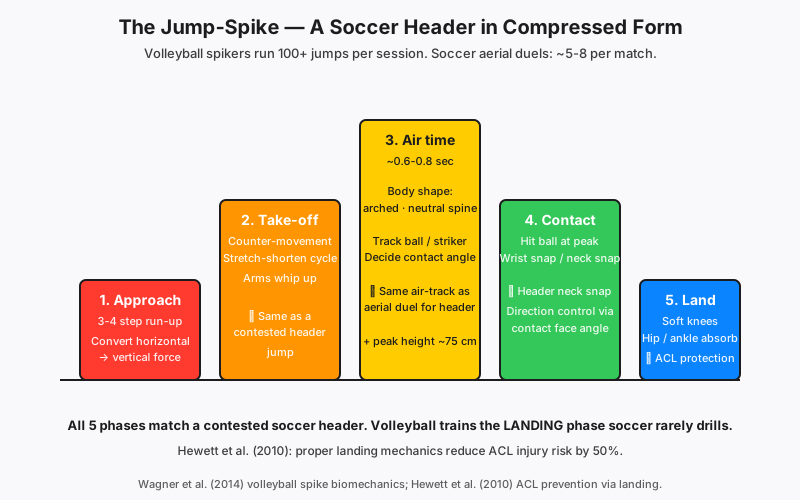
Transfer Elements Unique to Volleyball
- Vertical explosiveness — The high-intensity, repetitive jumping demands of spiking and blocking directly build the lower-limb power required for soccer's aerial contests
- 3D ball trajectory prediction — Instantly reading the speed, spin, and landing point of a served or spiked ball is a skill that transfers to processing long balls and dealing with crosses in soccer
- Mid-air core control — Maintaining a stable body axis while spiking in the air translates directly to postural stability during headers and volley shots in soccer
- Vocal communication — Volleyball has a deeply embedded culture of in-play calls such as "Mine!", "Left!", and "One touch!" This builds the foundation for on-field coaching — a skill often lacking in soccer
Kioumourtzoglou et al. (1998) found that volleyball players demonstrated the highest perceptual skills in ball trajectory prediction and speed estimation compared to basketball and water polo players. This ability to "read the flight of an incoming ball" transfers directly to processing long feeds, reacting to crosses, and goalkeeper positioning in soccer.
Volleyball intensively develops three capabilities soccer often overlooks: aerial play, prediction, and vocal communication. The transfer effect is particularly strong for goalkeepers and center-backs.
Jump Power and Aerial Duel Ability
Marques et al. (2009) found a significant positive correlation between jump training frequency and vertical jump performance. A single volleyball training session generates over 100 jumps — making it one of the most efficient forms of cross-training for building the explosive power soccer's aerial game demands.

Photo by Evgeniy Beloshytskiy on Unsplash
Soccer's aerial battles — winning headers, goalkeepers claiming high balls, attacking and defending corners — all depend on vertical explosiveness. Volleyball trains this capacity by design.
The Plyometric Effect
The volleyball spike is a textbook plyometric movement — a stretch-shortening cycle exercise. During the approach-plant-jump sequence, the lower-limb muscles rapidly transition from an eccentric (lengthening) contraction to a concentric (shortening) contraction. Markovic's (2007) meta-analysis showed that plyometric training improves vertical jump height by an average of 4.7% (effect size d = 0.79). Volleyball practice provides a natural competitive context in which these plyometric actions are repeated at high volume.
Jump Timing
In volleyball, jumping high is only part of the equation. What proves decisive is the ability to adjust jump timing to the setter's toss — its height, speed, and direction. This skill of "timing your jump to meet the ball at its arrival point" is cognitively and motorically identical to heading in soccer, especially when meeting a cross.
Mid-Air Core Control
To deliver maximum power at the point of contact during a spike, a player must stabilize the core while rotating the upper body — all while airborne. This mid-air trunk control transfers directly to soccer: maintaining posture while heading the ball, executing bicycle kicks, and keeping volley shots on target.
A volleyball player's average hang time is 0.6 to 0.8 seconds. The ability to control the body axis and deliver precise power to the ball within that brief window translates directly to soccer's aerial game.
Spatial Tracking — How Ball Trajectory Prediction Transfers
Volleyball players excel at instantly predicting the speed, spin, and landing point of an incoming ball and moving to the optimal position. This three-dimensional trajectory prediction skill transfers directly to processing long balls, handling crosses, and goalkeeper positioning in soccer.
In volleyball serve-receive, a player must read the ball's speed, spin direction, and trajectory from the server's hand motion and move to the ideal contact point within 0.5 to 1.0 seconds. This "reading the flight path of a projectile" skill is an extremely high-value transfer target for soccer.
The Mechanism Behind Trajectory Prediction
Abernethy's (1991) pioneering research showed that expert athletes are adept at using "advance cues" — predicting ball direction before the ball is even released. Volleyball players read a spiker's body orientation, arm angle, and wrist snap to anticipate the direction of the attack. This ability to "predict ball trajectory from body movement cues" transfers to reading the direction of passes and shots from an opponent's kicking motion in soccer.
Tracking the Ball in Three-Dimensional Space
Most soccer play unfolds in two dimensions (on the ground), but long feeds, crosses, corner kicks, and back-passes to the goalkeeper require three-dimensional trajectory prediction. Volleyball, where virtually every action occurs in 3D space, provides an intensive training environment for this capacity. McPherson & Vickers (2004) have suggested that ball-tracking accuracy is transferable across sports.
Reading Spin and Ball Movement
Through float serves (no spin) and jump serves (heavy spin), volleyball players develop an intuitive understanding of the relationship between spin rate and trajectory change. This mental model of "spin leads to movement" is a cognitive skill directly applicable to soccer — predicting the flight of curving free kicks around a wall and anticipating where a bending cross will drop.
The instinct volleyball builds — "knowing where the ball will be before it arrives" — is a three-dimensional trajectory prediction ability that creates a decisive edge in soccer's aerial duels and goalkeeper positioning.
Transfer of Team Communication Skills
In volleyball, vocal communication is a prerequisite for play. "Left!" "Right!" "Mine!" "One touch!" — this culture of constant calling directly addresses one of soccer's most common weaknesses: in-game team communication.
One of the most frequent complaints from youth soccer coaches is that players "don't talk on the pitch." In volleyball, silence means tactical breakdown. Who takes the ball, where the set goes, how many blockers to commit — all of these decisions are made on the basis of vocal information. Experiencing communication as an indispensable part of play translates directly into on-field coaching ability in soccer.
The Communication Structure of Volleyball
- Pre-play communication — Confirming serve-receive formations and calling the number of blockers. In soccer, this is equivalent to confirming marking assignments before set pieces
- Real-time communication — Calling "Mine!", "Yours!", and "One touch!" to share split-second decisions. In soccer, this maps to calls like "My ball!", "Turn!", and "You're free!"
- Post-play communication — Calls like "Nice one!", "Shake it off!", and "Reset!" after a rally. These support the team's psychological safety and resilience
A soccer pitch is far larger than a volleyball court, making vocal communication even more critical. Yet many soccer players never develop the habit. By repeatedly experiencing that "play breaks down without talking" in volleyball, communication becomes an unconscious habit that carries over to the soccer field.
Elevating the Quality of On-Field Coaching
In volleyball, the setter surveys the attackers' running patterns to decide toss distribution, communicating intent through voice calls. This process of "perceiving teammates' states and delivering the right information vocally" is cognitively identical to the role of a center-back or defensive midfielder in soccer — managing the defensive line (pushing up, dropping back, calling switches in marking).
In a volleyball match, six players communicate nonstop throughout every rally. Bringing that communication density onto the soccer pitch can transform a team's cohesion.
Transfer Benefits Specific to Goalkeepers
The overlap between volleyball and soccer goalkeeping is striking. Predicting the trajectory of an incoming ball, explosive lateral diving, mid-air ball handling, and directing teammates with voice commands — volleyball is one of the most efficient cross-training options for goalkeeper development.
Top European club academies widely incorporate volleyball-based drills into their goalkeeper development programs. This is no coincidence — it reflects the high degree of overlap between volleyball actions and the abilities a goalkeeper needs.
Reaction Ability and Diving
The volleyball dig (receiving a hard-driven spike) involves diving laterally to intercept a ball traveling at over 100 km/h. The movement pattern closely mirrors a goalkeeper's diving save in soccer. The explosive lateral push from a low position and the instant recovery after landing are shared skills across both sports.
Handling High Balls
The volleyball block jump — timing a vertical leap to extend both hands at maximum height — closely resembles a goalkeeper punching or catching a cross. Predicting where the ball will arrive and getting hands to the ball at the peak of the jump is one of a goalkeeper's most important skills.
Anticipation and Positioning
A volleyball libero (defensive specialist) makes micro-adjustments in positioning by reading the spiker's body orientation, approach angle, and arm swing. This use of "advance cues," as described by Abernethy (1991), is cognitively identical to a soccer goalkeeper reading a penalty taker's body angle or a free-kick taker's foot swing to anticipate direction.
Commanding the Defense with Voice
In volleyball, back-row players call out coverage instructions to the blockers at the net. This structure of "communicating information from back to front by voice" is exactly what a soccer goalkeeper does when issuing positional corrections and marking instructions to the defensive line. The habit of "moving teammates with your voice," cultivated in volleyball, transfers directly to a goalkeeper's coaching ability.
Volleyball simultaneously trains the four core competencies a goalkeeper needs: reaction, high-ball handling, anticipation, and coaching. For any player aspiring to be a keeper, it is the most complementary cross-training sport available.
Tracking the Volleyball-to-Soccer Transfer with Footnote
When recording volleyball insights in Footnote, the key to maximizing transfer is to articulate specifically which ability was trained, in which soccer situation it applies, and how it can be used.
Transfer from volleyball to soccer occurs on two fronts: physical skills (jump power, diving) and cognitive skills (trajectory prediction, communication). When logging entries in Footnote, be intentional about capturing both dimensions.
Example Log Entries
- Jump power transfer — "Spiking drills in volleyball helped me lock in my jump timing and peak height. I'll apply this to winning headers from corners in my next soccer match."
- Trajectory prediction transfer — "During serve-receive, I practiced reading the server's hand angle to predict ball direction. I can use the same cues as a GK to read shot trajectories."
- Communication transfer — "I started calling out naturally during the volleyball game. In soccer, I'll increase my vocal output on the back line — calling the line up and confirming marks."
- Aerial posture transfer — "Block drills taught me to stay stable on my axis in the air. I'll use this to hold my body position during aerial challenges even under physical contact in soccer."
Position-Specific Recording Tips
- GK — Focus entries on diving, high-ball handling, and coaching voice
- CB — Focus on aerial duel dominance and vocal control of the defensive line
- FW — Focus on header timing and movement to meet crosses
- All positions — Track changes in communication habits and improvements in reading ball flight
Once five matches of data accumulate in Footnote, the AI analyzes correlations between volleyball training and soccer performance. Patterns such as "self-assessed aerial duel ratings improve in weeks that include volleyball" or "reflection comments mentioning communication increase" become visible — helping shape an optimized cross-training plan.
Volleyball's transfer goes well beyond aerial duels. The habit of talking, the eye for reading ball flight, and the mindset of defending as a unit — logging these in Footnote makes invisible growth visible.
Frequently Asked Questions
Can I benefit from the transfer even if I have no volleyball experience?▾
Yes. Even basic passing drills and casual games deliver measurable benefits. Jump power and ball trajectory prediction, in particular, are stimulated even at a beginner level. Lower-barrier formats like beach volleyball or soft volleyball are excellent starting points. The key is simply accumulating experience handling a ball in the air.
Which soccer position benefits most from volleyball?▾
The greatest transfer goes to goalkeepers (GK). Reaction, diving, high-ball handling, and coaching all transfer directly. Next in line are center-backs (CB) for aerial duel ability and forwards (FW) for heading precision. Communication improvement, meanwhile, benefits every position on the pitch.
I'm worried about the knee stress from volleyball jumping drills.▾
Appropriate frequency and progressive load management are essential. One to two sessions per week at 30 to 45 minutes each will not place excessive stress on the joints. Marques et al. (2009) likewise recommend a gradual plyometric program. Prioritize learning proper landing technique and avoid excessive jumping on hard surfaces. For players still in their growth years, emphasize quality over quantity.
Which volleyball drills transfer most effectively to soccer?▾
Three recommendations by objective: (1) For aerial duels and jump power — spiking and blocking drills. (2) For GK ability — dig (hard-hit receive) drills. (3) For communication — game-format practice (6v6 or 3v3). Game situations are especially valuable because they integrate prediction, decision-making, and vocal communication, broadening the scope of transfer.
How should I log volleyball practice in Footnote?▾
Pair each entry with the "ability trained in volleyball" and "the soccer situation it applies to." For example: "Practiced timed block jumps in volleyball → Apply to improve header timing on corner-kick defense in soccer." Linking a specific scenario to a specific ability in your log improves the accuracy of Footnote's AI analysis.
References
- [1] Marques, M. C., van den Tilaar, R., Stöcklin, M., & Gonzalez-Badillo, J. J. (2009). “Physical fitness qualities of professional volleyball players: Determination of positional differences” Journal of Strength and Conditioning Research, 23(4), 1106–1111. Link
- [2] Sheppard, J. M. & Young, W. B. (2006). “Agility literature review: Classifications, training and testing” Journal of Sports Sciences, 24(9), 919–932. Link
- [3] Vaeyens, R., Lenoir, M., Williams, A. M., Philippaerts, R. M., & Brewer, J. (2008). “Talent identification and development programmes in sport: Current models and future directions” Sports Medicine, 38(9), 703–714. Link
- [4] Kioumourtzoglou, E., Kourtessis, T., Michalopoulou, M., & Derri, V. (1998). “Differences in several perceptual abilities between experts and novices in basketball, volleyball and water-polo” Perceptual and Motor Skills, 86(3), 899–912.
- [5] Abernethy, B. (1991). “Visual search strategies and decision-making in sport” International Journal of Sport Psychology, 22(3–4), 189–210.
- [6] Markovic, G. (2007). “Does plyometric training improve vertical jump height? A meta-analytical review” British Journal of Sports Medicine, 41(6), 349–355. Link
- [7] McPherson, S. L. & Vickers, J. N. (2004). “Cognitive control in motor expertise” International Journal of Sport and Exercise Psychology, 2(3), 274–300.
- [8] Hammami, A., Gabbett, T. J., Slimani, M., & Bouhlel, E. (2018). “Does cross-training improve physical fitness in youth soccer players? A systematic review” Biology of Sport, 35(4), 361–369.
Related Articles
Verbalization Accelerates Transfer -- Why Writing Makes Skills from Other Sports Carry Over to Soccer
11 min read
The Science Behind How Verbalization Improves Soccer — How 'Writing' and 'Thinking' Connect in the Brain
6 min read
Mental Training and the Soccer Notebook Habit — The Science of Writing Your Way to a Stronger Mind
9 min read
Growth Mindset and the Soccer Journal — How to Raise Players Who Believe in Effort Over Talent
9 min read
The Kinetic Chain -- The Science of Cross-Sport Body Mechanics and Its Application to Soccer
10 min read
Track Your Growth with Footnote
Just record your matches — AI analyzes every 5 games. Visualize growth with PVS Score. All features free during beta.
30-second signup · No credit card required
Last updated: 2026-05-06 ・ Footnote Editorial