How Swimming Transforms Cardiovascular Fitness, Upper-Body Strength, and Recovery for Soccer Players
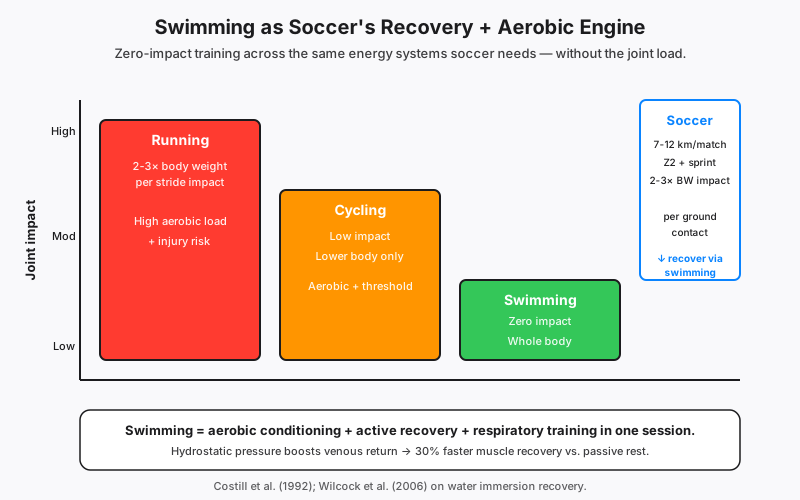
Soccer training tends to hammer the legs, yet performing for 90 minutes demands cardiovascular endurance, winning aerial duels and physical battles requires upper-body strength, and surviving fixture congestion depends on recovery capacity — all of which can be developed efficiently in the water. As Tanaka (2009) demonstrated, swimming delivers cardiovascular training effects equal to or greater than land-based exercise while imposing virtually zero impact on the joints. By resting the legs while pushing the cardiorespiratory system, building upper-body strength, and accelerating recovery, swimming stands as one of the most cost-effective forms of cross-training available to soccer players.
Why Swimming Works for Soccer Players
Swimming offers something nearly impossible to replicate on land: high-intensity aerobic exercise in a non-weight-bearing environment. It is the only form of cross-training that maintains and improves cardiovascular fitness without loading the musculoskeletal structures of the lower limbs.

Photo by Gita on Unsplash
Every soccer player faces the same dilemma: the need to build cardiovascular fitness while simultaneously avoiding leg fatigue and joint damage. Push the cardio system through running and the legs pay the price; rest the legs and aerobic capacity declines. Mujika & Padilla (2000) reported that VO2max can drop by as much as 7% within just two weeks of training cessation.
Swimming resolves this dilemma at its root. Buoyancy supports over 90% of body weight, reducing joint impact to near zero. At the same time, water resistance is roughly 800 times greater than air resistance, enabling high-intensity, full-body aerobic work.
- Buoyancy-based offloading — Near-zero impact on the knees, ankles, and hips. Cardiovascular training can continue even during minor lower-limb injuries
- Full-body engagement — The upper limbs, lower limbs, and core all contribute to propulsion. Swimming naturally strengthens the upper body, which soccer alone rarely develops
- Hydrostatic pressure enhances venous return — Water pressure assists blood circulation, accelerating lactate clearance after training
- Reduced thermoregulatory strain — Dehydration risk from sweating is much lower in water, making pools an excellent training environment in hot weather
The core value of swimming is the ability to push the cardiorespiratory system hard without using the legs. Whether it is the off-season, the day after a match, or a period of minor lower-limb injury, swimming is the only cross-training modality that maintains and improves cardiovascular fitness in all of these scenarios.
Cardiovascular Cross-Training — Maintaining VO2max While Resting the Legs
Tanaka (2009) demonstrated that swimming produces cardiovascular adaptations equivalent to land-based exercise — including VO2max gains, resting heart rate reduction, and increased cardiac output. For soccer players, this means a way to preserve endurance without lower-limb loading.

Photo by Gabriel Meinert on Unsplash
In a comprehensive review published in Exercise and Sport Sciences Reviews, Tanaka (2009) compared the cardiovascular adaptations produced by swim training with those from running. The conclusion was clear: swimming elicits equivalent adaptations across every component of VO2max — increased left ventricular volume, lower resting heart rate, and greater maximal cardiac output.
The Relationship Between VO2max and Match Performance
According to Reilly et al. (2000), elite soccer players typically have a VO2max in the range of 55–70 mL/kg/min, which correlates directly with recovery speed between high-intensity sprints. Players with a higher VO2max show less decline in second-half running distance and maintain a higher level of performance across the full 90 minutes.
How Swimming Strengthens the Cardiovascular System
- Central circulatory adaptation — The horizontal body position combined with hydrostatic pressure increases venous return, promoting a greater stroke volume. The heart becomes a more efficient pump
- Respiratory muscle strengthening — Breathing against water pressure forces the diaphragm and intercostal muscles to work harder. Lomax & McConnell (2003) reported that swimmers exhibit significantly greater respiratory muscle strength than runners
- Peripheral vascular adaptation — Cool water promotes cycles of vasoconstriction and vasodilation, helping to maintain vascular elasticity
The critical point is that all of these adaptations are achieved without taxing the legs at all. A 30-minute pool session the day after a match provides a cardiovascular stimulus that keeps the aerobic system engaged without impeding lower-limb recovery.
One to two swim sessions per week (30–45 minutes each) can maintain VO2max without compromising lower-limb recovery. This is especially valuable during congested fixture periods and rehabilitation phases.
Upper-Body and Core Development — Building Soccer's 'Hidden Weapon' in the Water
Soccer is often seen as a lower-body sport, but upper-body strength is decisive in aerial duels, physical challenges, and throw-ins. Swimming is one of the few cross-training methods that develops the arms, back, and core in an integrated manner.
In their comprehensive review of soccer physiology, Reilly et al. (2000) identified upper-body strength and core stability alongside lower-limb power and endurance as essential physical qualities for elite soccer players. Heading, shoulder charges, jostling for position, and long throws all depend on upper-body strength.
Upper-Body Muscle Groups Developed by Swimming
- Latissimus dorsi and teres major — The primary movers in the freestyle pull phase. Directly translates to the strength needed to hold off opponents during aerial challenges
- Deltoids and trapezius — Loaded throughout the entire stroke cycle. Contributes to throw-in distance and accuracy
- Rectus abdominis, obliques, and erector spinae — The core must maintain a horizontal body position throughout each stroke to generate stable propulsion. This is the same stabilization mechanism used during shooting and passing in soccer
- Pectoral muscles — Strongly recruited during the pull phase of butterfly and breaststroke. Contributes to thoracic stability during physical contact
Why Swimming Excels as Core Training
Land-based core exercises such as planks and sit-ups develop stability in a static environment, but soccer demands the ability to stabilize the core while in motion. Swimming requires athletes to produce propulsive stroke movements and maintain core stability simultaneously — training precisely the kind of dynamic core stability the game demands. The ability to hold a stable core in the unstable aquatic environment transfers directly to maintaining balance during contact while dribbling and staying controlled in the air during aerial challenges.
Swimming is an exercise in coordinating the entire body to generate a single propulsive force. This 'full-body integration' pattern forms the shared foundation for kicking, heading, and sprinting in soccer.
— Adapted from principles of swimming biomechanics
Active Recovery and Injury Prevention — Harnessing the Water to Accelerate Recovery
Reilly & Ekblom (2005) showed that light aquatic exercise the day after a match significantly reduces perceived fatigue and muscle soreness compared with passive recovery. Swimming is one of the most evidence-backed active recovery methods available.
After a soccer match, the body is dealing with micro-muscle damage, lactate accumulation, and inflammatory responses. Instead of complete rest (passive recovery), low-intensity exercise to promote recovery — known as active recovery — has been supported by a large body of research. Aquatic exercise is particularly effective because multiple recovery mechanisms operate simultaneously.
Four Mechanisms of Aquatic Recovery
- Hydrostatic compression — At a depth of 1 m, approximately 75 mmHg of pressure is applied uniformly across the body, promoting venous return in a manner similar to compression garments
- Active blood flow in a non-weight-bearing environment — Gentle kicking and stroking activates the muscle pump, improving circulation without loading the joints
- Mild cooling for anti-inflammatory effect — Pool temperatures of 25–28 °C provide a gentle cooling effect that reduces inflammation without the extremes of an ice bath
- Psychological refreshment — The novelty of the aquatic environment contributes to mental recovery, particularly useful for breaking the monotony of in-season training
Swimming for Injury Prevention
Soccer carries a high risk of overuse injuries. In junior and youth players especially, repetitive impact on growing bones can cause patellar tendinopathy (jumper's knee) and Osgood-Schlatter disease. Incorporating one to two swim sessions per week reduces cumulative lower-limb loading while maintaining overall training volume. Considering the detraining effects reported by Mujika & Padilla (2000), switching to swimming rather than simply resting is vastly superior for maintaining fitness.
A 20–30-minute light swim the day after a match speeds recovery compared with complete rest. Only the aquatic environment delivers all four mechanisms — hydrostatic pressure, offloading, cooling, and psychological refreshment — at the same time.
Breathing Control Transfer — What Swimming Teaches About Respiratory Management
Swimming's restricted breathing environment trains the conscious control of breathing patterns. This ability transfers directly to post-sprint recovery in soccer, concentration before set pieces, and mental control during penalty kicks.
One of the ways swimming differs fundamentally from other forms of cross-training is its restriction on breathing. In freestyle, a breath can only be taken every two to four strokes, requiring conscious control over the timing of inhalation and exhalation. This 'forced respiratory management' yields unexpected benefits for soccer performance.
Three Game Situations Where Breathing Control Transfers
- Recovery after high-intensity sprints — After an all-out sprint, many players fall into rapid, shallow breathing. The deep, rhythmic breathing pattern developed through swimming accelerates the repayment of oxygen debt
- Concentration before set pieces — The ability to deliberately regulate breathing before a free kick, corner, or penalty is directly linked to the respiratory control experience gained through swimming. Lomax & McConnell (2003) reported a correlation between respiratory muscle strength and breathing control ability
- Sustaining decision-making in the final minutes — When breathing becomes erratic under fatigue, cognitive function declines. The 'breathing stabilization under load' cultivated in swimming supports clear-headed decision-making during the 80th–90th minute of a match
Swimming as Respiratory Muscle Training
Lomax & McConnell (2003) found that swimmers have significantly higher maximal inspiratory pressure (MIP) and maximal expiratory pressure (MEP) than track athletes and soccer players. Swimming against water pressure constitutes a form of respiratory muscle resistance training in itself. Stronger respiratory muscles improve ventilatory efficiency during exercise, meaning that the same exercise intensity feels easier — a reduction in perceived breathlessness.
A player who can control their breathing can control not only their body but also their thinking. Swimming teaches more than stamina — it teaches the ability to consciously design your own breathing.
Recording Swimming Cross-Training with Footnote
To maximize the benefits of swimming, do not stop at 'I swam today.' The key is to articulate what carries over to soccer and log it. Here is how to use Footnote's recording framework for that purpose.
When using swimming as cross-training, recording the following perspectives in your Footnote practice log will help you consciously enhance the transfer effect.
Sample Log for a Swim Session
- Session details — 'Freestyle 400 m + breaststroke 200 m + kick drills 200 m. Heart rate peaked at around 170 bpm'
- Body awareness notes — 'Felt increased range of motion around the shoulder blades. Focused on core stability during the second half of each stroke'
- Transfer point to soccer — 'The sensation of stabilizing the core in the water is the same as maintaining an upright axis while shielding the ball under contact'
- Experiment for the next soccer session — 'During aerial duels, consciously apply the core stabilization feeling from swimming'
Sample Log for a Recovery Swim
When the swim is for recovery the day after a match, log your subjective recovery indicators. For example: 'Day after match. Easy freestyle for 20 minutes. Leg heaviness was 6/10 before getting in, improved to 3/10 afterward. Breathing stayed relaxed throughout.' Accumulating this kind of subjective data helps you discover the recovery protocol that works best for you.
Footnote's periodic AI analysis can even compare your performance in weeks that include swimming with weeks that do not. When a pattern like 'In months with one swim session per week, my second-half self-rating averaged 0.5 points higher' becomes visible, your motivation to keep swimming gains a scientific foundation.
Do not settle for 'I swam today.' Write all the way to 'Focused on core stability in the water — will apply it to aerial duels in the next match.' Only when you connect the dots does a cross-training log become an engine for transfer.
Frequently Asked Questions
Can swimming still help my soccer even if I'm not a good swimmer?▾
Yes. Even water walking and aqua jogging deliver the recovery benefits of hydrostatic pressure and provide a cardiovascular stimulus. The joint-offloading advantages of buoyancy apply just the same. Swimming technique does not need to be polished for the exercise itself to be effective cross-training. Simply getting into the pool is the first step.
How often should I swim?▾
One to two sessions per week, 30–45 minutes each, is recommended. Combining a low-intensity recovery swim the day after a match (20–30 minutes) with a moderate- to high-intensity cardiovascular session mid-week (30–45 minutes) is an effective approach. There is no need to drastically cut soccer training volume — the key is integrating swimming as a complement.
Could swimming build too much muscle and hurt my soccer performance?▾
One to two swim sessions per week will not produce bodybuilder-level hypertrophy. Swimming primarily develops muscular endurance, not the kind of excessive bulk that would hinder performance. In fact, improved upper-body muscular endurance works in your favor during physical battles in the closing stages of a match.
Does pool training in winter increase the risk of catching a cold?▾
Indoor heated pools pose no problem. Moderate regular exercise has actually been shown to improve immune function. The key precaution is post-swim temperature management — dry off thoroughly and change into warm clothing promptly.
What is the best way to log swimming sessions in Footnote?▾
In your practice log entry, include the swim details and always articulate at least one 'transfer point to soccer.' For example: 'Focused on core stability during freestyle — same sensation could help me hold balance while dribbling under pressure.' Writing this transforms a simple swim log into a transfer-training record. Once you have logged five sessions, the AI analysis can start detecting patterns.
References
- [1] Mujika, I. & Padilla, S. (2000). “Detraining: Loss of training-induced physiological and performance adaptations. Part I” Sports Medicine, 30(2), 79-87.
- [2] Tanaka, H. (2009). “Swimming exercise: Impact of aquatic exercise on cardiovascular health” Exercise and Sport Sciences Reviews, 37(1), 3-8. Link
- [3] Reilly, T., Bangsbo, J., & Franks, A. (2000). “Anthropometric and physiological predispositions for elite soccer” Journal of Sports Sciences, 18(9), 669-683. Link
- [4] Lomax, M. & McConnell, A. K. (2003). “Inspiratory muscle fatigue in swimmers after a single 200 m swim” Journal of Sports Sciences, 21(8), 659-664. Link
- [5] Reilly, T. & Ekblom, B. (2005). “The use of recovery methods post-exercise” Journal of Sports Sciences, 23(6), 619-627. Link
- [6] Hammami, A., Gabbett, T. J., Slimani, M., & Bouhlel, E. (2018). “Does cross-training improve physical fitness in youth soccer players? A systematic review” Biology of Sport, 35(4), 361-369.
- [7] Wilcock, I. M., Cronin, J. B., & Hing, W. A. (2006). “Physiological response to water immersion: A method for sport recovery?” Sports Medicine, 36(9), 747-765. Link
Related Articles
Verbalization Accelerates Transfer -- Why Writing Makes Skills from Other Sports Carry Over to Soccer
11 min read
The Science Behind How Verbalization Improves Soccer — How 'Writing' and 'Thinking' Connect in the Brain
6 min read
Growth Mindset and the Soccer Journal — How to Raise Players Who Believe in Effort Over Talent
9 min read
Mental Training and the Soccer Notebook Habit — The Science of Writing Your Way to a Stronger Mind
9 min read
CrossFit for Soccer Players — Unlocking Full-Body Functional Strength and Metabolic Conditioning
12 min read
Track Your Growth with Footnote
Just record your matches — AI analyzes every 5 games. Visualize growth with PVS Score. All features free during beta.
30-second signup · No credit card required
Last updated: 2026-05-06 ・ Footnote Editorial