CrossFit for Soccer Players — Unlocking Full-Body Functional Strength and Metabolic Conditioning
CrossFit is a training system built on constantly varied, high-intensity functional movements, and it has drawn growing attention as a program that simultaneously develops the strength, power, endurance, and flexibility soccer demands. Tibana et al. (2016) reported that CrossFit participants achieved significantly higher VO2max and muscular endurance scores than a conventional training group, while Heinrich et al. (2012) demonstrated that HIIT-style functional training improves both cardiovascular fitness and body composition in a short time frame. Sustaining effort over 90 minutes yet producing explosive sprints, jumps, and duels on demand — CrossFit is one of the few methodologies that addresses both of these seemingly contradictory requirements in a single program.
Why CrossFit and Soccer Are a Natural Fit — Shared Physical Demands
The “10 General Physical Skills” that CrossFit targets — cardiorespiratory endurance, stamina, strength, flexibility, power, speed, coordination, agility, balance, and accuracy — overlap remarkably well with what soccer asks of its players across 90 minutes.

Photo by Ambitious Studio* on Unsplash
CrossFit founder Greg Glassman defined fitness as “a broad, general, and inclusive capacity to perform any physical task.” That definition maps directly onto soccer’s competitive demands. During a match, players cover 10–13 km (cardiorespiratory endurance), execute more than 200 changes of direction (agility), perform 30–40 sprints (power and speed), engage in aerial duels and body contact requiring full-body strength (strength and balance), and control the ball with precision (coordination and accuracy).
How CrossFit Differs from Conventional Training
- Weight training — Builds raw strength but offers limited transfer to cardiorespiratory endurance or agility. Single-joint exercises dominate, creating a gap between gym work and soccer’s multi-joint movement patterns.
- Long-distance running — Improves aerobic capacity but can compromise power and speed. It also fails to replicate soccer’s intermittent work–rest profile.
- CrossFit — Combines compound functional movements at high intensity, stimulating strength, power, endurance, and agility simultaneously. As Glassman (2002) argued in the CrossFit Journal, “The lack of specialization is the ultimate specialization.”
In a study published in the Journal of Sports Science & Medicine, Tibana et al. (2016) found that subjects who completed an 8-week CrossFit program improved VO2max by 8.3% and total-body muscular endurance by 15.2%, significantly outperforming a conventional split-training group. This ability to drive simultaneous gains across multiple physical qualities is the scientific basis for CrossFit’s compatibility with soccer.
Soccer is a sport where the most versatile athletes survive. Speed alone, strength alone, or endurance alone is never enough. CrossFit’s philosophy of developing broad physical capacity at the same time mirrors exactly the kind of fitness soccer rewards.
Soccer-Specific CrossFit Programming — WOD Adaptations and Sample Workouts
When customizing CrossFit’s Workout of the Day (WOD) for soccer players, the emphasis should fall on lower-body power output, change-of-direction ability, and intermittent high-intensity work patterns.

Photo by Victor Freitas on Unsplash
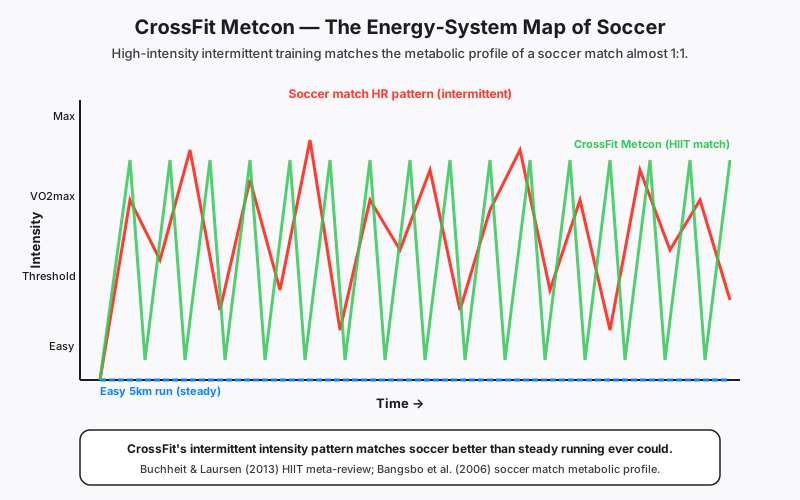
A standard CrossFit WOD typically spans 10–20 minutes of high-intensity circuit work. The key to adapting it for soccer is to reproduce the same intermittent pattern found in a match: bursts of high-intensity effort followed by brief recovery, then another burst. Smith et al. (2013) confirmed that CrossFit-style circuit training is an efficient protocol for improving both cardiovascular function and muscular strength.
Sample Soccer-Specific WOD: 3 Rounds (15–18 min)
- Front Squats × 8 — Builds lower-body strength and kicking stability. Holding the barbell in the front-rack position simultaneously trains anti-flexion core strength.
- Box Jumps × 10 — Develops explosive hip-extension power, directly transferring to heading jump height and sprint acceleration.
- Kettlebell Swings × 15 — Strengthens the hip-hinge pattern and the posterior kinetic chain — the power source for long-range kicks and throw-ins.
- Burpees × 10 — Trains full-body coordination under cardiovascular stress. The get-up-from-the-ground pattern mirrors post-tackle recovery in a match.
- 200 m Run — Simulates positional transitions. The goal is to maintain running quality under cumulative fatigue across rounds.
Aim for 5–6 minutes per round, with 30–60 seconds of rest between rounds. Because the workout is designed to mimic the accumulating fatigue of the second half, expect times to increase as rounds progress. The top priority is maintaining proper form throughout; breakdown in technique not only raises injury risk but also reduces the transfer effect to soccer performance.
The goal of a WOD is not “finish as fast as possible” but “maintain form under fatigue.” The players who can still deliver an accurate pass or win a header in the 85th minute are the ones whose movement quality holds up when they are tired.
Metabolic Conditioning — Building the Energy Systems to Last 90 Minutes
Heinrich et al. (2012) demonstrated that high-intensity functional training simultaneously improves both aerobic and anaerobic energy systems. This dual adaptation is ideal for soccer’s intermittent work pattern.
Roughly 90% of a soccer match’s energy expenditure comes from the aerobic system, yet the moments that decide games — goalmouth sprints, duels, jumps — depend on the anaerobic system. In a study published in the Journal of Strength and Conditioning Research, Heinrich et al. (2012) showed that participants in a 5-week high-intensity functional training program made significant gains in both VO2max and anaerobic power. The adaptations were more efficient than training the aerobic and anaerobic systems separately.
The Three Energy Systems and How CrossFit Targets Them
- ATP-CP system (0–10 s) — Powers instant bursts: sprints, shots, jumps. Olympic lifts and plyometrics provide a direct stimulus.
- Glycolytic system (10 s–2 min) — Sustains repeated high-intensity efforts such as pressing sequences and rapid attack-to-defense transitions. AMRAP (As Many Rounds As Possible) and EMOM (Every Minute on the Minute) intervals target this system optimally.
- Oxidative system (2 min+) — Underpins sustained performance across the full 90 minutes. Longer WODs and chippers (multi-movement sequences) develop aerobic capacity.
What makes CrossFit programming effective is that it stimulates all three energy systems on a rotating basis, and sometimes within a single WOD. A review in Sports Medicine by Feito et al. (2018) confirmed that experienced CrossFit practitioners reach cardiovascular fitness levels comparable to sport-specific athletes, making it a viable alternative for any player who wants to boost soccer endurance without relying solely on long-distance runs.
Metabolic conditioning is not just general fitness work. It is the training that determines whether you can still sprint in the 89th minute or deliver a precise pass in extra time — it builds the “last reserves” that separate winners from the rest.
— Principles of Metabolic Conditioning
Explosive Power Development — Applying Olympic Lifts to Soccer
Hackett et al. (2016) reported a significant positive correlation between Olympic lifting movement patterns and both sprint acceleration and vertical jump height. The clean, snatch, and jerk — core movements in CrossFit — share structural mechanics with explosive power production in soccer.
Olympic lifts (the clean & jerk and the snatch) are central to CrossFit and are characterized by the triple extension — simultaneous extension of the ankles, knees, and hips to drive a barbell from the ground overhead. In a review published in the Strength and Conditioning Journal, Hackett et al. (2016) detailed how this triple extension pattern is biomechanically identical to the acceleration phase of a sprint, the take-off in a jump, and the push-off in a change of direction.
Biomechanical Parallels with Soccer Movements
- Power Clean → Sprint acceleration — The rapid hip extension that drives the barbell from floor to shoulders matches the direction and timing of the ground-push phase in early sprint acceleration.
- Hang Snatch → Heading jump — Pulling the barbell from hip height to overhead trains the same explosive vertical force integration needed to win aerial duels.
- Push Jerk → Throw-ins and power shots — Transferring force from the legs through the torso to press a load overhead mirrors the kinetic chain used in long throw-ins and driven shots.
- Deadlift → Body-contact resilience — Heavy deadlifts recruit the entire posterior chain, building the trunk and lower-body rigidity that keeps a player on their feet through shoulder-to-shoulder challenges.
Research by Comfort et al. (2012) in the Strength and Conditioning Journal found significant correlations between power clean 1RM, 10 m sprint time, and vertical jump height. By incorporating these lifts regularly through CrossFit programming, soccer players can develop explosive power efficiently. However, correct technique is essential and must be learned under qualified coaching — self-taught execution significantly increases injury risk.
Olympic lifts do not train “the ability to lift heavy objects.” They train the ability to integrate full-body force in a single instant. That ability is the engine behind sprint explosiveness, heading jump height, and shot power — the foundational power that drives soccer performance.
Age-Appropriate Programming — From Junior Players to Youth Academy Athletes
The NSCA position statement (Faigenbaum et al., 2009) affirms that youth resistance training is both safe and beneficial when conducted under proper supervision with progressive loading. However, load selection and movement choices must be matched to the athlete’s developmental stage.
CrossFit’s high-intensity, heavy-load reputation often raises concerns about suitability for young athletes. Yet the NSCA (National Strength and Conditioning Association) position statement (Faigenbaum et al., 2009) concluded that properly supervised youth resistance training improves muscular strength, bone density, and injury resilience. The keys are qualified instruction and gradual progression.
Guidelines by Age Group
- Elementary school (U-12) — Follow CrossFit Kids guidelines. Focus on bodyweight exercises (squats, push-ups, lunges) delivered as playful circuits. No barbells or kettlebells; the goal is mastering fundamental movement patterns. Sessions of 15–20 minutes, 1–2 times per week.
- Middle school (U-15) — Once foundational movement patterns are solid, introduce light barbells and dumbbells. Prioritize technique in the front squat, deadlift, and press; chasing heavy loads comes later. Keep WOD intensity moderate, managing heart rate below 85% of maximum.
- High school (U-18) — Progressively introduce Olympic lifting variations as movement proficiency allows. Power cleans and snatches must always be coached by a qualified instructor. WOD duration and intensity can approach adult levels over time, but periodization aligned with the match calendar is essential.
- Post-youth (U-18+) — Full-scale CrossFit programming is appropriate. Avoid high-intensity WODs within 48 hours of a match. Aim for 2–3 sessions per week in-season and 3–4 per week in the off-season.
Lloyd & Oliver (2012) proposed the Youth Physical Development (YPD) model in the Strength and Conditioning Journal, recommending that training be planned around “sensitive periods” — windows in which specific physical qualities develop most readily. For soccer players, the optimal progression is coordination and fundamental movement in elementary school, building a strength base in middle school, and dedicated power and endurance development in high school.
CrossFit is not a “dangerous” training system; it is a scalable one. The movements stay the same while load, intensity, and volume are adjusted to the individual. Progression should be based on movement proficiency, not age — that is the key to balancing safety with effectiveness.
Functional Training in Professional Soccer — How Top Clubs Apply CrossFit Principles
Led by Europe’s elite clubs, functional training that draws on CrossFit elements is spreading across professional soccer. The global shift from linear strength work toward compound, multi-joint movement programming is well underway.
Professional soccer teams rarely use the “CrossFit” brand name outright, but the functional movements at its core — Olympic lifts, kettlebell training, plyometrics, and gymnastic exercises — have become standard elements in many clubs’ physical preparation programs. A comprehensive review by Suchomel et al. (2016) in Sports Medicine analyzed the transfer effects of weightlifting movements and confirmed their value for sport performance in general.
Adoption and Benefits
- Kettlebell training — Exercises such as kettlebell swings, Turkish get-ups, and goblet squats are now common in warm-ups and physical sessions at many clubs. Jay et al. (2011) also reported that kettlebell training is effective for preventing lower-back pain, adding a player-health rationale for adoption.
- Circuit-based physical sessions — AMRAP and EMOM formats borrowed from CrossFit allow coaches to deliver maximum physiological stimulus within limited training windows.
- Prehabilitation — Injury-prevention work built on functional movement patterns often uses CrossFit mobility drills and warm-up sequences as its foundation.
An important nuance is that professional clubs do not adopt CrossFit wholesale. Programs are customized around match schedules, individual player conditions, and position-specific demands. Amateur soccer players incorporating CrossFit should follow the same “customization principle,” always selecting exercises and loads with the ultimate goal of improving soccer performance.
The best physical trainers are not the ones who know the latest methods. They are the ones who can “translate” any method to fit the competitive demands and condition of each individual athlete.
— Principles of Functional Training in Practice
Logging CrossFit Training in Footnote
To get the most out of CrossFit, record more than just the WOD itself. Articulating how each movement transfers to a specific soccer skill turns a generic gym log into a meaningful growth record. Footnote’s practice-log framework is built for exactly this.
When you use CrossFit as cross-training for soccer, adding a “soccer transfer point” to every WOD entry in Footnote transforms a simple fitness log into a targeted development record.
Sample CrossFit Session Log
- WOD details and numbers — “3-round WOD: Front Squat 40 kg × 8, Box Jump 60 cm × 10, KB Swing 16 kg × 15, Burpees × 10, 200 m Run. Total time: 16:42.”
- Form under fatigue — “Knees started caving in on front squats in round 3. The drop in kicking accuracy I notice late in matches might stem from the same hip-stability issue.”
- Soccer transfer point — “Focusing on hip extension during box jumps made my landing more stable. I should try cueing the same feeling during heading jumps at next practice.”
- Rate of perceived exertion — “RPE 8/10. Breathing became labored midway through round 2, but I maintained movement quality. Similar sensation to the second half of a match. Building tolerance at this intensity is the goal.”
Connecting WOD Numbers to Soccer Progress
One of CrossFit’s strengths is that performance is quantifiable: power clean loads, WOD completion times, box jump heights. By tracking these numbers consistently in Footnote alongside subjective observations of soccer performance — perceived sprint speed, aerial duel win rate, conditioning over 90 minutes — you can identify which CrossFit elements deliver the greatest on-pitch return.
Don’t let your CrossFit log stop at “today’s WOD time.” Write the connection: “front squat knee stability → kicking accuracy,” “burpees under fatigue → post-tackle recovery speed.” That is how you maximize CrossFit’s value as soccer cross-training.
Frequently Asked Questions
Are there any special prerequisites for soccer players to start CrossFit?▾
No special prerequisites are needed. Every CrossFit movement is designed to be scalable, so athletes of any fitness level can begin. That said, learning correct form for foundational movements — front squats, deadlifts, presses — should be the first priority. We recommend completing a Foundations class at a CrossFit-affiliated box (gym) before jumping into regular WODs.
Can CrossFit training reduce the endurance I need for soccer?▾
Not with proper programming. In fact, as Heinrich et al. (2012) showed, high-intensity functional training improves both aerobic and anaerobic capacity simultaneously. Soccer endurance is not just about steady-state running; it also includes tolerance for repeated high-intensity efforts. CrossFit WODs are well suited to developing this soccer-specific endurance. During the season, adjust WOD volume and intensity to complement your match and practice schedule.
I’ve heard CrossFit has a high injury rate. Is it safe for soccer players?▾
Hak et al. (2013) found that the CrossFit injury rate is 3.1 per 1,000 training hours — lower than soccer (6.2) and rugby (7.8). Injury risk increases when athletes chase heavier loads before mastering form, or train at excessive frequency. Under the guidance of a CrossFit-certified coach and with a form-first approach (prioritizing movement quality over load), CrossFit can be practiced safely.
How often should I do CrossFit per week, and how do I balance it with soccer training?▾
During the season, 1–2 sessions per week (40–50 minutes each) is recommended. Avoid the day before and the day after a match, and schedule CrossFit on days when soccer training intensity is low. In the off-season, increase to 3–4 sessions per week to build a strength and power base. If CrossFit and soccer practice fall on the same day, the ideal order is soccer first, then CrossFit at least 4 hours later.
What if there is no CrossFit gym nearby? Are there workouts I can do at home or on the field?▾
Plenty of WODs require no barbell at all. Benchmark workouts like “Cindy” and “Murph” combine bodyweight exercises (burpees, air squats, lunges, push-ups, pull-ups) with running and need zero equipment. A single kettlebell opens up swings, goblet squats, and Turkish get-ups. On a soccer field, adding shuttle runs or sprints increases sport specificity further.
References
- [1] Tibana, R. A., de Almeida, L. M., Frade de Sousa, N. M., Nascimento, D. C., Neto, I. V. S., de Almeida, J. A., ... & Prestes, J. (2016). “Two consecutive days of crossfit training affects pro and anti-inflammatory cytokines and osteoprotegerin without impairments in muscle power” Frontiers in Physiology, 7, 260. Link
- [2] Heinrich, K. M., Patel, P. M., O'Neal, J. L., & Heinrich, B. S. (2014). “High-intensity compared to moderate-intensity training for exercise initiation, enjoyment, adherence, and intentions: An intervention study” BMC Public Health, 14(1), 789. Link
- [3] Faigenbaum, A. D., Kraemer, W. J., Blimkie, C. J. R., Jeffreys, I., Micheli, L. J., Nitka, M., & Rowland, T. W. (2009). “Youth resistance training: Updated position statement paper from the National Strength and Conditioning Association” Journal of Strength and Conditioning Research, 23(S5), S60-S79. Link
- [4] Hackett, D., Davies, T., Soomro, N., & Halaki, M. (2016). “Olympic weightlifting training improves vertical jump height in sportspeople: A systematic review with meta-analysis” British Journal of Sports Medicine, 50(14), 865-872. Link
- [5] Smith, M. M., Sommer, A. J., Starkoff, B. E., & Devor, S. T. (2013). “Crossfit-based high-intensity power training improves maximal aerobic fitness and body composition” Journal of Strength and Conditioning Research, 27(11), 3159-3172. Link
- [6] Feito, Y., Heinrich, K. M., Butcher, S. J., & Poston, W. S. C. (2018). “High-intensity functional training (HIFT): Definition and research implications for improved fitness” Sports, 6(3), 76. Link
- [7] Suchomel, T. J., Nimphius, S., & Stone, M. H. (2016). “The importance of muscular strength in athletic performance” Sports Medicine, 46(10), 1419-1449. Link
- [8] Comfort, P., Allen, M., & Graham-Smith, P. (2011). “Comparisons of peak ground reaction force and rate of force development during variations of the power clean” Journal of Strength and Conditioning Research, 25(5), 1235-1239. Link
Related Articles
Core and Axis -- How Ballet, Gymnastics, and Yoga Build Soccer's Unshakable Foundation
11 min read
Multidimensional Cardiovascular Development — The Science of Synergy from Multi-Sport Training
10 min read
The Art of 1v1 Duels — What Martial Arts, Fencing & Basketball Teach Us About Winning Individual Battles
10 min read
Pacing Strategy — The Science of Surviving 90 Minutes, Borrowed from Endurance Sports
10 min read
The Kinetic Chain -- The Science of Cross-Sport Body Mechanics and Its Application to Soccer
10 min read
Track Your Growth with Footnote
Just record your matches — AI analyzes every 5 games. Visualize growth with PVS Score. All features free during beta.
30-second signup · No credit card required
Last updated: 2026-05-06 ・ Footnote Editorial