The Art of 1v1 Duels — What Martial Arts, Fencing & Basketball Teach Us About Winning Individual Battles
A soccer 1v1 is far more than a footrace. As McGarry et al. (2002) showed through dyadic interaction theory, a duel is a spatiotemporal coupling between two agents — each constrained by the other's movements, each seeking to break that coupling at the decisive moment. Martial arts have refined center-of-gravity manipulation and destabilization to an art form; fencing has optimized distance control and selective reaction; basketball has systematized lateral defensive posture and anticipation. This article integrates insights from all three disciplines to present a scientific approach to elevating your duel performance in soccer.
What Makes a Great Duelist in Soccer
Duel ability is not a single skill — it is a multi-component competency that integrates perception, decision-making, and body control. Under Davids et al.'s (2008) constraints-led approach, an elite duelist is a player who can actively manipulate the environmental constraints of a 1v1 encounter.

Photo by C.F. Photography on Unsplash
Bundesliga data analysis shows that each player averages 15 to 20 duels per match, and duel win rate correlates significantly with team performance. But what exactly does it mean to be 'strong in duels'? The answer lies in a cluster of interrelated abilities.
The Four Pillars of Duel Ability
- Perceptual Anticipation — The ability to read an opponent's center-of-gravity shift, gaze direction, and shoulder angle to predict their next move 0.2 seconds ahead. Savelsbergh et al. (2002) identified this use of anticipatory cues as the defining characteristic of expert performers
- Distance Control — The ability to maintain optimal spacing with an opponent and judge when to press versus when to hold. Too close and you get beaten; too far and you apply no pressure
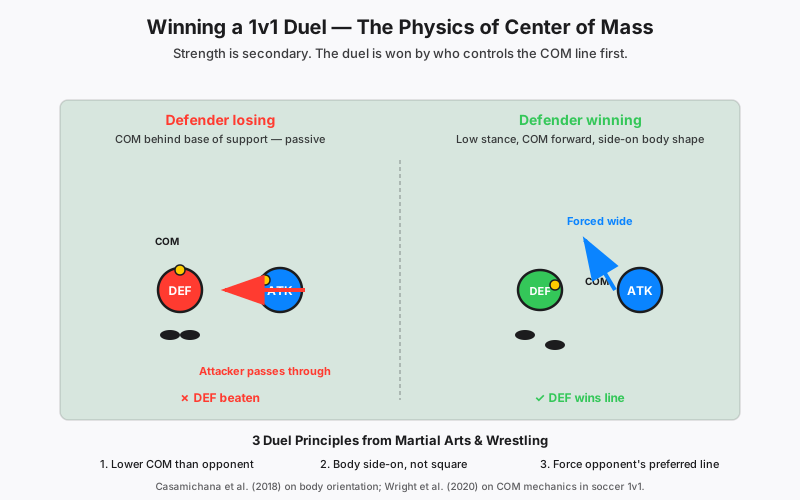
- Body Control (Center-of-Gravity Management) — The skill of keeping your own center of gravity low and stable while destabilizing your opponent's balance. It is positioning and leverage, not body mass, that determine the outcome
- Psychological Dominance — The ability to use feints, pressure, and body language to force the opponent into moving first, thereby seizing the initiative in the encounter
These abilities are difficult to develop through soccer training alone. During a match or typical practice session, cognitive resources are split across ball manipulation, positioning, and tactical awareness — leaving limited opportunity to focus purely on the craft of 1v1 engagement. This is precisely where cross-sport transfer becomes powerful.
The core of duel ability is the speed of correct decision-making relative to your opponent. This is a perceptual-cognitive skill, not a physical one — and it transfers efficiently from martial arts, fencing, and basketball.
What Martial Arts Teach About Reading and Breaking Balance
Judo and wrestling athletes monitor their opponent's center of gravity continuously through both tactile and visual channels. Imamura et al. (2006) reported that expert judoka detect center-of-gravity shifts within 100 milliseconds. This ability transfers directly to body-contact situations in soccer.
The single most valuable insight martial arts offer for soccer duels is the skill of reading an opponent's center of gravity. In judo, kuzushi (breaking balance) is the act of displacing an opponent's center of gravity outside their base of support — and this is structurally identical to the mechanics behind a shoulder charge or body contest in soccer.
Three Cues for Reading Center of Gravity
- Foot width and weight distribution — An opponent with a narrow stance is vulnerable laterally. When their weight shifts onto one foot, their response in the opposite direction is delayed
- Shoulder-hip rotation differential — When the upper body rotates ahead of the hips, the opponent's ability to initiate movement in that direction is delayed by 0.1 to 0.2 seconds. This serves as a cue for distinguishing real intent from feints
- Knee flexion angle — The moment an opponent's knees are fully extended is when their ability to change direction is at its lowest. Attacking at this instant raises the probability of a successful challenge
Mori et al. (2002) used visual occlusion tasks to demonstrate that martial arts experts can predict attack timing from subtle postural changes. This 'posture-reading' ability is structurally identical to a soccer defender anticipating when a dribbler will make their move.
Applying It to Soccer: The Moment of Contact
The key principle when applying martial arts insights to soccer is this: initiate contact at the moment your opponent's center of gravity is in motion. Pushing against a stationary opponent has little effect. But applying force in the opposite direction at the instant they begin to move creates maximum balance disruption with minimum effort.
The principle of kuzushi in judo is to catch the moment the opponent begins to move and ride the direction of their force. In soccer body contests as well, timing contact to the opponent's movement initiation is what makes it most effective.
— Imamura et al., 2006
What Fencing Teaches About Distance Management and Selective Reaction
Fencers manage distance by dividing space into three zones: attack range, preparation zone, and safety zone. Williams & Walmsley (2000) showed that fencers' choice reaction times are significantly faster than those of general athletes, and suggested this advantage stems from mastery of distance management.
The most transferable insight fencing offers for soccer 1v1s is the 'three-zone distance model.' Fencers constantly classify the distance between themselves and their opponent into three zones and make instant decisions about which action to take in each.
The Three-Zone Distance Model
- Attack Range (Close Distance) — The distance where a single lunge reaches the opponent. In soccer, this means being one step from the ball. Within this zone, the principle of 'whoever moves first gains the advantage' applies
- Preparation Zone (Middle Distance) — A distance where you can react to the opponent's movements but cannot launch an immediate attack. This is the zone a soccer defender should maintain for the longest possible time during a 1v1
- Safety Zone (Long Distance) — A distance where neither player meaningfully influences the other. In soccer, this corresponds to a cover-shadowing position
Roi & Bianchedi (2008) reported that elite fencers perform an average of 3 to 4 distance-adjustment steps per second during a bout. This 'micro-stepping' is essentially the same technique as a soccer defender's 'jockeying' — the constant fine-tuning of distance relative to the attacker.
Optimizing Reaction: The Power of Not Reacting
One of the most important traits advanced fencers display is the ability to not react. Beginners respond to every movement their opponent makes, but experts ignore feints and react only to genuine attacks. This 'selective non-reaction' maps directly onto soccer defensive technique — holding your ground and reading the attacker's true intention instead of lunging at every shimmy.
The greatest lesson from fencing: in a duel, the ability to stay still when you should not react is more valuable than raw reaction speed.
What Basketball Teaches About Lateral Defensive Posture
On-ball defense in basketball shares the most direct structural similarity with 1v1 defending in soccer. McInnes et al. (1995) reported that basketball players perform over 600 lateral slide steps per game, suggesting that this repetition dramatically elevates lateral reactive ability.
The key insight basketball provides for soccer is lateral responsiveness. A dribbler in soccer creates an advantage by maintaining the option to go either left or right. The defender must simultaneously prepare for both possibilities — and basketball has the most systematized training methodology for exactly this type of movement.
Principles of Basketball Defensive Stance
- Wide Base — A stance wider than shoulder width with a low center of gravity. The greater the contact area with the ground, the faster the first step laterally
- Hip Hinge — Bending at the hip joint rather than the knees engages the gluteus maximus, enabling explosive lateral movement
- Active Hands — Using the hands to deny passing lanes and restrict the opponent's field of vision. In soccer, this translates to using the arms to channel the attacker's path
- Mirroring — Fixing the gaze on the opponent's hips (center of gravity) rather than the ball, allowing the defender to track real movement and ignore fakes
The concept of mirroring is directly applicable to soccer defense. Rather than watching the dribbler's feet or the ball, tracking the position of the hips dramatically reduces the probability of falling for a feint. Shim et al. (2005) experimentally demonstrated that basketball defenders predict the direction of a drive by reading the angle of the opponent's hips and shoulders.
Transfer of Lateral Quickness
Basketball 1v1 defensive drills — zigzag slides, closeout drills, and the like — share the same objective as soccer agility training but add the critical element of decision-making against a live opponent. This develops something that simple ladder drills cannot: the ability to move laterally while reading and responding to another person's actions.
The best defenders do not stop the attacker. They take away the direction the attacker wants to go and steer them where the defense wants them.
— Fundamental Principles of Basketball Coaching
Integrating All Three — Designing a Duel-Training Program
Rather than practicing martial arts, fencing, and basketball insights in isolation, it is essential to design integrated training sessions based on Davids et al.'s (2008) constraints-led approach.
The framework for integrating insights from all three sports is a four-phase sequence: Read, Measure, Destabilize, and Strike. Each phase draws on the discipline whose expertise is most applicable.
The Integrated Framework: Four-Phase Model
- Read (Martial Arts) — Instantly assess the opponent's center of gravity, weight distribution, and postural balance. From knee angle, shoulder orientation, and stance width, identify which directions they can and cannot move
- Measure (Fencing) — Perceive the distance to the opponent through the three-zone model and maintain constant awareness of which zone you occupy. Control when to enter attack range and when to retreat to safety
- Destabilize (Martial Arts + Fencing) — Use feints, body fakes, and sudden directional changes to shift the opponent's center of gravity and create a moment of imbalance
- Strike (Basketball + Fencing) — The instant the opponent's balance breaks, explode into action with a decisive first step. Combine the acceleration of a fencing lunge with the directional agility of a basketball slide step
Sample Weekly Training Schedule
- Monday: Martial arts elements (no-grip sumo, balance-disruption games) — 10 min
- Wednesday: Fencing elements (distance-control drills, pursuit games) — 10 min
- Friday: Basketball elements (1v1 defensive drills, slide steps) — 10 min
- Every session: Integrated 1v1s (constrained — small grids, touch limits, etc.) — 15 min
The critical point is that you are not performing these other sports as-is. Instead, you are extracting the constraint conditions that mirror soccer 1v1 situations and practicing them in concentrated form. There is no need to learn a martial arts curriculum — the goal is to isolate the principle of 'reading and breaking an opponent's center of gravity' and reapply it within a soccer context.
The key to integrating insights from three sports is principle extraction. You are not learning the sport itself — you are articulating the principles that transfer to soccer duels and rehearsing them through constrained practice.
Tracking Your Duel-Skill Growth with Footnote
Because duel ability is a composite skill, making growth visible requires multi-dimensional tracking. Use Footnote's reflection features to articulate and log improvements across all four phases — Read, Measure, Destabilize, and Strike.
Duel-skill growth cannot be captured by match statistics (duel win rate) alone. Documenting the process — why you won a particular challenge, why you got beaten — in words is what reveals the next area for improvement.
Recording Template
- Situation — Where and when did the 1v1 occur? (wide area or central zone, attacking or defending)
- Read accuracy — Did you anticipate the opponent's move? What cue did you rely on?
- Distance management — Was your spacing too close, too far, or just right? Which zone were you in?
- Outcome and insight — Summarize the success or failure factor in a single sentence
Consistent recording reveals patterns in your dueling. You might discover that you are vulnerable when opponents attack your right side, or that your reaction is delayed after an opponent uses a feint before their real move. These specific, verbalized weaknesses point directly to what you should focus on in the next training session.
Tips for Logging Cross-Training Insights
When applying principles learned from other sports to soccer, record in two stages: 'what you learned' and 'how it applied on the pitch.' For example: 'Judo kuzushi principle applied to shoulder charges — initiating contact at the moment the opponent begins to move was noticeably more effective.' Accumulating concrete examples of transfer like this accelerates growth.
Frequently Asked Questions
Can I do duel training even if I have no martial arts experience?▾
Absolutely. You do not need to learn a martial arts system. The 'center-of-gravity reading' and 'balance-breaking principles' described in this article can be trained through simple warm-up games like sumo-style pushing contests or shoulder-tap games. What matters is developing the feel for your opponent's balance, not mastering techniques.
Where should a player who struggles with 1v1s start?▾
Start with the basketball defensive stance — wide base, hip hinge, eyes on the opponent's hips. The most common issue in soccer 1v1 defending is an unstable body position, and simply adopting a basketball-style stance often produces a dramatic improvement in lateral responsiveness.
In which soccer situation is fencing-style distance sense most useful?▾
It is most effective when a fullback or center-back faces an opposing winger in a 1v1 near the sideline. The task of shepherding the attacker toward the touchline without diving in — maintaining a 'not too close, not too far' spacing — is essentially the fencing concept of the preparation zone in action.
At what age is it appropriate to introduce duel training?▾
From U-10 onward, elements can be introduced gradually. For players U-12 and younger, focus on the perceptual side — observing the opponent's movements — rather than physical destabilization. Use playful formats such as balance games and tag-based activities to develop a feel for 1v1 dynamics, then progress to duels involving physical contact from U-13 onward.
How should I track duel-skill growth in Footnote?▾
After each match, pick one 1v1 situation and record three things in short sentences: what cue you read from the opponent, whether your spacing was appropriate, and any deliberate body-control technique you applied. Review these entries weekly, and patterns will emerge — such as a tendency to be beaten on your left side or to overreact to feints.
References
- [1] McGarry, T., Anderson, D. I., Wallace, S. A., Hughes, M. D., & Franks, I. M. (2002). “Sport competition as a dynamical self-organizing system” Journal of Sports Sciences. Link
- [2] Davids, K., Button, C., & Bennett, S. (2008). “Dynamics of Skill Acquisition: A Constraints-Led Approach” Human Kinetics.
- [3] Savelsbergh, G. J. P., Williams, A. M., Van der Kamp, J., & Frankl, H. (2002). “Visual search, anticipation and expertise in soccer goalkeepers” Journal of Sports Sciences. Link
- [4] Imamura, R. T., Hreljac, A., Escamilla, R. F., & Edwards, W. B. (2006). “A three-dimensional analysis of the center of mass for three different judo throwing techniques” Journal of Sports Science and Medicine.
- [5] Williams, A. M., & Walmsley, A. (2000). “Response timing and muscular coordination in fencing: A comparison of elite and novice fencers” Journal of Science and Medicine in Sport.
- [6] Roi, G. S., & Bianchedi, D. (2008). “The science of fencing: Implications for performance and injury prevention” Sports Medicine. Link
- [7] Shim, J., Carlton, L. G., Chow, J. W., & Chae, W. S. (2005). “The use of anticipatory visual cues by highly skilled tennis players” Journal of Motor Behavior.
- [8] Mori, S., Ohtani, Y., & Imanaka, K. (2002). “Reaction times and anticipatory skills of karate athletes” Human Movement Science.
Related Articles
Verbalization Accelerates Transfer -- Why Writing Makes Skills from Other Sports Carry Over to Soccer
11 min read
How Martial Arts Build Duel Strength, Body Control, and Mental Toughness for Soccer
10 min read
The Science of How Fencing Transfers Spatial Awareness, Reaction Speed, and 1v1 Tactics to Soccer
12 min read
How Basketball Builds Spatial Awareness, Passing Decisions & Transition Speed — The Science of Transfer to Soccer
10 min read
Cross-Training for Defenders -- How Martial Arts, Basketball & Gymnastics Build a Stronger Defensive Foundation
10 min read
Track Your Growth with Footnote
Just record your matches — AI analyzes every 5 games. Visualize growth with PVS Score. All features free during beta.
30-second signup · No credit card required
Last updated: 2026-05-06 ・ Footnote Editorial