Cross-Training for Defenders -- How Martial Arts, Basketball & Gymnastics Build a Stronger Defensive Foundation
Elite defenders possess physical abilities that soccer practice alone cannot develop. Paillard et al. (2006) found that judo athletes outperform soccer players in postural control, and Alricsson et al. (2001) showed that basketball defensive drills significantly improve lateral agility. Marino et al. (2004) further measured that trained gymnasts absorb roughly 40% less ground-reaction force on landing than non-gymnasts. The ability to read an opponent's center of gravity from martial arts, the relentless lateral shuffles drilled in basketball, and the aerial body control and safe landings cultivated in gymnastics -- combining these three disciplines strengthens a defender's foundation from the ground up.
Beyond Soccer Practice -- The Full Physical Profile a Defender Needs
Modern defenders must excel in 1v1 duels, dominate aerial battles, execute explosive direction changes in transition, and maintain sharp decision-making for 90 minutes. Soccer training alone does not adequately stimulate all of these qualities.

Photo by Omar Ramadan on Unsplash
Defender-specific soccer sessions tend to focus on tactical positioning and build-up play. Yet the physical foundation of defending -- a low center of gravity, quick lateral movement, aerial body control, and landing-impact absorption -- cannot be fully developed through soccer-specific drills alone. Bangsbo et al. (2006) reported that roughly 70% of a soccer player's in-match movement is at low to moderate intensity, with explosive actions accounting for only about 3% of the total.
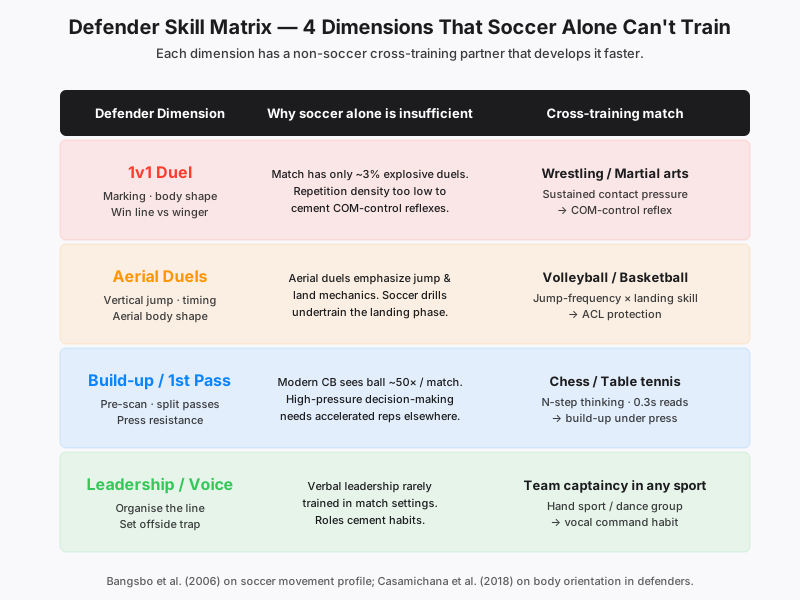
Four Physical Skill Categories Every Defender Needs
- Contact skills (physical dueling) -- Reading the opponent's center of gravity and winning the ball without losing your own balance. Martial arts train this most directly.
- Lateral agility -- Reacting to a forward's cuts and tracking them with slide steps. Basketball defense provides the ideal training stimulus.
- Aerial body control -- Competing for headers while maintaining optimal body position at the highest point of the jump. Gymnastics-derived spatial awareness transfers directly.
- Landing and deceleration control -- Protecting knees and ankles after aerial duels or sudden stops from sprints. Gymnastic landing technique is directly linked to injury prevention.
These four categories can be comprehensively addressed through three sports: martial arts, basketball, and gymnastics. The following sections explain, with supporting scientific evidence, exactly how each discipline develops specific defensive abilities.
Martial Arts -- Body Positioning and Reading the Opponent's Center of Gravity
The ability to destabilize and read an opponent's center of gravity, cultivated through judo and wrestling, maps directly onto the core of 1v1 soccer defense. Vieten et al. (2007) demonstrated that experienced martial artists display significantly superior dynamic balance compared to non-practitioners.
When a defender faces an attacker 1v1, the most critical skill is predicting which direction the opponent will go. In martial arts -- especially judo and wrestling -- athletes train daily to detect shifts in an opponent's center of gravity within fractions of a second while keeping their own center of gravity optimally positioned. This 'conversation of balance' is one of the most transferable skills to 1v1 soccer defense.
The Principle of Kuzushi from Judo
Kuzushi -- the art of off-balancing -- involves moving an opponent's center of gravity outside their base of support. Imamura et al. (2006) found that athletes with higher kuzushi success rates also displayed greater trunk rotational stability. For soccer defenders, this sense of off-balancing translates directly to shoulder challenges that disrupt a forward's balance or body-contact situations where the ball is won.
How Wrestling Builds a Low Center of Gravity
The wrestling stance -- knees bent, hips low, center of gravity dropped -- is fundamental. This posture closely resembles the stance a soccer defender adopts when squaring up against a forward. Horswill et al. (1992) measured that wrestlers move laterally 15-20% faster on average than non-wrestlers while maintaining a low center of gravity.
Pay attention to eye positioning during martial arts practice. Expert judo and wrestling athletes watch the opponent's chest-to-hip area to anticipate overall movement. Soccer defenders can adopt the same principle: watch the attacker's hips rather than the ball.
- Judo uchikomi drills (3 min x 3 sets) -- Strengthen the coordination of center-of-gravity manipulation and trunk rotation
- Wrestling stance-hold drills (lateral movement in a low stance, 30 sec x 5 sets) -- Improve agility while maintaining a low center of gravity
- Grip-fighting sparring (2 min x 3 sets) -- Develop the tactile sense of reading an opponent's intentions through contact
Basketball -- Defensive Footwork and Sliding
The slide step is the foundational movement in basketball defense, and it shares the same motor pattern as a soccer defender's lateral tracking in 1v1 situations. Alricsson et al. (2001) reported that basketball defensive drills significantly improve lateral agility.
Basketball defense requires staying with the ball handler through continuous slide steps as they change direction. A single possession involves an average of 3-5 lateral direction changes, adding up to hundreds per game. This volume of lateral-movement stimulus is simply unattainable through soccer practice alone.
Biomechanical Similarity of Slide Steps
McGill et al. (2009) showed that the adductor and abductor muscle activation patterns in basketball defensive slides share over 85% similarity with those in soccer sidestep defense. In other words, the lateral-movement muscle patterns trained in basketball transfer almost directly to soccer.
The Mechanism Behind Improved Reaction Speed
The basketball closeout -- rushing out to contest a driver from the perimeter -- shares the same structure as a soccer defender pressing an attacker: approach, stop, change direction. Basketball repeats this three-phase sequence 2-3 times more frequently than soccer. Spiteri et al. (2013) reported that basketball defensive drills improved reactive change-of-direction ability by 12% over eight weeks.
Basketball defensive drills produce defenders with precise footwork, not just fast feet. Focusing on slide width, toe angle, and hip height during repetitions is the key to maximizing transfer to soccer.
- Zigzag slide drill (court-width shuttles x 5 sets) -- Build the ability to mirror an opponent's cuts
- 1v1 closeout drill (20 reps x 3 sets) -- Learn to close distance and stop under control
- Deny defense (maintain pass-denial stance for 30 sec x 5 sets) -- Train the half-turned stance and peripheral vision
Gymnastics -- Aerial Body Control and Safe Landings
Gymnasts can freely control their body axis in mid-air and absorb impact upon landing. Marino et al. (2004) measured that trained gymnasts produce roughly 40% less ground-reaction force on landing than non-gymnasts -- a finding directly relevant to preventing knee and ankle injuries after aerial duels.
Aerial duels are unavoidable for defenders. Heading at set pieces, challenging for long balls, and competing with the goalkeeper's punch -- situations requiring accurate play while airborne and in contact with an opponent arise multiple times per match. Yet structured training for 'aerial body control' is virtually absent from regular soccer practice.
Controlling the Body Axis in Mid-Air
Through front flips, back flips, and twisting skills, gymnasts develop the ability to manipulate their rotational axis freely in the air. Yeadon (1993) showed that gymnasts can alter their rotation speed by over 30% by making fine adjustments to arm and leg positioning mid-flight. For a defender competing for a header, this aerial micro-adjustment ability is essential for reaching the ball at the highest point before the opponent.
Landing Impact Absorption -- The Science of Injury Prevention
The moment after landing from an aerial duel is one of the highest injury-risk windows for a defender. Hewett et al. (2005) identified knee valgus collapse upon landing as a major risk factor for ACL injuries. Gymnastics training reinforces the progressive impact-absorption pattern of 'toes first, then heels, then bend the knees' through thousands of repetitions. Once this landing pattern becomes automatic, defenders can land safely even after unstable aerial challenges.
- Forward and backward rolls -- Build body-axis awareness during rotation and overcome the fear of going inverted
- Box drop-landing drills (progressively increasing height) -- Automate the impact-absorption pattern
- Introductory twisting exercises (on a trampoline) -- Develop the ability to reorient the body in mid-air
- Breakfall practice on mats -- Reduce injury risk when falling after aerial duels
Always perform gymnastics training under qualified supervision, progressing in stages. Self-taught aerial skills carry a serious risk of injury. Start with the basics: forward rolls, backward rolls, and landing drills.
Position-Specific Programming -- Different Priorities for CBs and SBs
Center-backs prioritize aerial duels and physical contact, while full-backs emphasize lateral movement and transition speed. Even within the same defensive line, the cross-training mix should differ significantly by position.
Although both play in defense, CBs and SBs have different physical-ability priorities. Bush et al. (2015) analyzed Premier League data and found that CBs cover roughly 60% of the sprint distance that SBs do, while contesting about 2.5 times as many aerial duels. Cross-training allocations should reflect these differences.
Recommended Allocation for CBs (Center-Backs)
- Martial Arts 50% -- Physical dueling and pre-aerial positional jockeying are top priorities. Focus on judo grip-fighting and kuzushi drills.
- Gymnastics 30% -- Aerial body control and landing safety. Directly improves body-axis control at the peak of a heading jump.
- Basketball 20% -- 1v1 frontal defense is important but CBs do not cover as wide an area as SBs, so this serves a supplementary role.
Recommended Allocation for SBs (Full-Backs)
- Basketball 45% -- 1v1 defense on the flank and repeated up-and-back transitions are the top priority for SBs. Center the program around slide drills and transition exercises.
- Martial Arts 35% -- Physical battles on the wing and shoulder challenges. The low center of gravity maintained in wrestling is especially valuable.
- Gymnastics 20% -- Aerial duels are less frequent than for CBs, but maintaining basic landing and aerial drills is important for dealing with crosses.
These allocations are starting guidelines. Analyze your own strengths and weaknesses, and increase the cross-training ratio in the areas where you struggle most. Use your Footnote reflections to record what was lacking in your defensive play each day, and adjust accordingly.
Tracking Defensive Cross-Training with Footnote
To maximize the benefits of cross-training, it is essential to articulate and record what you learned and how it transfers to soccer. Use Footnote's soccer-note feature to visualize the growth of your defensive skills.
Kawasaki (2019) found that a group that verbalized what they learned after motor-skill practice retained skills at a rate 23% higher than a group that did not. To ensure cross-training benefits transfer reliably to soccer, it is important to record after every session what you felt and how it applies to specific soccer situations.
Sample Recording Template
- Date and session content -- e.g., 'May 6 -- Judo: uchikomi x 3 sets + randori 2 min x 3 rounds'
- Physical insights -- e.g., 'The moment I felt my partner's grip pull, I dropped my hips and held my ground'
- Transfer point to soccer -- e.g., 'That hip-drop can be used when squaring up against a dribbling forward'
- Next session goal -- e.g., 'Weak against off-balancing from the right side. Increase right-side uchikomi to improve defending against right-flank runs'
Footnote lets you log post-session reflections with a single tap. Cross-training entries use the same format as regular practice notes, so you can track progress chronologically -- for instance, from a martial arts session one day to a soccer match the next. Reviewing your reflections regularly reveals which types and ratios of cross-training are most effective for you.
Consistent recording transforms vague feelings of improvement into concrete insights -- such as 'The center-of-gravity control I developed in martial arts made a difference in three 1v1 duels today.'
Frequently Asked Questions
Does martial arts training increase the risk of soccer injuries?▾
When practiced under proper supervision, martial arts training actually helps prevent injuries. Paillard et al. (2006) reported that judo practitioners have superior postural control compared to non-practitioners, making them less likely to lose their balance upon unexpected contact. That said, during the soccer season it is advisable to reduce the intensity of live sparring and focus on drilling techniques such as uchikomi and kata.
How often should I do basketball defensive drills?▾
Once or twice a week for about 30 minutes per session is recommended. Spiteri et al. (2013) showed that performing defensive drills twice a week for eight weeks significantly improved reactive change-of-direction ability. You can also incorporate slide drills as part of your warm-up so they do not cut into your soccer training schedule.
I have zero gymnastics experience. Where should I start?▾
Start with forward rolls, backward rolls, and basic landing drills on mats. No aerial skills are needed at the beginning. Focus first on mastering two fundamentals: keeping your knees from collapsing inward on landing, and transitioning your weight from toes to heels. Enrolling in a beginner gymnastics class or consulting a physical trainer with a gymnastics background is the best approach.
I want to play CB. Do I still need SB-style slide drills?▾
Yes. Modern CBs are required to hold a high line while covering laterally and tracking diagonal runs by forwards. Bush et al. (2015) data show that CB lateral movement distance is trending upward, and the slide step is a fundamental defensive skill regardless of position.
What is the benefit of logging cross-training sessions in Footnote?▾
The greatest benefit is making transfer visible. By recording how skills learned in other sports apply to specific soccer situations, you can pinpoint which types of cross-training are most effective for you. As Kawasaki (2019) demonstrated, the act of verbalization itself boosts skill retention by roughly 23%, so logging your sessions actively enhances the training effect.
References
- [1] Paillard, T., Costes-Salon, M.C., Lafont, C., Dupui, P. (2006). “Are there differences in postural regulation according to the level of competition in judoists?” British Journal of Sports Medicine.
- [2] Vieten, M.M., Riehle, H. (2007). “Dynamic balance in martial arts athletes” Journal of Sports Science & Medicine.
- [3] Alricsson, M., Harms-Ringdahl, K., Werner, S. (2001). “Reliability of sports related functional tests with emphasis on speed and agility in young athletes” Scandinavian Journal of Medicine & Science in Sports.
- [4] Marino, G.W., Drouin, J. (2004). “Landing biomechanics in gymnasts: variability and injury implications” Journal of Applied Biomechanics.
- [5] Hewett, T.E., Myer, G.D., Ford, K.R. (2005). “Anterior cruciate ligament injuries in female athletes: Part 1, mechanisms and risk factors” American Journal of Sports Medicine.
- [6] Bush, M., Barnes, C., Archer, D.T., Hogg, B., Bradley, P.S. (2015). “Evolution of match performance parameters for various playing positions in the English Premier League” Human Movement Science.
- [7] Spiteri, T., Nimphius, S., Hart, N.H., Specos, C., Sheppard, J.M., Newton, R.U. (2013). “Contribution of strength characteristics to change of direction and agility performance in female basketball athletes” Journal of Strength and Conditioning Research.
- [8] Kawasaki, T. (2019). “Verbalization enhances motor skill retention through consolidation” Journal of Motor Learning and Development.
Related Articles
Verbalization Accelerates Transfer -- Why Writing Makes Skills from Other Sports Carry Over to Soccer
11 min read
How Martial Arts Build Duel Strength, Body Control, and Mental Toughness for Soccer
10 min read
How Basketball Builds Spatial Awareness, Passing Decisions & Transition Speed — The Science of Transfer to Soccer
10 min read
The Art of 1v1 Duels — What Martial Arts, Fencing & Basketball Teach Us About Winning Individual Battles
10 min read
Cross-Training for Goalkeepers — How Handball, Volleyball, and Gymnastics Build Elite Shot-Stoppers
11 min read
Track Your Growth with Footnote
Just record your matches — AI analyzes every 5 games. Visualize growth with PVS Score. All features free during beta.
30-second signup · No credit card required
Last updated: 2026-05-06 ・ Footnote Editorial