Cross-Training for Midfielders: How Chess, Tennis, and Basketball Sharpen Your Playmaking Brain
Great midfielders are said to "see what others can't." The real engine behind that ability is pattern-recognition speed and spatial awareness. de Groot (1965) found that chess grandmasters perceive board patterns five times faster than beginners, and Vestberg et al. (2012) reported that top-level soccer players score in the top 5% on design-fluency tests—a measure of executive function. Smeeton et al. (2004) further showed that tennis players' anticipation skills are on par with those of soccer players. Chess trains the ability to think several moves ahead; tennis sharpens omnidirectional reactions and rapid transitions; basketball cultivates passing creativity in tight spaces. Together, these three disciplines strengthen, from the ground up, a midfielder's power to dictate the game.
Beyond Technique: The Full Cognitive Profile of a Modern Midfielder
The modern soccer midfielder needs far more than ball-handling skill. What separates an average midfielder from an elite one is the cognitive ability to instantly read the structure of a match, anticipate several moves ahead, and continually make optimal decisions with 360-degree awareness.

Photo by Omar Ramadan on Unsplash
Midfielder training sessions typically devote most of their time to passing accuracy and ball control. Yet what truly determines a midfielder's match-day performance is cognition, not technique. A landmark study by Vestberg et al. (2012) showed that executive-function scores among Swedish top-league players clustered in the top 5% of the general population, with the most pronounced gap found among midfielders.
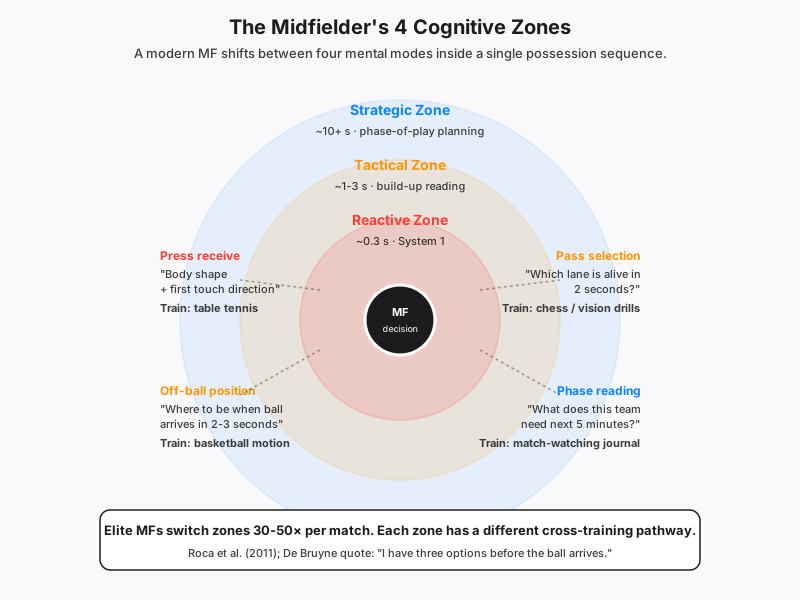
Four Cognitive Skill Categories Every Midfielder Needs
- Pattern Recognition — The ability to instantly chunk the positions of teammates, opponents, and open space on the pitch and match them against known patterns. Chess trains this most directly.
- 360-Degree Spatial Awareness — The ability to process information from all directions—including behind you—while on the ball and translate it into the best available play. Tennis provides the ideal stimulus for omnidirectional processing.
- Pass Creativity — The ability to discover unconventional passing lanes that break an opponent's expectations rather than relying on standard patterns. Basketball's tight-space passing links directly to this skill.
- Game-Tempo Management — The ability to deliberately speed up or slow down play depending on the match situation, controlling the rhythm for the entire team. Chess-style time-management thinking transfers naturally here.
These four categories can be comprehensively covered by three activities: chess, tennis, and basketball. It is worth noting that one of the three—chess—is a purely mental exercise, not a physical one. Improving as a midfielder requires not just "body training" but also "brain training."
Chess: Pattern Recognition and Game Management
Since de Groot's (1965) pioneering research, chess-based pattern recognition has been a central topic in cognitive science. Grandmasters can read a position in five seconds because they have stored roughly 50,000 chunk patterns in memory. This "chunking" mechanism operates identically to the way a soccer midfielder processes a match.
When a grandmaster and a beginner look at the same board, the beginner processes each piece one by one, while the grandmaster instantly recognizes clusters of three to five pieces as single "chunks." Simon & Chase (1973) estimated the number of these chunks at roughly 50,000. When a soccer midfielder scans the pitch and simultaneously registers "the right flank is open," "the press is coming through midfield," and "the defensive line is high," the underlying cognitive process is the same chunking mechanism at work in chess.
Thinking Ahead: Training to Predict Two Moves in Advance
Chess constantly demands forward thinking: "If I make this move, how will my opponent respond, and what will I do next?" Holding (1985) showed that intermediate players accurately read two to three moves ahead, while advanced players manage four to five. For a soccer midfielder, predicting "If I play this pass, where will the forward move, how will the defender react, and where will the second ball drop?" two or three moves ahead is the core skill for controlling the flow of a match.
Controlling Tempo: The Time-Management Mindset
Clock-management strategy in chess maps surprisingly well onto game-tempo management in soccer. In the opening you move quickly, following established patterns; in the complex middle game you invest time in deep calculation; in the endgame you balance remaining time against efficient decisions. This framework of "when to go fast, when to go slow" transfers directly as a mental model for the midfielder controlling match tempo.
- Play online chess (5-min blitz or 15-min rapid) 3–4 times per week to sharpen pattern-recognition speed and forward-thinking ability
- Solve tactics puzzles (10–15 per day) to strengthen the "chunking" skill of instantly grasping relationships among multiple pieces
- Review each game briefly (5-min post-game analysis) to build the habit of verbalizing alternative moves: "Was there a better option in that position?"
Chess practice fits into commute time or rest days without interfering with physical training. Free platforms like Lichess make it easy to start with just 15 minutes a day.
Tennis: 360-Degree Awareness and Transition Speed
Tennis players simultaneously process ball trajectory, opponent body position, and open court space, selecting a shot within 0.5 seconds. Smeeton et al. (2004) demonstrated that the anticipation abilities of tennis players are on par with those of soccer players, providing evidence for the cross-sport transfer of perceptual-cognitive skills.
Tennis is one of the few sports that demands true omnidirectional response. Serves, returns, baseline rallies, net play, lob defense—you must handle balls from every angle while constantly searching for open space on the opponent's side of the court. This "omnidirectional information processing" closely mirrors the cognitive load a midfielder faces when operating in the center of the pitch.
Anticipation and Forward Reading: Decoding Body Language
Abernethy & Russell (1987) demonstrated that expert tennis players can predict ball direction from pre-contact cues—racket backswing, shoulder angle, foot orientation. This "anticipation from body language" is the same cognitive process a soccer midfielder uses to read an opponent's passing lane or dribbling direction. In tennis, this anticipation cycle occurs an average of four to six times per point, enabling a high volume of prediction training in a short time.
Faster Offensive-Defensive Transitions
During a tennis rally, the switch from an attacking shot (a powerful forehand) to a defensive shot (a lob) can happen in 0.5 to 1 second. O'Donoghue & Ingram (2001) found that top players execute over 200 offensive-defensive transitions per match on average. The rapid toggling a midfielder needs—possession to counter-attack, pressing to retreating—can be trained with exceptional efficiency through tennis transitions.
- Mini-tennis (rallying inside the service box) to sharpen reaction speed and directional prediction in tight spaces
- Volley-volley drills (close-range rallies at the net) to train sub-0.3-second decision-execution coupling
- Random-feed drills (coach varies ball direction without warning) to improve reactive ability to stimuli from all directions
Tennis lateral movement—split step into side step—mirrors the preparation movement a midfielder makes just before receiving the ball. Use tennis to ingrain the "stop, then explode" rhythm into your body.
Basketball: Passing Creativity and Court Vision
Passing in basketball's congested space is the most efficient way to develop a midfielder's ability to discover "invisible" passing lanes. Memmert's (2006) attentional-focus framework showed that overcoming inattentional blindness is the key to creativity.
A basketball court packs ten players into a 28 m × 15 m area. Threading an accurate pass through that density requires the ability to instantly spot gaps in the defense, anticipate teammate movement, and choose a pass that defeats the opponent's expectations. Memmert & Roth (2007) demonstrated that creative play ability transfers significantly across invasion games—basketball, soccer, and handball.
No-Look Passes and Gaze Manipulation
Advanced basketball players routinely use the no-look pass—delivering the ball without looking at the target. The essence of the technique is deceiving defenders with your gaze while using peripheral vision to locate the passing lane. Ryu et al. (2013) showed that basketball players are significantly better than soccer players at extracting information from peripheral vision. For a midfielder, this combination of "gaze faking" and "peripheral-vision use" can dramatically improve the accuracy of through balls and switches of play.
Pick-and-Roll = The Wall Pass in Soccer
Basketball's fundamental pick-and-roll tactic—using a screen to free a teammate from their marker, then delivering the pass—is structurally identical to soccer's wall pass (give-and-go). Screen angle, roll timing, and reading the defender's reaction all transfer directly. With over 50 pick-and-rolls occurring in a single basketball game, you get massive repetition of wall-pass decision-making.
- 3-on-2 half-court games to rapidly repeat passing decisions in numerical-advantage situations
- No-look pass drills (deliver the ball with your gaze locked on a fixed point) to train peripheral vision and gaze manipulation
- 2-on-2 pick-and-roll drills to sharpen wall-pass decision speed and timing
- 3-on-2 full-court fast breaks to develop passing judgment in transition situations
Basketball is soccer in miniature. By spinning your decisions faster on a small court, everything feels like slow motion when you return to the pitch.
— European academy coach, interview
Position-Specific Programming: Different Priorities for DMs and AMs
DMs prioritize game management and pattern recognition; AMs prioritize creativity and transition speed. Even within the midfielder role, the cross-training mix should vary clearly by position.
Cognitive demands differ significantly between DMs (defensive midfielders) and AMs (attacking midfielders). Bradley et al.'s (2009) Premier League analysis found that DMs average about 30% more passes per match than AMs, distributed evenly across all 360 degrees. AMs, on the other hand, show a higher proportion of forward passes and dribbles, with roughly twice as many creative 1-v-1 breakthrough situations as DMs.
Recommended Mix for DMs (Defensive Midfielders)
- Chess 45% — A bird's-eye view of the entire match and the pattern recognition to sense danger before it materializes are a DM's most critical abilities. Chess clock-management thinking maps directly onto tempo control.
- Basketball 35% — Distributing the ball across all 360 degrees and recycling possession quickly after a turnover are a DM's lifeblood. Basketball's ball-distribution skills transfer directly.
- Tennis 20% — Used to sharpen reaction speed during ball recovery and the defensive-to-offensive transition. A supporting but important role.
Recommended Mix for AMs (Attacking Midfielders)
- Basketball 40% — Passing creativity in congested zones and no-look deliveries are what set AMs apart. Pick-and-roll judgment directly elevates the quality of give-and-go play.
- Tennis 35% — Directly supports omnidirectional play in tight spaces around the final third and the explosive transition speed needed on the counter-attack.
- Chess 25% — Reading defensive formations and instantly selecting how to break them down. Even AMs cannot do without forward-thinking ability.
DMs are judged on "decisions that prevent the game from falling apart"; AMs are judged on "decisions that win the game." Even within the same pattern-recognition skill, DMs lean toward threat detection while AMs lean toward chance creation. Decide which mindset to practice in chess, and the training effect shifts accordingly.
Tracking Cognitive Growth in Footnote
Because a midfielder's cognitive skills are hard to see, verbalizing and recording them matters all the more. Logging "what you noticed, what you decided, and what happened" in Footnote makes your cognitive growth visible over time.
Kawasaki (2019) found that a group that verbalized what they learned after motor-skill practice retained 23% more skill the next day than a group that did not. Unlike physical changes like increased sprint speed or shot power, cognitive gains such as "reading the game more deeply" or "seeing more passing options" are hard to notice on your own. Continuous recording in Footnote makes these gains tangible and sustains motivation.
Cognitive Skill Recording Template
- Date & Activity — e.g., "May 6 — Chess: 5 blitz games + 15 tactics puzzles"
- Cognitive Takeaway — e.g., "Spotted an opponent's knight fork three moves in advance and prevented it"
- Transfer Point to Soccer — e.g., "The feeling of reading intentions two moves ahead applies to predicting press direction and securing a passing lane"
- Match Application — e.g., "In today's match I read the opposing DM's positioning and chose a through ball behind the line. It felt like the same board-scanning process as chess"
Footnote lets you place cross-training logs and soccer match or practice logs on the same timeline for easy review. You can start discovering cause-and-effect relationships yourself, such as "the week after I drilled forward thinking in chess, my through-ball success rate went up."
A midfielder's growth should be measured by "what you can see now that you couldn't before." Keep recording what you noticed and what you missed in Footnote, and your cognitive map will steadily expand.
Frequently Asked Questions
Chess isn't a sport. Can it really help my soccer performance?▾
Yes, and the evidence is robust. Vestberg et al. (2012) found a significant correlation between soccer performance and executive function (cognitive test scores). Chess is one of the most efficient activities for training executive function—especially pattern recognition, forward thinking, and working memory. By exercising the "mental muscles" that physical training can't reach, chess improves both the speed and quality of your decisions on the pitch.
I've never played tennis. Where should I start?▾
Start with mini-tennis—rallying inside the service box. Full-court technique is unnecessary. The skills you want to transfer to midfield play are "omnidirectional reaction speed" and "fast offensive-defensive transitions," both of which can be trained effectively through close-range mini-tennis rallies. Even 30 minutes once a week for two to three months should produce a noticeable difference in your on-pitch reactions.
Will basketball training hurt my soccer fitness?▾
Not if you manage the load properly. Cross-training basketball for midfielders is not about playing extended full-court games; the focus is on half-court passing-decision drills and 3-on-2 mini-games. At one to two sessions per week of 20–30 minutes each, it will not encroach on your soccer training plan or place excessive stress on your knees and ankles.
I want to play DM. What chess rating should I aim for?▾
You don't need to chase a rating. What matters is the volume of pattern-recognition reps. Playing five blitz games (5-minute) a day on Lichess plus 10–15 tactics puzzles, sustained over three months, accumulates roughly 500 competitive games and over 1,000 pattern-learning problems. That volume of repetition is what shows up as faster pattern recognition on the pitch.
What's the benefit of logging cross-training in Footnote?▾
For midfielders, the biggest benefit is making cognitive growth visible. Unlike physical gains—running faster, shooting harder—cognitive gains like "reading the game more deeply" or "spotting more passing lanes" are difficult to notice in the moment. By recording consistently in Footnote, you can look back three months later and see concretely what you can see now that you couldn't before.
References
- [1] de Groot, A.D. (1965). “Thought and Choice in Chess” Mouton Publishers.
- [2] Simon, H.A., Chase, W.G. (1973). “Skill in chess” American Scientist.
- [3] Vestberg, T., Gustafson, R., Maurex, L., Ingvar, M., Petrovic, P. (2012). “Executive functions predict the success of top-soccer players” PLoS ONE.
- [4] Smeeton, N.J., Ward, P., Williams, A.M. (2004). “Do pattern recognition skills transfer across sports? A preliminary analysis” Journal of Sports Sciences.
- [5] Memmert, D., Roth, K. (2007). “The effects of non-specific and specific concepts on tactical creativity in team ball sports” Journal of Sports Sciences.
- [6] Abernethy, B., Russell, D.G. (1987). “Expert-novice differences in an applied selective attention task” Journal of Sport Psychology.
- [7] Bradley, P.S., Sheldon, W., Wooster, B., Olsen, P., Boanas, P., Krustrup, P. (2009). “High-intensity running in English FA Premier League soccer matches” Journal of Sports Sciences.
- [8] Kawasaki, T. (2019). “Verbalization enhances motor skill retention through consolidation” Journal of Motor Learning and Development.
Related Articles
Verbalization Accelerates Transfer -- Why Writing Makes Skills from Other Sports Carry Over to Soccer
11 min read
How Chess Transfers Tactical Thinking, Anticipation, and Pattern Recognition to Soccer
10 min read
Tennis × Soccer — The Science Behind How Anticipation, Footwork, and Rotational Movement Transfer to the Pitch
11 min read
How Basketball Builds Spatial Awareness, Passing Decisions & Transition Speed — The Science of Transfer to Soccer
10 min read
Cross-Training for Forwards — How Track & Field, Martial Arts, and Fencing Sharpen a Striker's Edge
11 min read
Track Your Growth with Footnote
Just record your matches — AI analyzes every 5 games. Visualize growth with PVS Score. All features free during beta.
30-second signup · No credit card required
Last updated: 2026-05-06 ・ Footnote Editorial