Cross-Training for Forwards — How Track & Field, Martial Arts, and Fencing Sharpen a Striker's Edge
Scoring goals demands far more than raw speed. Faude et al. (2012) found that 83% of Bundesliga goals originated from sequences of three or fewer actions, with the decisive factors being sprinting, positioning, and one-on-one duels with defenders. Track & field develops explosive acceleration, martial arts builds the body-control skills needed inside the box, and fencing sharpens the split-second timing of runs behind the defensive line — this guide explains how these three disciplines strengthen a forward's arsenal, grounded in sports-science research.
What Makes Elite Forwards Special — The Science of Scoring
Faude et al. (2012) analyzed 360 Bundesliga goals and showed that the actions directly leading to goals fall into three categories: sprinting (45%), precise positioning (31%), and one-on-one duels (22%). Each of these elements can be trained most efficiently through a different sport.

Photo by Jannes Glas on Unsplash
Breaking down a forward's skill set reveals demands that differ markedly from other positions. While midfielders are expected to sustain performance throughout the full 90 minutes, forwards must deliver explosive output in the handful of decisive moments that arise during a match. Faude et al. (2012) conducted a video analysis of every Bundesliga goal and quantified exactly what happens in the final phase before the ball hits the net.
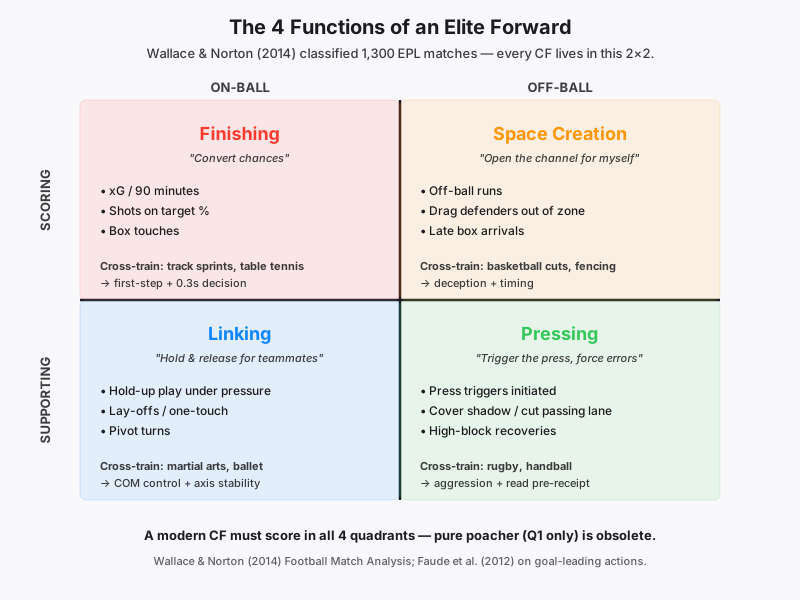
Three Abilities That Produce Goals
- Explosive sprinting — The acceleration over the first 0–10 m that gets you behind the defender. According to Haugen et al. (2014), most match-deciding sprints in soccer cover less than 30 m, and it is the first five steps that determine the outcome
- Box positioning — The ability to secure an advantageous position while in physical contact with a defender. Whether you get to the cross before your marker is decided by raw physical gamesmanship
- Timing of runs behind the line — Reading gaps in the defensive line and launching at the precise instant that avoids offside. The combination of this 'read' and the quality of the first step is what converts a through ball into a goal
The crucial insight is that these three elements depend on distinct physical and cognitive capacities. Explosive sprinting is best trained through track & field short-distance work, box positioning through martial arts, and run timing through fencing. Rather than vaguely dabbling in 'other sports,' forwards should choose cross-training disciplines that address their position-specific challenges.
A forward's scoring ability is not 'talent' — it is a composite of three trainable skills. And none of the three can be developed efficiently through soccer practice alone.
Track & Field — Explosive Acceleration and Sprint-Form Optimization
Haugen et al. (2014) demonstrated that a soccer player's sprint performance correlates strongly with the acceleration-phase technique used in short-distance track events. Adopting sprint-start mechanics and acceleration drills from track & field can fundamentally transform a forward's first-step speed.
For a forward, sprinting is not about sustaining pace for 90 minutes — it is about covering a few explosive meters to beat a defender in an instant. Track & field's short-distance events offer the most systematized approach to training this kind of burst speed. Haugen et al. (2014), in their sports-science review, identified acceleration-phase biomechanics as the single strongest predictor of sprint performance in soccer.
Three Elements Forwards Should Learn from Track & Field
- Start posture and forward lean — The forward lean drilled in a track sprint start translates directly to the first step of a run behind the defense. Tilting the torso to roughly 45 degrees and driving the ground backward generates maximum acceleration in the fewest possible steps
- Stride efficiency (minimizing ground-contact time) — Weyand et al. (2000) showed that what separates fast sprinters is not stride length but shorter ground-contact time. The same principle applies to a forward's sprint: consciously reducing the time each foot spends on the ground is the key to unlocking greater speed
- Converting arm swing into propulsion — Track athletes generate 10–15% of their propulsive force through arm action. During soccer training, attention is focused on ball handling and arm mechanics tend to be neglected; learning proper arm-swing form through track work produces a noticeable improvement in sprint speed
In practice, the ideal setup is one sprint-drill session per week (10 m x 6–8 reps, 30 m x 4–6 reps) under the guidance of a track coach. The acceleration technique within the first three steps, in particular, falls within the specialized expertise of track coaches rather than soccer coaches. Cometti et al. (2001) confirmed that individual differences in soccer players' 10 m sprint times are largely attributable to the quality of their acceleration technique.
It is not the fastest player who scores — it is the player whose first five steps are fastest. And the quality of those five steps is something track & field can teach.
— Summary based on sprint-science research
Martial Arts — Box Positioning and Body Control
Paillard et al. (2006) demonstrated that experienced martial artists possess superior dynamic balance. Inside the penalty area, where physical contact is unavoidable, the skill of securing an advantageous position while leaning into a defender is structurally identical to grappling technique in martial arts.
Play inside the penalty area is the closest thing in soccer to hand-to-hand combat. Jostling with a defender to get first contact on a cross, shaking off a marker at set pieces, holding off a defender with your back to goal before turning to shoot — all of these depend on the ability to position your body advantageously while in contact with an opponent.
Specific Skills Martial Arts Transfer to Forwards
- Low-center-of-gravity shielding — The principle of judo's off-balancing (kuzushi): keeping your center of gravity lower than your opponent's gives you stability against being pushed off the ball. This weight management transfers directly to a forward holding up play with a defender on their back
- Core stability under contact — The grappling skill from wrestling: maintaining a rigid core while bodies are pressed together. This transfers to heading accuracy when you leap for a cross while a defender pushes into you
- Winning position through push-and-pull — The technique cultivated in sumo and judo of 'using your opponent's force to reposition yourself.' Inside the box, you read the direction of the defender's pressure and ride that force to shift into a more favorable position
Bernards et al. (2017) reported that martial-arts training improves self-efficacy and stress tolerance. For a forward, this matters on a mental level as well — staying composed in the congested goalmouth area. Being surrounded by multiple defenders inside the penalty area without flinching, and continuing to seek the optimal position, requires a deep familiarity with physical contact. Martial arts provides the most systematic form of 'desensitization to contact.'
Forwards who score inside the box are not simply 'more skillful' — they move their bodies differently. Martial arts is the most efficient way to teach that difference.
Fencing — Timing Runs Behind the Line and Explosive First Steps
Williams & Walmsley (2000) demonstrated that experienced fencers have significantly faster reaction times than non-experts. The 'timing read' needed to break through the defensive line and the 'explosive first step' that follows are structurally identical to the lunge in fencing.
A forward's run behind the defense shares a striking structural resemblance with a fencing attack. In fencing, you read an opening in your opponent's guard and launch a lunge the instant you enter striking range. A forward likewise reads a gap in the defensive line and triggers a sprint at the precise moment that avoids offside. In both cases, the speed of the 'read, decide, first step' sequence determines success or failure.
Three Abilities Fencing Sharpens for Forwards
- Reading timing — In fencing you gauge the moment to attack by watching the tip of your opponent's blade, their weight shifts, and their breathing rhythm. A forward reads a defender's eye movement, stepping rhythm, and the sway of the defensive line to time a run. As Williams & Walmsley (2000) showed, this 'reading' is a cognitive skill that improves with training
- Explosive lunge power — The fencing lunge drives off the rear leg and extends the front leg forward in a sudden thrust. Roi & Bianchedi (2008) reported that this movement simultaneously develops lower-limb explosive power and reaction speed — the same neuro-muscular recruitment pattern used in a forward's first step when breaking free
- Feinting technique — In fencing you fake a movement to draw your opponent's reaction, then strike in the opposite direction. The diagonal runs and check runs a forward uses against defenders (pulling short before sprinting deep) are structurally identical to the fencing sequence of feint followed by attack
Particularly noteworthy is how short the decision-to-movement interval is in fencing. Williams & Walmsley (2000) found that expert fencers significantly outperform non-experts in choice reaction time — selecting the correct response from multiple options and executing it. This maps directly to a forward's ability to decide in an instant whether to make the run or hold, and to move the body immediately after that decision.
A fencing touch is completed in 0.3 seconds. Whether a forward's run behind the line succeeds is also decided in 0.3 seconds. Fencing is what trains the quality of that 0.3-second window.
— Summary of shared structures between fencing and soccer
Position-Specific Programs — Optimal Menus for Center Forwards vs. Wingers
Center forwards and wingers have different priority demands. Center forwards should emphasize martial arts and the acceleration phase of sprinting, while wingers should focus on top-speed maintenance from track & field and distance management from fencing — tailoring cross-training to positional characteristics maximizes transfer effects.
Lumping all forwards together misses the fact that center forwards (CFs) and wingers face distinct in-match demand profiles. Customizing cross-training to match these differences maximizes the transfer effect.
Optimal Menu for Center Forwards (CFs)
- Top priority: Martial arts (once a week, 60 min) — The position with the most defender contact. Judo or wrestling develops the center-of-gravity control and contact tolerance needed for aerial and ground duels inside the box
- Second priority: Track sprints (once a week, 30 min) — Focused on sub-10 m short-distance acceleration. The explosive power of the first 3–5 steps dictates a CF's success rate when running behind the line
- Third priority: Fencing (twice a month, 45 min) — Develops the timing sense to read gaps in the defensive line. The lunge movement improves first-step quality
Optimal Menu for Wingers (WG/SH)
- Top priority: Track sprints (once a week, 40 min) — The 20–30 m mid-distance sprint and top-speed maintenance are the winger's battleground. Beating a fullback down the flank requires outright top-end speed
- Second priority: Fencing (once a week, 45 min) — The ability to control distance in one-on-one situations against a side back. Using feints to unbalance the defender before accelerating past maps directly to fencing's 'engagement and deception' framework
- Third priority: Martial arts (twice a month, 45 min) — Contact frequency is lower than for CFs, but martial arts provides a useful foundation for body-control when cutting inside or contributing to hold-up play
The key is not to start everything at once. Begin with the one discipline where you feel the greatest need, confirm its effect over two to three months, and then layer in the next — a phased approach is recommended.
Recording Forward Cross-Training with Footnote
To maximize the impact of cross-training as a forward, it is essential to log insights from each discipline in terms of which scoring skill they transfer to — acceleration, positioning, or timing. Footnote's recording flow naturally encourages this kind of articulation.
When logging cross-training as a forward, categorizing notes under the three goal-scoring pillars — acceleration, positioning, and timing — makes transfer points immediately clear.
Example Entries for Forwards
- After a track session — 'Worked on 10 m sprint drills. Got the feel of maintaining a forward lean on the first step. Next practice I will apply this lean angle when sprinting behind the defense.'
- After a martial-arts session — 'In judo randori, I learned to rotate my hips to change body direction when being pushed. The same principle applies to turning to shoot while shielding the ball from a defender on a cross.'
- After a fencing session — 'The lunge takes 0.3 seconds from rear-leg push-off to front-foot landing. I want to bring this feeling of closing distance in an instant to my runs behind the defensive line.'
- Applying it in soccer practice — 'Tried the forward-lean start from track when making a run in behind. I was a half-step ahead of the defender twice. But I leaned too far and lost sight of the ball once — need to add a cue to keep my head up.'
Footnote's AI analysis, triggered every five matches, detects correlation patterns between cross-training entries and performance indicators such as goals, shots, and involvement in clear-cut chances. Trends like 'self-rated sprint metrics improved in weeks that included track drills' or 'hold-up play success rate rose after martial-arts sessions' make it objectively clear which cross-training combination works best for you.
Great strikers dominate the single second that matters in front of goal. Building that second — its acceleration, body control, and timing — by articulating what other sports teach you is the essence of forward cross-training.
Frequently Asked Questions
Can a forward only score if they are fast?▾
Straight-line top speed alone does not determine scoring ability. Faude et al. (2012) showed that the decisive factors are acceleration over the first 5–10 m and positioning. Even a slower forward can dramatically improve their scoring output by refining acceleration technique and mastering body control inside the box. Training the acceleration phase through track & field and positioning through martial arts makes it possible to build goal-scoring patterns that do not rely on top-end speed.
Do youth forwards need all three sports from the start?▾
There is no need to begin all three at once. For younger children, the top priority is having fun while experiencing a variety of movements. Start with a running clinic that teaches the basics of sprinting form; add martial arts (judo is a good entry point) in middle school; and progress to the more specialized distance-management training of fencing in high school. A phased approach like this is both practical and effective.
Is there a risk of getting injured in martial arts and missing soccer matches?▾
Under proper supervision, the risk in martial arts is manageable. For soccer cross-training purposes, limit sessions to kata (forms), breakfalls, and basic grappling drills rather than full-contact sparring — this keeps injury risk to a minimum. Scheduling is also important: avoid contact-based training in the week before a match. Judo breakfalls, incidentally, are also effective in preventing injuries from falls during soccer itself.
What are alternatives if there is no fencing club nearby?▾
The core skills fencing develops are 'reading timing' and 'an explosive first step.' Table tennis (reaction speed and anticipation) and badminton (lunge mechanics and direction changes) offer similar transfer effects. Tag games and tag rugby can also train the ability to read an opponent's movement and launch instantly. What matters is not the sport itself but the awareness of which capacity you are training.
How can I track forward cross-training results in Footnote?▾
Log your cross-training sessions in Footnote's practice records, noting the content and the intended transfer point. Once you have accumulated data from five matches, the AI will analyze correlations between cross-training activity and performance metrics — goals scored, sprint self-assessment, confidence in box play, and more. This makes it objectively clear which types and frequencies of cross-training are most effective for you.
References
- [1] Faude, O., Koch, T., & Meyer, T. (2012). “Straight sprinting is the most frequent action in goal situations in professional football” Journal of Sports Sciences, 30(7), 625–631. Link
- [2] Haugen, T. A., Tonnessen, E., Hisdal, J., & Seiler, S. (2014). “The role and development of sprinting speed in soccer” International Journal of Sports Physiology and Performance, 9(3), 432–441. Link
- [3] Weyand, P. G., Sternlight, D. B., Bellizzi, M. J., & Wright, S. (2000). “Faster top running speeds are achieved with greater ground forces not more rapid leg movements” Journal of Applied Physiology, 89(5), 1991–1999.
- [4] Cometti, G., Maffiuletti, N. A., Pousson, M., Chatard, J. C., & Maffulli, N. (2001). “Isokinetic strength and anaerobic power of elite, subelite and amateur French soccer players” International Journal of Sports Medicine, 22(1), 45–51. Link
- [5] Paillard, T., Noe, F., Riviere, T., Marion, V., Montoya, R., & Dupui, P. (2006). “Postural performance and strategy in the unipedal stance of soccer players at different levels of competition” Journal of Athletic Training, 41(2), 172–176.
- [6] Williams, L. R. T. & Walmsley, A. (2000). “Response timing and muscular coordination in fencing: A comparison of elite and novice fencers” Journal of Science and Medicine in Sport, 3(4), 460–475.
- [7] Roi, G. S. & Bianchedi, D. (2008). “The science of fencing: Implications for performance and injury prevention” Sports Medicine, 38(6), 465–481. Link
- [8] Bernards, J. R., Sato, K., Haff, G. G., & Bazyler, C. D. (2017). “Current research and statistical practices in sport science and a need for change” Sports, 5(4), 87. Link
Related Articles
Verbalization Accelerates Transfer -- Why Writing Makes Skills from Other Sports Carry Over to Soccer
11 min read
How Track and Field Transfers Sprint Speed, Agility, and Endurance to Soccer
11 min read
How Martial Arts Build Duel Strength, Body Control, and Mental Toughness for Soccer
10 min read
The Science of How Fencing Transfers Spatial Awareness, Reaction Speed, and 1v1 Tactics to Soccer
12 min read
Cross-Training for Defenders -- How Martial Arts, Basketball & Gymnastics Build a Stronger Defensive Foundation
10 min read
Track Your Growth with Footnote
Just record your matches — AI analyzes every 5 games. Visualize growth with PVS Score. All features free during beta.
30-second signup · No credit card required
Last updated: 2026-05-06 ・ Footnote Editorial