Cross-Training During Injury — Evidence-Based Strategies to Turn Rehab into a Growth Period
Injury is one of the toughest experiences a player can face, but with scientifically designed cross-training, the time away from the pitch can become an accelerated growth period rather than a setback. Mujika & Padilla (2000) reported that VO2max drops by 6–20% after just two to four weeks of complete rest; however, alternative training can minimize this decline. Podlog & Eklund (2006) further showed that players who engaged in cognitive training and structured goal-setting during injury often performed at a higher level upon return. By preserving cardiovascular fitness through swimming and cycling, sharpening cognitive skills through chess and video analysis, and maintaining muscle strength through non-affected-limb training, injured players can make the most of their recovery period. This guide lays out the cross-training strategy with full scientific backing.
Injury as a Hidden Growth Opportunity
Podlog & Eklund (2006) reported that players who proactively designed their return-from-injury process sometimes exceeded their pre-injury performance levels. How you spend your time while injured can shape the trajectory of your entire career.

Photo by Ortopediatri Çocuk Ortopedi Akademisi on Unsplash
The moment an injury strikes, most players are gripped by the fear of falling behind their teammates. Yet sport-psychology research consistently shows that players who strategically use their time away from the pitch often leap forward after returning.
Why Growth Is Possible While Injured
- Time opens up for training you normally skip — Hours previously consumed by practices and matches become available for addressing weaknesses you've been putting off: video analysis, cognitive training, and strengthening non-injured body parts
- Cognitive skills improve regardless of physical status — Tactical understanding, spatial awareness, and decision speed can all be trained without moving a muscle. Vestberg et al. (2012) demonstrated that executive function correlates with on-pitch soccer performance, and injury downtime is the perfect window to build these cognitive capacities
- Mental resilience gets forged in adversity — The process of facing and overcoming injury fundamentally strengthens mental toughness. Podlog & Eklund (2006) documented this psychological growth as 'adversarial growth'
The key mindset shift is moving from 'I can't do anything while injured' to 'I can do things now that I couldn't before.' As Mujika & Padilla (2000) demonstrated, complete rest leads to rapid declines in physical capacity. But with appropriate alternative training, the majority of cardiovascular fitness, strength, and cognitive skills can be maintained — and some can even be improved.
What injury takes away is soccer practice time, not growth time. Understanding precisely what you lose and what you can still develop is the starting point for designing effective training during injury.
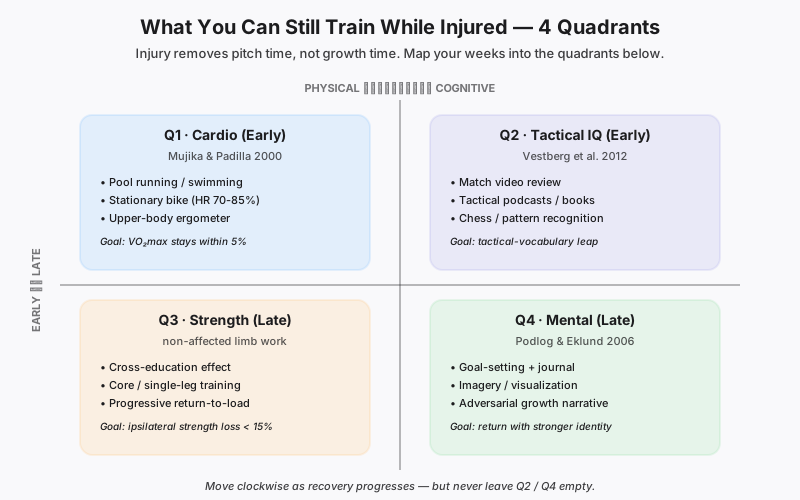
Maintaining Cardiovascular Fitness — How Swimming and Cycling Protect Your Aerobic Base
According to Mujika & Padilla (2000), completely stopping training can reduce VO2max by up to 20% within two to four weeks. Swimming and cycling keep cardiovascular fitness intact while placing minimal stress on the lower limbs, making them ideal alternatives during injury.
Cardiovascular fitness (VO2max) is the foundation of every soccer player's game. When it drops, you can't keep up with the pace of play and your decision-making deteriorates — because fatigue directly impairs cognitive function. Mujika & Padilla's (2000) comprehensive review in Sports Medicine examined both the rate of cardiovascular decline during complete rest and the effectiveness of alternative training in preserving fitness.
Swimming — Adaptable for Both Upper- and Lower-Body Injuries
Buoyancy offloads roughly 90% of body weight, making swimming viable for nearly every type of lower-limb injury. Tanaka (1994) found that athletes who replaced running with aquatic training maintained VO2max at levels comparable to those who continued land-based training.
- Ankle or knee injury — Use a pull buoy (a flotation device placed between the legs) to swim with the upper body only. Keeping heart rate at 70–85% HRmax preserves aerobic capacity
- Hip or lower-back injury — Start with pool walking and progress to swimming as pain allows. Water resistance maintains whole-body muscular endurance
- Upper-limb injury (shoulder, arm) — Use a kickboard and swim with the legs only. Kicking in the water is effective for maintaining soccer-relevant lower-body muscular endurance
Cycling — Maintaining Cardiovascular Fitness Without Joint Impact
Cycling produces roughly one-third the knee-joint impact of running, making it an option from the early stages of rehabilitation for many lower-limb injuries. A stationary bike eliminates the risk of falls and allows precise heart-rate control during training.
- LISS (Low-Intensity Steady State) — 30–45 minutes at 60–70% HRmax. Ideal for maintaining the aerobic base and can be started in the earliest phase of recovery
- HIIT (High-Intensity Interval Training) — After medical clearance, 30 seconds all-out + 90 seconds recovery for 6–8 sets. Replicates the intermittent exertion pattern of a soccer match
Players who maintain cardiovascular fitness during injury regain match-level fitness two to four weeks faster than those who rest completely. That gap can determine who wins the positional battle when you return.
Cognitive Training — Chess, Video Analysis, and Mental Rehearsal
Vestberg et al. (2012) demonstrated that executive functions — attentional control, working memory, and cognitive flexibility — correlate significantly with on-pitch soccer performance. Injury provides the ideal window to intensively develop these cognitive capacities, which require no physical movement at all.
Soccer decision-making — when to pass, where to position yourself, what the opponent will do next — depends on the brain's executive functions. And these functions can be improved without ever stepping onto a pitch. By investing in cognitive training during injury, you can ensure that when your body is ready to return, your 'mental fitness' already exceeds its pre-injury level.
Chess — Building Spatial Awareness and Anticipation
Burgoyne et al. (2016) confirmed the correlation between chess performance and fluid intelligence — the ability to solve novel problems. The spatial awareness required to read an entire board and the planning ability to think three to five moves ahead transfer directly to positioning decisions and pass-sequence anticipation in soccer. Adding just 15–30 minutes of online chess per day to your injury routine can yield meaningful benefits.
Video Analysis — Studying Yourself and Your Opponents
During the regular season, training and match schedules leave little time for in-depth video review. Injury opens up the perfect opportunity to commit to serious film study. Review your own past match footage to objectively analyze positioning, timing of movement, and decision quality. Study professional matches, focusing on players in your position — this deepens tactical understanding in ways that simply playing cannot.
Motor Imagery (Mental Rehearsal)
Schuster et al.'s (2011) meta-analysis confirmed that motor imagery training — mentally rehearsing movements in vivid detail — is effective for both maintaining and improving actual motor skills. By mentally rehearsing dribbling, shooting, and passing sequences during injury, you prevent neural pathway degradation and accelerate skill recovery upon return. Focused imagery sessions of 10–15 minutes per day are recommended.
Injury stops the body but it doesn't have to stop the brain. Sharpen cognition with chess, refine tactical vision through video analysis, and preserve neural pathways with mental rehearsal — these three pillars support your leap forward upon return.
Body-Part-Specific Split Training — Designing Programs Around Your Injury
The body parts that are not injured can be trained as hard as usual — or even harder. A lower-limb injury is a chance to strengthen the upper body and core; an upper-limb injury is a chance to build leg strength. By designing cross-training specific to your injury type, you can return stronger than you were before.
The core principle of training during injury is 'protect the injured area while maximally training everything else.' Sports medicine has documented the benefits of non-affected-limb training, and the cross-education effect — where training one limb partially mitigates strength loss in the contralateral, immobilized limb — is well established.
Lower-Limb Injuries (Ankle Sprain, Knee Ligament, Muscle Strain, etc.)
- Cardiovascular — Swimming with a pull buoy (upper body only), arm-crank ergometer
- Strength maintenance — Upper-body resistance training (bench press, rowing, shoulder press), core training (plank, side plank, dead bug)
- Cognitive — Chess, video analysis, motor imagery
- Injured limb — Follow physician/PT guidance, beginning with isometric contractions (muscle activation without joint movement) and progressing gradually through rehab
Upper-Limb Injuries (Shoulder Dislocation, Wrist Fracture, Finger Injury, etc.)
- Cardiovascular — Stationary bike, running (with the injured arm immobilized), kickboard swimming
- Strength maintenance — An opportunity to increase lower-body strength training (squats, lunges, leg press). Core training with exercises that do not involve the upper limbs
- Cognitive — Chess, video analysis, opponent scouting
- Soccer-specific — Dribbling, kicking, and other soccer movements that do not load the upper limbs can continue (with physician approval)
Back and Core Injuries (Spondylolysis, Herniated Disc, etc.)
- Cardiovascular — Pool walking (buoyancy reduces spinal load), stationary bike (with a back-friendly seat position)
- Strength maintenance — Seated or supine resistance exercises for the limbs. Core work begins with isometric exercises under PT supervision and progresses gradually
- Cognitive — Allocate the most time to cognitive training during this period. Recommended: 2–3 hours of video analysis per week, 15 minutes of chess daily
Every program must be designed in consultation with a physician and physiotherapist. Stop any exercise immediately if it causes pain and report it to your medical team. Self-directed rehab progression increases the risk of re-injury.
Return-to-Play Progression — Bridging Cross-Training Back to the Pitch
Ardern et al.'s (2016) consensus statement on return-to-sport criteria demonstrated that a staged Return-to-Play (RTP) process significantly reduces the risk of re-injury. The key to a safe return is gradually transitioning cross-training activities toward soccer-specific movements.
The most dangerous moment in the return process is the temptation to go full intensity as soon as the pain disappears. Ardern et al.'s (2016) consensus statement in the British Journal of Sports Medicine confirmed that a graduated return process substantially lowers re-injury rates. The goal is to progressively shift cross-training content closer to soccer-specific demands.
Five-Phase Return-to-Play Progression
- Phase 1: Non-Affected-Limb Training (immediately post-injury onward) — Maintain cardiovascular fitness with swimming and stationary bike. Strength-train non-injured body parts. Build cognitive skills with chess and video analysis. The only soccer connection is motor imagery
- Phase 2: Light Rehab Loading — Begin restoring range of motion and introducing light loads to the injured area. Gradually increase cross-training intensity. Introduce swimming intervals and stationary-bike HIIT
- Phase 3: Soccer Movement Introduction — Start straight-line jogging. Resume basic ball-touch drills. Gradually shift from cross-training to soccer-specific movement patterns
- Phase 4: Partial Team Training — Join non-contact drills. Practice passing, shooting, and positional play. Reduce cross-training frequency and increase soccer training volume
- Phase 5: Full Return — Participate in full-contact training. Progress through practice matches before returning to competitive play. Maintain cross-training once per week as a complementary session
Transitioning between phases always requires medical clearance. The move from Phase 2 to Phase 3 in particular should not be based solely on the absence of pain — it should require passing functional tests such as single-leg hop tests and change-of-direction tests. Grindem et al. (2016) reported that athletes who passed functional tests before returning from ACL reconstruction had roughly half the re-injury rate of those who returned without testing.
Rushing back and getting re-injured is far costlier than growing through cross-training and returning with confidence. A patient, structured return is overwhelmingly the better strategy for a long career.
Logging Your Injury-Period Training in Footnote
Record-keeping becomes even more valuable during injury. What you could do and what you couldn't, how your cardiovascular fitness tracked, what you gained from cognitive training — logging all of this in Footnote makes it visible exactly what you built during your time away.
Injury-period records serve two purposes. First, they track rehabilitation progress. Second, they capture insights gained while injured. Using Footnote to document both allows you to extract maximum value from the experience.
What to Record During Injury
- Daily training content — Log the type, duration, and intensity of each cross-training session: e.g., 'Swimming 30 min (pull buoy, HR 75%) + core training 20 min + chess 15 min'
- Cardiovascular fitness trends — Regularly record objective metrics such as stationary-bike power output or swimming pace. Confirming that your fitness is holding steady provides mental stability as well
- Insights from cognitive training — e.g., 'Video analysis revealed that my positioning is consistently 1 m too deep relative to the opposition defensive line. After returning, I'll focus on staying level with the line'
- Rehab progress and body sensations — e.g., 'Range of motion in the injured area improved by 10 degrees from last week. Zero pain while walking; mild discomfort when jogging'
As Footnote records accumulate, AI analysis can detect patterns linking injury-period training to post-return performance — for example, 'periods of consistent swimming correlated with faster cardiovascular recovery after return' or 'video analysis sessions preceded improvements in self-assessed positioning.' These insights make your training plan even smarter the next time an injury occurs (though ideally it won't).
The confidence gap between players who kept records during injury and those who stopped is larger than you might expect. A training log is one of the most powerful mental-support tools available during injury.
Frequently Asked Questions
When can I start training after getting injured?▾
Non-affected-limb training can begin as early as the day after injury, provided your doctor clears it. For example, if you sprain your ankle, upper-body strength training and swimming with a pull buoy can start right away. However, any training involving the injured area must follow your physician's and physiotherapist's instructions. Rushing rehab on your own increases the risk of re-injury.
What can I do to maintain cardiovascular fitness if I can't swim?▾
A stationary bike is the most versatile alternative. If a lower-limb injury also rules out cycling, an arm-crank ergometer or seated shadow boxing can elevate your heart rate. What matters is keeping your heart rate in the target zone (60–85% HRmax) — the specific exercise is secondary.
Does chess really improve soccer performance?▾
Chess does not directly improve soccer skills, but as Vestberg et al. (2012) demonstrated, executive functions — attentional control, planning ability, and cognitive flexibility — correlate significantly with soccer performance. The spatial awareness needed to read the entire board and the ability to think several moves ahead transfer to positioning decisions and anticipating play development on the pitch. It is a highly efficient way to use time when physical training is not possible.
I'm struggling with the urge to rush back. How can I stay patient?▾
Podlog & Eklund (2006) found that players who rushed their return had higher re-injury rates. The most effective coping strategy is to build a tangible sense of progress through what you can do while injured. Use Footnote to log daily progress — seeing that your cardiovascular fitness is holding steady and that cognitive training is producing new insights reframes the narrative from 'I can't do anything' to 'I'm growing in a different way.' That shift in perspective is the key.
How should I manage my injury-period records in Footnote?▾
Log your cross-training sessions (swimming, stationary bike, chess, video analysis, etc.) in the practice-record section with type, duration, and intensity. In the reflection section, articulate insights from cognitive training and rehab progress. Once five post-return match entries have accumulated, AI analysis will detect correlations between injury-period training content and post-return performance trends, providing data-driven guidance for optimizing future recovery strategies.
References
- [1] Mujika, I. & Padilla, S. (2000). “Detraining: Loss of training-induced physiological and performance adaptations. Part I” Sports Medicine, 30(2), 79–87. Link
- [2] Podlog, L. & Eklund, R. C. (2006). “A longitudinal investigation of competitive athletes' return to sport following serious injury” Journal of Applied Sport Psychology, 18(1), 44–68. Link
- [3] Vestberg, T., Gustafson, R., Maurex, L., Ingvar, M., & Petrovic, P. (2012). “Executive functions predict the success of top-soccer players” PLoS ONE, 7(4), e34731. Link
- [4] Tanaka, H. (1994). “Effects of cross-training: Transfer of training effects on VO2max between cycling, running, and swimming” Sports Medicine, 18(5), 330–339.
- [5] Schuster, C., Hilfiker, R., Amft, O., Scheidhauer, A., Andrews, B., Butler, J., Kischka, U., & Ettlin, T. (2011). “Best practice for motor imagery: A systematic literature review on motor imagery training elements in five different disciplines” BMC Medicine, 9, 75. Link
- [6] Ardern, C. L., Glasgow, P., Schneiders, A., Witvrouw, E., Clarsen, B., Cools, A., Gojanovic, B., Griffin, S., Khan, K. M., Moksnes, H., Mutch, S. A., Phillips, N., Reurink, G., Sadler, R., Silbernagel, K. G., Thorborg, K., Wangensteen, A., Wilk, K. E., & Bizzini, M. (2016). “2016 Consensus statement on return to sport from the First World Congress in Sports Physical Therapy, Bern” British Journal of Sports Medicine, 50(14), 853–864. Link
- [7] Grindem, H., Snyder-Mackler, L., Moksnes, H., Engebretsen, L., & Risberg, M. A. (2016). “Simple decision rules can reduce reinjury risk by 84% after ACL reconstruction” British Journal of Sports Medicine, 50(13), 804–808. Link
- [8] Burgoyne, A. P., Sala, G., Gobet, F., Macnamara, B. N., Campitelli, G., & Hambrick, D. Z. (2016). “The relationship between cognitive ability and chess skill: A comprehensive meta-analysis” Intelligence, 59, 72–83. Link
Related Articles
Verbalization Accelerates Transfer -- Why Writing Makes Skills from Other Sports Carry Over to Soccer
11 min read
How Swimming Transforms Cardiovascular Fitness, Upper-Body Strength, and Recovery for Soccer Players
10 min read
The Science Behind Cycling for Soccer: Endurance, Pacing, and Knee Protection
10 min read
How Chess Transfers Tactical Thinking, Anticipation, and Pattern Recognition to Soccer
10 min read
Cross-Training for High School Soccer — A Science-Based Approach to Injury Prevention and Competitive Performance
10 min read
Track Your Growth with Footnote
Just record your matches — AI analyzes every 5 games. Visualize growth with PVS Score. All features free during beta.
30-second signup · No credit card required
Last updated: 2026-05-06 ・ Footnote Editorial