Cross-Training for High School Soccer — A Science-Based Approach to Injury Prevention and Competitive Performance
High school soccer is the stage where a player's potential and risk are most evenly matched. DiFiori et al. (2014) found that high school athletes who specialize in a single sport suffer overuse injuries at roughly 1.5 times the rate of those who participate in multiple sports. At the same time, the pressure to focus exclusively on soccer intensifies as players eye college programs or professional pathways. This article draws on Myer et al. (2015) and their work on integrative neuromuscular training, as well as Jacobson et al. (2016) on early-specialization risks, to outline a cross-training strategy that delivers both injury prevention and competitive advantage.
Overuse Risk in High School Soccer Players — What the Data Shows
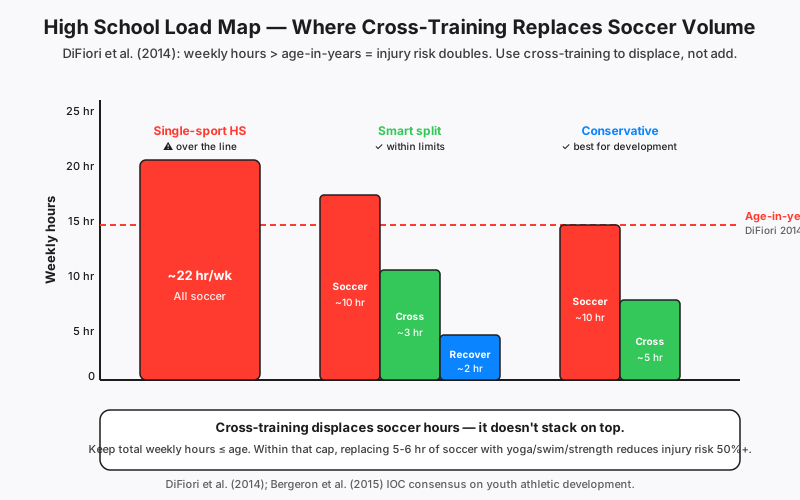
During the high school years, skeletal growth nears completion while training volume surges — creating a peak window for overuse injuries. DiFiori et al. (2014) showed that injury risk rises significantly when weekly training hours exceed the athlete's age in years.

Photo by Gurdaas Malik on Unsplash
High school soccer players commonly train five to six days a week with their school team, and many add club or regional squad sessions on top of that. DiFiori et al. (2014), writing as the American Medical Society for Sports Medicine, conducted a comprehensive review of early specialization and overuse in young athletes. They concluded that single-sport concentration during late adolescence (ages 15-18) is a risk factor for ACL tears, stress fractures, and tendon disorders.
Common Overuse Injuries in High School Soccer
- Osgood-Schlatter disease and patellar tendinitis — Caused by repetitive knee loading, especially frequent in forwards and midfielders who accumulate high kicking volumes
- Chronic ankle sprains — Repeated return-to-play without full rehabilitation leads to chronic ankle instability
- Lumbar spondylolysis (stress fracture of the spine) — Caused by repeated trunk rotation and hyperextension. Read et al. (2008) reported a prevalence of 8-15% among high school soccer players
- Groin pain syndrome — Resulting from repetitive kicking and change-of-direction loads. Holmich et al. (2010) noted that chronic groin pain in soccer players begins to increase during the high school years
When total weekly training hours exceed the athlete's age (e.g., more than 16 hours per week for a 16-year-old), overuse risk jumps sharply. Distributing training load through cross-training is a rational choice for long-term career protection.
A prospective cohort study by Jayanthi et al. (2015) confirmed that young athletes with a higher degree of single-sport specialization are more likely to experience serious injuries. Crucially, this trend is driven not just by training volume but by the monotony of movement patterns. When the same muscle groups and joints are loaded in the same direction repeatedly, tissue recovery simply cannot keep pace.
Complementary Cross-Training for Injury Prevention
Myer et al. (2015) reported that integrative neuromuscular training can reduce ACL injury risk by up to 72%. Strategically incorporating activities beyond soccer builds protective movement patterns that guard against overuse.
The injury-prevention benefits of cross-training work through two mechanisms: alternative loading and complementary neuromuscular adaptation. By activating muscle groups that soccer underuses and strengthening joint stability from multiple angles, cross-training corrects the strength and flexibility imbalances that are the breeding ground for overuse injuries.
Swimming — Active Recovery in a Non-Weight-Bearing Environment
Swimming eliminates impact on the joints while maintaining whole-body aerobic capacity, making it an ideal recovery tool. Reilly et al. (2009) reported a case in which soccer players who added one aquatic training session per week maintained their VO2max while showing lower inflammatory markers in the lower limbs. The combination of freestyle and backstroke also improves scapular stability, which helps protect the upper body during throw-ins and physical challenges.
Yoga and Pilates — Integrating Flexibility with Core Stability
A common weakness among high school soccer players is tightness in the hip flexors combined with insufficient hamstring flexibility. Imai et al. (2014) found that soccer players who completed an eight-week Pilates program showed significant improvements in the Star Excursion Balance Test — a measure of core stability — along with a reduction in non-contact injuries. Yoga's blend of static and dynamic flexibility work is particularly effective at preventing hamstring strains.
Cycling — Low-Impact Aerobic Base Building
Cycling imposes roughly one-third the impact on the knee joint compared to running, making it well suited for players with a history of patellar tendinitis or Osgood-Schlatter disease. Recovery rides in heart-rate zone 2 (60-70% of maximum) promote blood flow without depleting muscle glycogen, making cycling an optimal active-recovery option the day after a match.
The core principle of injury prevention is deliberately training movement patterns that soccer neglects. Swimming (non-weight-bearing), yoga (flexibility), and cycling (low-impact aerobic) form the most practical cross-training toolkit for high school soccer players.
Cognitive Cross-Training — Accelerating Tactical Maturity
The high school years are a period of rapid prefrontal cortex development, during which tactical decision-making ability leaps forward. Vestberg et al. (2012) demonstrated that elite soccer players score significantly higher on executive-function tests than the general population, suggesting that deliberately strengthening cognitive abilities directly boosts performance.
The value of cross-training extends well beyond physical benefits. Exposure to different sports' rules, tactics, and decision structures creates cognitive transfer effects that deepen soccer-specific tactical understanding.
Basketball — Spatial Awareness and Numerical Advantage Decisions
Five-on-five basketball shares structural similarities with common soccer scenarios (4v3, 3v2, and similar overload or underload situations), demanding rapid recognition of numerical advantages at high frequency. The smaller court compresses the see-decide-execute cycle, forcing faster decision loops than soccer typically does. Smeeton et al. (2004) demonstrated transfer of perceptual-cognitive skills between invasion games, showing that basketball experience can positively influence through-ball decision-making in soccer.
Chess and Go — Anticipation and Pattern Recognition
Board games might seem unrelated to soccer, yet Bilalic et al. (2009) showed that pattern-recognition ability in chess shares a common cognitive foundation with situational judgment in sport. Set-piece routines, build-up configurations, pressing escape routes — all are pattern-recognition problems. When combined with match-video analysis, board games can sharpen the intellectual dimension of competitive performance.
Futsal — A Compressed Tactical Environment
Futsal is played five-a-side on a small court, resulting in roughly six times as many ball touches per player as outdoor soccer. Travassos et al. (2012) reported that players with futsal backgrounds demonstrate superior decision speed and technical precision in tight spaces during outdoor soccer. Brazil's Ricardinho and Falcao, as well as Spain's Iniesta and Xavi — all products of futsal — are real-world examples of this cognitive transfer.
The adolescent brain is at peak capacity for absorbing tactical patterns. Activities with high decision density — basketball, chess, futsal — raise a player's soccer tactical IQ indirectly but powerfully.
Integrating Cross-Training with Periodization
Maintaining 100% soccer load year-round invites performance plateaus and overtraining syndrome. Drawing on Issurin (2010) and his block-periodization model, this section explains how to embed cross-training systematically across the season.
A typical high school soccer calendar features multiple competitive peaks throughout the year. Adjusting the type and intensity of cross-training around each peak is the key to maximizing both injury prevention and performance.
Cross-Training Allocation by Season Phase
- Base-building phase (off-season) — Raise the cross-training ratio to 30-40% of total training. Use swimming, cycling, and yoga to rebuild the aerobic base and restore flexibility. This is also the ideal window for introducing strength training
- Pre-season (1-2 months before competition) — Reduce the ratio to 15-20%. Focus on activities with high tactical transfer such as futsal and basketball. Intensity can match soccer training
- In-season (competition period) — Limit cross-training to 5-10%. Low-intensity recovery activities only — yoga, stretching, and aquatic recovery
- Transition phase (1-2 weeks after a competition block) — Step away from soccer entirely and engage in recreational sports of choice. The goal is both psychological refreshment and physical recovery
Issurin's (2010) block-periodization model calls for clearly separating the abilities targeted in each phase. The off-season serves as an accumulation block for building a broad fitness base, while the pre-season transmutation block converts that base into soccer-specific performance. Cross-training delivers its greatest impact during the accumulation block.
Sample Weekly Schedule (Off-Season Base-Building Phase)
- Monday: Soccer technical session (90 min) + Yoga (30 min)
- Tuesday: Futsal (60 min)
- Wednesday: Soccer tactical session (90 min)
- Thursday: Swimming (45 min) + Core training (20 min)
- Friday: Soccer small-sided games (90 min)
- Saturday: Friendly match or cycling recovery ride (60 min)
- Sunday: Full rest day
The heart of periodization is the courage to subtract. Reducing cross-training during competition is obvious, but the decision to increase cross-training during the off-season is what determines performance across the entire season.
Cross-Training Strategy with an Eye on College and Professional Pathways
College coaches and professional scouts evaluate upside and injury resilience, not just current ability. Gullich & Emrich (2014) found that elite athletes who participated in multiple sports during their junior years ultimately reached higher competitive levels.
The biggest psychological barrier to cross-training for high school players is the fear of falling behind by not focusing solely on soccer. However, Gullich & Emrich (2014), comparing German Olympic athletes with national-level competitors, found that those who ultimately reached the highest level had greater sporting diversity during their youth.
What College Soccer Programs Look For
College soccer coaches do not prioritize a highly specialized 18-year-old; they look for a player with room to grow over four years. Beyond fitness test numbers (Yo-Yo intermittent recovery test, sprints, agility), they value tactical intelligence, communication skills, and above all a body that stays healthy. The well-rounded physical literacy and injury resilience that cross-training builds are precisely the source of that four-year growth potential.
Current Trends in Elite Academy Development
Top-tier professional academies worldwide are increasingly adopting multi-sport approaches. Kawasaki Frontale's academy in Japan incorporates futsal and handball elements into training, while Yokohama F. Marinos has been reported to run tactical sessions drawing on basketball concepts. In Europe, Ajax and FC Barcelona have systematically introduced cross-training from the early teens onward. The global direction in youth development is clear: multi-sport exposure is the standard, not the exception.
We are not looking for the best 18-year-old. We are looking for the 18-year-old who will become the best 22-year-old.
— A widely held view among NCAA Division I soccer coaches
If you are thinking about your pathway, recording in Footnote how cross-training has improved specific abilities becomes a powerful tool for self-advocacy. For example, being able to articulate how spatial awareness developed through basketball transferred to your positioning on the soccer pitch gives you a decisive edge at tryouts and scouting events.
Recording in Footnote — Visualizing and Reflecting on Cross-Training
The key to maximizing the benefits of cross-training is not leaving it as a one-off experience. Use Footnote to connect insights from other sports back to soccer. When you put the transfer process into words, physical experience becomes knowledge.
Simply doing cross-training does not automatically produce skill transfer. As Rosalie & Muller (2012) demonstrated, transfer requires a deliberate extraction process. Footnote is the tool that turns this extraction process into a habit.
Three Elements Worth Recording
- What you did — Which activity, for how long, and at what intensity. Example: "30 minutes of freestyle swimming, maintaining heart-rate zone 2"
- Physical observations — Activation of muscle groups you rarely use in soccer, changes in flexibility, differences in fatigue. Example: "Freestyle opened up my scapular range of motion — throw-ins might feel easier"
- Transfer hypothesis — How the experience might apply to specific soccer situations. Example: "The 2v1 passing decisions in basketball felt directly applicable to counter-attacks in soccer"
After each weekend match, reflecting on where that week's cross-training showed up in the game turns your hypotheses into verified insights. Running this hypothesis-execute-verify cycle in Footnote is what elevates cross-training from casual variety to a strategic growth investment.
The habit of recording in Footnote also becomes a powerful asset at tryouts and pathway interviews, where you can logically explain your own growth process. For high school soccer players, the ability to articulate development is as important a differentiator as on-field skill.
Frequently Asked Questions
My school team trains six days a week. How do I find time for cross-training?▾
You do not need a separate day. Incorporate 10 minutes of yoga-based dynamic stretching into your warm-up, swap your cool-down for aquatic walking, or commute to school by bike. Work within the schedule you already have. It is also worth discussing a guaranteed rest day (one per week) with your coach. The American Medical Society for Sports Medicine recommends at least one continuous month off from the primary sport each year.
Should cross-training only be done during injury rehabilitation?▾
Cross-training during rehab is important, but incorporating it proactively reduces injury risk in the first place. Myer et al. (2015) showed that athletes who sustained a preventive neuromuscular training program reduced ACL injury risk by up to 72%. The goal is not to cross-train after getting hurt — it is to build a body that resists injury through regular cross-training.
Will cross-training make me slower or less sharp on the soccer pitch?▾
At appropriate intensity and frequency, there is no evidence that cross-training diminishes soccer performance. In fact, learning new movement patterns stimulates the nervous system in diverse ways, enhancing overall motor-learning capacity. The key is periodization: reduce cross-training and increase soccer-specific work as competition approaches.
How can I convince my teammates or coach that cross-training is worthwhile?▾
Scientific evidence is the most persuasive tool. Share summaries of the DiFiori and Myer studies cited in this article, and point to the fact that elite academies like Bayern Munich and Ajax incorporate cross-training as standard practice. Better still, use Footnote to track and visualize your own cross-training outcomes — presenting real performance data is the strongest possible evidence.
References
- [1] DiFiori JP, Benjamin HJ, Brenner JS, et al. (2014). “Overuse injuries and burnout in youth sports: a position statement from the American Medical Society for Sports Medicine” British Journal of Sports Medicine. Link
- [2] Myer GD, Sugimoto D, Thomas S, Hewett TE (2013). “The influence of age on the effectiveness of neuromuscular training to reduce anterior cruciate ligament injury in female athletes: a meta-analysis” American Journal of Sports Medicine. Link
- [3] Jayanthi NA, LaBella CR, Fischer D, et al. (2015). “Sports-specialized intensive training and the risk of injury in young athletes: a clinical case-control study” American Journal of Sports Medicine. Link
- [4] Gullich A, Emrich E (2014). “Considering long-term sustainability in the development of world class success” European Journal of Sport Science. Link
- [5] Issurin VB (2010). “New horizons for the methodology and physiology of training periodization” Sports Medicine. Link
- [6] Vestberg T, Gustafson R, Maurex L, et al. (2012). “Executive functions predict the success of top-soccer players” PLoS ONE. Link
- [7] Rosalie SM, Muller S (2012). “A model for the transfer of perceptual-motor skill learning in human behaviors” Research Quarterly for Exercise and Sport. Link
- [8] Travassos B, Araujo D, Davids K, et al. (2013). “Expertise effects on decision-making in sport are constrained by requisite response behaviours: a meta-analysis” Psychology of Sport and Exercise. Link
Related Articles
Verbalization Accelerates Transfer -- Why Writing Makes Skills from Other Sports Carry Over to Soccer
11 min read
The Science Behind Cycling for Soccer: Endurance, Pacing, and Knee Protection
10 min read
The Science Behind Yoga for Soccer: Flexibility, Focus, Breathing, and Injury Prevention
10 min read
Flexibility and Mobility — The Science Behind How Yoga, Ballet, and Gymnastics Prevent Soccer Injuries
10 min read
Cross-Training for Junior-High Soccer Players — A Strategic Approach to Standing Out at Tryouts
9 min read
Track Your Growth with Footnote
Just record your matches — AI analyzes every 5 games. Visualize growth with PVS Score. All features free during beta.
30-second signup · No credit card required
Last updated: 2026-05-06 ・ Footnote Editorial