Cross-Training for Junior-High Soccer Players — A Strategic Approach to Standing Out at Tryouts
The junior-high years coincide with PHV (Peak Height Velocity) — a period of dramatic physical change that soccer practice alone cannot fully address. Lloyd & Oliver's (2012) Youth Physical Development Model shows that trainability for strength, power, and endurance surges during this window. Players who go on to succeed at competitive tryouts and academy selections overwhelmingly share one trait: they have strategically incorporated movement stimuli outside of soccer to differentiate themselves physically from their peers.
Why the Junior-High Years Are the Golden Window for Cross-Training
Ages 12–15 overlap with PHV, when height shoots up while strength, coordination, and flexibility fall out of balance. Correcting this 'growth imbalance' demands movement stimuli that soccer alone cannot provide.

Photo by Selma DA SILVA on Unsplash
Unlike the 'sampling years' of younger players, cross-training at the junior-high level is not about trying many sports for fun — it is a strategic supplement designed to elevate soccer performance. Cote et al.'s (2007) DMSP model defines this phase as the 'specializing years,' recommending that athletes increase their focus on a primary sport while continuing complementary activities.
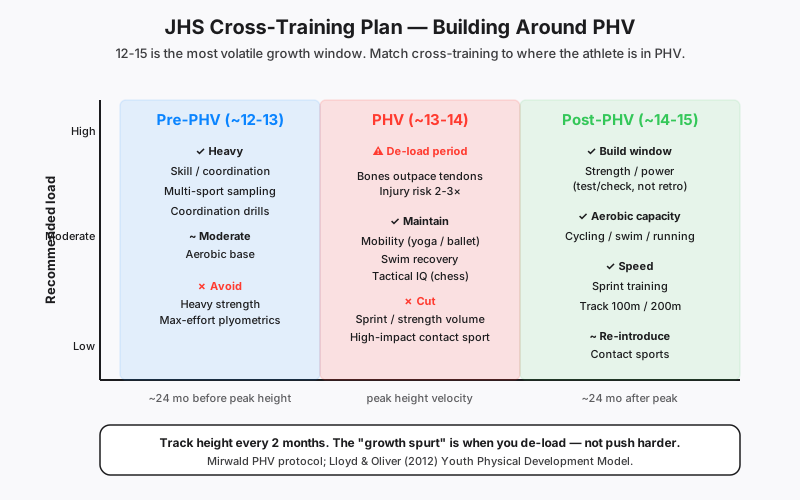
Three Challenges of the PHV Period
- Bone–muscle imbalance — Bones elongate before muscles and tendons can catch up. Flexibility drops and injury risk spikes
- Temporary loss of motor control — Known as the 'clumsy period,' coordination dips as the body outgrows its own proprioceptive map. Players who were smooth on the ball may suddenly look awkward
- Rapid cardiovascular development — Aerobic capacity surges in a 'window of opportunity.' Endurance stimuli applied during this period lay the foundation for a lifetime of fitness
Soccer practice alone cannot address all three challenges simultaneously. Maintaining flexibility and restoring whole-body muscular balance in particular require movement stimuli from outside the sport.
A player going through PHV can look as though they have regressed. This is not decline — it is a sign of growth. Use cross-training to restore balance and resist the urge to panic.
Physical Development and Training Load — Science-Based Guidelines for the PHV Period
Building on Lloyd & Oliver's (2012) Youth Physical Development Model, the critical question for this age group is not just 'what to do' but 'how much load to apply.' These guidelines help avoid both overloading and under-stimulating the developing body.
The greatest danger is copying adult training programs wholesale. Growth plates have not yet closed, so heavy weightlifting should be avoided. However, Faigenbaum et al. (2009) have demonstrated that bodyweight-based resistance training is both safe and effective for this age group when properly supervised.
Core Principles of Load Management
- Manage weekly total load — Think in terms of soccer practice + cross-training + PE class combined. Avoid more than five high-intensity sessions per week
- Prioritize bodyweight exercises — Own-body resistance, not barbells or dumbbells, is the best choice at this developmental stage
- Address bilateral imbalance — Soccer naturally favors the dominant foot. Cross-training provides an opportunity to load both sides equally and reduce injury risk
- Estimate PHV timing — During the months of peak growth rate, reduce impact-heavy activities and shift toward low-impact options such as swimming and yoga
Training for young athletes should be designed for their future, not for their present results.
— Lloyd & Oliver, 2012
The Best Cross-Training Activities for Ages 12–15
Choose cross-training to shore up the weaknesses soccer practice leaves exposed: sprint mechanics, core stability, flexibility, and cardiorespiratory endurance. Here are the most effective options for each gap.
Track & Field (Sprints and Hurdles)
A soccer match includes an average of 20–30 all-out sprints, yet team practice rarely devotes systematic time to sprint mechanics. Track-style sprint drills — high knees, arm-swing coordination, ground-contact positioning — address this gap directly and have been shown to improve 10 m and 30 m acceleration times significantly. Hurdle drills also expand hip-joint range of motion.
Swimming
Swimming eliminates impact loading on joints — a critical benefit during PHV — while simultaneously training cardiovascular fitness and full-body strength. Freestyle in particular demands trunk rotation and core stabilization, which translates to reduced torso sway during high-speed running on the pitch. Even a single 30-minute session per week produces measurable cross-training benefits for cardiorespiratory fitness.
Martial Arts (Judo and Wrestling)
Grappling-based martial arts develop balance, center-of-gravity control, and trunk rigidity under physical contact — the exact attributes that decide 50/50 duels on the pitch. They also serve as a full-body bodyweight resistance workout, making them an effective alternative to traditional weight training for this age group.
Yoga and Pilates
These are the most effective tools for maintaining and improving flexibility during the PHV period, when range of motion tends to decline. The added benefits of breath control and body awareness (proprioception) also support sustained concentration during matches and overall stress management. A growing number of European academies now include one to two yoga sessions per week in their youth programs.
Sample Weekly Schedule
- Monday: Soccer practice
- Tuesday: Sprint drills (30 min) + stretching
- Wednesday: Soccer practice
- Thursday: Swimming (30–40 min)
- Friday: Soccer practice
- Saturday: Match or soccer practice
- Sunday: Full rest or yoga (20–30 min)
Standing Out at Tryouts — Where Physical Versatility Meets Soccer Intelligence
At competitive academy tryouts, coaches evaluate not only current ability but also upside. A player with a multi-dimensional physical profile signals 'room to grow' — and that impression can tip the balance when technical skill is otherwise equal.
Scouts look for two things: what a player can do right now and how much further they can develop. Vaeyens et al. (2008) argue that talent identification should prioritize developmental potential, and cross-training experience is one of the most visible indicators of that potential.
Cross-Training-Derived Qualities That Stand Out at Tryouts
- Quality of agility — Players with track experience change direction more efficiently. Their deceleration-to-reacceleration sequences are smoother and waste less energy
- Contact resilience — Those with martial-arts backgrounds hold their ground in duels and recover their balance quickly after physical challenges
- Posture under fatigue — Swimmers and yoga practitioners maintain running form deeper into the second half. Their core endurance is noticeably higher
- Flexibility and injury resistance — High flexibility correlates with lower hamstring and ankle-sprain risk. Coaches see these players as 'durable investments'
None of these qualities develop fully through soccer practice alone. In the limited observation window of a tryout, cross-training gives a player something the other candidates do not have.
Tryout insight: when several candidates are technically equal, physical versatility and the impression of untapped potential become the tiebreaker. Cross-training is the investment that creates that edge.
Balancing School, Team Practice, and Cross-Training — A Realistic Time-Management Plan
Junior-high students already juggle academics, team activities, and often extra tutoring. The goal is not to add more obligations but to weave cross-training elements into the time they already have.
The theoretically optimal plan is worthless if it cannot be executed. Most families have no room to add another after-school activity on top of five or six weekly practice sessions.
Replace and Integrate — Don't Simply Add
- Use 15 morning minutes for sprint drills — Short enough to fit before school. Borrow a warm-up sequence from a track program and run it three times a week
- Upgrade stretching time to yoga — Swap routine pre- and post-practice stretches for yoga poses. Zero additional time, meaningful gains in flexibility and breath control
- Capitalize on off-seasons and exam breaks — When soccer practice scales back, ramp up cross-training. A short-course swimming block during exam season is a perfect fit
- Turn the commute into training — Cycling to school doubles as cardio; walking to school can become an interval workout (30 seconds brisk, 30 seconds normal)
Academics Come First
Even for players aiming at a professional pathway, academics should not be sacrificed. Jonker et al. (2011) found that athletes with higher academic achievement also demonstrate greater self-regulation — and stronger long-term athletic performance. Cross-training time should come from smart scheduling, never from cutting into study time.
A realistic target: 90 minutes per week (three sessions of 30 minutes). This alone produces a meaningful multi-dimensional training effect. Choose consistency over perfection.
Why Recording Cross-Training in Footnote Matters
At the junior-high level, logging cross-training builds both self-analysis skills and tryout-ready documentation. The habit of articulating not just 'what I did' but 'why I did it and what changed' develops the autonomy that separates self-driven athletes from coach-dependent ones.
Unlike younger players, junior-high athletes possess the cognitive maturity to understand the purpose behind each training choice. Those who use Footnote to regularly reflect on their work develop lower reliance on external direction and enter a self-sustaining growth cycle.
A Simple Recording Framework for Young Athletes
- What (activity log) — Record the activity, duration, and intensity in brief (e.g., freestyle swim 500 m / 20 min)
- Why (purpose link) — State which soccer attribute the session was meant to improve (e.g., reduce torso sway in the second half)
- Transfer (on-pitch change) — Note any concrete change observed in soccer (e.g., felt more stable contesting aerial duels)
Running this What-Why-Transfer cycle elevates cross-training from 'vague supplementary exercise' to a deliberate performance-enhancement strategy. Over time, the accumulated records reveal which combinations produce the best results for the individual player.
Using Records as Tryout Material
Footnote logs can serve as self-presentation material during tryouts and academy selections. Demonstrating that you recognize your own weaknesses and proactively work to address them sends a powerful message to coaches. An increasing number of professional academies worldwide now include self-analysis ability as an explicit evaluation criterion in their intake process.
A Footnote log is proof that a player thinks independently and takes initiative. At tryouts, this kind of self-analysis record is becoming a differentiator on par with highlight reels.
Frequently Asked Questions
I'm already maxed out with team practice. How do I find time for cross-training?▾
You don't need to create new time slots. Replace pre- and post-practice stretching with yoga, add a 15-minute sprint drill before school, or swim for 30 minutes on a rest day. Integrating cross-training into your existing routine is the realistic approach — and 90 minutes per week is enough to see meaningful results.
Is it safe for middle-school players to do strength training?▾
Faigenbaum et al. (2009) found that supervised bodyweight resistance training is both safe and effective for this age group. Heavy barbell or dumbbell work is not recommended, but push-ups, squats, planks, and grappling-based martial arts are all excellent ways to build functional strength.
Should intense training be avoided during the PHV growth spurt?▾
During the six months surrounding the peak growth-rate period, it is wise to reduce high-impact activities and shift toward low-impact options like swimming and yoga. That said, complete rest is unnecessary — moderate exercise actually supports healthy growth. Track monthly height changes and adjust training load accordingly.
How often should I cross-train?▾
Two to three sessions per week, each lasting 20–40 minutes, is the recommended range for this age group. Ideally, schedule cross-training on days without soccer practice, though it can also be incorporated into warm-ups and cool-downs. Aim for a ratio of roughly 80% soccer to 20% cross-training.
Tryouts are only three months away. Is it too late to start cross-training?▾
Three months is enough time for sprint drills (acceleration gains) and yoga (flexibility and posture improvements) to produce visible results. However, the full benefits of cross-training emerge after six months or more of consistent work. Start now for the upcoming tryout, but commit to it as a long-term habit rather than a short-term fix.
References
- [1] Lloyd, R.S. & Oliver, J.L. (2012). “The Youth Physical Development Model: a new approach to long-term athletic development” Strength and Conditioning Journal. Link
- [2] Cote, J., Baker, J., & Abernethy, B. (2007). “Practice and play in the development of sport expertise” Handbook of Sport Psychology (3rd ed.), Wiley.
- [3] Faigenbaum, A.D., Kraemer, W.J., Blimkie, C.J.R., Jeffreys, I., Micheli, L.J., Nitka, M., & Rowland, T.W. (2009). “Youth resistance training: updated position statement paper from the National Strength and Conditioning Association” Journal of Strength and Conditioning Research. Link
- [4] Vaeyens, R., Lenoir, M., Williams, A.M., & Philippaerts, R.M. (2008). “The effects of task constraints on visual search behavior and decision-making skill in youth soccer players” Journal of Sport and Exercise Psychology. Link
- [5] Jonker, L., Elferink-Gemser, M.T., & Visscher, C. (2011). “Differences in self-regulatory skills among talented athletes: the significance of competitive level and type of sport” Journal of Sports Sciences. Link
- [6] LaPrade, R.F., Agel, J., Baker, J., Brenner, J.S., Cordasco, F.A., Cote, J., et al. (2016). “AOSSM Early Sport Specialization Consensus Statement” Orthopaedic Journal of Sports Medicine. Link
- [7] Moesch, K., Elbe, A.M., Hauge, M.L.T., & Wikman, J.M. (2011). “Late specialization: the key to success in centimeters, grams, or seconds (cgs) sports” Scandinavian Journal of Medicine & Science in Sports. Link
- [8] Balyi, I. & Hamilton, A. (2004). “Long-term athlete development: trainability in childhood and adolescence” Olympic Coach Magazine, National Coaching Institute.
Related Articles
Verbalization Accelerates Transfer -- Why Writing Makes Skills from Other Sports Carry Over to Soccer
11 min read
How Track and Field Transfers Sprint Speed, Agility, and Endurance to Soccer
11 min read
How Martial Arts Build Duel Strength, Body Control, and Mental Toughness for Soccer
10 min read
Soccer Journals for U-15 Players --- Recording Techniques That Make the Difference at Tryouts
8 min read
Cross-Training for High School Soccer — A Science-Based Approach to Injury Prevention and Competitive Performance
10 min read
Track Your Growth with Footnote
Just record your matches — AI analyzes every 5 games. Visualize growth with PVS Score. All features free during beta.
30-second signup · No credit card required
Last updated: 2026-05-06 ・ Footnote Editorial