Multi-Sport Participation for Elementary-Age Athletes — The Scientific Case Against Early Specialization and a Practical Guide to Cross-Training
"Shouldn't my child focus exclusively on soccer?" — it is one of the most common questions parents ask, and sports science has a clear answer. Moesch et al. (2011) found that the majority of elite athletes participated in multiple sports before age 12, and that they ultimately outperformed peers who specialized early. The "sampling years" of elementary school (ages 6–12) are the ideal window for accumulating diverse movement experiences — experiences that build the foundation for long-term growth as a soccer player.
The Risks of Early Specialization — Three Problems Backed by Science
LaPrade et al. (2016) demonstrated that single-sport specialization before age 12 is associated with increased injury risk, burnout, and diminished long-term performance. The intuition that "starting earlier means gaining an advantage" runs counter to the data.

Photo by Yuval Zukerman on Unsplash
Early specialization refers to year-round concentration on a single sport before age 12, to the exclusion of all others. The consensus statement by LaPrade et al. (2016) issued an unequivocal warning against this trend.
Risk 1: Overuse Injuries
Repeating the same movement patterns places excessive stress on bones, cartilage, and tendons that are still growing. In a soccer-only environment, the repetitive kicking motion raises the risk of conditions such as Osgood-Schlatter disease and Sever's disease. Participating in multiple sports distributes the load across different muscle groups and joints, reducing localized overload.
Risk 2: Burnout
Brenner (2007) reported significantly higher burnout rates among early-specializing young athletes. When enjoyment is lost during elementary school, the probability of dropping out of the sport entirely by middle or high school rises dramatically.
Risk 3: A Ceiling on Long-Term Performance
Moesch et al. (2011) showed that athletes who reached the international level had participated in more sports during childhood and specialized later. Early specialization may create short-term advantages, but it ultimately constrains the athlete's ceiling for growth.
The key insight: "the early starter wins" holds true only during elementary school. In the vast majority of cases, the growth curve after age 12 reverses the gap.
The Sampling Years and Diverse Motor Development — Putting the Cote Model into Practice
Cote et al. (2007) proposed the Developmental Model of Sport Participation (DMSP), which identifies ages 6–12 as the "sampling years." During this phase, acquiring a wide range of motor skills through "deliberate play" is the key driver of long-term athlete development.
Jean Cote's Developmental Model of Sport Participation (DMSP) divides youth sport engagement into three stages: the sampling years (ages 6–12), the specializing years (ages 13–15), and the investment years (age 16 onward). Elementary-school-age children fall squarely within the sampling years.
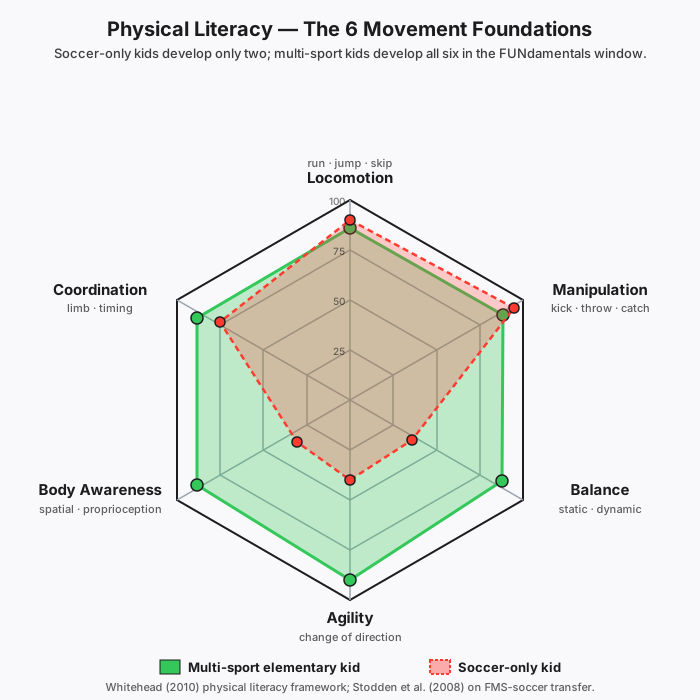
The Value of Deliberate Play
"Deliberate play" in the Cote model refers to activities that children engage in spontaneously, driven by enjoyment — in contrast to adult-designed "deliberate practice." Pickup soccer in the park, tag with friends, and free swim sessions all qualify. Deliberate play sustains intrinsic motivation while promoting implicit motor learning.
Building a Broader Movement Toolkit
- Swimming — core stability and breath control
- Gymnastics — spatial awareness and body control
- Basketball — court vision and quickness
- Baseball — kinetic chain of the throwing motion and hand-eye coordination
- Dance — rhythmic sense and whole-body coordination
Giusti et al. (2017) found that children with a diverse movement background learn new skills faster. The breadth of the "toolkit" built during the sampling years determines the rate of improvement once specialization begins.
Recommended Sports by Developmental Stage — Age-Appropriate Combinations
The six years of elementary school span a wide range of physical and cognitive development. Cross-training that suits a six-year-old differs markedly from what benefits a twelve-year-old. Matching activities to the pre-golden age (roughly 5–8) and golden age (roughly 9–12) windows is essential.
Early Elementary (Ages 6–7): Building a Foundation of Fundamental Movement
- Swimming — whole-body coordination, breath control, and core awareness in the water. Injury risk is extremely low
- Gymnastics — rotational awareness, inverted-body perception, and spatial orientation. The basis for controlling one's own body
- Tag and chase games — acceleration, deceleration, direction changes, and reaction speed. Agility develops naturally through play
Mid-Elementary (Ages 8–9): Coordination and Decision-Making
- Basketball — spatial awareness, passing decisions, and teamwork. Develops hand-eye coordination
- Table tennis — reaction speed, anticipation, and hand-eye coordination through racket manipulation
- Dance and rhythmic movement — full-body rhythmic synchronization, memorizing and reproducing step patterns
Late Elementary (Ages 10–12): Maximizing the Golden Age
- Track and field — sprint mechanics and proper running form. Directly transfers to speed on the soccer pitch
- Martial arts (judo, karate) — core strength, manipulation of an opponent's center of gravity, and mental toughness
- Tennis or badminton — footwork, split-step timing, and tactical thinking
The golden age (roughly 9–12) is the period when neural development peaks. Movement patterns experienced during this window are encoded into long-term memory with exceptional efficiency, making multi-sport exposure the highest-return investment at this stage.
How Parents Can Help — Quality of Free Play Matters More Than the Number of Organized Activities
Multi-sport participation does not mean signing up for every club in town. Respecting children's autonomy and weaving diverse movement into everyday play is the most scientifically effective approach.
The most common trap is over-scheduling: soccer on Monday, swim lessons on Tuesday, gymnastics on Wednesday — until the child has zero free time and no room for deliberate play, defeating the entire purpose.
Three Principles for Parents to Keep in Mind
- Preserve at least two unscheduled days per week — unstructured play time is essential for motor-learning consolidation. The brain integrates movement patterns during rest
- Prioritize the child's own interests — the child's intrinsic curiosity matters more than any strategic calculation by the parent. Transfer of skills will not occur if the child's interest does not last
- Praise the process, not the result — instead of asking "Did you win your soccer game today?", try "What movement was the most fun today?"
Examples of Play-Based Cross-Training
- Family badminton in the park — natural footwork and spatial-awareness practice
- Weekend at an adventure playground — pulling, balancing, and spatial orientation in one session
- Catch or dodgeball — throwing kinetic chain plus situational decision-making
- Skateboarding or inline skating — balance and center-of-gravity management
The best training for a child is any activity that does not feel like training.
— Jean Cote
When to Specialize — Finding the "Not Too Early, Not Too Late" Window
The scientific consensus places the optimal starting point for serious soccer specialization around age 13. However, it is not an all-or-nothing switch — a gradual transition is critical.
Bridge & Toms (2013) tracked Premier League academy players and found that those who gradually increased the proportion of training dedicated to their primary sport between ages 12 and 13 showed the highest retention rates and the strongest performance outcomes. The goal is not abrupt specialization, but a progressive shift in emphasis.
A Gradual Specialization Model
- Ages 6–9: Soccer 50% / Other sports 50% (peak sampling period)
- Ages 10–12: Soccer 65% / Other sports 35% (soccer becomes the primary activity, but others continue)
- Ages 13–14: Soccer 80% / Supplementary training 20% (transition into specialization)
- Age 15 onward: Soccer 90% / Maintenance cross-training 10%
These ratios are guidelines, not rigid prescriptions. They should be adjusted based on the child's maturation level, motivation, and competitive context. The optimal timing can shift by one to two years between early and late maturers.
The signal to watch for: when the child begins saying, unprompted, "I want to play more soccer" or "Soccer is what I enjoy most," that is the sign to accelerate specialization. Let the child's intrinsic motivation — not the agenda of a parent or coach — set the pace.
Recording Multi-Sport Experiences in Footnote
Many families wonder how to log activities outside of soccer. Footnote offers a way to record other sports through the lens of "how does this transfer to soccer?"
Without recording, multi-sport experiences remain nothing more than memories. But when put into words, they become material that helps the young athlete understand — years later, during the specialization phase — "why am I instinctively good at this particular movement?"
Tips for Recording at the Elementary Level
- Write one line about what you did today (e.g., "Practiced dribbling in basketball")
- Add one line about how it felt similar to soccer (e.g., "Dodging defenders felt like dribbling past opponents")
- If writing is difficult, a parent can ask questions and jot down the answers — that counts
- Once a month, look back at "all the different sports I tried this month" to build a reflection habit
How Parents and Coaches Can Use the Records
Footnote records can serve as documentation of a player's multi-sport background for selection trials or club transfers. A growing number of overseas academies now factor "multi-sport experience" into their evaluation criteria. Having a written record is becoming a genuine differentiator.
Footnote entries can be short — even a single line works. The act of writing itself promotes transfer (the verbalization effect). For elementary-age children, start with one sentence and prioritize building the habit.
Frequently Asked Questions
My child's coach says to focus only on soccer. Is it still okay to play other sports?▾
The scientific evidence says yes. The consensus statement by LaPrade et al. (2016) explicitly warns against single-sport specialization before age 12. Respect the coach's perspective, but use off-season windows and free weekends for other sports. Balance is the goal.
Don't kids need to specialize early to get into elite academy programs?▾
Elite-level scouts look more at future potential than current polish. Children with diverse movement backgrounds tend to absorb new techniques faster and are more resilient to injury. Skill gaps visible at the time of selection are frequently reversed after age 13.
How many days per week should my child do sports other than soccer?▾
For younger children (ages 6–9), two to three sessions per week of non-soccer activity is ideal. For older children (ages 10–12), one to two sessions still yields meaningful benefits. What matters is not the number of sessions but whether the child is genuinely enjoying a variety of movements.
Which sport helps soccer the most?▾
Picking "the single best" sport misses the point of multi-sport participation. That said, basketball (spatial awareness, decision-making), swimming (core strength, cardio), and gymnastics (body control) tend to offer the most transferable elements. Ultimately, the sport the child is most interested in is the one that helps the most.
Won't playing many sports make my child a 'jack of all trades, master of none'?▾
Before age 12, breadth is the right strategy. Moesch et al. (2011) found that athletes who reached the elite level had participated in more sports before age 12 than those who did not. The 'jack of all trades' concern only becomes relevant if no direction has been chosen by age 15 or so.
References
- [1] Moesch, K., Elbe, A.M., Hauge, M.L.T., & Wikman, J.M. (2011). “Late specialization: the key to success in centimeters, grams, or seconds (cgs) sports” Scandinavian Journal of Medicine & Science in Sports. Link
- [2] LaPrade, R.F., Agel, J., Baker, J., Brenner, J.S., Cordasco, F.A., Cote, J., et al. (2016). “AOSSM Early Sport Specialization Consensus Statement” Orthopaedic Journal of Sports Medicine. Link
- [3] Cote, J., Baker, J., & Abernethy, B. (2007). “Practice and play in the development of sport expertise” Handbook of Sport Psychology (3rd ed.), Wiley.
- [4] Brenner, J.S. (2007). “Overuse injuries, overtraining, and burnout in child and adolescent athletes” Pediatrics. Link
- [5] Bridge, M.W. & Toms, M.R. (2013). “The specialising or sampling debate: a retrospective analysis of adolescent sports participation in the UK” Journal of Sports Sciences. Link
- [6] Giusti, N.E., Carder, S.L., Vopat, L., & Baker, J. (2017). “Comparing burnout in sport-specializing versus sport-sampling adolescent athletes: a systematic review and meta-analysis” Orthopaedic Journal of Sports Medicine.
- [7] Cote, J. & Vierimaa, M. (2014). “The developmental model of sport participation: 15 years after its first conceptualization” Science & Sports. Link
Related Articles
Verbalization Accelerates Transfer -- Why Writing Makes Skills from Other Sports Carry Over to Soccer
11 min read
Dance x Soccer -- How Agility, Body Control, and Rhythm Become Weapons on the Pitch
9 min read
How Swimming Transforms Cardiovascular Fitness, Upper-Body Strength, and Recovery for Soccer Players
10 min read
Growth Mindset and the Soccer Journal — How to Raise Players Who Believe in Effort Over Talent
9 min read
A Parent's Guide to Cross-Training — How to Support Your Child's Multi-Sport Development
12 min read
Track Your Growth with Footnote
Just record your matches — AI analyzes every 5 games. Visualize growth with PVS Score. All features free during beta.
30-second signup · No credit card required
Last updated: 2026-05-06 ・ Footnote Editorial