Dance x Soccer -- How Agility, Body Control, and Rhythm Become Weapons on the Pitch
Dance and soccer may seem worlds apart, yet motor-science analysis reveals a shared movement architecture: coordinating the whole body to a rhythm while changing direction unpredictably. Kiefer et al. demonstrated that dance training improves motor learning and dynamic balance, and Sheppard & Young showed that change-of-direction speed depends on perceptual-motor integration. This article explains how dance sharpens agility, body control, and rhythmic awareness, and unpacks why Brazil's "ginga" culture has produced the world's greatest dribblers.
Why Dance Works for Soccer -- The Mechanism of Motor-Learning Transfer
Dance simultaneously trains whole-body coordination, dynamic balance, and rhythmic perception. These are the foundational abilities that underpin changes of direction, feints, and precision of ball touch in soccer -- and positive transfer between the two has been scientifically confirmed.

Photo by Robert Collins on Unsplash
In motor learning, "transfer" refers to the phenomenon in which skills acquired in one activity improve performance in another. Kiefer et al. (2013) demonstrated that dance training produces significant improvements in dynamic balance, motor coordination, and body control -- the very abilities at the heart of soccer agility.
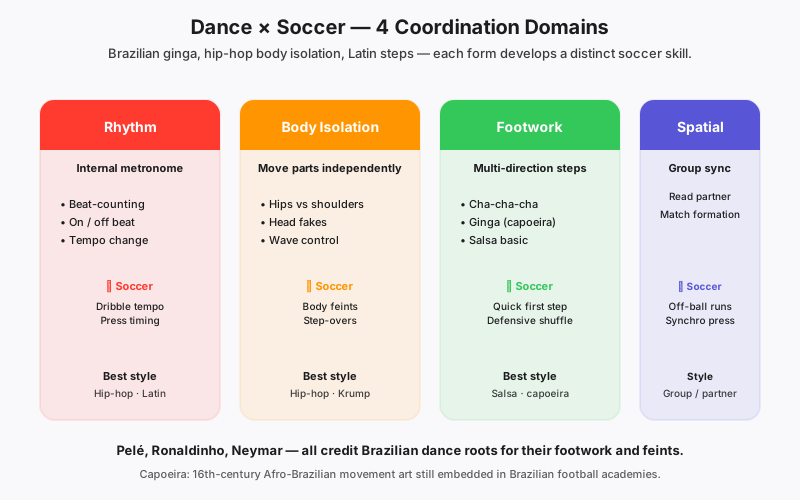
Three Foundational Abilities Dance Develops
- Whole-body coordination -- The ability to move the upper and lower body in different rhythms. In soccer, this means deceiving the opponent with an upper-body fake while generating actual movement in a different direction with the lower body.
- Dynamic balance -- The ability to stay stable while the center of gravity is constantly shifting. This is the foundation for transitioning seamlessly into the next move during sharp directional changes while dribbling.
- Rhythmic perception and control -- The ability to synchronize body movements to a musical beat. In soccer, this transfers to tempo changes during dribbling and timing coordination with teammates.
Alpert (2011) positioned dance as complementary training for athletes, noting that it efficiently improves "movement quality" -- smoothness, timing control, and independent control of body segments -- aspects that are difficult to develop through conventional agility drills alone.
Dancers and soccer players are answering the same question: "Where do I place my body next, and when do I move?" The only difference is whether you express it with the whole body or with the feet.
— Summary of motor-learning transfer theory
Rhythm and Timing -- The Engine Behind Tempo Changes in Dribbling
Effective dribbling in soccer relies not on a steady rhythm but on changes in tempo to wrong-foot the opponent. The rhythmic control cultivated through dance -- acceleration and deceleration, on-beat and off-beat placement, syncopation -- translates directly to rhythm changes during dribbling.

Photo by Maick Maciel on Unsplash
The most effective weapon in soccer dribbling is a change of tempo. A player who runs at a constant rhythm is easy for a defender to predict, but a sudden tempo shift delays the response. This manipulation of pace -- tempo changes, accents, syncopation (shifting the beat) -- shares the same structure as the core of dance.
Syncing Body Movement to a Musical Beat
In dance, performers alternate between moving "on the beat" and intentionally shifting "off the beat." Against the defender's anticipated "beat" -- the interval between ball touches -- releasing the ball half a beat early, or delaying it half a beat to draw a weight shift, is fundamentally the same motor strategy as dancing off the beat.
Tempo-Change Examples in Practice
- Explosive acceleration from slow motion -- The transition from a slow-motion dance phrase to a snap action transfers to the sensation of surging forward from a low-speed dribble.
- Beat subdivision -- The feeling of subdividing two beats into four for finer movement maps onto the technique of making quick, short touches on the ball to freeze the defender's feet.
- The freeze (stillness) -- A momentary pause that delays the opponent's decision. This is identical to stopping the ball to read the defender's weight before choosing a direction.
In soccer, "ma" (the pause) is equivalent to a rest in music. A player who has internalized the value of rests through dance understands the power of standing still during a dribble.
Agility and Change of Direction -- How Dance Steps Accelerate COD
Sheppard & Young (2006) defined agility as "perceptual-decision + change-of-direction speed." Dance is training in instantly switching steps in response to changes in the music, directly strengthening the neural circuits for reactive change of direction (reactive COD).
Sheppard & Young's (2006) review in the Journal of Sports Sciences established that true agility requires a perceptual-decision component -- the ability to recognize external stimuli and immediately select the appropriate motor response. Dance trains this reactive agility directly by demanding instant step selection in response to musical breaks or a partner's movements.
Directional-Change Patterns in Dance
Hip-hop footwork, salsa steps, and breakdance floor work all demand rapid shifts of the center of gravity in multiple directions. Mechanically, this is the same challenge as a cut inside, a step-over, or a turn in soccer.
Ricotti (2011), publishing in the Journal of Sports Science and Medicine, reported that dance training significantly improves both static and dynamic balance, with a particular gain in the speed of balance recovery after unpredictable perturbations. This directly benefits the ability to change direction while absorbing contact in soccer.
How Reactive Agility Gets Reinforced
- Perceptual-motor coupling -- The neural circuit that instantly adjusts footwork to musical changes also shortens reaction time to an opponent's movement.
- Automation of multi-directional steps -- Weight transfers in every direction become automatic, enabling rapid directional changes at a subconscious level.
- Improved deceleration -- The "stop-and-go" skill of halting abruptly and transitioning into the next move strengthens the deceleration phase of COD.
Ladder drills practice changing direction on a predetermined pattern. Dance practices changing direction unpredictably. The latter is far closer to what happens in an actual match.
Body Isolation and Multi-Joint Coordination -- Operating Upper and Lower Body Independently
Dance "isolation" -- the technique of moving one body part independently -- trains the multi-joint independent control essential for body feints, maintaining vision while dribbling, and precision ball control in soccer.
In dance, "isolation" refers to the technique of moving individual body segments -- head, chest, hips, legs -- independently. A hip-hop chest pop, the separation of arms and legs in locking -- these develop multi-joint independent control: the ability to move one part of the body while keeping the rest stable.
Upper-Body / Lower-Body Separation in Soccer
Soccer is full of situations where the upper body deceives while the lower body generates the actual direction of travel. The Matthews feint, a body fake followed by a cut-back, dropping a shoulder before passing in the opposite direction -- all of these depend on the ability to decouple upper-body and lower-body movement.
- Body feint -- Leaning the upper body to the right while actually carrying the ball to the left. Independent control of upper and lower body is essential.
- Maintaining vision while dribbling -- Manipulating the ball at the feet while keeping the head up to scan the surroundings. An exercise in decoupling the head from the lower limbs.
- Shielding -- Protecting the ball with the body while using the arms and shoulders to resist the opponent's pressure. The limbs function independently around a stable core.
- No-look pass -- Separating the line of sight from the kicking direction. Impossible without the ability to fully decouple head and lower-limb movement.
As Kiefer et al. (2013) suggest, the motor-skill improvements from dance are driven not by increased muscle strength but by neural adaptation -- more efficient motor programs, suppression of unnecessary co-contraction, and greater precision in independent segment control. Dance rewires the brain to enable complex multi-joint movements.
Just as a dancer can isolate the chest, the hips, or the neck, an elite dribbler can tell a lie with the upper body while the lower body tells the truth. This "dual personality within the body" is the essence of the feint.
Neymar, Ronaldinho, and Brazil's "Ginga" Culture
The soul of Brazilian soccer -- "ginga" -- originates from capoeira and samba: a rhythmic body sway. The irregular rhythm and fluid weight shifts in Neymar's and Ronaldinho's dribbling were born from immersion in dance culture from early childhood.
Brazilian soccer has a unique concept called "ginga." Ginga is a rhythmic, swaying body movement rooted in capoeira (a Brazilian martial-art dance form) and samba footwork. In Brazil's street-soccer culture, players with ginga earn the most respect -- not simply the fastest or strongest, but those who can "break down the opponent with rhythm."
Ronaldinho and the Rhythm of Samba
Ronaldinho is known to have danced samba from an early age. The unpredictable tempo changes, the fluid body sway, the playful ball touch -- his style of drawing the opponent into his own rhythm is deeply intertwined with the rhythmic structure of samba.
Neymar and the Movements of Capoeira
Neymar's feints bear clear elements of the capoeira "ginga step" -- a fundamental movement of swaying the center of gravity from side to side. The instant acceleration out of the sway matches the attack patterns of capoeira in kinetic structure.
The Tactical Edge Ginga Provides
- Unpredictability -- The absence of a fixed rhythm prevents defenders from anchoring their weight, keeping them perpetually one step behind.
- Bodily fluidity -- Constant swaying makes it easier to absorb contact, giving the player the choice of drawing the foul or beating the defender outright.
- Creativity -- A strong rhythmic sense enables improvisation, allowing the player to generate the optimal solution for each situation on the fly.
A player with ginga creates rhythm within a match the way a musician creates it on stage. The opponent is swept into that rhythm and, by the time they realize it, they have already been beaten.
— Summary of research on Brazilian soccer culture
Recording Dance-to-Soccer Transfer in Footnote
Verbalizing the rhythmic sensations and body-control changes you notice through dance -- such as "which rhythm pattern shifted" or "which body part gained more independence" -- maximizes the transfer effect.
Transfer from dance to soccer occurs along three axes: rhythm, isolation, and quality of directional change. Using the ALR (Abstract, Lingualize, Reapply) framework from the cross-training verbalization article, record your observations with the template below to anchor the transfer effect at a verbal level.
Recording Template
- What you did in dance -- e.g., "60-minute hip-hop basics, isolation drills + choreography"
- Rhythm insights -- e.g., "The sensation of accelerating sharply on beat 6 of an 8-count felt fresh"
- Body insights -- e.g., "During the chest-only isolation drill, I grasped the feeling of keeping everything below the hips fixed"
- Transfer point to soccer -- e.g., "During a body feint, lean only the upper body while the lower body drives in the opposite direction"
- What to try in the next training session -- e.g., "Deliberately vary dribbling tempo -- fast to slow and back"
Organize by Three Transfer Categories
- Rhythm -- Tempo changes, syncing/offsetting to the beat, pace variation. Transfers to dribble-tempo control and feint timing.
- Isolation -- Independent control of body segments, upper-/lower-body separation. Transfers to body feints and maintaining vision.
- Footwork -- Directional changes, cross-steps, weight shifts. Transfers to agility, cut-ins, and turns.
Footnote's AI analysis every five matches also detects correlations between your dance logs and on-pitch performance. Trends such as "dribble success rate improved in weeks with more rhythm-category entries" become visible, helping you identify the training elements with the highest impact for you.
The moment after a dance session when you think, "That rhythmic sensation could be useful in soccer" -- capture it in Footnote immediately. Verbalizing that instinct is what creates reproducibility on the pitch.
Frequently Asked Questions
What dance genre is most effective for soccer?▾
It depends on your goal. For rhythm and tempo changes, hip-hop or house. For isolation and body control, popping or locking. For lower-body footwork, capoeira or salsa. Every genre shares the fundamental structure of "changing direction unpredictably to a rhythm," which transfers to soccer.
Can I benefit even with zero dance experience?▾
Beginners actually have the most room to grow. Stepping to a beat, isolation, and weight transfer will start to feel natural within a few weeks. Even incorporating a beginner hip-hop or rhythm-training session once or twice a week from YouTube will produce a noticeable change in your dribbling rhythm within a month.
Is it true that Brazilian players are strong because of dance?▾
Samba and capoeira are woven into daily life in Brazil, so players grow up with rich experience linking music and body movement. The rhythmic play of Ronaldinho and Neymar reflects this cultural accumulation. However, acquiring ginga is not exclusive to Brazilians -- deliberate practice connecting dance and soccer can develop the same rhythmic sense in anyone.
How should I log dance sessions in Footnote?▾
Enter the dance content in a Footnote practice log and add a one-line note under "Transfer point to soccer." Being conscious of whether it falls under the Rhythm, Isolation, or Footwork category makes it easier for the AI analysis to detect patterns. Example: "45 min hip-hop basics. Sensation of accelerating in the second half of an 8-count -> applicable to accelerating on the 2nd touch of a dribble (Rhythm)."
References
- [1] Kiefer, A. W., Riley, M. A., Shockley, K., Villard, S., & Van Order, G. C. (2013). “Multi-segmental postural coordination in professional ballet dancers” Gait & Posture, 34(1), 76–80. Link
- [2] Alpert, P. T. (2011). “The health benefits of dance” Home Health Care Management & Practice, 23(2), 155–157. Link
- [3] Ricotti, L. (2011). “Static and dynamic balance in young athletes” Journal of Human Sport and Exercise, 6(4), 616–628. Link
- [4] Sheppard, J. M. & Young, W. B. (2006). “Agility literature review: Classifications, training and testing” Journal of Sports Sciences, 24(9), 919–932. Link
- [5] Koutedakis, Y. & Jamurtas, A. (2004). “The dancer as a performing athlete: Physiological considerations” Sports Medicine, 34(10), 651–661. Link
- [6] Bloomfield, J., Polman, R., & O’Donoghue, P. (2007). “Physical demands of different positions in FA Premier League soccer” Journal of Sports Science and Medicine, 6(1), 63–70.
Related Articles
Verbalization Accelerates Transfer -- Why Writing Makes Skills from Other Sports Carry Over to Soccer
11 min read
Ballet x Soccer -- How Body Awareness, Change of Direction, and Core Control Become Weapons on the Pitch
11 min read
The Science Behind Yoga for Soccer: Flexibility, Focus, Breathing, and Injury Prevention
10 min read
The Science Behind How Verbalization Improves Soccer — How 'Writing' and 'Thinking' Connect in the Brain
6 min read
Badminton x Soccer — The Science Behind How Agility, Reaction Speed, and Full-Body Coordination Transfer to the Pitch
10 min read
Track Your Growth with Footnote
Just record your matches — AI analyzes every 5 games. Visualize growth with PVS Score. All features free during beta.
30-second signup · No credit card required
Last updated: 2026-05-06 ・ Footnote Editorial